
BAME Awarding Gap Fund Staff information session and
BAME Awarding Gap Fund Staff information session and Q&A 14 December 2020 BAME Awarding Gap Fund Steering Group
What will be covered: • • Background About the fund Summary of funding criteria The process Science of Bias Module Potential project areas Q&A
Background • 2017 - Launch of the UCL BAME Awarding Gap project as part of an Of. S funded consortium project led by Kingston University, which concluded in 2019 • Some key highlights from then until now: • Analysis of the awarding gap at UCL and awareness raising of gaps at institutional/local level • Development and completion of the Inclusive Curriculum Health Check (ICHC) • Appointment and work of BAME Awarding Gap Faculty Leads • Launch of BAME Awarding Gap Staff Toolkit • Implementation of Student Curriculum Partners Scheme
About the Fund • Funding (£ 250 k) secured from the Office of the Vice Provost of Education and Student Affairs (OVPESA) to launch the BAME Awarding Gap Fund • This has been established to provide funding for intervention projects lasting up to 3 years designed to eliminate programme level awarding gaps • Staff can bid for up to a maximum of £ 25, 000 per project over a 3 year period • Applications for funding will be assessed against 8 criteria
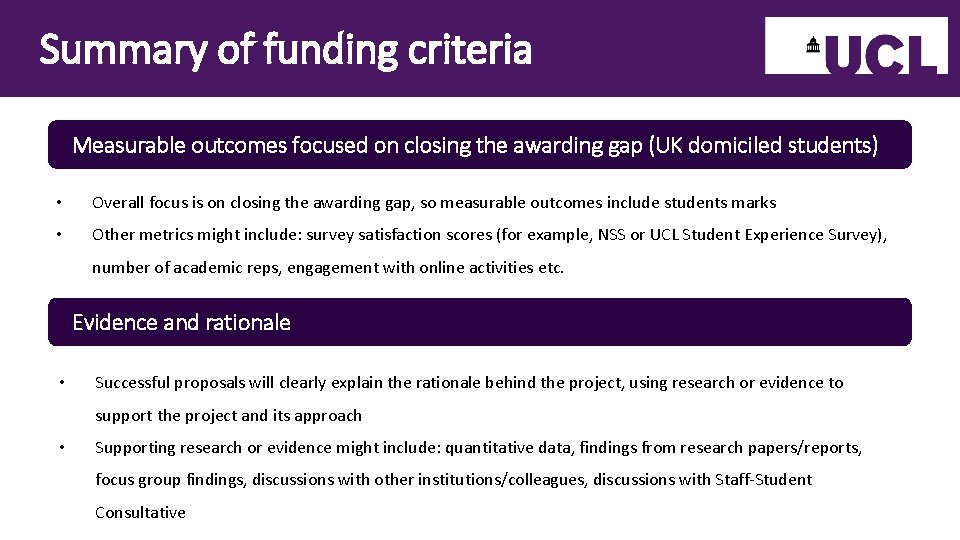
Summary of funding criteria Measurable outcomes focused on closing the awarding gap (UK domiciled students) • Overall focus is on closing the awarding gap, so measurable outcomes include students marks • Other metrics might include: survey satisfaction scores (for example, NSS or UCL Student Experience Survey), number of academic reps, engagement with online activities etc. Evidence and rationale • Successful proposals will clearly explain the rationale behind the project, using research or evidence to support the project and its approach • Supporting research or evidence might include: quantitative data, findings from research papers/reports, focus group findings, discussions with other institutions/colleagues, discussions with Staff-Student Consultative
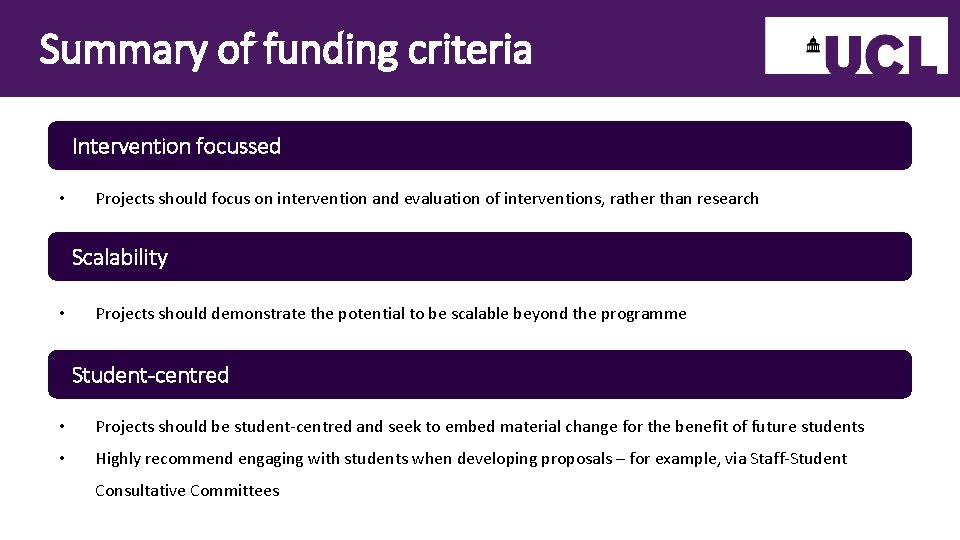
Summary of funding criteria Intervention focussed • Projects should focus on intervention and evaluation of interventions, rather than research Scalability • Projects should demonstrate the potential to be scalable beyond the programme Student-centred • Projects should be student-centred and seek to embed material change for the benefit of future students • Highly recommend engaging with students when developing proposals – for example, via Staff-Student Consultative Committees
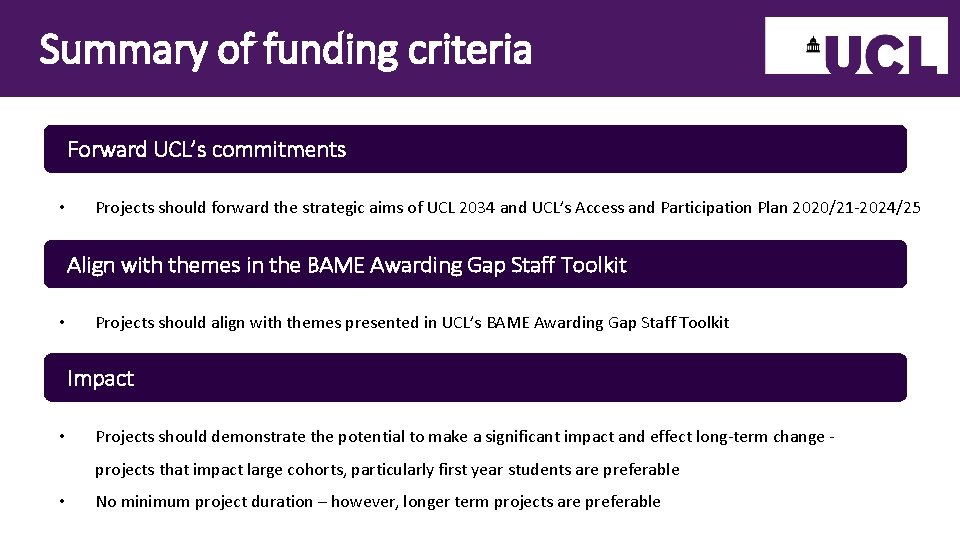
Summary of funding criteria Forward UCL’s commitments • Projects should forward the strategic aims of UCL 2034 and UCL’s Access and Participation Plan 2020/21 -2024/25 Align with themes in the BAME Awarding Gap Staff Toolkit • Projects should align with themes presented in UCL’s BAME Awarding Gap Staff Toolkit Impact • Projects should demonstrate the potential to make a significant impact and effect long-term change projects that impact large cohorts, particularly first year students are preferable • No minimum project duration – however, longer term projects are preferable
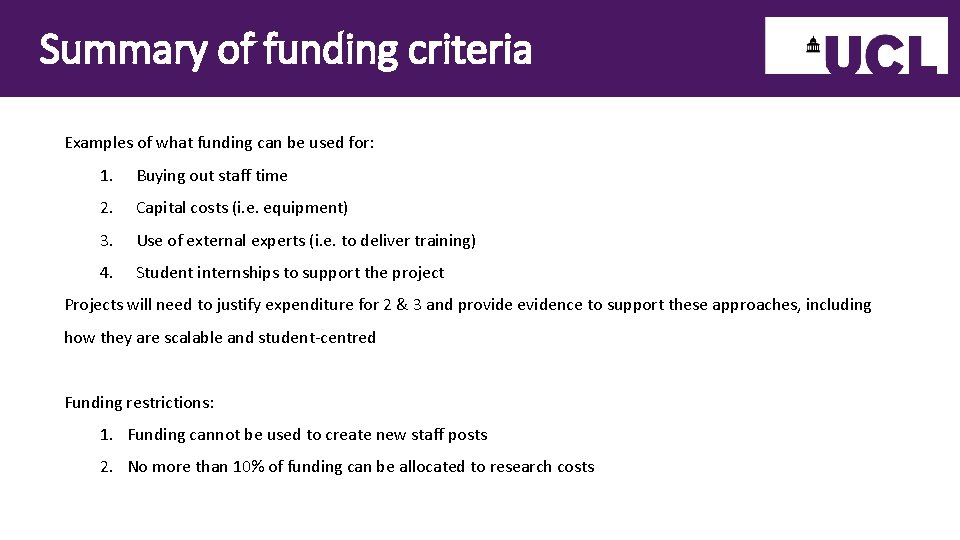
Summary of funding criteria Examples of what funding can be used for: 1. Buying out staff time 2. Capital costs (i. e. equipment) 3. Use of external experts (i. e. to deliver training) 4. Student internships to support the project Projects will need to justify expenditure for 2 & 3 and provide evidence to support these approaches, including how they are scalable and student-centred Funding restrictions: 1. Funding cannot be used to create new staff posts 2. No more than 10% of funding can be allocated to research costs
The process • Attend a Q&A session to find out more information and discuss your ideas: • Monday 14 December 10: 00 – 11: 00 • January – dates tbc • Submit your application in line with the following deadlines: • Monday 1 February 2021 • Monday 6 September 2021 • Deadlines tbc for 2021/22 academic year • Project proposal forms and guidance will be made available before December 18
The process • Successful projects can expect to receive access to the following support and networks: • Meetings to discuss project progress • Q&A sessions • Support to collect relevant programme and/or module(s) data • An invitation to join an online platform to share ideas, experiences and best practice with colleagues working on projects across the institution • Reporting requirements will include: • Completion of a Project Update Report every 6 months, including reporting back on the status of gaps • Completion of an End Project Report • Projects 6 months or under will only be required to submit an End Project Report
Science of Bias Module Lasana Harris, Associate Professor in Social Cognition & BAME Awarding Gap Faculty Lead, Brain Sciences Science of Bias Module Talk
Potential project areas Potential projects might focus on: • Enhancing personal tutoring • Developing and implementing active, collaborative learning approaches • Redesigning modules/programmes or developing existing modules • Some more examples of project case studies are available in the Universities UK (2019) #closingthegap report

Q&A
- Slides: 13