
Bamboo to Bioplastics Mohammed Al Makhaita Alberto Eyzaguirre
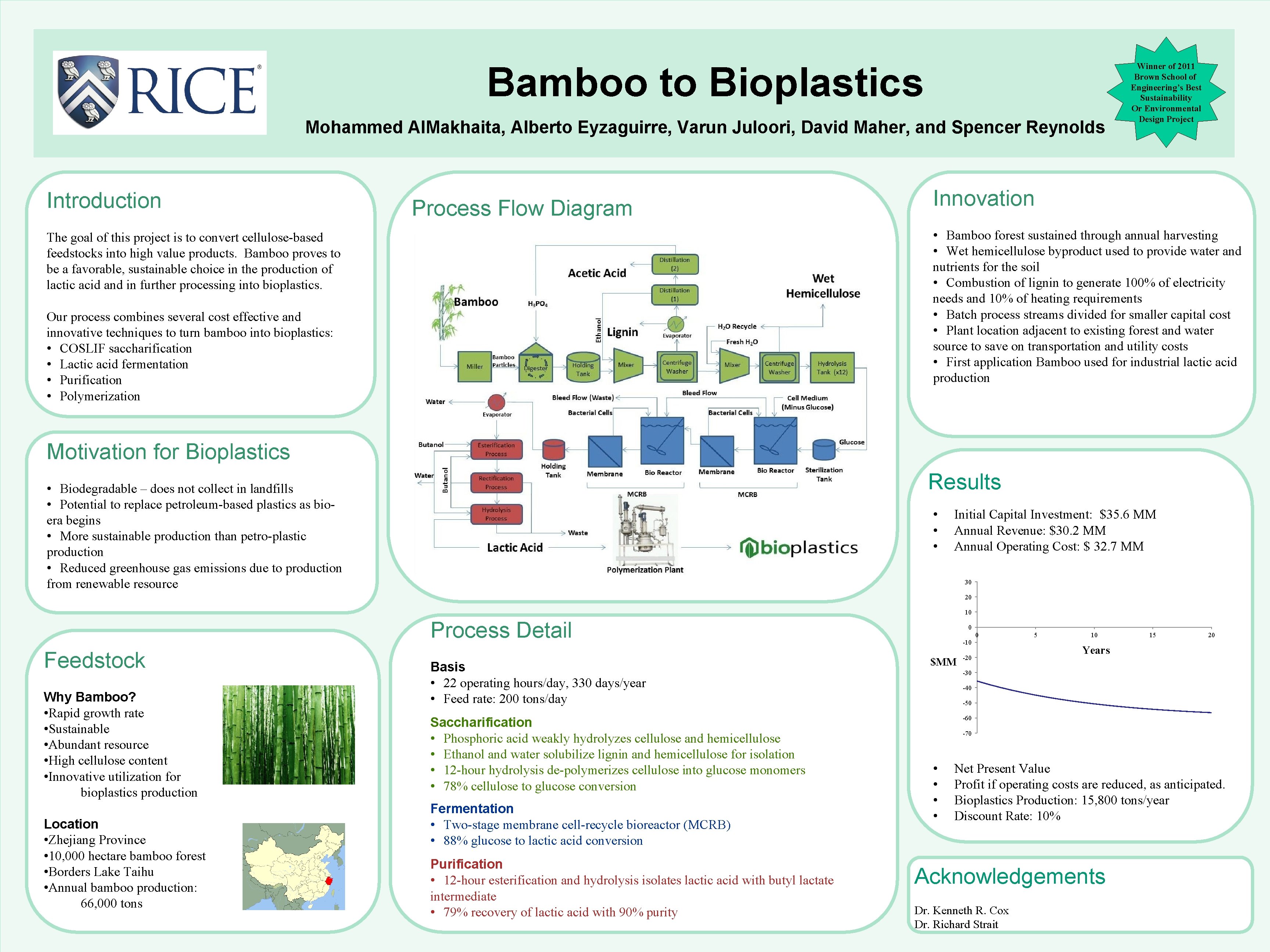
Bamboo to Bioplastics Mohammed Al. Makhaita, Alberto Eyzaguirre, Varun Juloori, David Maher, and Spencer Reynolds Introduction Process Flow Diagram Winner of 2011 Brown School of Engineering’s Best Sustainability Or Environmental Design Project Innovation • Bamboo forest sustained through annual harvesting • Wet hemicellulose byproduct used to provide water and nutrients for the soil • Combustion of lignin to generate 100% of electricity needs and 10% of heating requirements • Batch process streams divided for smaller capital cost • Plant location adjacent to existing forest and water source to save on transportation and utility costs • First application Bamboo used for industrial lactic acid production The goal of this project is to convert cellulose-based feedstocks into high value products. Bamboo proves to be a favorable, sustainable choice in the production of lactic acid and in further processing into bioplastics. Our process combines several cost effective and innovative techniques to turn bamboo into bioplastics: • COSLIF saccharification • Lactic acid fermentation • Purification • Polymerization Motivation for Bioplastics Results • Biodegradable – does not collect in landfills • Potential to replace petroleum-based plastics as bioera begins • More sustainable production than petro-plastic production • Reduced greenhouse gas emissions due to production from renewable resource • • • Initial Capital Investment: $35. 6 MM Annual Revenue: $30. 2 MM Annual Operating Cost: $ 32. 7 MM 30 20 10 Process Detail Feedstock Why Bamboo? • Rapid growth rate • Sustainable • Abundant resource • High cellulose content • Innovative utilization for bioplastics production Location • Zhejiang Province • 10, 000 hectare bamboo forest • Borders Lake Taihu • Annual bamboo production: 66, 000 tons Basis • 22 operating hours/day, 330 days/year • Feed rate: 200 tons/day Saccharification • Phosphoric acid weakly hydrolyzes cellulose and hemicellulose • Ethanol and water solubilize lignin and hemicellulose for isolation • 12 -hour hydrolysis de-polymerizes cellulose into glucose monomers • 78% cellulose to glucose conversion Fermentation • Two-stage membrane cell-recycle bioreactor (MCRB) • 88% glucose to lactic acid conversion Purification • 12 -hour esterification and hydrolysis isolates lactic acid with butyl lactate intermediate • 79% recovery of lactic acid with 90% purity 0 -10 $MM 0 -20 5 10 15 20 Years -30 -40 -50 -60 -70 • • Net Present Value Profit if operating costs are reduced, as anticipated. Bioplastics Production: 15, 800 tons/year Discount Rate: 10% Acknowledgements Dr. Kenneth R. Cox Dr. Richard Strait
- Slides: 1