
Baltimore City Department of Public Works Municipal Separate
Baltimore City Department of Public Works
Municipal Separate Storm Sewer System Permit (MS 4) Watershed Implementation Plan (WIP) Accelerating NPDES MS 4 Projects Project Delivery By Prakash Mistry, Engineer Supervisor Baltimore City DPW 410‐ 396‐ 4700 Eissa Haj-Hamad, P. E, Program Manager PRIME AE Group 410‐ 396‐ 4700 Baltimore City Department of Public Works
Agenda • • • Background & Project Overview WIP - Project Locations MS 4 WIP Challenges MS 4 Program - WIP Strategy Types of WIP Projects – – • • Structural / Traditional BMPs Environmental Site Design (ESD) Alternative BMPs (Stream Restoration) Alternative BMP (Impervious Area Removal/Lot Greening) Current Program Status Contract Procurement Project Delivery Looking Forward Questions Baltimore City Department of Public Works
Background & Project Overview • City of Baltimore’s MS 4 Permit – Permit issued December 27, 2013 – Completion is December 27, 2018 – City will restore over 4, 041 acres of impervious surface area by December 2018 to meet the required strategies to meet the 20% restoration goal • 1, 191 equivalent impervious acres by installing stormwater management projects including traditional Best Management Practices (BMPs), Environmental Site Design (ESD) practices, and Alternative BMPs • 2, 766 equivalent impervious acres by employing a variety of programs to improve water quality, including mechanical street sweeping, preventive inlet cleaning, and IDDE • 279 equivalent impervious acres by fostering partnerships to encourage private development of stormwater management – Estimated cost for all projects combined approximately $80 million Baltimore City Department of Public Works
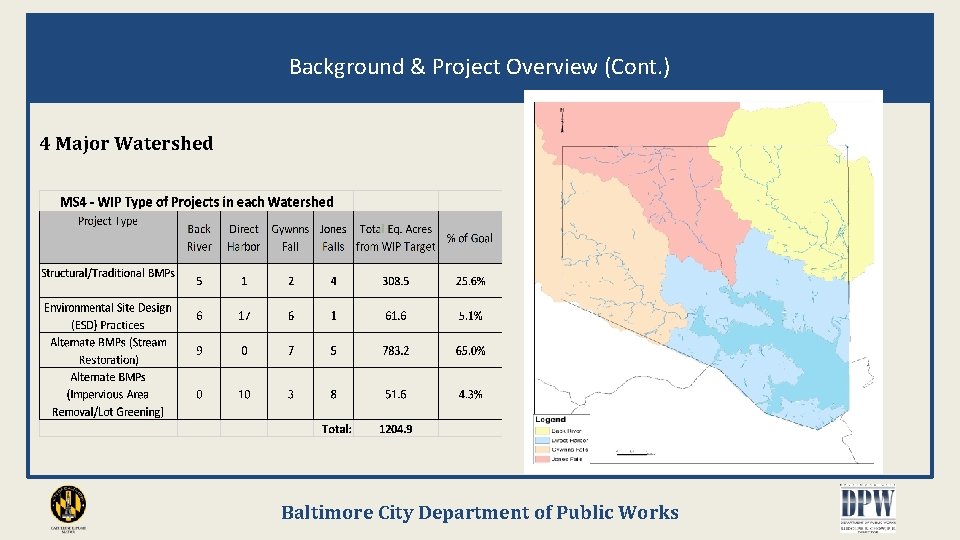
Background & Project Overview (Cont. ) 4 Major Watershed Baltimore City Department of Public Works
Background & Project Overview (Cont. ) Baltimore City Department of Public Works
Background & Project Overview (Cont. ) Baltimore City Department of Public Works
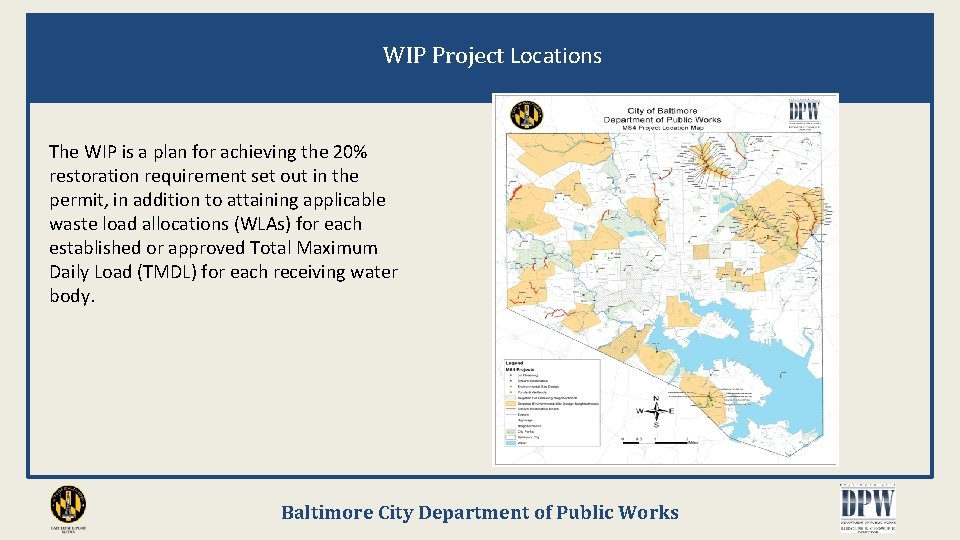
WIP Project Locations The WIP is a plan for achieving the 20% restoration requirement set out in the permit, in addition to attaining applicable waste load allocations (WLAs) for each established or approved Total Maximum Daily Load (TMDL) for each receiving water body. Baltimore City Department of Public Works
MS 4 WIP Challenges – – – – Replacing infeasible projects to meet WIP goal Limited public lands (School and Rec & Parks) Ultra‐Urban Areas (45% of the City is impervious) Unfavorable topography Limited spaces to install SWM facilities Selecting ESD’s projects Design and Construction Budget • It took longer to negotiate design scope to meet the budget – Various Permits • Maryland Department of the Environment (MDE) • United State Army Corps of Engineers (USAE) • Maryland Historic Trust (MHT) • Rec & Parks • Public/Private Landowners (federal agencies, Schools, MTA, CSX, etc. ) • City Agencies ( MOT, OLRA, planning, etc. ) – Aggressive design and construction schedule – Resources – Long expenditure authorization process Baltimore City Department of Public Works
MS 4 WIP Challenges (Cont. ) Other Challenges – Rights of Entry for private property (ROE) – Contractor Capacity Limitations – Late Program Start – Some projects that are no longer viable – Identify replacement projects – Contractor's Procurement Approvals – Improve maintenance program – Competition with other Jurisdiction to meet deadline – Staffing Baltimore City Department of Public Works
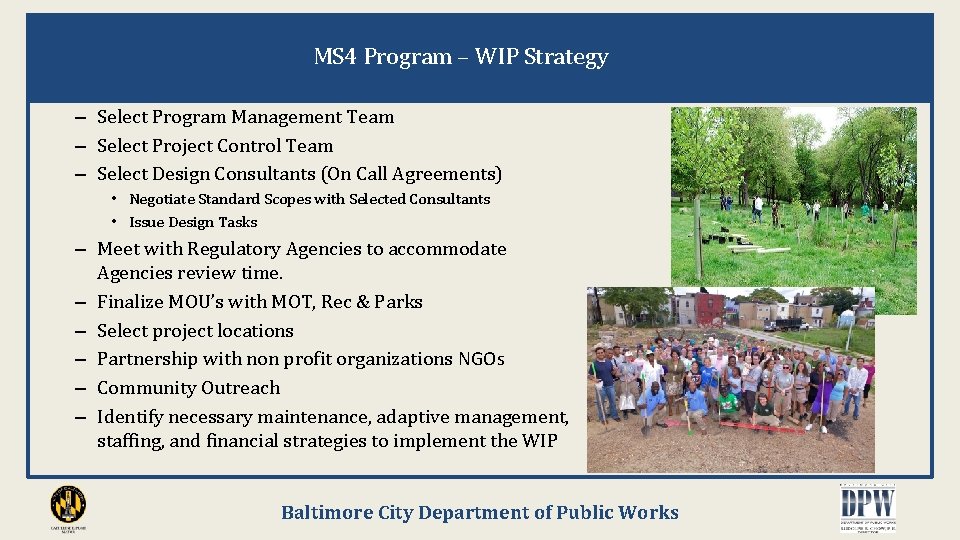
MS 4 Program – WIP Strategy – Select Program Management Team – Select Project Control Team – Select Design Consultants (On Call Agreements) • Negotiate Standard Scopes with Selected Consultants • Issue Design Tasks – Meet with Regulatory Agencies to accommodate Agencies review time. – Finalize MOU’s with MOT, Rec & Parks – Select project locations – Partnership with non profit organizations NGOs – Community Outreach – Identify necessary maintenance, adaptive management, staffing, and financial strategies to implement the WIP Baltimore City Department of Public Works
NGO & Inter-agency List Inter-agency collaboration § § § § Baltimore Development Corporation Baltimore Housing Department of Planning Department of Public Works Department of Recreation and Parks Tree. Baltimore Department of Transportation Office of the Mayor NGO Collaboration § Baltimore Green Space § Baltimore Orchard Project § Baltimore Tree Trust Blue Water Baltimore § Civic Works § Parks & People Foundation § USDA Forest Service / § Baltimore Ecosystem Study Baltimore City Department of Public Works
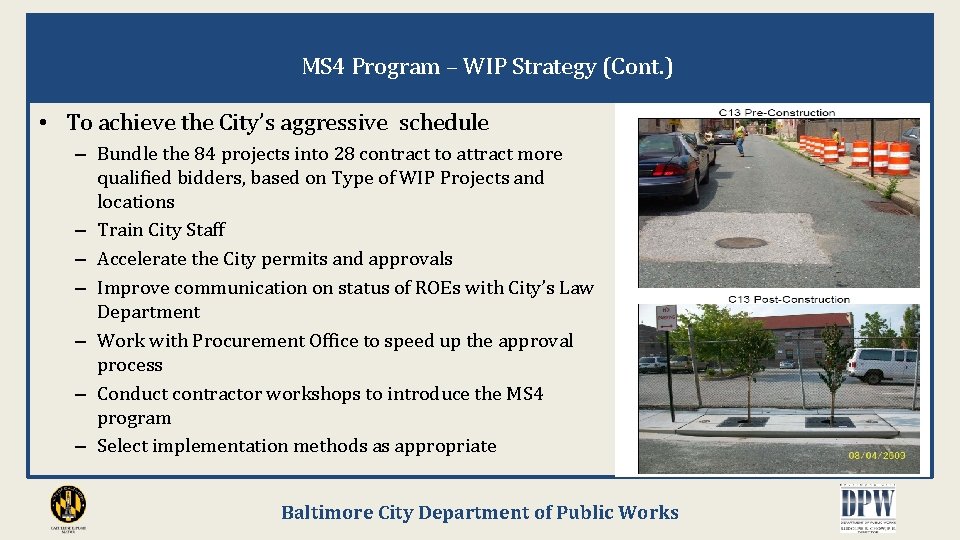
MS 4 Program – WIP Strategy (Cont. ) • To achieve the City’s aggressive schedule – Bundle the 84 projects into 28 contract to attract more qualified bidders, based on Type of WIP Projects and locations – Train City Staff – Accelerate the City permits and approvals – Improve communication on status of ROEs with City’s Law Department – Work with Procurement Office to speed up the approval process – Conduct contractor workshops to introduce the MS 4 program – Select implementation methods as appropriate Baltimore City Department of Public Works
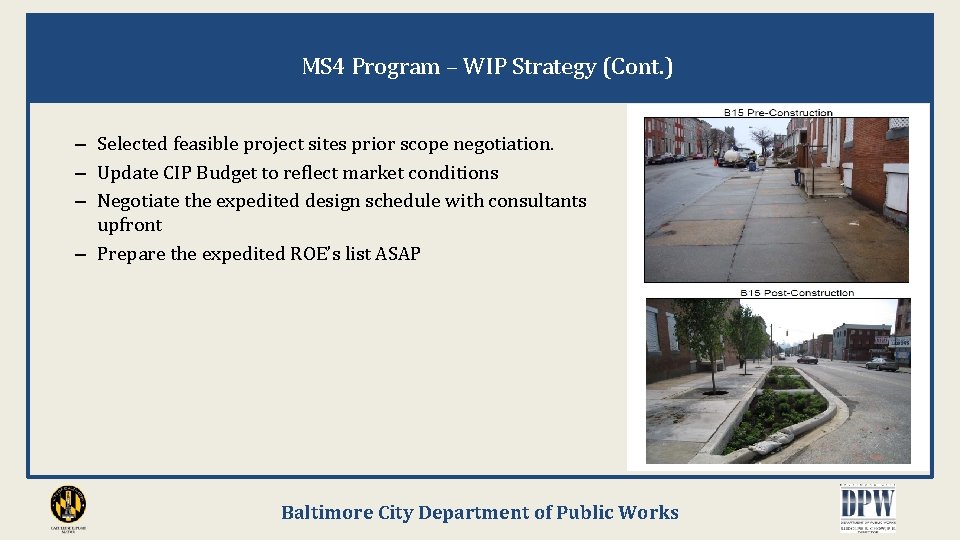
MS 4 Program – WIP Strategy (Cont. ) – Selected feasible project sites prior scope negotiation. – Update CIP Budget to reflect market conditions – Negotiate the expedited design schedule with consultants upfront – Prepare the expedited ROE’s list ASAP Baltimore City Department of Public Works
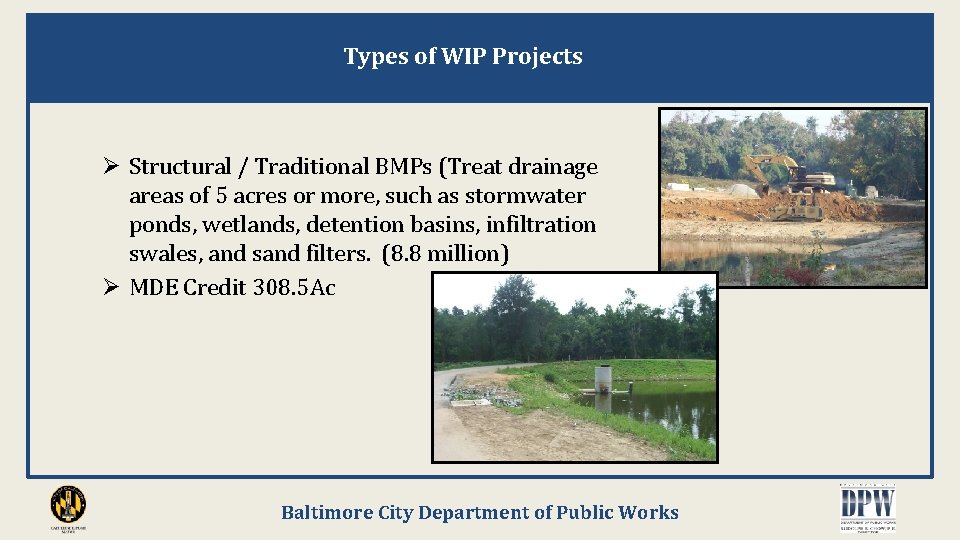
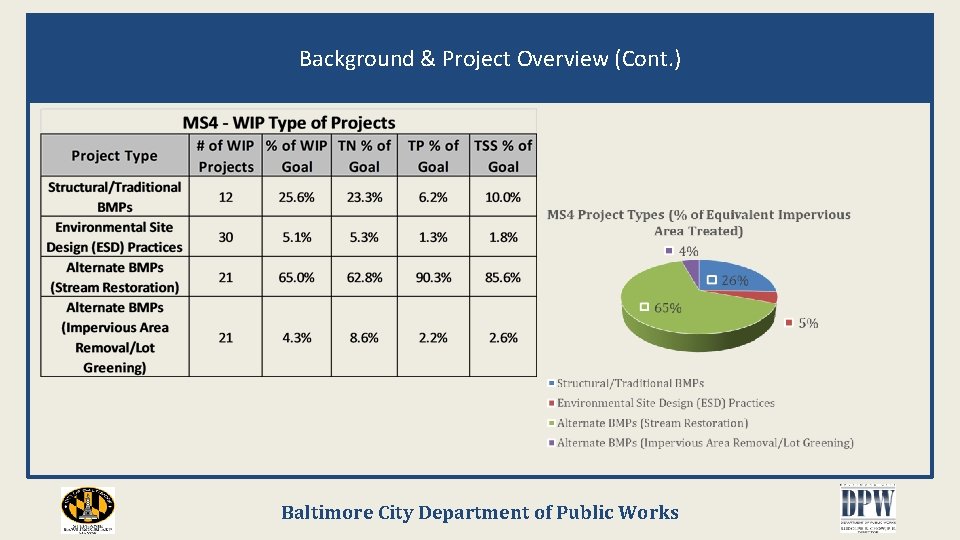
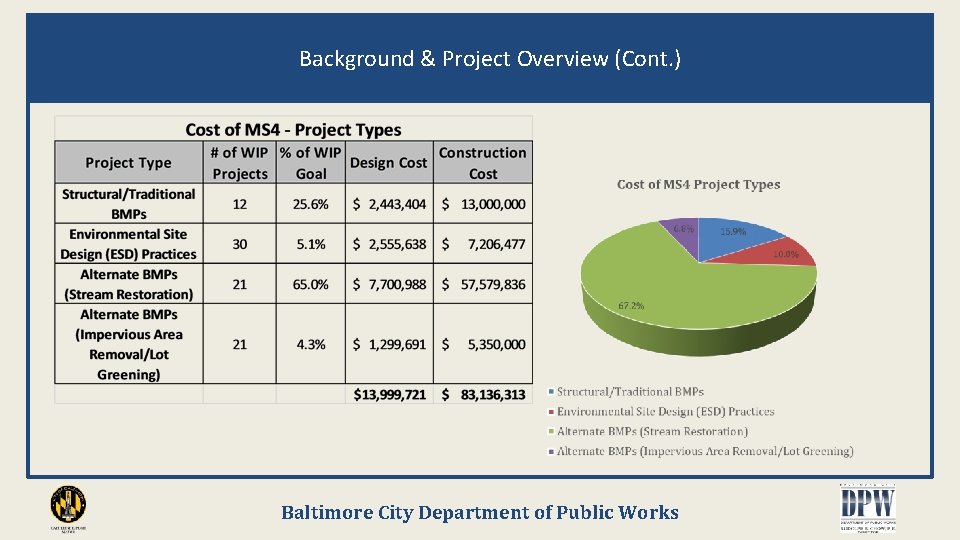
Types of WIP Projects Ø Structural / Traditional BMPs (Treat drainage areas of 5 acres or more, such as stormwater ponds, wetlands, detention basins, infiltration swales, and sand filters. (8. 8 million) Ø MDE Credit 308. 5 Ac Baltimore City Department of Public Works
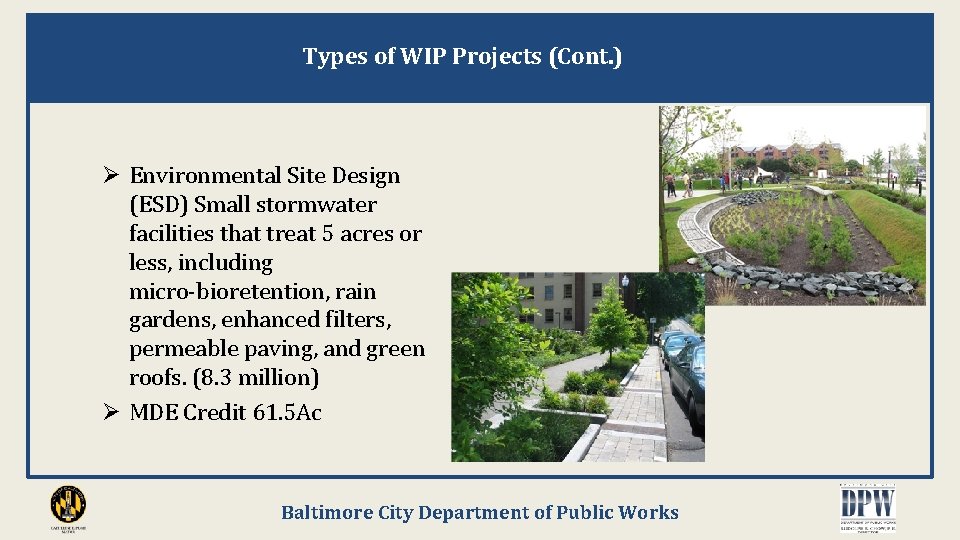
Types of WIP Projects (Cont. ) Ø Environmental Site Design (ESD) Small stormwater facilities that treat 5 acres or less, including micro‐bioretention, rain gardens, enhanced filters, permeable paving, and green roofs. (8. 3 million) Ø MDE Credit 61. 5 Ac Baltimore City Department of Public Works
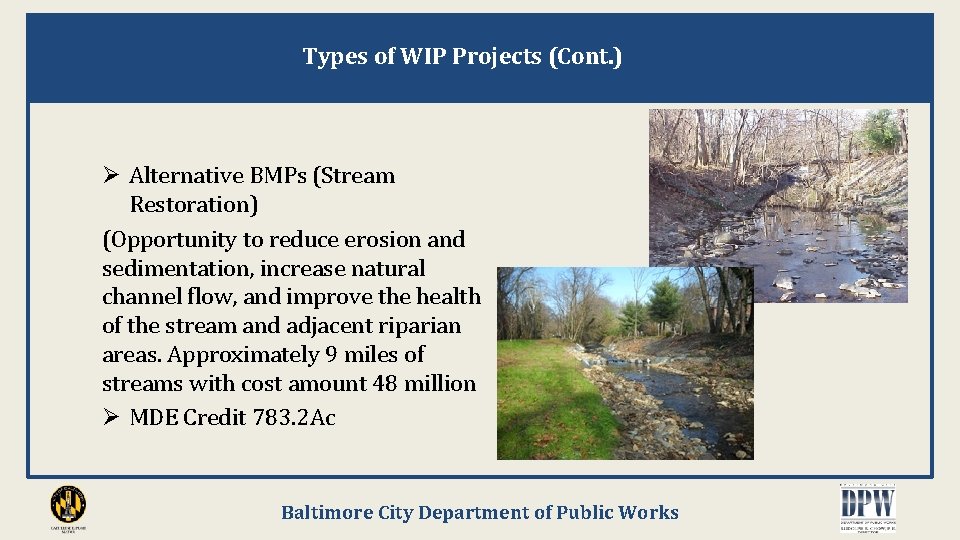
Types of WIP Projects (Cont. ) Ø Alternative BMPs (Stream Restoration) (Opportunity to reduce erosion and sedimentation, increase natural channel flow, and improve the health of the stream and adjacent riparian areas. Approximately 9 miles of streams with cost amount 48 million Ø MDE Credit 783. 2 Ac Baltimore City Department of Public Works
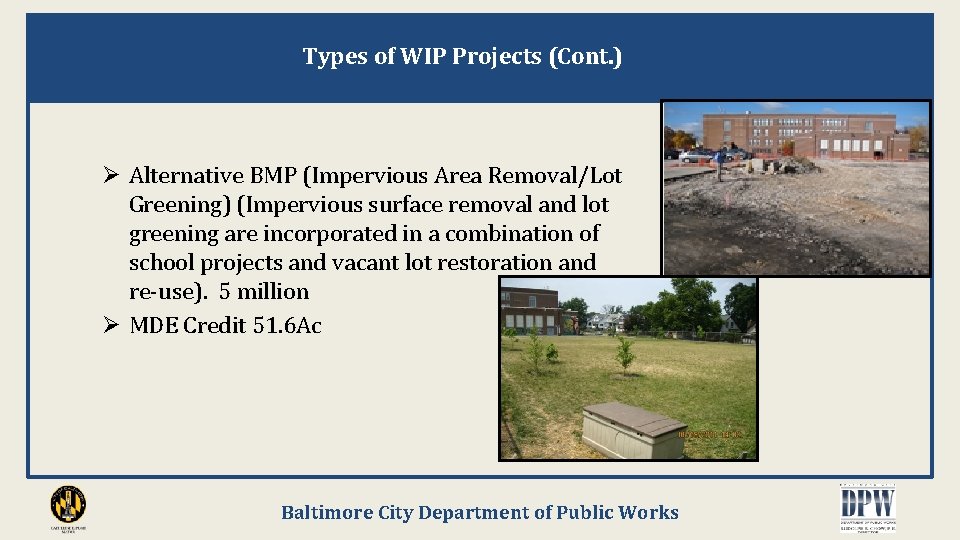
Types of WIP Projects (Cont. ) Ø Alternative BMP (Impervious Area Removal/Lot Greening) (Impervious surface removal and lot greening are incorporated in a combination of school projects and vacant lot restoration and re‐use). 5 million Ø MDE Credit 51. 6 Ac Baltimore City Department of Public Works
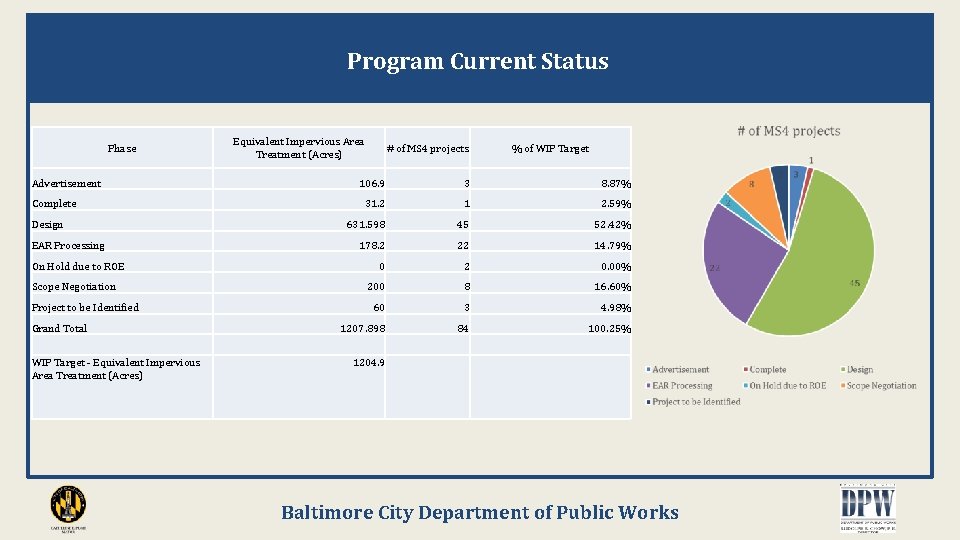
Program Current Status Phase Advertisement Complete Design EAR Processing On Hold due to ROE Scope Negotiation Project to be Identified Grand Total WIP Target ‐ Equivalent Impervious Area Treatment (Acres) # of MS 4 projects % of WIP Target 106. 9 3 8. 87% 31. 2 1 2. 59% 631. 598 45 52. 42% 178. 2 22 14. 79% 0 2 0. 00% 200 8 16. 60% 60 3 4. 98% 1207. 898 84 100. 25% 1204. 9 Baltimore City Department of Public Works
Project Delivery Method To select a suitable project delivery method, we must carefully analyze the following: • Project development phase • Project needs, e. g. specialty contractors, ROW, site feasibility, etc. • Resources and technical capability to manage the current workload Baltimore City Department of Public Works
Project Delivery Method (Cont. ) q Contract Procumbent Project Delivery • Traditional Design‐Bid‐Build (DBB) for projects past the design stage – Procured early – Less cost • Design/Build (DB) – Procured after 30% design • Others – Construction Manager at Risk (CMAR) Baltimore City Department of Public Works
Program Schedule - DBB Baltimore City Department of Public Works
Program Schedule - DB Baltimore City Department of Public Works
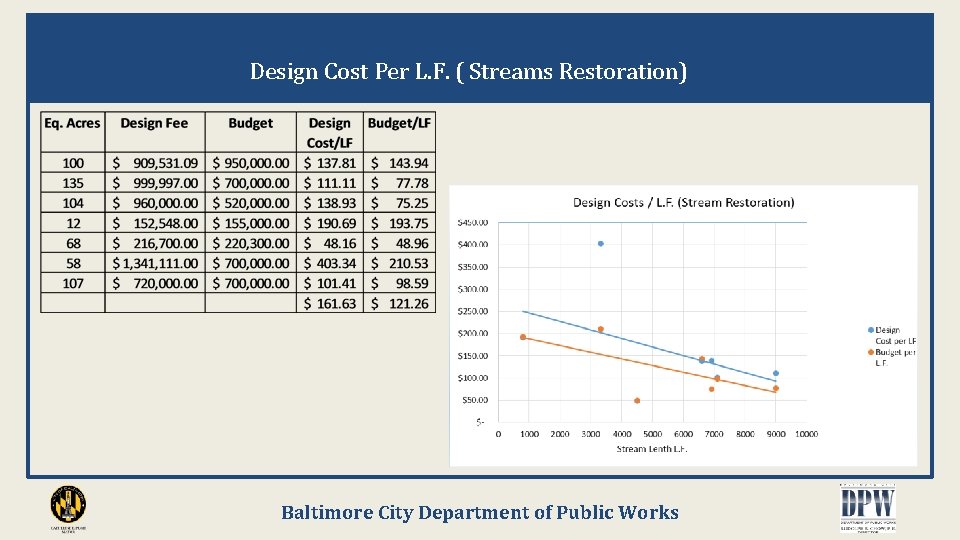
Design Cost Per L. F. ( Streams Restoration) Baltimore City Department of Public Works
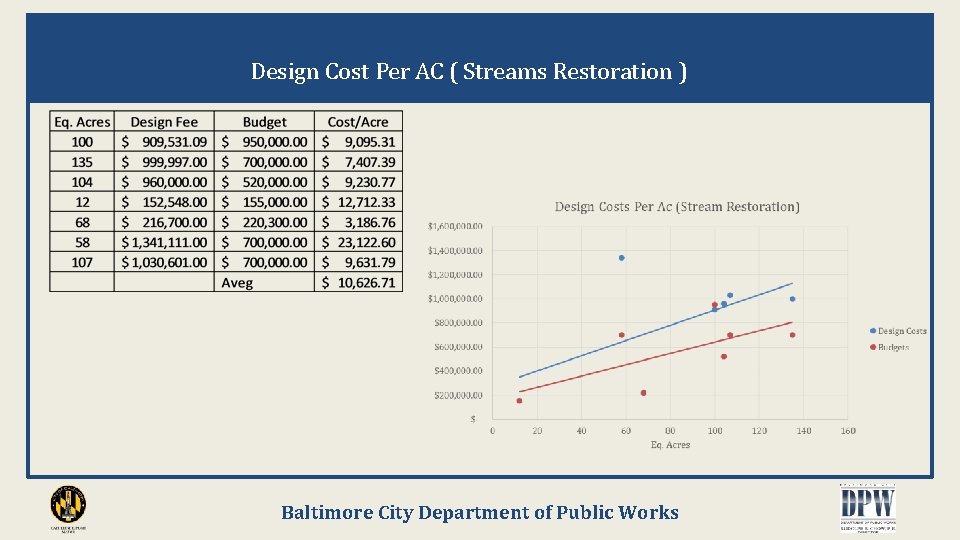
Design Cost Per AC ( Streams Restoration ) Baltimore City Department of Public Works
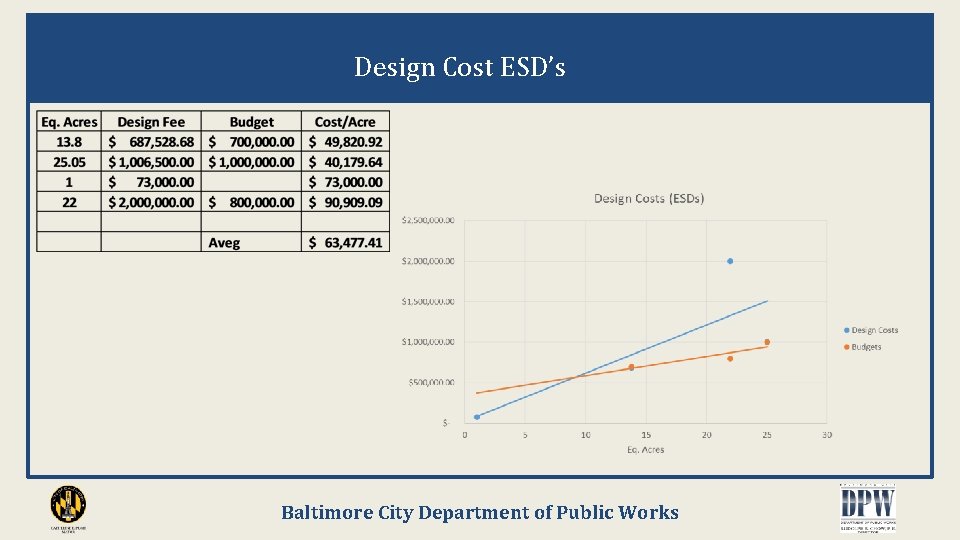
Design Cost ESD’s Baltimore City Department of Public Works
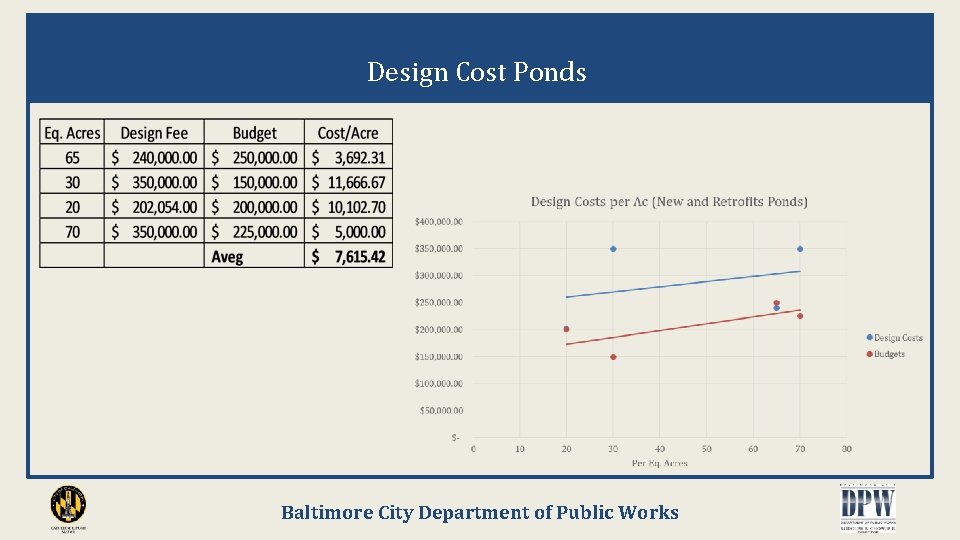
Design Cost Ponds Baltimore City Department of Public Works
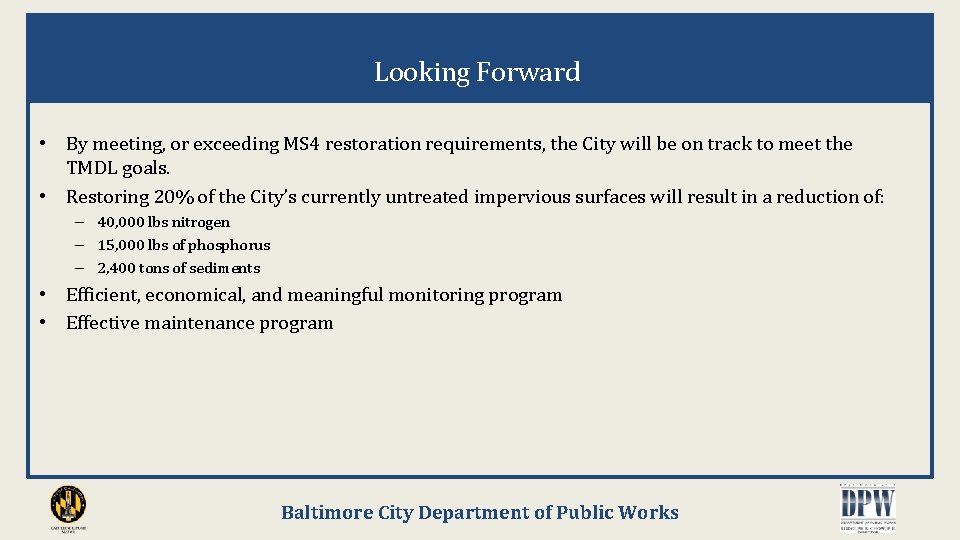
Looking Forward • By meeting, or exceeding MS 4 restoration requirements, the City will be on track to meet the TMDL goals. • Restoring 20% of the City’s currently untreated impervious surfaces will result in a reduction of: – 40, 000 lbs nitrogen – 15, 000 lbs of phosphorus – 2, 400 tons of sediments • Efficient, economical, and meaningful monitoring program • Effective maintenance program Baltimore City Department of Public Works
Contact Information DPW, Office Engineering and Construction (OEC) Acting Chief - Mr. Azzam Ahmad Abel Wolman Municipal Building 200 N. Holliday Street, Room 309 Baltimore, MD 21201 Prakash Mistry, Engineer Supervisor prakash. mistry@baltimorecity. gov 410 -396 -4700 Eissa Haj-Hamad, P. E. -Program Manager eissa. haj‐hamad@baltimorecity. gov Tracy Moffatt, Project Team Leader tracy. moffatt@baltimorecity. gov Baltimore City Department of Public Works
- Slides: 29