
Balmoral PondMill Creek Water Resources Assessments Balmoral Pond
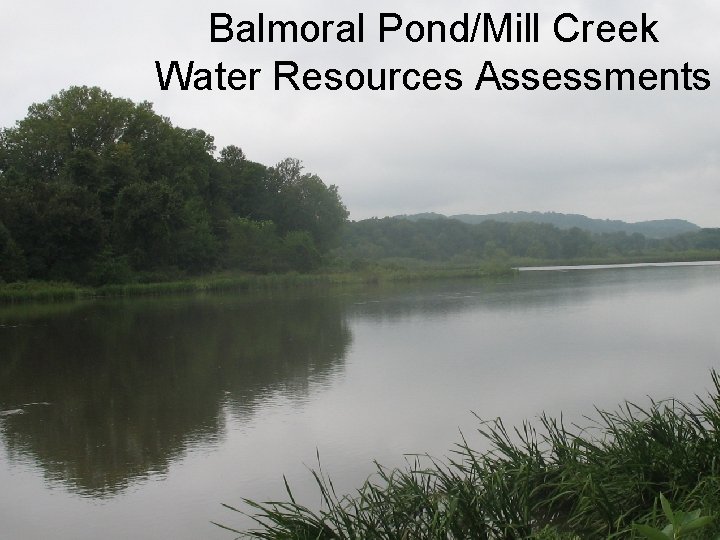
Balmoral Pond/Mill Creek Water Resources Assessments Balmoral Pond Water Resources Assessments
Water Quality Assessments • Water Chemistry was sampled at sites 1, 2, & 3 on the adjacent map • Sites 1 & 2 sampled on September 14, 2007 • Site 3 sampled from October 2006 through August 2007 as part of a longer term baseline water quality study. • Parameters sampled: Nitrogen, phosphorus, conductivity, oxygen, Ph, temperature, and water transparency
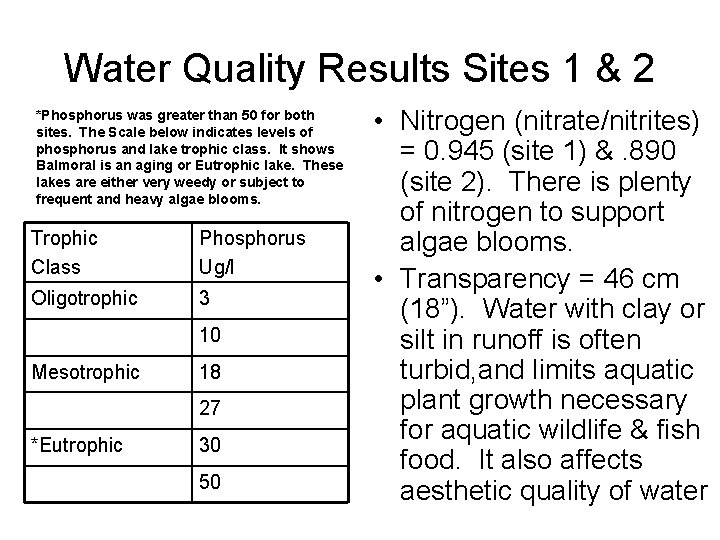
Water Quality Results Sites 1 & 2 *Phosphorus was greater than 50 for both sites. The Scale below indicates levels of phosphorus and lake trophic class. It shows Balmoral is an aging or Eutrophic lake. These lakes are either very weedy or subject to frequent and heavy algae blooms. Trophic Class Phosphorus Ug/l Oligotrophic 3 10 Mesotrophic 18 27 *Eutrophic 30 50 • Nitrogen (nitrate/nitrites) = 0. 945 (site 1) &. 890 (site 2). There is plenty of nitrogen to support algae blooms. • Transparency = 46 cm (18”). Water with clay or silt in runoff is often turbid, and limits aquatic plant growth necessary for aquatic wildlife & fish food. It also affects aesthetic quality of water
Water Quality Sites 1 & 2 • Dissolved oxygen levels at both sites were well above the acceptable limits for aquatic organisms. However the lake’s shallow water depth (1 foot average from the dam to sample site 1) means the lake can easily go anoxic or lose the oxygen during hot, calm days of summer and during ice on conditions (winterkill). • Ph at both sites was 8. 5 and in the normal range for surface waters – not too acidic or basic.
Sediment Assessment • A sediments core was taken from the Balmoral impoundment at Site A (see map) about 15 yards from the dam crest on November 12, 2007 • Total core depth was 38 inches (97 cm) • Sediments were highly compacted clay and silt • Metals analysis includes: Arsenic, cadmium, chromium, copper, lead mercury, nickel, zinc • Pesticides/insecticides analysis includes: Dieldrin, Chlorate, phosphorus, nitrogen, Dichloro-Diphenyl. Trichloroethane (DDT) • Nutrients analysis includes phosphorus and nitrogen • Results not yet back from the laboratory
Water Quality & River Ecology Rivers naturally transport soil & debris from the surrounding watershed. Here in the driftless area of southwestern Wisconsin soil erosion is common and rivers can move thousands of tons of soil per year. Where dams have been constructed, sediment is deposited in the slow current behind the dam. In 1944, researchers predicted “most millponds in Wisconsin will be short lived due to rapid in-filling and loss of storage capacity”. Based on this information it is not surprising that the Balmoral Pond has lost most of it’s capacity. Dams have had a profound effect on many streams and their food webs. Loss of fast water current causes displacement of many fish and other aquatic organisms over the years. Recreational opportunities and habitat within the impoundment declines progressively as storage capacity is lost. The fisheries potential is reduced as sediment smothers spawning beds and creates conditions favorable to exotic fishes like carp. Fish food production is severely harmed because only pollution tolerant aquatic insects can survive in such a sluggish and silty environment. Most aquatic insects require natural river flow to pass enough oxygen and food for survival. The impoundments often become choked with invasive plants or algae to the detriment of both wildlife and fishes.
- Slides: 6