
Ballistic evidence helps explain What type of firearm
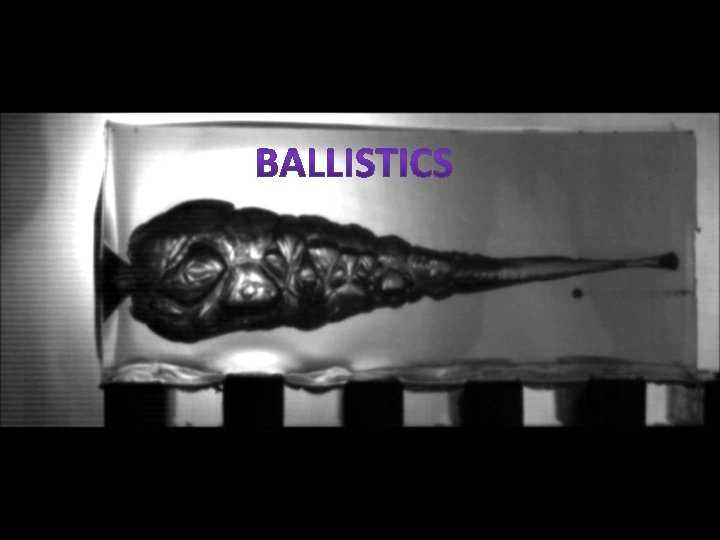

• Ballistic evidence helps explain: – What type of firearm was used – The caliber of the bullet used – The number of bullets fired – Where the shooter was located – Whether a weapon was fired recently – If a firearm was used in previous crimes

• Gun Powder and Firearms – Chinese invented gunpowder over a thousand years ago for fireworks – It was later discovered that the explosive force could be directed down a cylinder – Muzzle loading matchlocks that used the wick to ignite the powder are invented – Percussion firing replaced the muzzle loading leading to cartridge and breach loading. – Modern weapons
• Modern Firearms are divided into 2 categories: – 1. Long Guns • Require two hands for accurate firing • Rifles fire bullets • Shotguns fire pellets (shot) or single projectile (slug) – 2. Handguns • Pistols are fired with one hand • Revolvers have a cylinder that usually holds six cartridges and can be fired in rapid succession
• Automatic vs. Semi-Automatic weapons: – Semiautomatic weapons fire only one bullet per pull of the trigger – Automatic fire repeatedly as long as trigger is pressed
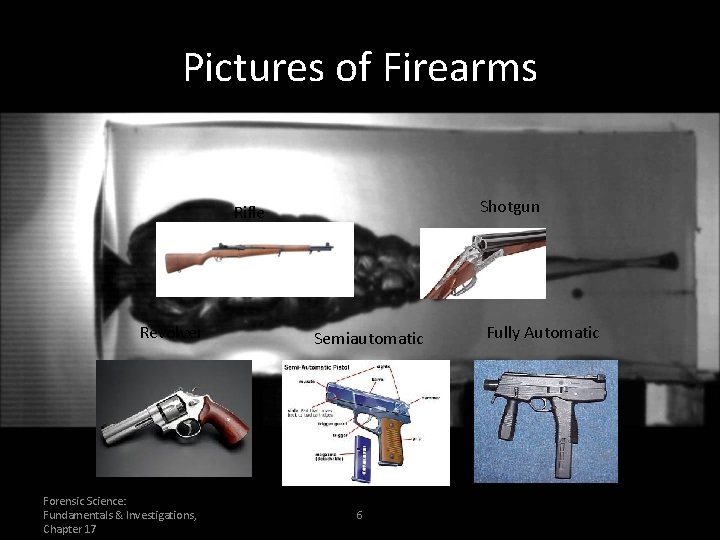
Pictures of Firearms Shotgun Rifle Revolver Forensic Science: Fundamentals & Investigations, Chapter 17 Semiautomatic 6 Fully Automatic
• Goddard, Sacco and Vanzetti, and the valentine’s day massacre 1925 • Comparison microscope invented by Goddard* • Northwestern University in Chicago sets up first crime lab • Now forensics can… – 1. Compare bullets and match them to a specific firearm – 2. Accurately estimate the distance of a shooting – 3. Detect gunpowder residue around wounds and on shooters – 4. Restore obliterated serial numbers
• Databases – Police upload information on bullet marks – Maryland forces each gun sale to first log a test fire into the system • Low success: only used in one case • 2. 6 million dollar cost – Crime Stats • Generally … – Harsher gun laws = higher crime rate – Lenient gun laws = lower crime rates WHY?
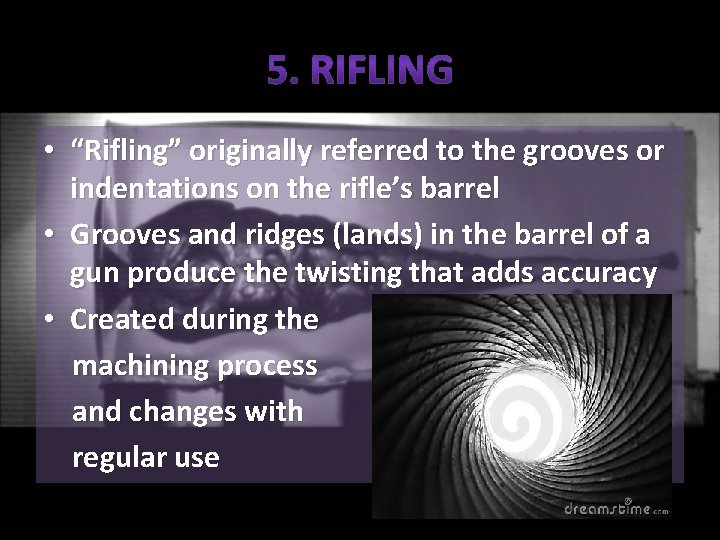
• “Rifling” originally referred to the grooves or indentations on the rifle’s barrel • Grooves and ridges (lands) in the barrel of a gun produce the twisting that adds accuracy • Created during the machining process and changes with regular use
• Leaves a pattern on the bullet that is fired that is unique to that particular firearm – Rifling does change overtime as the gun is used and cleaned – Criminals can take “forensic counter measures” to try and conceal that their gun was the gun used in the commission of a crime. • Technology has allowed for ballistics experts to identify patterns of lands and grooves in pistols and rifles
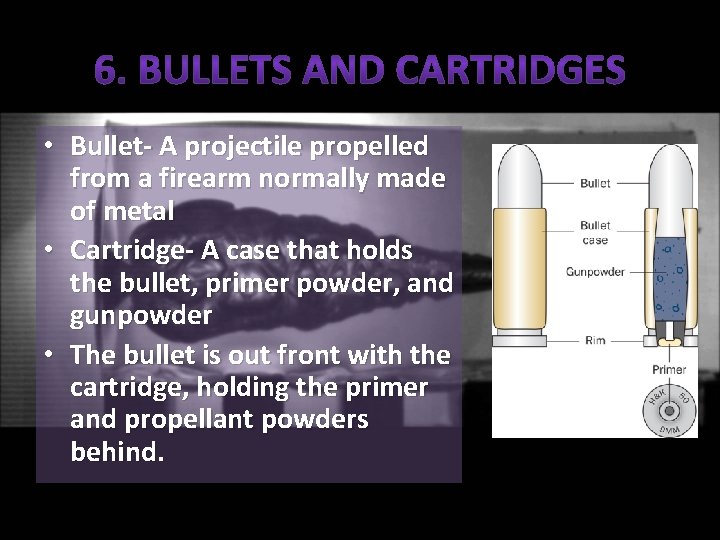
• Bullet- A projectile propelled from a firearm normally made of metal • Cartridge- A case that holds the bullet, primer powder, and gunpowder • The bullet is out front with the cartridge, holding the primer and propellant powders behind.
• Measure of the diameter of the cartridge usually in hundredths or an inch • Common calibers include –. 22, . 25, . 357, . 38, . 44, and. 45 • Example: . 22 -caliber cartridge measures 22/100 of an inch
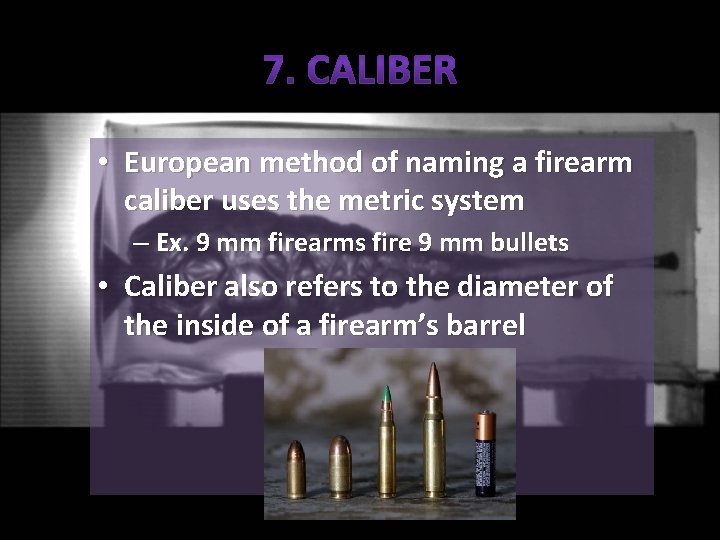
• European method of naming a firearm caliber uses the metric system – Ex. 9 mm firearms fire 9 mm bullets • Caliber also refers to the diameter of the inside of a firearm’s barrel
• Why should the caliber of ammunition match the firearm that shoots it? • If they do not match, what could go wrong?
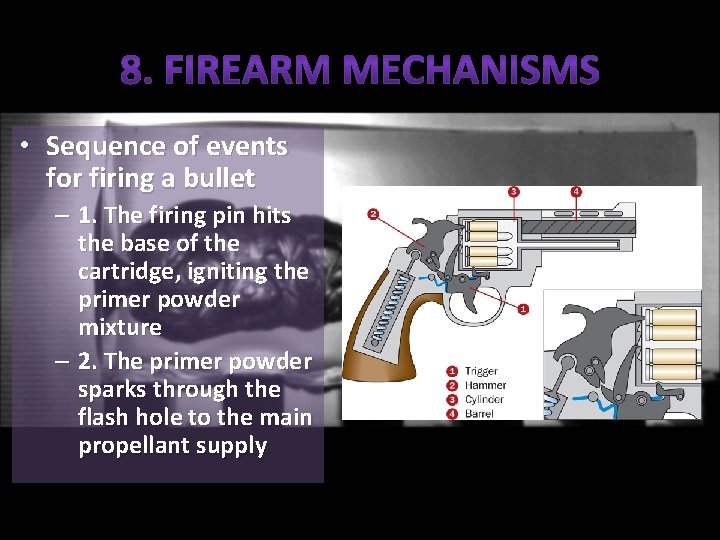
• Sequence of events for firing a bullet – 1. The firing pin hits the base of the cartridge, igniting the primer powder mixture – 2. The primer powder sparks through the flash hole to the main propellant supply
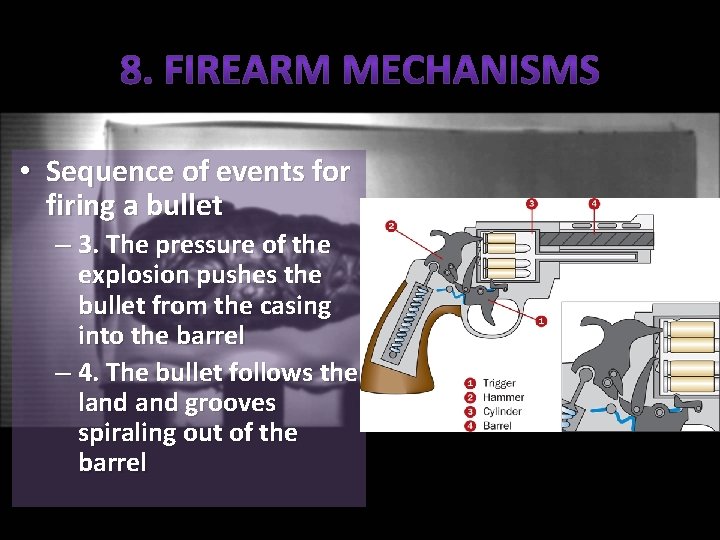
• Sequence of events for firing a bullet – 3. The pressure of the explosion pushes the bullet from the casing into the barrel – 4. The bullet follows the land grooves spiraling out of the barrel
• Process: you must answer three questions – 1. How is each fired bullet marked? – 2. What is the procedure to match a spent bullet to the firearm that shot it? – 3. What makes up a test-firing, and why is it done?
• Rifling patterns on crime scene bullets are compared to suspected firearms • To acquire known bullets, suspects firearms are test-fired into water tank or gel block to avoid damage • Each gun has it’s own unique markings or rifling that is left on the bullet when it is fired. • Rifling can tell you – Without a comparison bullet: class evidence / manufacturer – With a comparison bullet: individual evidence / which gun fired
• Can also be used to identify the firearm used – Firing pin marks • Impression made on the bottom of the cartridge by the firing pin as it strikes the bottom of the cartridge – Breechblock marks • Marks produced when the cartridge slams backward and strikes the breechblock
• Can also be used to identify the firearm used – Extractor Marks • Minute scratches produced as the cartridges is placed in the firing chamber by the extractor – Ejector Marks • Minutes scratches produced as the cartridge is removed from the chamber by the ejector
• Particles of unburned powder and traces of smoke • Contains nitrates and leaves traces on the hand, arm, face, hair or clothing of the shooter and or victim.
• Investigators look for the presence of GSR when attempting to recreate a crime scene • Chemical testing can detect residue even if removal is attempted • Distance from victim to shooter can be determined by examining the residue pattern on the victim – GSR decreases as the distance between firearm and victim increases.
• Entrance wounds are smaller than exit wounds – Skin is elastic so it stretches as the bullet goes in and on the way out the bullet may be carrying body tissue and bone. • If the bullet penetrates clothing, what can fibers in the wound tell you? – Direction of penetration • Gunshot residue is found only on entrance wounds.
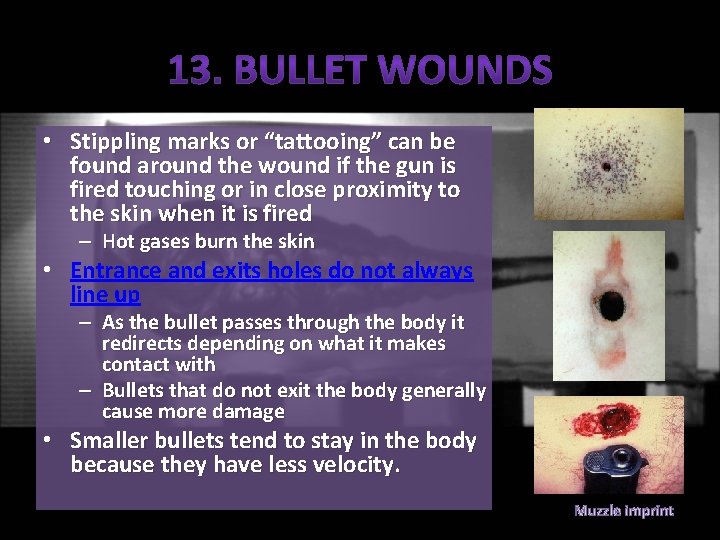
• Stippling marks or “tattooing” can be found around the wound if the gun is fired touching or in close proximity to the skin when it is fired – Hot gases burn the skin • Entrance and exits holes do not always line up – As the bullet passes through the body it redirects depending on what it makes contact with – Bullets that do not exit the body generally cause more damage • Smaller bullets tend to stay in the body because they have less velocity.
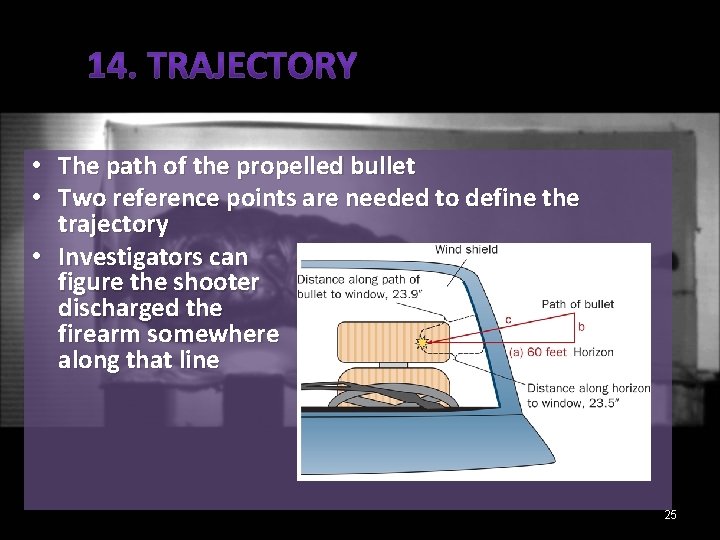
• The path of the propelled bullet • Two reference points are needed to define the trajectory • Investigators can figure the shooter discharged the firearm somewhere along that line 25
• Reference points can be – bullet holes in objects or victims – An entry point and exit point on a victim – Gunshot residue or spent cartridge casings • Lasers can trace a straight-line path to determine the position of the shooter • Why might trajectory be difficult to determine? 26
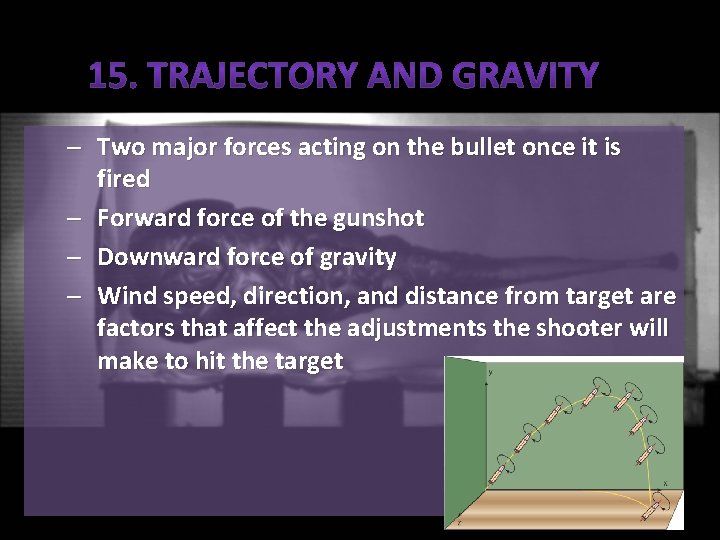
– Two major forces acting on the bullet once it is – – – fired Forward force of the gunshot Downward force of gravity Wind speed, direction, and distance from target are factors that affect the adjustments the shooter will make to hit the target 27
• Use the Law of Tangents – TOA – Tangent (ᶿ) = opposite / adjacent • IF the angle is pointing upwards – Shooter was firing downwards and is positioned above the bullet hole – Add the height of the bullet to final answer • If the angel is pointing down – Shooter was firing upwards and is positioned below the bullet hole – Subtract the answer of your equation from the height of the bullet hole 28
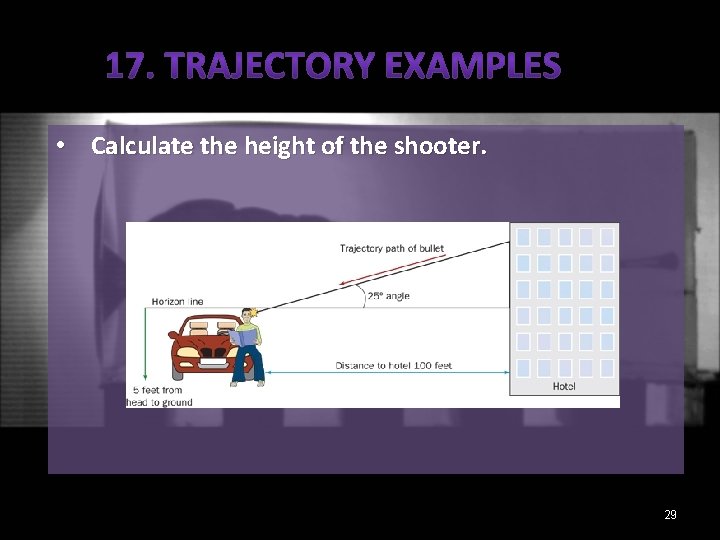
• Calculate the height of the shooter. 29
• A shooter in a building fired upwards to into a neighboring office building. If the building he was in was 100 ft from the neighboring building, the angle of the bullet hole was 50 degrees, and the height of the bullet was 100 ft from the ground. How high was the shooter? 30
- Slides: 30