
BALLAST IRS GE 1 JUNE 2004 1 1232020
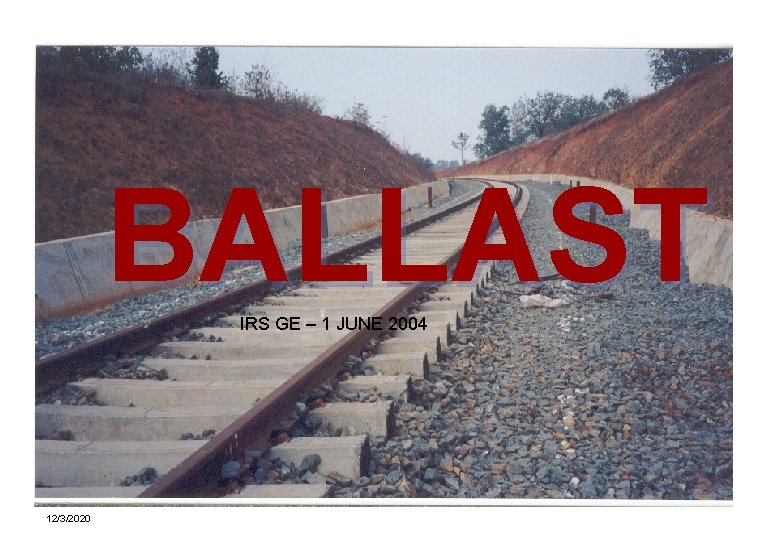
BALLAST IRS GE – 1 JUNE 2004 1 12/3/2020
l S. K. GARG Sr. Prof. (WORKS) l IRSE 1987 EXAM BATCH l Worked in Central Railways 1989 to 2008 l Asst. Engineer at Wardha in Nagpur Division l Divisional Engr(N) in Solapur Division l Senior Divional Engineer(Co) in Mumbai Div l Dy Chief Engr in MTP and at Panvel in Mumbai area l In Head quarters of Central Railways at CSTM 2
Important Functions of Ballast l Resist vertical, lateral and longitudinal forces l Provide resilience and absorb energy l Reduce formation pressure l Facilitate track geometry correction l Facilitate track drainage l Provide voids 5
Additional Functions of Ballast l Inhibit vegetation growth l Absorb airborne noise l Provide adequate electrical resistance 6
Requirements of Track Ballast l Tough and wear resistant l Hard without getting crushed under moving loads l Generally cubical having sharp edge l Non-porous and non-absorbent of water 8
Requirements of Track Ballast l Resist Attrition l Durable and should not get pulverized under weather condition l Good drainage of water l Economical in cost 9
Track Ballast 1. 2. 3. 4. Ballast may be subdivided into following zones: Crib Shoulder Top Ballast Bottom Ballast 10
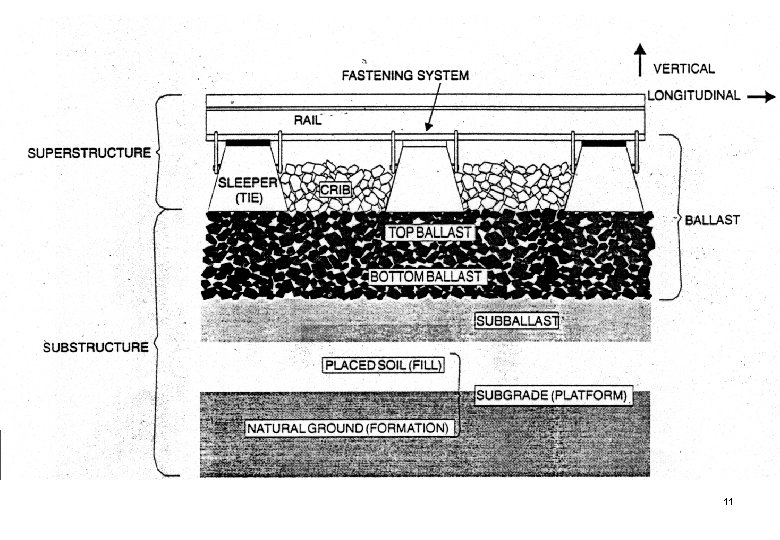
11
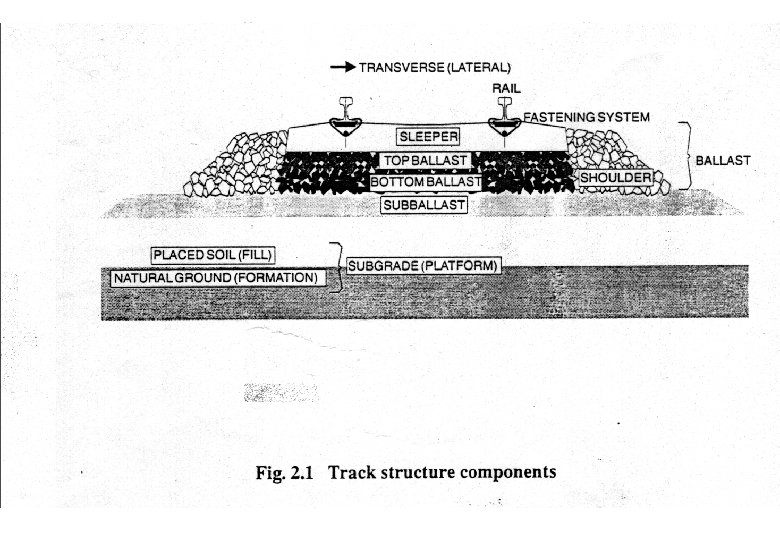
12
Flakiness Index l The flakiness index of an aggregate is the percentage by weight of particles in it whose least dimension (thickness) is less than three-fifths(60%) of their mean dimension 13
Elongation Index l The elongation index of an aggregate is the percentage by weight of particles in it whose greatest dimension (length) is greater than one and four-fifth times (1. 8 times) their mean dimension 14
Ballast Fouling Potential sources are l Ballast breakdown 1. 2. 3. 4. Handling Tamping/packing Traffic Weathering 15 CONTD. .
Ballast Fouling l Fines from subgrade 1. Mud pumping 2. Seepage l Fines from surface 1. Droppings from trains 2. Wind or water transported 16
Effects of Fouling l Impedes drainage l Affects elasticity of ballast l Tamping/ packing becomes difficult l Increases dynamic loads l Reduces electrical resistance 17
Remedial measures - fouling l Shoulder screening : Preventive maintenance – Once in 3 yrs. l Deep Screening : Breakdown maintenance – Once in 10 yrs. l Deep Screening of track shall be done after 500 GMT or 10 years, whichever is earlier, or if clean cushion is less than 150 mm. (ACS 132) 18
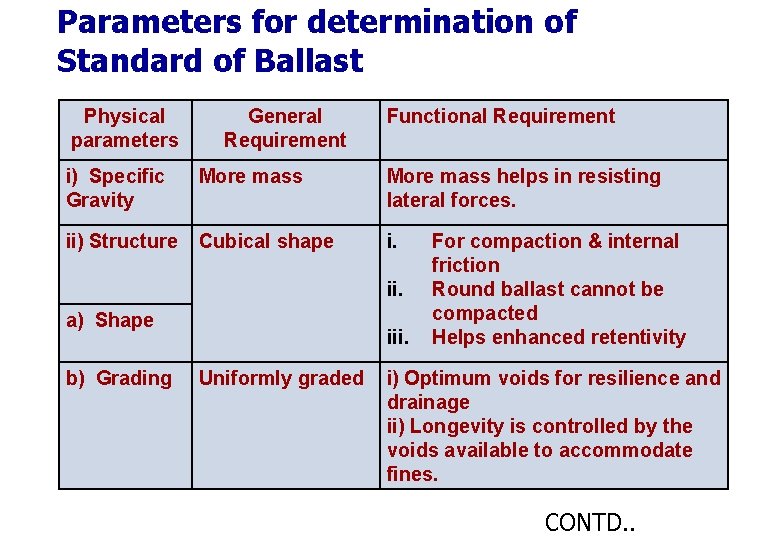
Parameters for determination of Standard of Ballast Physical parameters General Requirement Functional Requirement i) Specific Gravity More mass helps in resisting lateral forces. ii) Structure Cubical shape i. ii. a) Shape b) Grading iii. Uniformly graded For compaction & internal friction Round ballast cannot be compacted Helps enhanced retentivity i) Optimum voids for resilience and drainage ii) Longevity is controlled by the voids available to accommodate fines. CONTD. .
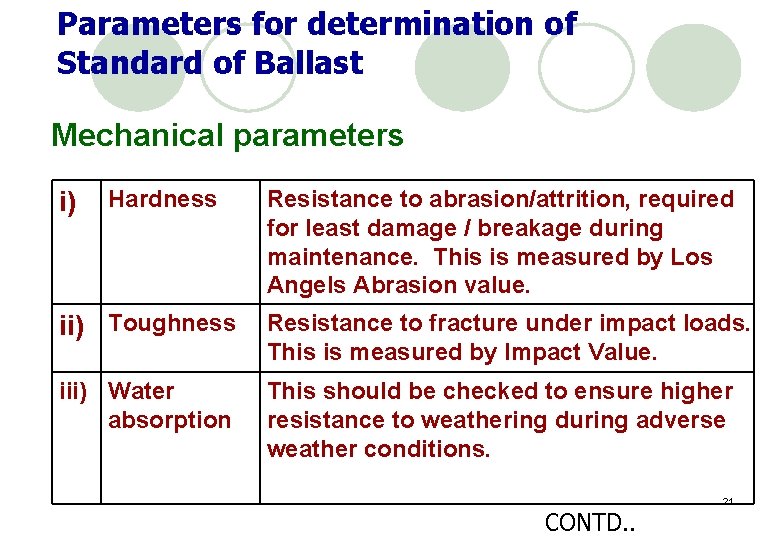
Parameters for determination of Standard of Ballast Mechanical parameters i) Hardness Resistance to abrasion/attrition, required for least damage / breakage during maintenance. This is measured by Los Angels Abrasion value. ii) Toughness Resistance to fracture under impact loads. This is measured by Impact Value. iii) Water absorption This should be checked to ensure higher resistance to weathering during adverse weather conditions. 21 CONTD. .
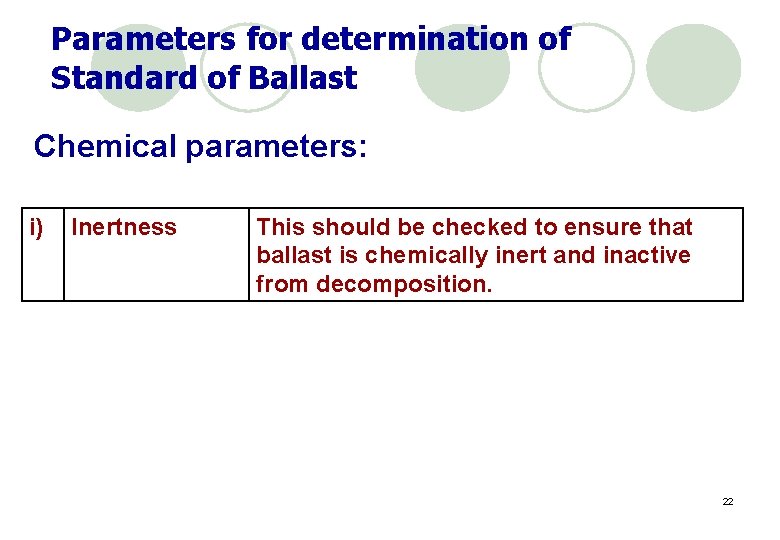
Parameters for determination of Standard of Ballast Chemical parameters: i) Inertness This should be checked to ensure that ballast is chemically inert and inactive from decomposition. 22
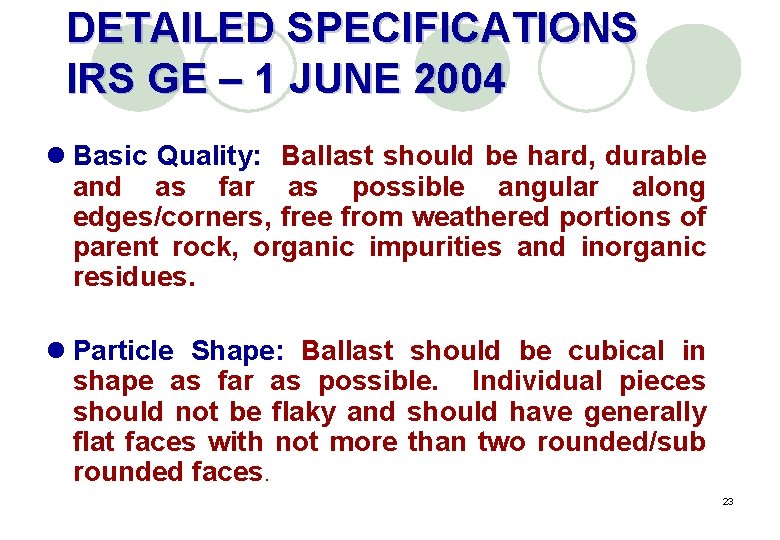
DETAILED SPECIFICATIONS IRS GE – 1 JUNE 2004 l Basic Quality: Ballast should be hard, durable and as far as possible angular along edges/corners, free from weathered portions of parent rock, organic impurities and inorganic residues. l Particle Shape: Ballast should be cubical in shape as far as possible. Individual pieces should not be flaky and should have generally flat faces with not more than two rounded/sub rounded faces. 23
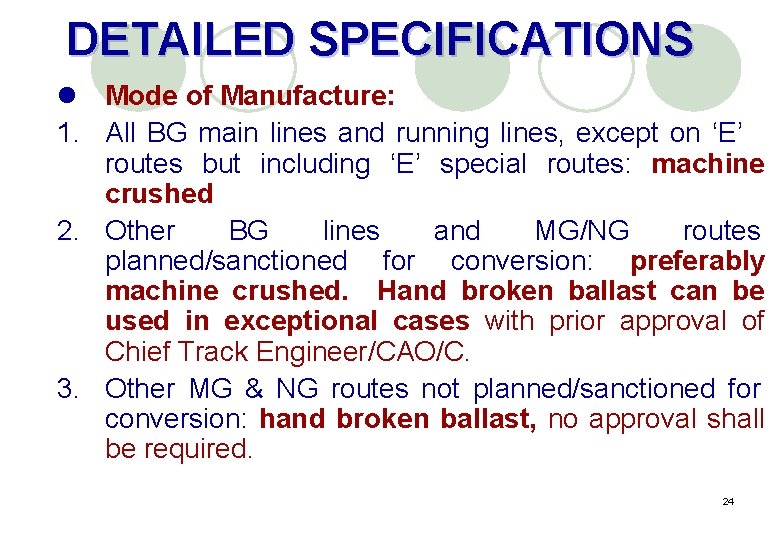
DETAILED SPECIFICATIONS l Mode of Manufacture: 1. All BG main lines and running lines, except on ‘E’ routes but including ‘E’ special routes: machine crushed 2. Other BG lines and MG/NG routes planned/sanctioned for conversion: preferably machine crushed. Hand broken ballast can be used in exceptional cases with prior approval of Chief Track Engineer/CAO/C. 3. Other MG & NG routes not planned/sanctioned for conversion: hand broken ballast, no approval shall be required. 24
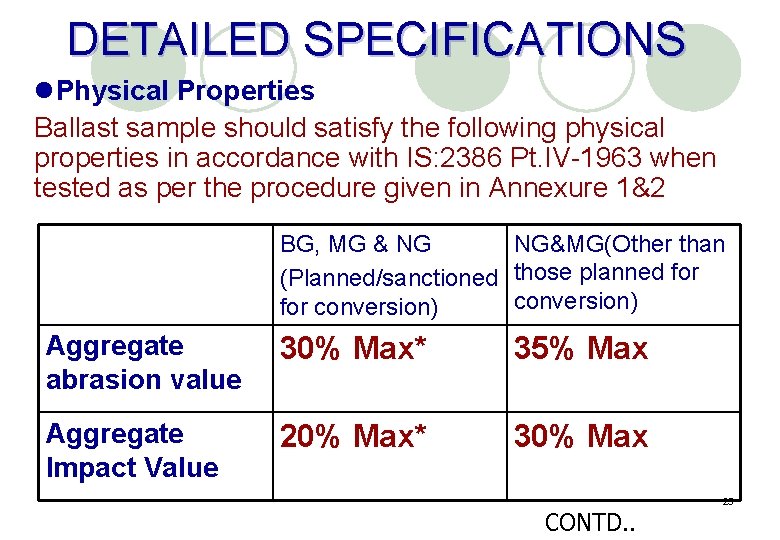
DETAILED SPECIFICATIONS l. Physical Properties Ballast sample should satisfy the following physical properties in accordance with IS: 2386 Pt. IV-1963 when tested as per the procedure given in Annexure 1&2 BG, MG & NG NG&MG(Other than (Planned/sanctioned those planned for conversion) Aggregate abrasion value 30% Max* 35% Max Aggregate Impact Value 20% Max* 30% Max 25 CONTD. .
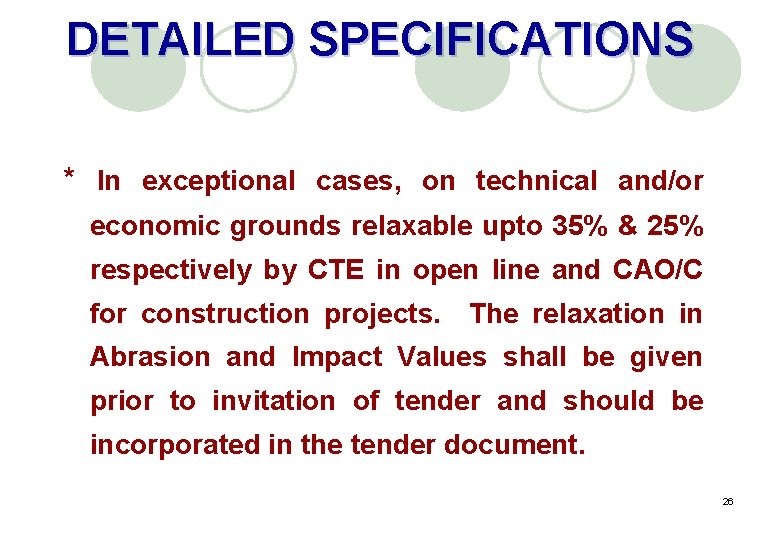
DETAILED SPECIFICATIONS * In exceptional cases, on technical and/or economic grounds relaxable upto 35% & 25% respectively by CTE in open line and CAO/C for construction projects. The relaxation in Abrasion and Impact Values shall be given prior to invitation of tender and should be incorporated in the tender document. 26
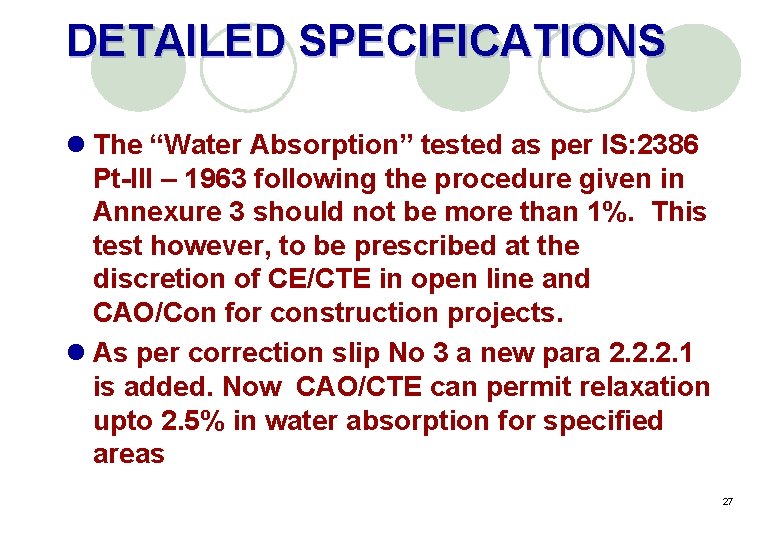
DETAILED SPECIFICATIONS l The “Water Absorption” tested as per IS: 2386 Pt-III – 1963 following the procedure given in Annexure 3 should not be more than 1%. This test however, to be prescribed at the discretion of CE/CTE in open line and CAO/Con for construction projects. l As per correction slip No 3 a new para 2. 2. 2. 1 is added. Now CAO/CTE can permit relaxation upto 2. 5% in water absorption for specified areas 27
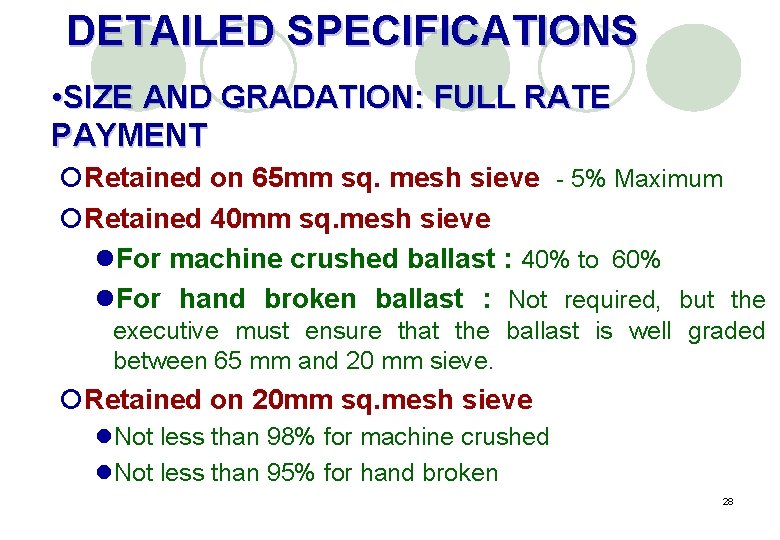
DETAILED SPECIFICATIONS • SIZE AND GRADATION: FULL RATE PAYMENT ¡Retained on 65 mm sq. mesh sieve - 5% Maximum ¡Retained 40 mm sq. mesh sieve l. For machine crushed ballast : 40% to 60% l. For hand broken ballast : Not required, but the executive must ensure that the ballast is well graded between 65 mm and 20 mm sieve. ¡Retained on 20 mm sq. mesh sieve l. Not less than 98% for machine crushed l. Not less than 95% for hand broken 28
DETAILED SPECIFICATIONS OVERSIZE BALLAST - Reduced Rate Payments i) Retention on 65 mm square mesh sieve ¡A Maximum of 5% ballast retained on 65 mm sieve shall be allowed without deduction in payment. ¡In case ballast retained on 65 mm sieve exceeds 5% but does not exceed 10%, payment at 5% reduction in contracted rate shall be made for the full stack. 29
DETAILED SPECIFICATIONS OVERSIZE BALLAST- Reduced Rate Payments • If ballast retained on 40 mm square mesh sieve (machine crushed case only) > 60%, payment at the reduced rates shall be made for the full stack in addition to the reduction worked out above. • 5% reduction in contracted rates if retention on 40 mm sq. mesh sieve is between 60% (excluding) and 65% (including) • 10% reduction in contracted rates if retention on 40 mm sq. mesh sieve is between 65% (excluding) and 70% (including). 30
DETAILED SPECIFICATIONS REJECTION OF BALLAST ON GRADATION ACCOUNT l OVERSIZE: ¡ When the ballast retained on 65 mm sieve > 10 %. ¡ When the ballast retained on 40 mm sieve > 70 %. l UNDERSIZE: ¡ When the ballast retained on 40 mm sieve < 40 %. ¡ Machine Crushed Ballast: When the ballast retained on 20 mm sieve < 98%. ¡ Hand Broken Ballast: When the ballast retained on 20 mm sieve < 95%. 31
DETAILED SPECIFICATIONS METHOD OF SIEVE ANALYSIS • Sieve sizes are nominal sizes. • The following tolerances shall be permitted: 65 mm square mesh sieve plus minus 1. 5 mm 40 mm Square Mesh Sieve Plus Minus 1. 5 mm 20 mm Square Mesh Sieve Plus Minus 1. 0 mm • Mesh size of the sieves should be checked before actual measurement. • The screen shall not be less than 100 cm in length, 70 cm in 32 breadth and 10 cm in height on sides.
DETAILED SPECIFICATIONS METHOD OF SIEVE ANALYSIS • While carrying out sieve analysis, the screen shall not be kept inclined, but held horizontally and shaken vigorously. • The pieces of ballast retained on the screen can be turned with hand to see if they pass through but should not be pushed through the sieve. • The percentage passing through or retained on the sieve shall be determined by weight. 33
DETAILED SPECIFICATIONS CONDITIONS FOR SUBMISSION OF TENDER l Each tenderer at the time of tendering shall submit the test report of Impact Value, “Abrasion Value, Water Absorption Value from approved laboratories and the list of these Laboratories shall be mentioned in the tender documents. l The tenderer shall also furnish an undertaking as incorporated in the tender document that the ballast supply at all times will conform to Specifications for Track Ballast as specified by Railway. 34
DETAILED SPECIFICATIONS STACK MEASUREMENT l Stacking on a neat, plain, firm and well drained ground l The height of stack shall not be less than 1 m (hilly areas 0. 5 m ) but not more than 2. 0 m. l Top width shall not be less than 1 m. l Top of stack shall be kept parallel to the ground plane. l The side slopes should not be flatter than 1. 5: 1 (H : V). l Cubical content of each stack shall normally be not less 35 than 30 cum in plain areas and 15 cum in hilly areas.
DETAILED SPECIFICATIONS WAGON MEASUREMENT l A continuous white line should be painted inside the wagon l The cubical content in cubic meter corresponding to white line should also be painted on both sides outside the wagon. l In addition, short pieces of flats with cubical contents punched shall be welded at the centre of all the four sides as permanent reference. l In case the supply is taken in general service wagons, actual measurements will be taken. 36

DETAILED SPECIFICATIONS SHRINKAGE ALLOWANCE l Payment shall be made for the gross measurements either in stacks or in wagons without any deduction for shrinkage/voids. l When ballast supply is taken in wagons, shrinkage upto 8% shall be permitted at destination while verifying the booked quantities by the consignee. 37
DETAILED SPECIFICATIONS SAMPLING AND TESTING l A minimum of 3 samples of ballast for sieve analysis shall be taken for measurement done on any particular date even if the numbers of stacks to be measured are less than three. l The test viz. , determination of Abrasion Value, Impact Value and Water Absorption should be got done through approved laboratories or Railway’s own laboratories (List of these laboratories shall be mentioned in the tender document). 38
DETAILED SPECIFICATIONS SAMPLING AND TESTING l Norms to be followed in respect of sampling, testing and acceptance: ¡ On supply of the first 100 cum, the tests for size gradation, Abrasion value, Impact value and water absorption (if prescribed) shall be carried out by Railways. ¡ Further supply shall be accepted only after this ballast satisfies the specifications for these tests. ¡ Railway reserves the right to terminate the contract as per GCC at this stage itself in case the ballast supply fails to conform with any of these specifications. 39 CONTD. .
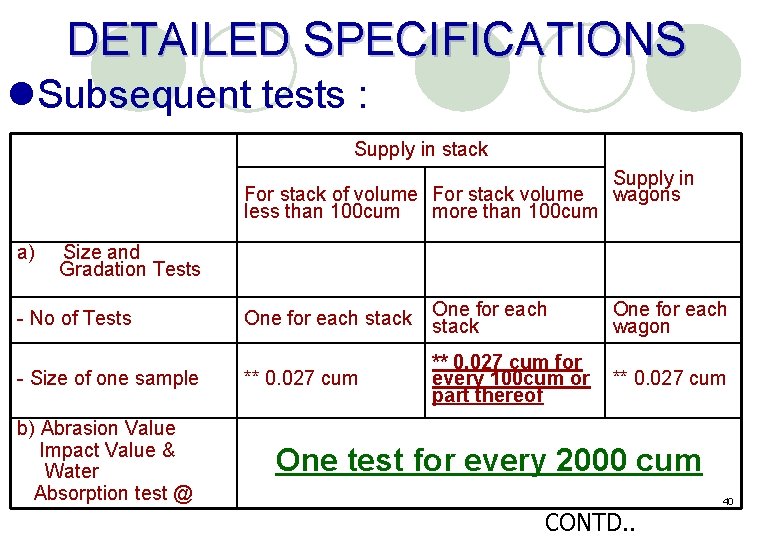
DETAILED SPECIFICATIONS l. Subsequent tests : Supply in stack For stack of volume For stack volume less than 100 cum more than 100 cum a) Supply in wagons Size and Gradation Tests - No of Tests - Size of one sample b) Abrasion Value Impact Value & Water Absorption test @ One for each stack One for each wagon ** 0. 027 cum for every 100 cum or part thereof ** 0. 027 cum One test for every 2000 cum 40 CONTD. .
DETAILED SPECIFICATIONS ** Sample should be collected using a wooden box 0. 3 mx 0. 3 m from different parts of the stack/wagon. @ These tests shall be done for the purpose of monitoring quality during supply – further supply can be suspended in case of non-conformation. • The above tests may be carried out more frequently, if warranted at the discretion of Railway l All tests for abrasion value Impact value and water absorption conducted subsequently to award of contract shall be done at Railways’ cost. 41
IRPWM PROVISIONS REGARDING BALLAST l PARAS 261 TO 271 IN IRPWM l PARA 263: PROFILE OF BALLAST l PARA 270 OF IRPWM: SURPLUS BALLAST IN TRACK SHALL BE COLLECTED AND STACKED IN REGULAR HEAPS. l PARA 264 -267 MODIFIED VIDE RAILWAY BOARD’S LETTER No. 2006/CE – II/MB/2 Dt. 42

43
- Slides: 39