
Ballads Popular Poetry What Is a Ballad A
Ballads Popular Poetry
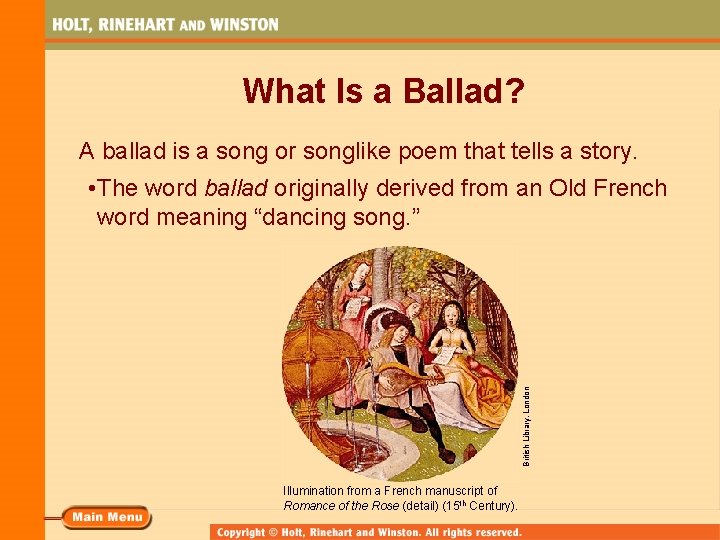
What Is a Ballad? A ballad is a song or songlike poem that tells a story. British Library, London • The word ballad originally derived from an Old French word meaning “dancing song. ” Illumination from a French manuscript of Romance of the Rose (detail) (15 th Century).
More About Ballads are: • Narrative Poems • Anonymous • Meant to be sung There are two types of ballads: • Folk ballads • Literary ballads
Folk Ballads Folk ballads were originally composed by anonymous singers and were passed down orally from generation to generation before they were written down. • The English folk ballads we read today • first surfaced in the 12 th c. England • probably took their present form in the fifteenth century • originated in and around the British Isles • were collected and printed in the 1700 s by Sir Thomas Percy’s Reliques of Ancient English Poetry • Written to commemorate important community events
Literary Ballads Literary ballads are composed and written down by known poets, usually in the style of folk ballads. • The Rime of the Ancient Mariner (1798) by Samuel Taylor Coleridge • “We Are Seven” (1798) by William Wordsworth • “La Belle Dame sans Merci” (1819) by John Keats • “Is My Team Ploughing” (1896) by A. E. Housman
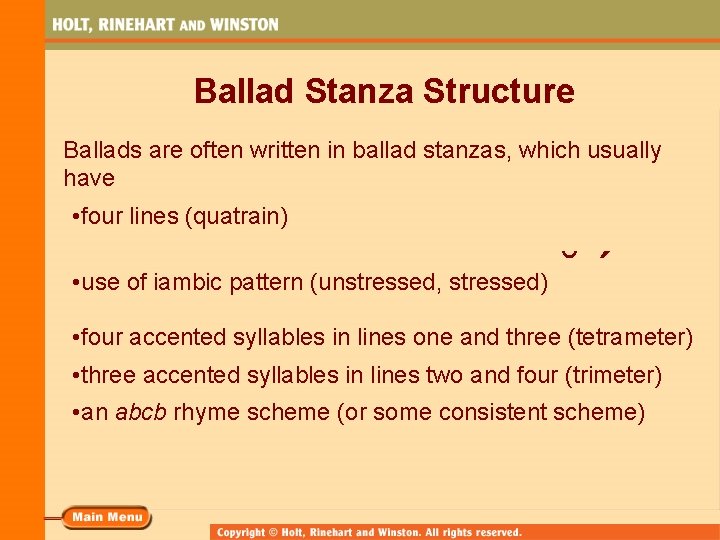
Ballad Stanza Structure Ballads are often written in ballad stanzas, which usually have • four lines (quatrain) • use of iambic pattern (unstressed, stressed) ˘´ • four accented syllables in lines one and three (tetrameter) • three accented syllables in lines two and four (trimeter) • an abcb rhyme scheme (or some consistent scheme)
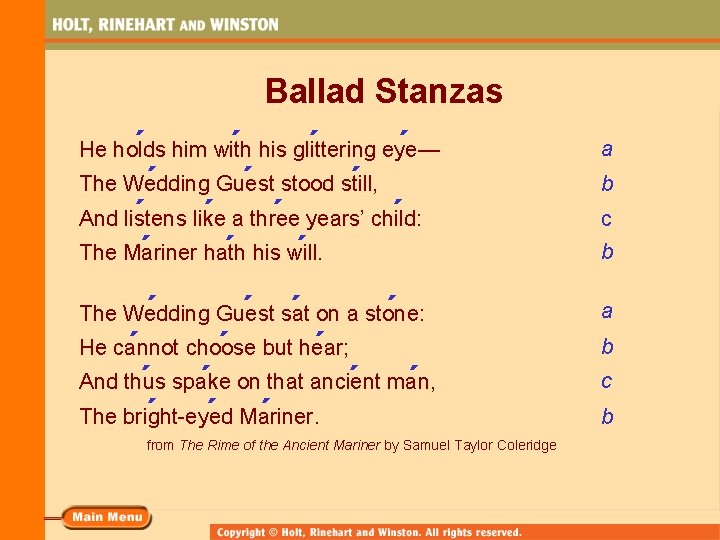
Ballad Stanzas ´ ´ He holds him with his glittering eye— a The Wedding Guest stood still, b ´ ´ ´ The Mariner ´ hath ´ his will. ´ ´ ´ And listens like a three years’ child: ´ ´ c b The Wedding Guest sat on a stone: a He cannot choose but hear; b ´ ´ ´ The bright-eyed ´ ´ Mariner. ´ ´ And thus spake on that ancient man, from The Rime of the Ancient Mariner by Samuel Taylor Coleridge c b
Basic Characteristics • The story is more important than the characters • Background material/info is only briefly mentioned • Action is swift • Tragic tone • Often ends in death, suicide, and return of the dead
More Characteristics of Ballads often • deal with supernatural events • tell sensational, sordid, or tragic stories • have a strong, simple beat (iambic tetrameter & trimeter) • use a great deal of repetition • repetition—a repeated word • refrain – a repeated line or lines • incremental repetition—a phrase or sentence with a new element added each time it is repeated
Characteristics of Ballads • use a question-and-answer format • contain conventional phrases that have meanings beyond their literal ones • The phrases “make my bed” or “make my bed narrow” mean that the characters are preparing for death.
The End
- Slides: 11