
Ball State University WheelerThanhauser Orchid Collection Species Bank
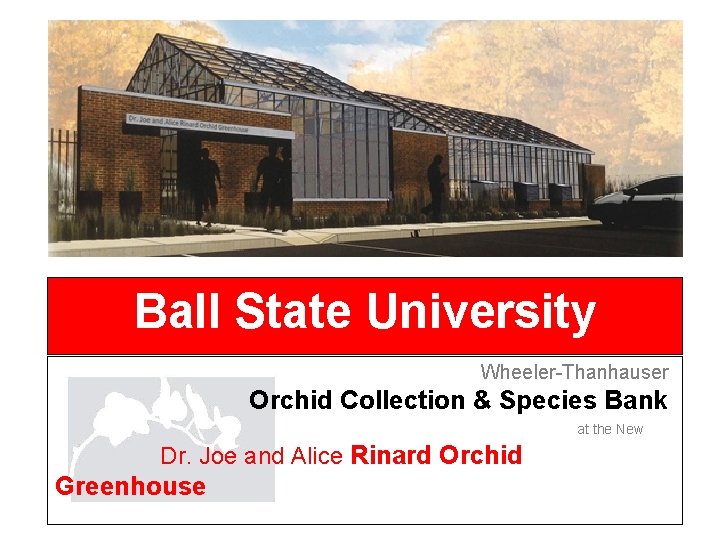
Ball State University Wheeler-Thanhauser Orchid Collection & Species Bank at the New Dr. Joe and Alice Rinard Orchid Greenhouse
Rinard Orchid Greenhouse Docent Training 2017 Objectives �Welcome new volunteers �Provide introduction to materials �Provide online resources �Partner new volunteers with existing ones for mentoring �Discuss how to sign-up �Handouts �Next steps ROGH Docent Program 2017
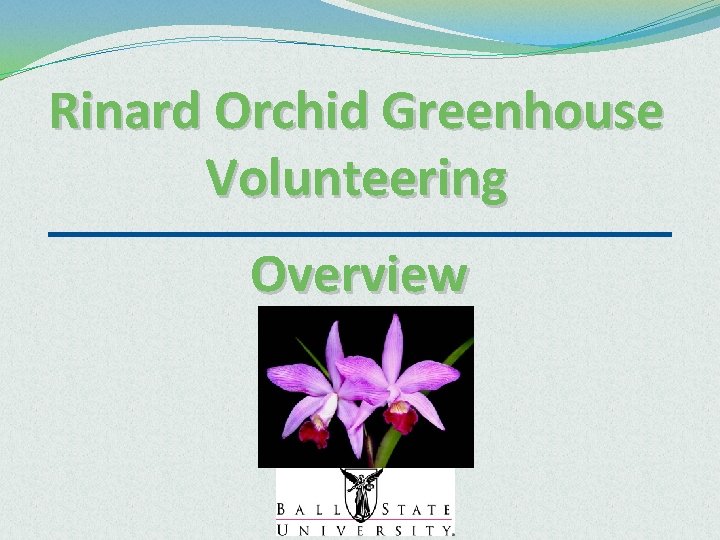
Rinard Orchid Greenhouse Volunteering Overview
History of Collection General • Home of Wheeler-Thanhauser Orchid Collection & Species Bank • Education, conservation and research • Original gift marked BSU as only 1 of 2 collegiate orchid collections in USA in 1971. Uses • Nature Education, school tours, casual visitation, illustration, photography & research ROGH Docent Program 2017
Greenhouse History Facility • Over 2, 000 orchids, including species & hybrids • Largest collegiate orchid collection in USA • Original: 1, 400 sq ft, built in 1971 NEW: Dr. Joe and Alice Rinard Orchid Greenhouse, 3, 400 sq ft, built in 2014 • Includes non-orchid plants and animals for ‘tropical’ experience • lessons of biology, ecology & plant-insect interactions ROGH Docent Program 2017
Greenhouse Recreates Tropics �Many orchid species found in tropics �Tropical rainforests – home to wide number of plants and animals �Food from Tropics - banana, coffee, chocolate, vanilla, cinnamon, pepper, ginger, cardamom �Medicines from tropics - snake venom (blood pressure, heart failure), periwinkle (cancer) �Today, rainforests occupy only 2% of the entire Earth's surface, less than 6% of the Earth's land surface. ROGH Docent Program 2017
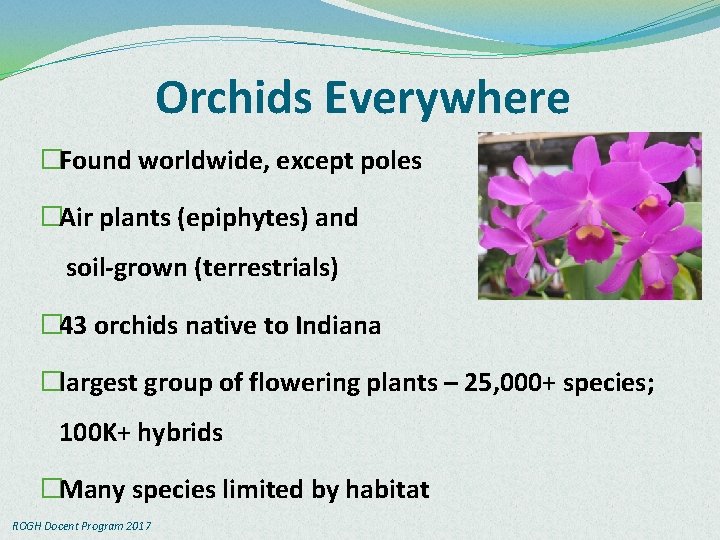
Orchids Everywhere �Found worldwide, except poles �Air plants (epiphytes) and soil-grown (terrestrials) � 43 orchids native to Indiana �largest group of flowering plants – 25, 000+ species; 100 K+ hybrids �Many species limited by habitat ROGH Docent Program 2017
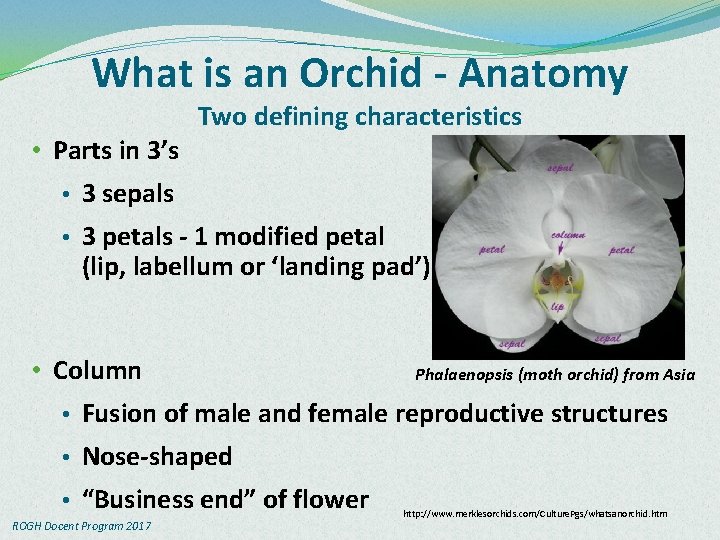
What is an Orchid - Anatomy Two defining characteristics • Parts in 3’s • 3 sepals • 3 petals - 1 modified petal (lip, labellum or ‘landing pad’) • Column Phalaenopsis (moth orchid) from Asia • Fusion of male and female reproductive structures • Nose-shaped • “Business end” of flower ROGH Docent Program 2017 http: //www. merklesorchids. com/Culture. Pgs/whatsanorchid. htm
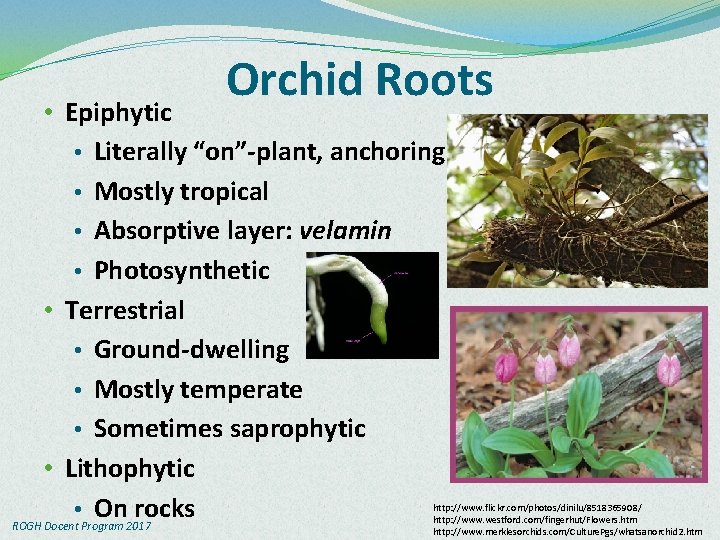
Orchid Roots • Epiphytic • Literally “on”-plant, anchoring • Mostly tropical • Absorptive layer: velamin • Photosynthetic • Terrestrial • Ground-dwelling • Mostly temperate • Sometimes saprophytic • Lithophytic • On rocks ROGH Docent Program 2017 http: //www. flickr. com/photos/dinilu/8518365908/ http: //www. westford. com/fingerhut/Flowers. htm http: //www. merklesorchids. com/Culture. Pgs/whatsanorchid 2. htm
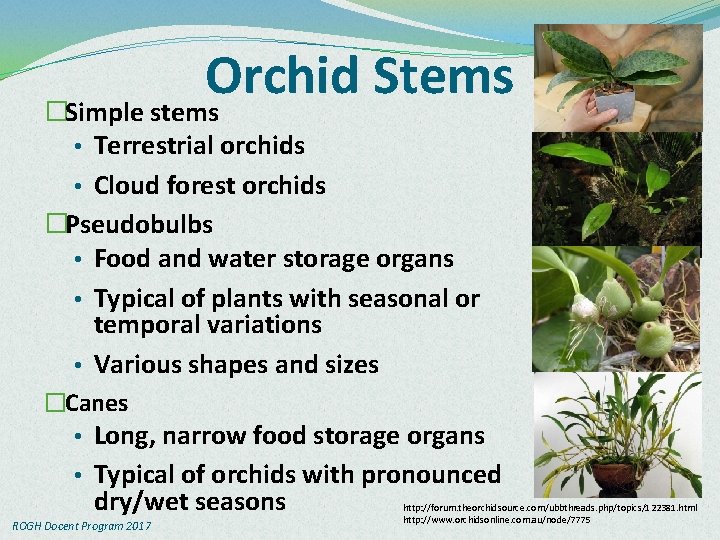
Orchid Stems �Simple stems • Terrestrial orchids • Cloud forest orchids �Pseudobulbs • Food and water storage organs • Typical of plants with seasonal or temporal variations • Various shapes and sizes �Canes • Long, narrow food storage organs • Typical of orchids with pronounced dry/wet seasons ROGH Docent Program 2017 http: //forum. theorchidsource. com/ubbthreads. php/topics/122381. html http: //www. orchidsonline. com. au/node/7775

Orchid Leaves �Parallel leaf venation �Structure of the leaves corresponds to the specific habitat �Leaf Types �Conduplicate - thick or leathery • Waxy cuticle to retain water • Defined midline • Drains water well �Soft-herbaceous - often terrestrial, w/ dormancy �Reticulate - network �Primitive plicate - pleated ROGH Docent Program 2017
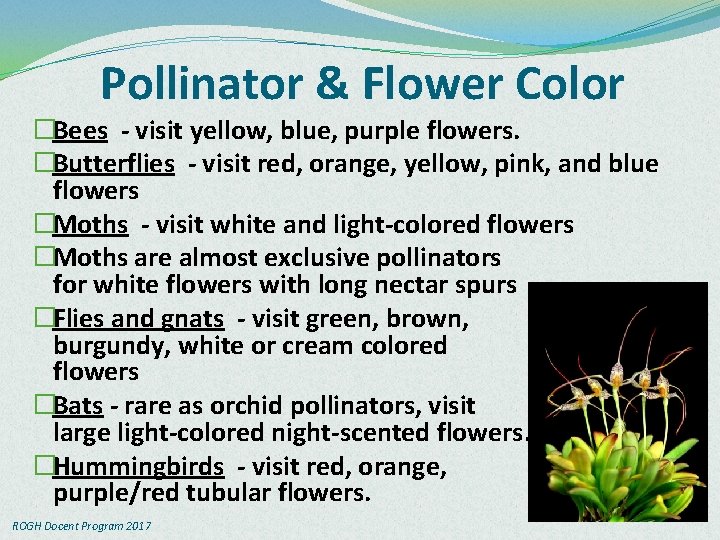
Pollinator & Flower Color �Bees - visit yellow, blue, purple flowers. �Butterflies - visit red, orange, yellow, pink, and blue flowers �Moths - visit white and light-colored flowers �Moths are almost exclusive pollinators for white flowers with long nectar spurs �Flies and gnats - visit green, brown, burgundy, white or cream colored flowers �Bats - rare as orchid pollinators, visit large light-colored night-scented flowers. �Hummingbirds - visit red, orange, purple/red tubular flowers. ROGH Docent Program 2017
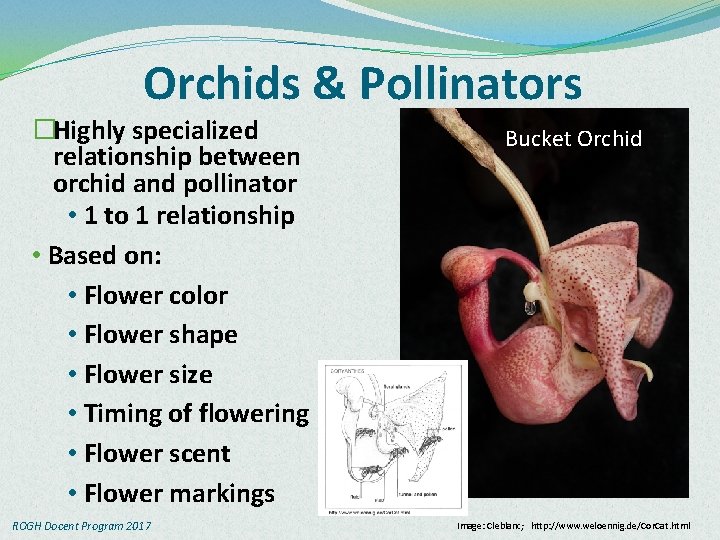
Orchids & Pollinators �Highly specialized relationship between orchid and pollinator • 1 to 1 relationship • Based on: • Flower color • Flower shape • Flower size • Timing of flowering • Flower scent • Flower markings ROGH Docent Program 2017 Bucket Orchid Image: Cleblanc; http: //www. weloennig. de/Cor. Cat. html
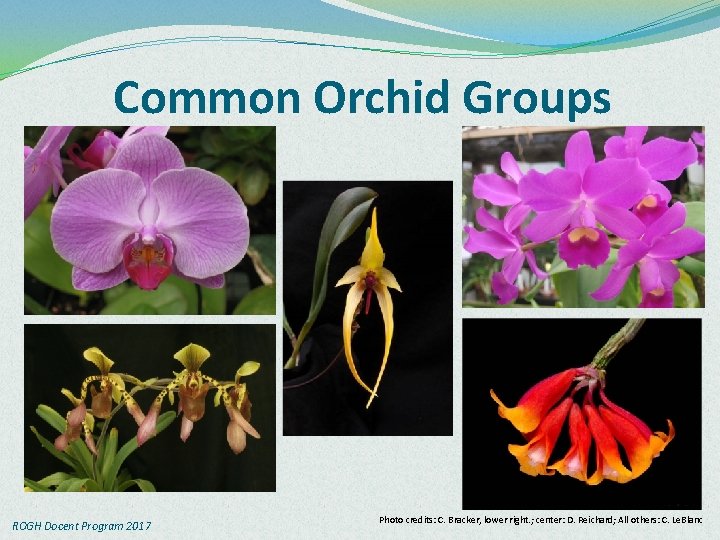
Common Orchid Groups ROGH Docent Program 2017 Photo credits: C. Bracker, lower right. ; center: D. Reichard; All others: C. Le. Blanc
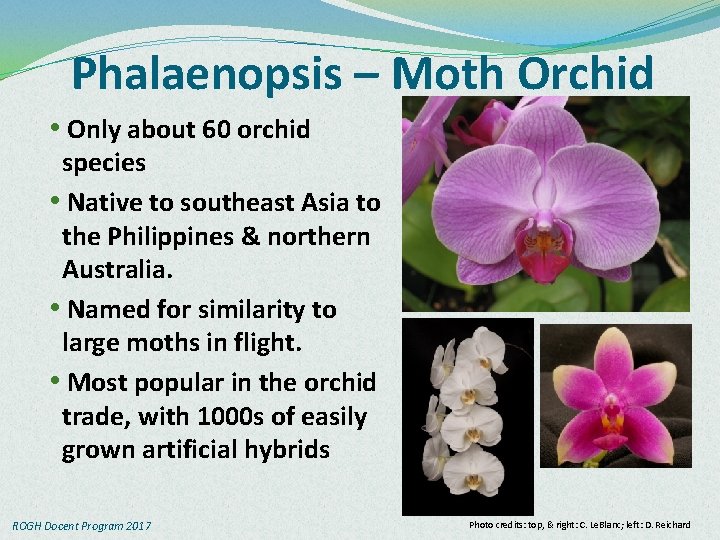
Phalaenopsis – Moth Orchid • Only about 60 orchid species • Native to southeast Asia to the Philippines & northern Australia. • Named for similarity to large moths in flight. • Most popular in the orchid trade, with 1000 s of easily grown artificial hybrids ROGH Docent Program 2017 Photo credits: top, & right: C. Le. Blanc; left: D. Reichard
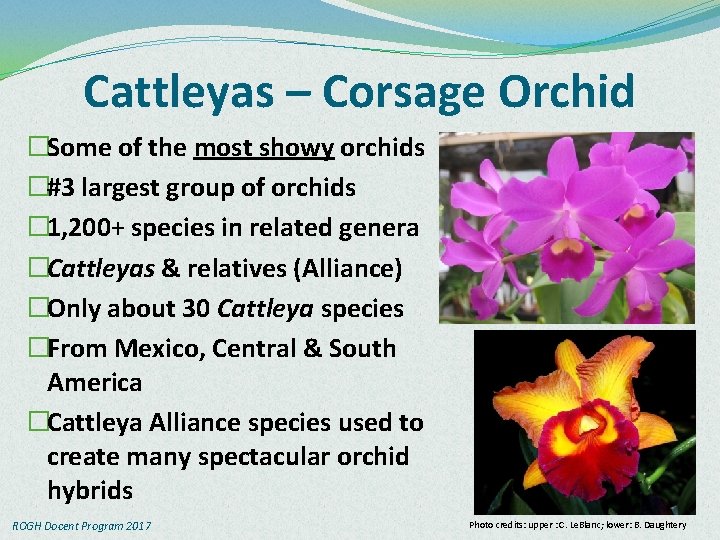
Cattleyas – Corsage Orchid �Some of the most showy orchids �#3 largest group of orchids � 1, 200+ species in related genera �Cattleyas & relatives (Alliance) �Only about 30 Cattleya species �From Mexico, Central & South America �Cattleya Alliance species used to create many spectacular orchid hybrids ROGH Docent Program 2017 Photo credits: upper : C. Le. Blanc; lower: B. Daughtery
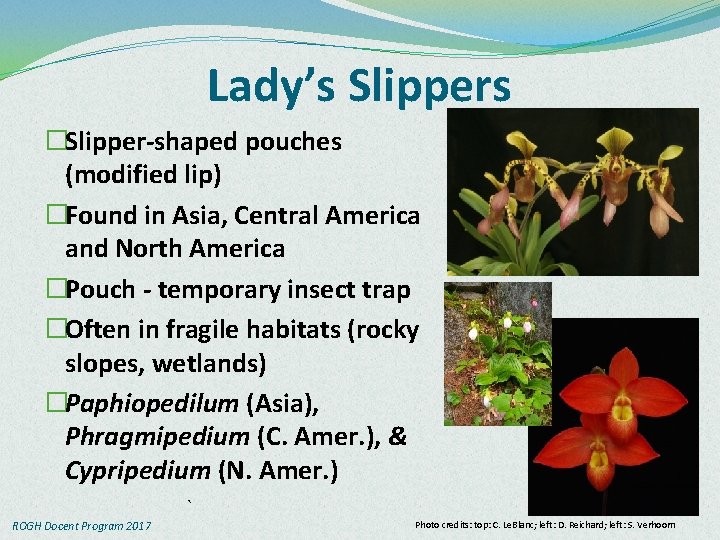
Lady’s Slippers �Slipper-shaped pouches (modified lip) �Found in Asia, Central America and North America �Pouch - temporary insect trap �Often in fragile habitats (rocky slopes, wetlands) �Paphiopedilum (Asia), Phragmipedium (C. Amer. ), & Cypripedium (N. Amer. ) ` ROGH Docent Program 2017 Photo credits: top: C. Le. Blanc; left: D. Reichard; left: S. Verhoorn
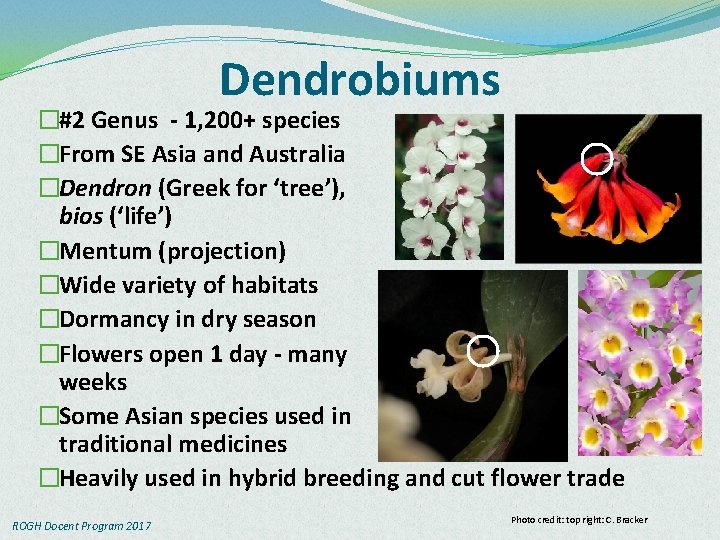
Dendrobiums �#2 Genus - 1, 200+ species �From SE Asia and Australia �Dendron (Greek for ‘tree’), bios (‘life’) �Mentum (projection) �Wide variety of habitats �Dormancy in dry season �Flowers open 1 day - many weeks �Some Asian species used in traditional medicines �Heavily used in hybrid breeding and cut flower trade ROGH Docent Program 2017 Photo credit: top right: C. Bracker
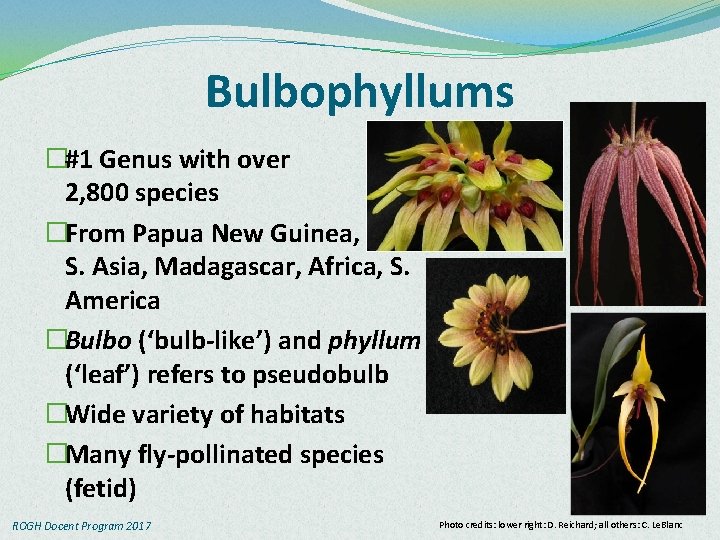
Bulbophyllums �#1 Genus with over 2, 800 species �From Papua New Guinea, S. Asia, Madagascar, Africa, S. America �Bulbo (‘bulb-like’) and phyllum (‘leaf’) refers to pseudobulb �Wide variety of habitats �Many fly-pollinated species (fetid) ROGH Docent Program 2017 Photo credits: lower right: D. Reichard; all others: C. Le. Blanc

Questions? ROGH Docent Program 2017
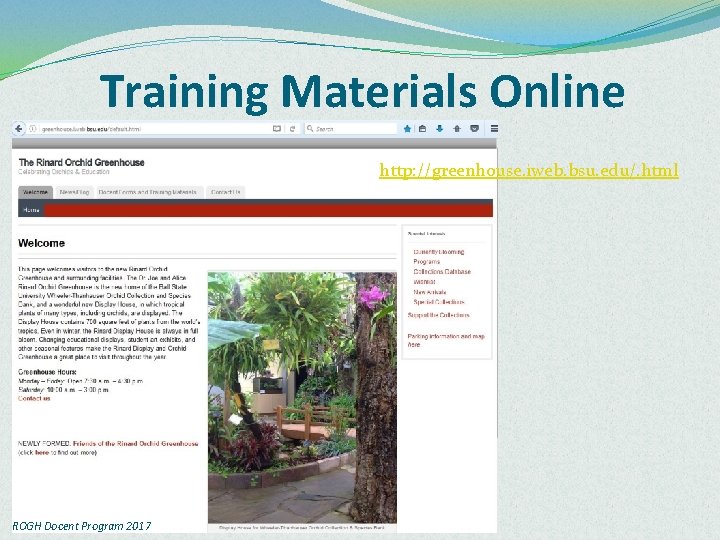
Training Materials Online http: //greenhouse. iweb. bsu. edu/. html ROGH Docent Program 2017

Sign-up Genius ROGH Docent Program 2017
Rinard Orchid Greenhouse Docent Training 2017 Objectives �Welcome new volunteers �Provide introduction to materials �Provide online resources �Partner new volunteers with existing ones for mentoring �Discuss how to sign-up �Handouts �Next steps ROGH Docent Program 2017
- Slides: 23