
Ball Mill Contents Principle Construction Working Applications Advantages
Ball Mill Contents � Principle � Construction � Working � Applications � Advantages � Equations governing the operating speed
Construction � � � � Ball mill consist of a hollow cylindrical shell rotating about its axis. Axis of the shell horizontal or at small angle to the horizontal It is partially filled with balls made up of Steel, Stainless steel or rubber Inner surface of the shell is lined with abrasion resistant materials such as Manganese, Steel or rubber Length of the mill is approximately equal to its diameter Balls occupy about 30 -50% of the volume. dia of the ball 12 mm-125 mm Shell is rotated through a drive gear (60 -100 rpm) and large mills, shell might be in 3 m in dia and 4. 25 m in length. Operation may be batch or continuous, wet or dry…in a continuosly operated ball mill outlet is normally covered with coarse screen to prevent the escape of the balls. .

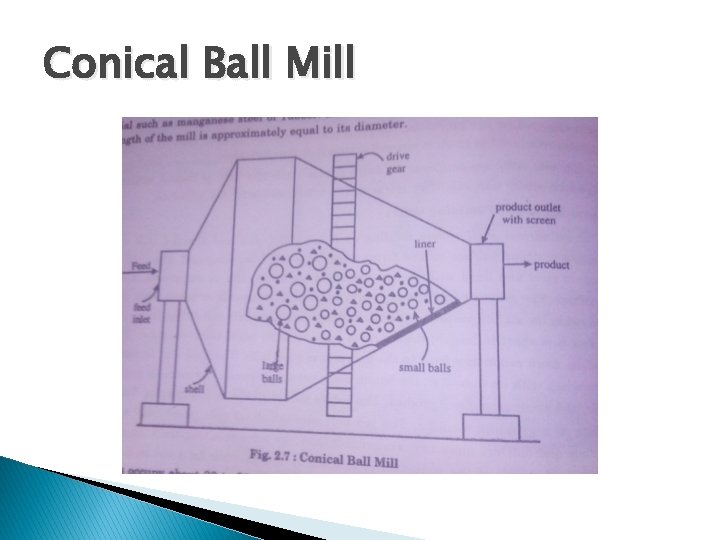
Conical Ball Mill
Working of a Conical Ball mill Material to be ground is fed from the left through a 60 cone and product is discharged through a 30 cone to the right. � As the shell rotates the balls are lifted up on the rising side of the shell and they cascade down from near the top of the shell � The solid particles in between balls are ground and reduced in size by impact. � As the shell rotates the large balls segregate near the feed end and small balls segregate near the product end � If the rate of feed is increased, coarser product will be obtained and if the speed of rotation is increased the fineness for a given capacity increases. �
� During grinding, balls themselves wear and are continuosly replaced by new ones so that mill contain balls of various ages and thus of various sizes � Ball mill produces 1 to 50 tonn/hr of powder of which 70 to 90 % will pass through a 200 mesh screen and energy requirment of the ball mill is about 16 kwh/tonn � In case of a batch operated mill a measured quantity of a solid to be ground is charged to the mill through the opening in the shell. The opening is closed and the mill is rotated for several hours. It is then stopped and the product is discharged
Applications � The ball mill is used for grinding materials such as coal, pigments, and fedspar for pottery. Grinding can be carried out in either wet or dry but the former is carried out at low speeds. The advantages of wet grinding are less power consumption, increased capacity, no dust formation etc… Dis advantages are high wear on the grinding medium and neccesity to dry the product
Advantages of Ball Mill � The cost of installation is low � The cost of Production is low � It is suitable for materials of all degree of hardness � The grinding Meduim is cheap � Used for the grinding of explosive materials � Suitable for both batch &continuous operations
Factors influencing the size of the product � � � Feed rate: With a high feed rate, less size reduction is effected since in this case the material is in the mill for a shorter time. Properties of the feed material: With a hard material, a smaller size reduction is achieved Level of the material in the mill: A low level of material in the mill results into a reduction in the power consumption. if the level of material is raised power is wasted by the production of under size material
• Weight of the balls: With a heavy discharge of balls, we get a fine product. We can increase the weight of the charge by increasing the number of balls or by using a ball material of high density • Speed & rotation of Ball mill: low speeds, the balls simply roll over one another and little grinding is obtained while at very high speeds the balls are carried along the walls of the shell and the mill is said to be centrifuging. The minimum speed at which centrifuging occurs is called critical speed. In practise operating speed must be less than the critical speed.
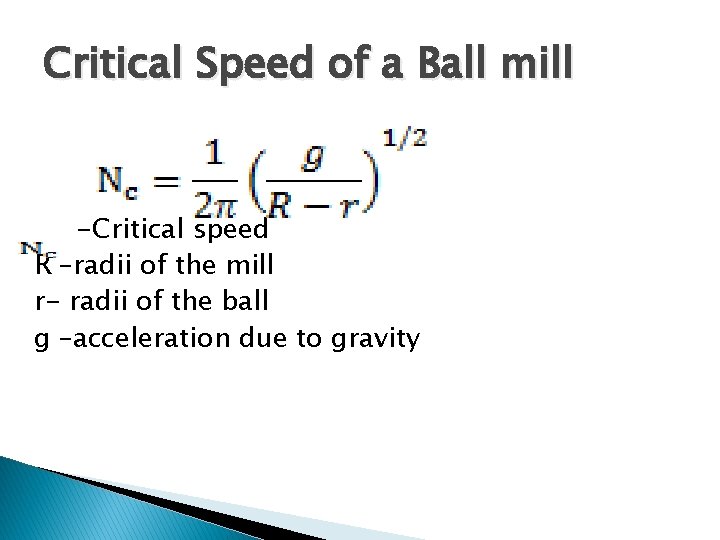
Critical Speed of a Ball mill -Critical speed R –radii of the mill r- radii of the ball g –acceleration due to gravity
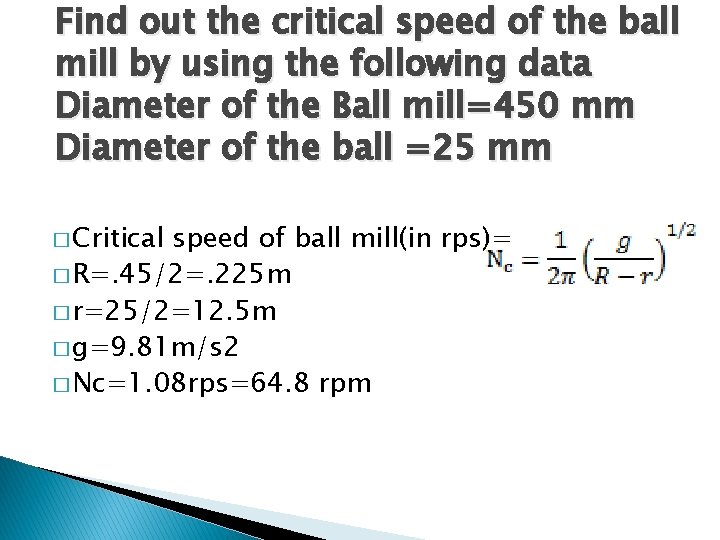
Find out the critical speed of the ball mill by using the following data Diameter of the Ball mill=450 mm Diameter of the ball =25 mm � Critical speed of ball mill(in rps)= � R=. 45/2=. 225 m � r=25/2=12. 5 m � g=9. 81 m/s 2 � Nc=1. 08 rps=64. 8 rpm
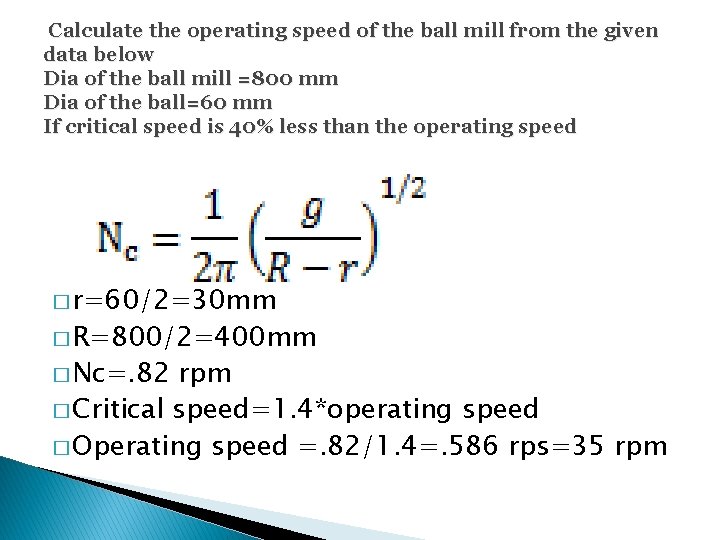
Calculate the operating speed of the ball mill from the given data below Dia of the ball mill =800 mm Dia of the ball=60 mm If critical speed is 40% less than the operating speed � r=60/2=30 mm � R=800/2=400 mm � Nc=. 82 rpm � Critical speed=1. 4*operating speed � Operating speed =. 82/1. 4=. 586 rps=35 rpm
- Slides: 13