
BALEAP Conference 2019 Symposium EAP in Transnational Higher

BALEAP Conference 2019 Symposium EAP in Transnational Higher Education in China David Foster & Jeanne O’Connell (University of Nottingham Ningbo China) david. foster@nottingham. edu. cn, jeanne. o’connell@nottingham. edu. cn Xiucai Lu (Xi’an Jiaotong Liverpool University) xiucai. lu@xjtlu. edu. cn Ricky Jeffrey (Zhejiang University – International Campus) rickyjeffrey@intl. zju. edu. cn Chair: Richard Silburn (Manchester Metropolitan University) r. silburn@mmu. ac. uk Online materials for this symposium: osf. io/3 jfsm
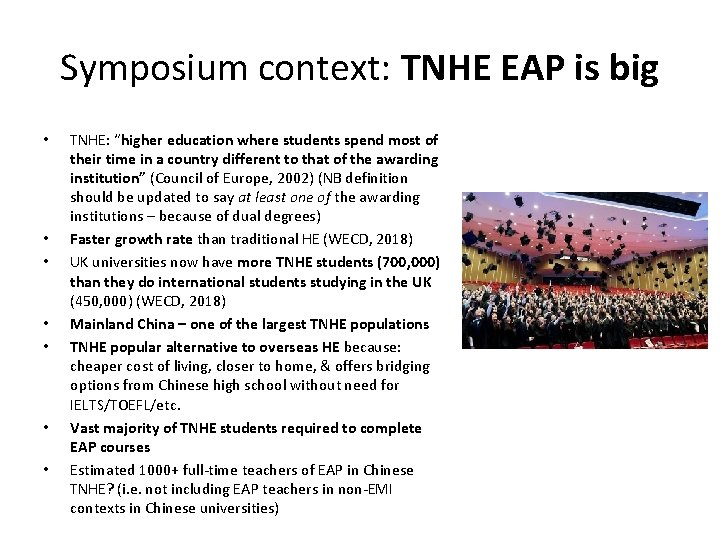
Symposium context: TNHE EAP is big • • TNHE: “higher education where students spend most of their time in a country different to that of the awarding institution” (Council of Europe, 2002) (NB definition should be updated to say at least one of the awarding institutions – because of dual degrees) Faster growth rate than traditional HE (WECD, 2018) UK universities now have more TNHE students (700, 000) than they do international students studying in the UK (450, 000) (WECD, 2018) Mainland China – one of the largest TNHE populations TNHE popular alternative to overseas HE because: cheaper cost of living, closer to home, & offers bridging options from Chinese high school without need for IELTS/TOEFL/etc. Vast majority of TNHE students required to complete EAP courses Estimated 1000+ full-time teachers of EAP in Chinese TNHE? (i. e. not including EAP teachers in non-EMI contexts in Chinese universities)
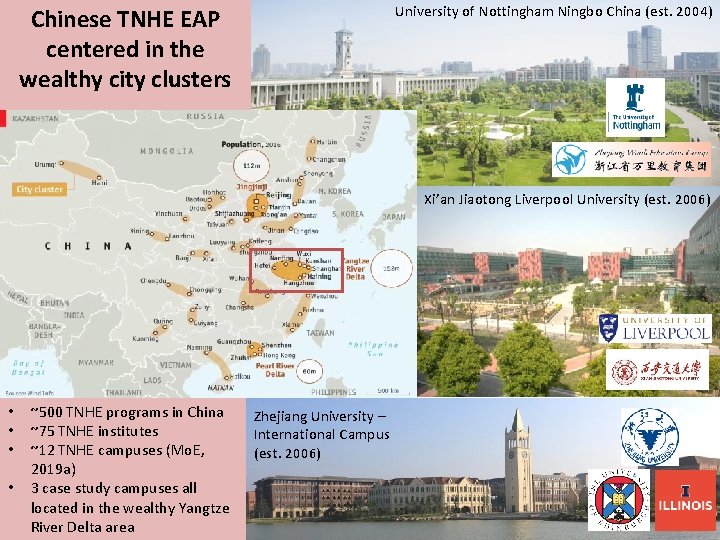
University of Nottingham Ningbo China (est. 2004) Chinese TNHE EAP centered in the wealthy city clusters Xi’an Jiaotong Liverpool University (est. 2006) • • ~500 TNHE programs in China ~75 TNHE institutes ~12 TNHE campuses (Mo. E, 2019 a) 3 case study campuses all located in the wealthy Yangtze River Delta area Zhejiang University – International Campus (est. 2006)
Symposium research question & approach Overarching research question • TNHE EAP has now existed in China on a significant scale for 15 years. How is TNHE EAP in China distinctive from EAP in other contexts? General methodological approach • Case studies of three TNHE campuses (employing ~250 full-time EAP teachers in total) – University of Nottingham Ningbo China (oldest) – Xi’an-Jiaotong Liverpool University (largest) – Zhejiang University International Campus (first of new model)O
Symposium themes • Large scale (of staff & students) • Joint partnership between several institutions • Adaptation to local context (bridging to local school education system, staff, culture, …. )
University of Nottingham Ningbo China (est. 2004) Case study 1: University of Nottingham Ningbo China (UNNC) David Foster & Jeanne O’Connell Centre for English Language Education www. nottingham. edu. cn/en/cele Xi’an Jiaotong Liverpool University (est. 2006) Zhejiang University – International Campus (est. 2016)
University of Nottingham Ningbo China (est. 2004) Case study 2: Xi’an Jiaotong Liverpool University (XJTLU) Xi’an Jiaotong Liverpool University (est. 2006) Xiucai Lu Language Centre www. xjtlu. edu. cn/ en/departments/c entres/languagecentre/about/mis sion-and-vision Zhejiang University – International Campus (est. 2016)
University of Nottingham Ningbo China (est. 2004) Case study 3: Zhejiang University International Campus (ZJU -IC) Ricky Jeffrey English Language Center www. intl. zju. e du. cn/en/lang uage-center Xi’an Jiaotong Liverpool University (est. 2006) Zhejiang University – International Campus (est. 2016)
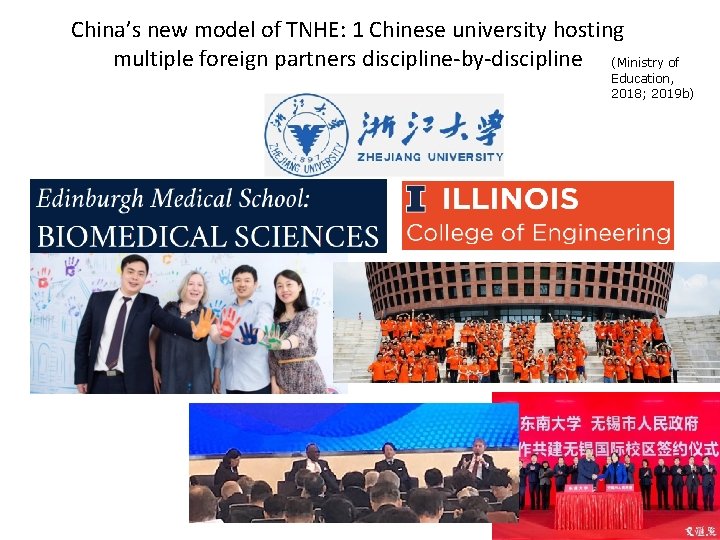
China’s new model of TNHE: 1 Chinese university hosting multiple foreign partners discipline-by-discipline (Ministry of Education, 2018; 2019 b)
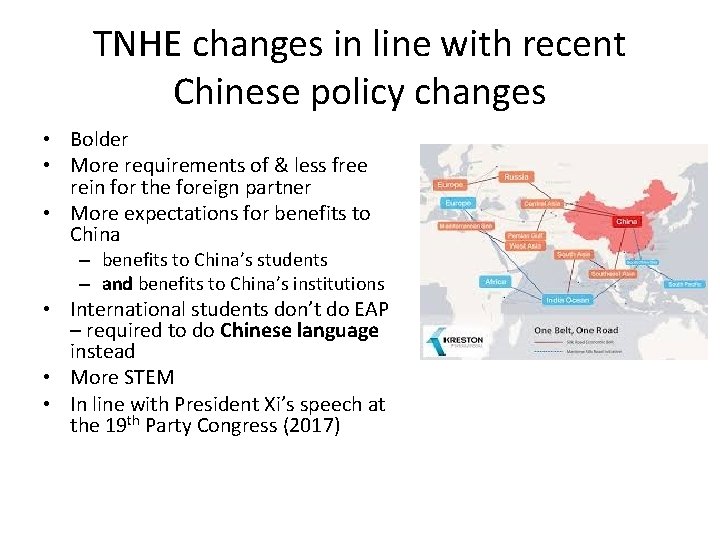
TNHE changes in line with recent Chinese policy changes • Bolder • More requirements of & less free rein for the foreign partner • More expectations for benefits to China – benefits to China’s students – and benefits to China’s institutions • International students don’t do EAP – required to do Chinese language instead • More STEM • In line with President Xi’s speech at the 19 th Party Congress (2017)
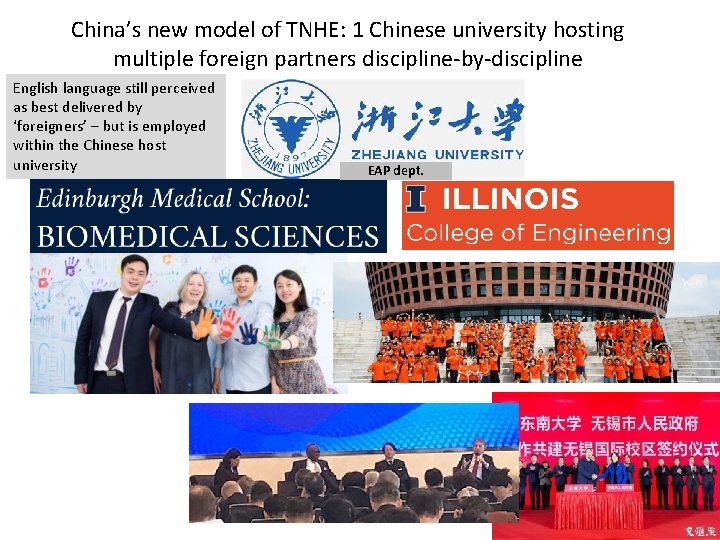
China’s new model of TNHE: 1 Chinese university hosting multiple foreign partners discipline-by-discipline English language still perceived as best delivered by ‘foreigners’ – but is employed within the Chinese host university EAP dept.
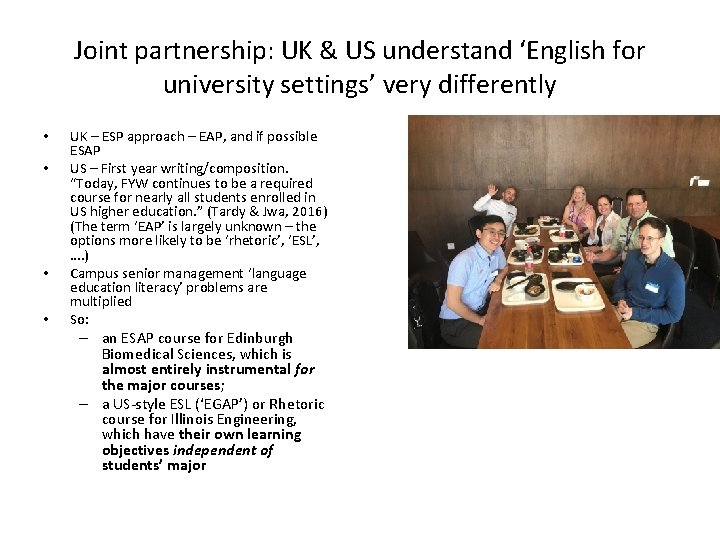
Joint partnership: UK & US understand ‘English for university settings’ very differently • • UK – ESP approach – EAP, and if possible ESAP US – First year writing/composition. “Today, FYW continues to be a required course for nearly all students enrolled in US higher education. ” (Tardy & Jwa, 2016) (The term ‘EAP’ is largely unknown – the options more likely to be ‘rhetoric’, ‘ESL’, …. ) Campus senior management ‘language education literacy’ problems are multiplied So: – an ESAP course for Edinburgh Biomedical Sciences, which is almost entirely instrumental for the major courses; – a US-style ESL (‘EGAP’) or Rhetoric course for Illinois Engineering, which have their own learning objectives independent of students’ major
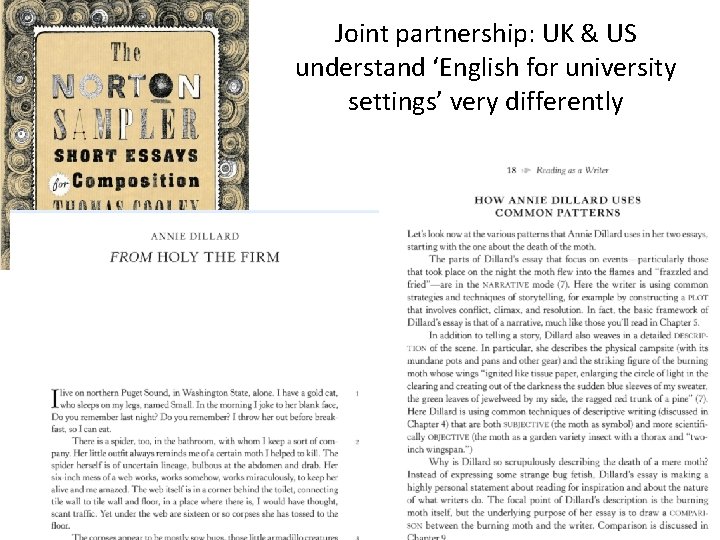
Joint partnership: UK & US understand ‘English for university settings’ very differently
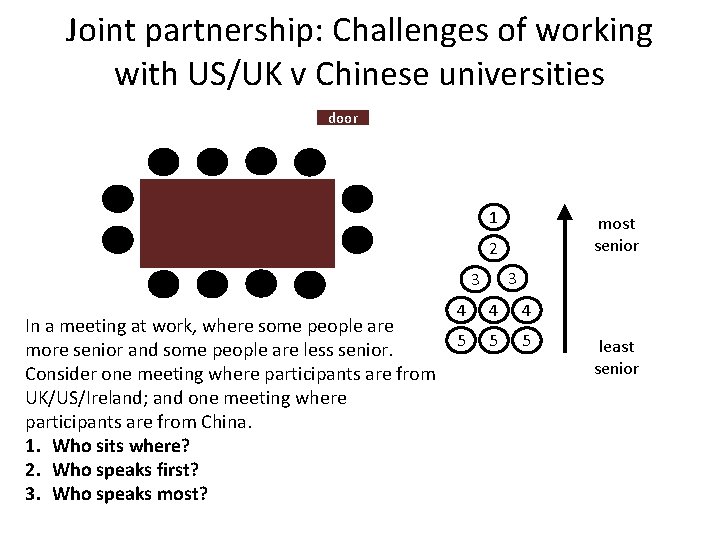
Joint partnership: Challenges of working with US/UK v Chinese universities door 1 most senior 2 3 3 In a meeting at work, where some people are more senior and some people are less senior. Consider one meeting where participants are from UK/US/Ireland; and one meeting where participants are from China. 1. Who sits where? 2. Who speaks first? 3. Who speaks most? 4 4 4 5 5 5 least senior
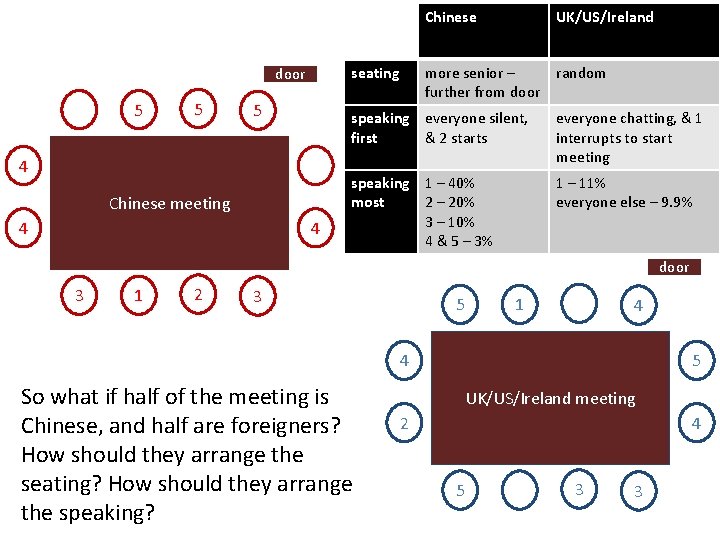
Chinese seating door 5 5 5 4 Chinese meeting 4 4 UK/US/Ireland more senior – random further from door speaking everyone silent, first & 2 starts everyone chatting, & 1 interrupts to start meeting speaking 1 – 40% most 2 – 20% 3 – 10% 4 & 5 – 3% 1 – 11% everyone else – 9. 9% door 3 1 2 3 5 1 4 4 So what if half of the meeting is Chinese, and half are foreigners? How should they arrange the seating? How should they arrange the speaking? 5 UK/US/Ireland meeting 2 4 5 3 3
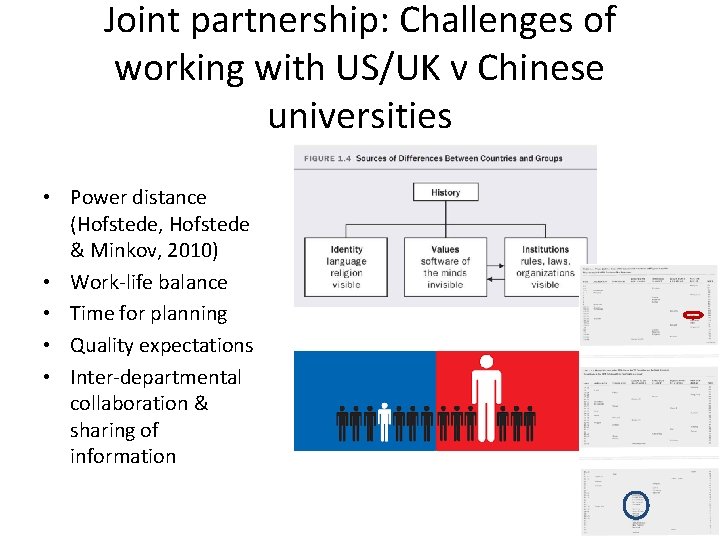
Joint partnership: Challenges of working with US/UK v Chinese universities • Power distance (Hofstede, Hofstede & Minkov, 2010) • Work-life balance • Time for planning • Quality expectations • Inter-departmental collaboration & sharing of information
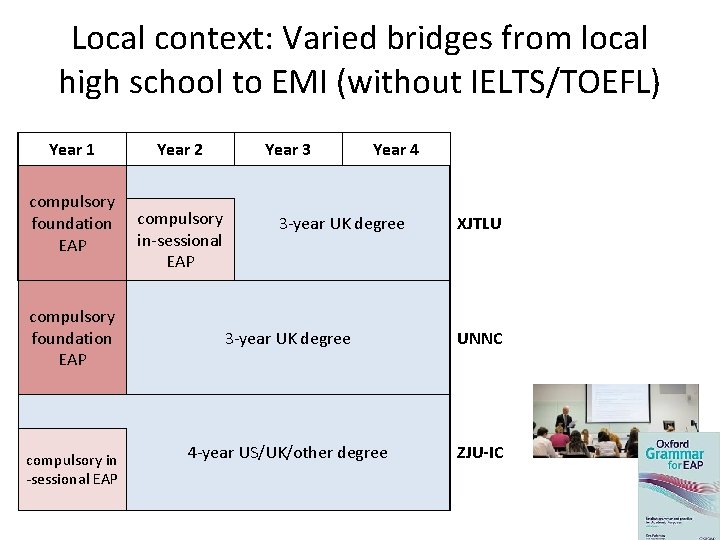
Local context: Varied bridges from local high school to EMI (without IELTS/TOEFL) Year 1 compulsory foundation EAP compulsory in -sessional EAP Year 2 compulsory in-sessional EAP Year 3 Year 4 3 -year UK degree XJTLU 3 -year UK degree UNNC 4 -year US/UK/other degree ZJU-IC
Symposium Conclusions
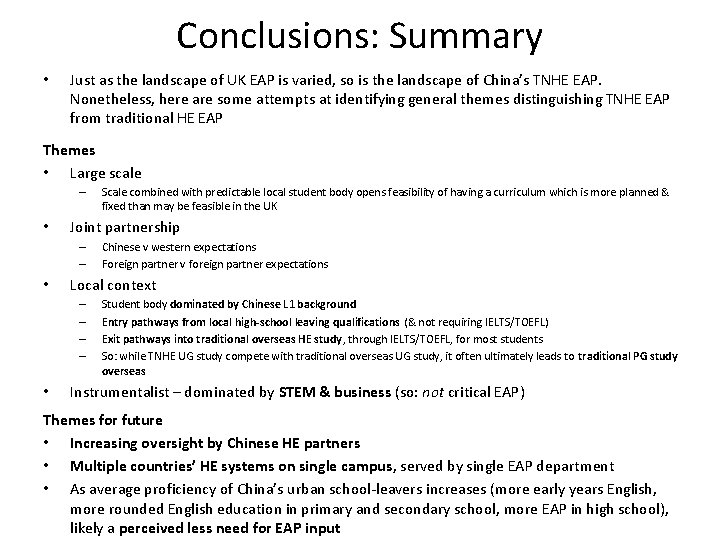
Conclusions: Summary • Just as the landscape of UK EAP is varied, so is the landscape of China’s TNHE EAP. Nonetheless, here are some attempts at identifying general themes distinguishing TNHE EAP from traditional HE EAP Themes • Large scale – • Joint partnership – – • Chinese v western expectations Foreign partner v foreign partner expectations Local context – – • Scale combined with predictable local student body opens feasibility of having a curriculum which is more planned & fixed than may be feasible in the UK Student body dominated by Chinese L 1 background Entry pathways from local high-school leaving qualifications (& not requiring IELTS/TOEFL) Exit pathways into traditional overseas HE study, through IELTS/TOEFL, for most students So: while TNHE UG study compete with traditional overseas UG study, it often ultimately leads to traditional PG study overseas Instrumentalist – dominated by STEM & business (so: not critical EAP) Themes for future • Increasing oversight by Chinese HE partners • Multiple countries’ HE systems on single campus, served by single EAP department • As average proficiency of China’s urban school-leavers increases (more early years English, more rounded English education in primary and secondary school, more EAP in high school), likely a perceived less need for EAP input
References • • • British Council, 2013. 'The evolution of transnational education: data, definitions, opportunities and impacts analysis'. British Council website. Available at: ttps: //www. britishcouncil. org/sites/default/files/the_shape_of_things_to_come_2. pdf Council of Europe, 2002. 'Lisbon Recognition Convention'. Council of Europe website. Available at: www. coe. int/t/dg 4/highereducation/recognition/code%20 of%20 good%20 practice_EN. asp Ding, A. & Bruce, I. , 2017. The English for Academic Purposes Practitioner. London: Palgrave Macmillan. Hofstede, Hofstede & Minkov. 2010. Cultures and Organizations. Ministry of Education, 2018. ’Highlights of the Ministry of Education's work 2018’ [ 教育部 2018年 作要点], website of the Ministry of Education of the PRC. http: //www. moe. gov. cn/jyb_xwfb/moe_164/201807/t 20180716_343155. html Ministry of Education, 2019 a. List of institutions and projects approved and reviewed by the Ministry of Education [教育部审批和复核的机构及项目名单]. Chinese-Foreign Cooperation in Running Schools website. http: //www. crs. jsj. edu. cn/index/sort/1006 Ministry of Education, 2019 b. Zhejiang University thoroughly studies and implements the spirit of the National Education Congress [浙江大学深入学习贯彻全国教育大会精神]. Ministry of Education of China website. http: //www. moe. gov. cn/jyb_xwfb/s 6192/s 133/s 192/201901/t 20190110_366512. html Tardy, C. & Jwa, 2016. Composition studies and EAP. In: Hyland & Shaw eds. Routledge Handbook of English for Academic Purposes. Warwick Economics and Development, 2018. 'Transnational Education: Global Location, Local Innovation: A Report produced for Universities UK International'. Universities UK website. Available at: https: //www. universitiesuk. ac. uk/policy-and-analysis/reports/Documents/UUKi%20 WECD%20 WEB%20(1). pdf Xi, J. 2017. Speech at the 19 th Party Congress. http: //www. xinhuanet. com/english/special/201711/03/c_136725942. htm
- Slides: 20