
Balantidium coli Dr AJIT KUMAR Ho D Department

Balantidium coli Dr. AJIT KUMAR Ho. D Department of Veterinary Parasitology Bihar Veterinary College Bihar Animal Sciences University Patna-800014 Image source: Google image
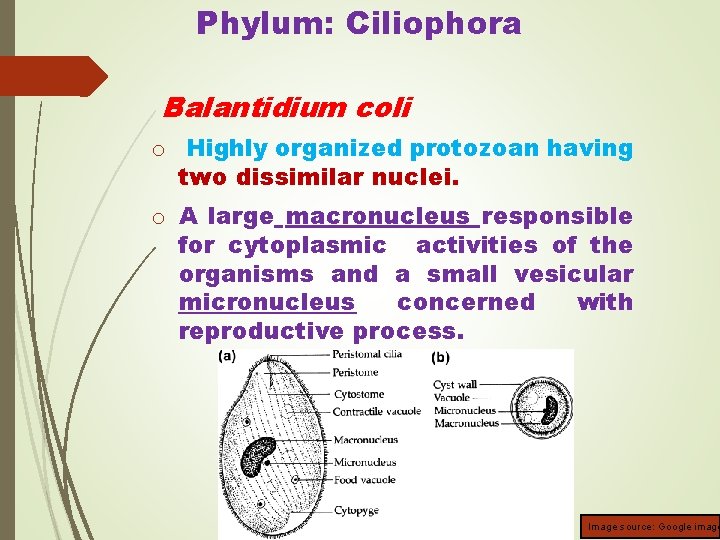
Phylum: Ciliophora Balantidium coli o Highly organized protozoan having two dissimilar nuclei. o A large macronucleus responsible for cytoplasmic activities of the organisms and a small vesicular micronucleus concerned with reproductive process. Image source: Google image
Balantidium coli o Locomotion: by cilia. o Reproduction: Asexual reproduction by transverse binary fission and sexual reprocess by conjugation.
Balantidium coli o Host: Pig, dog, cattle, monkey and man. o Location: large intestine ( caecum and colon). o Two developmental stages: Trophozoite and cyst
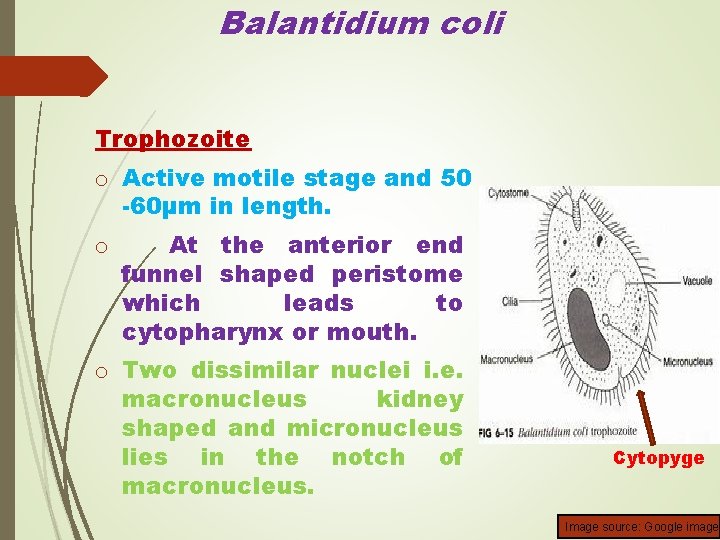
Balantidium coli Trophozoite o Active motile stage and 50 -60µm in length. o At the anterior end funnel shaped peristome which leads to cytopharynx or mouth. o Two dissimilar nuclei i. e. macronucleus kidney shaped and micronucleus lies in the notch of macronucleus. Cytopyge Image source: Google image
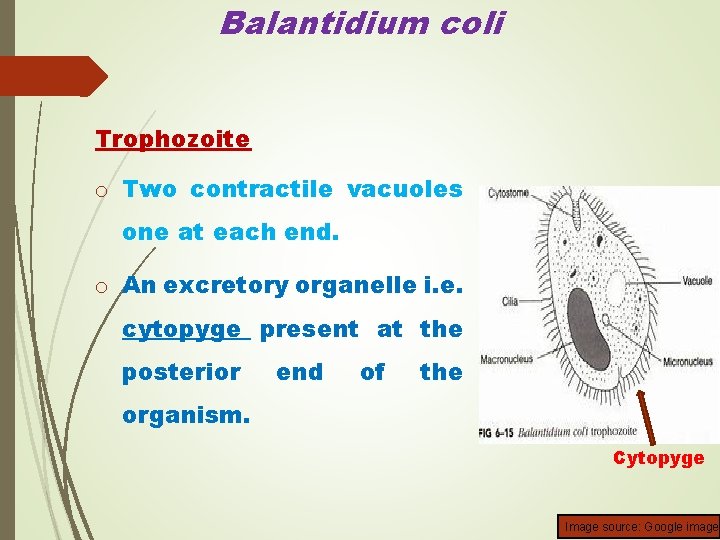
Balantidium coli Trophozoite o Two contractile vacuoles one at each end. o An excretory organelle i. e. cytopyge present at the posterior end of the organism. Cytopyge Image source: Google image
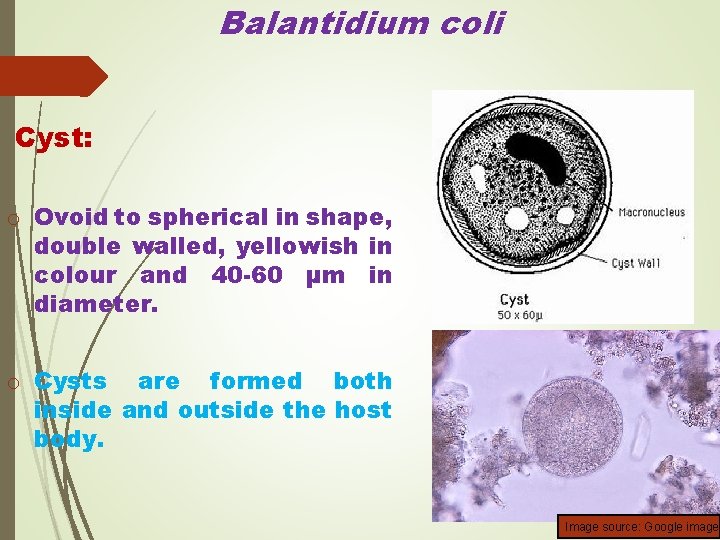
Balantidium coli Cyst: o Ovoid to spherical in shape, double walled, yellowish in colour and 40 -60 µm in diameter. o Cysts are formed both inside and outside the host body. Image source: Google image
Balantidium coli Transmission: o Pig is considered as primary hot and in it B. coli exists as commensal in the large intestine of most pigs. o Pig is probable the persistent source of infection for man, cattle etc. o Hosts get infection through the ingestion of contaminated food and water with cyst of B. coli.
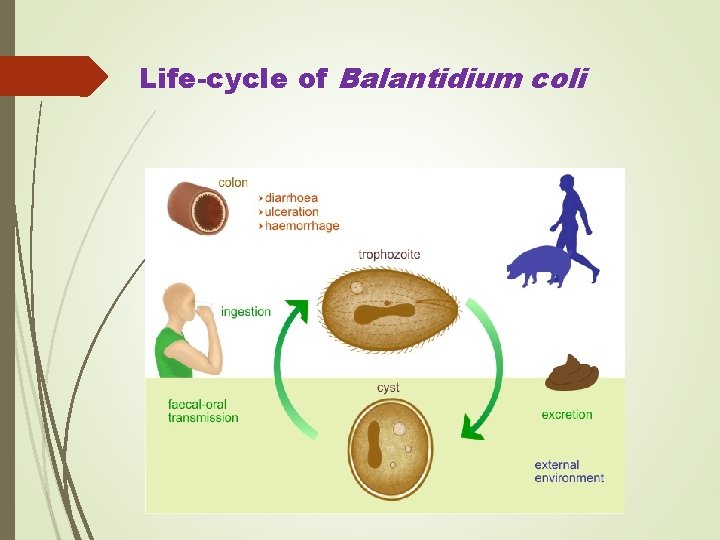
Life-cycle of Balantidium coli
Balantidium coli Pathogenesis and symptoms: o In pigs normally it is non- pathogenic invade the but occasionally mucosa and producing superficial to deep ulcer with enteritis. It produces diarrhoea and dysentery with hemorrhage.
Balantidium coli Pathogenesis and symptoms: o In man, superficial B. to coli produce deep ulcer associated with enteritis. The initial lesions may resemble those produce by Entamoeba histolytica but do not show the similar tendency to enlarge or spread.
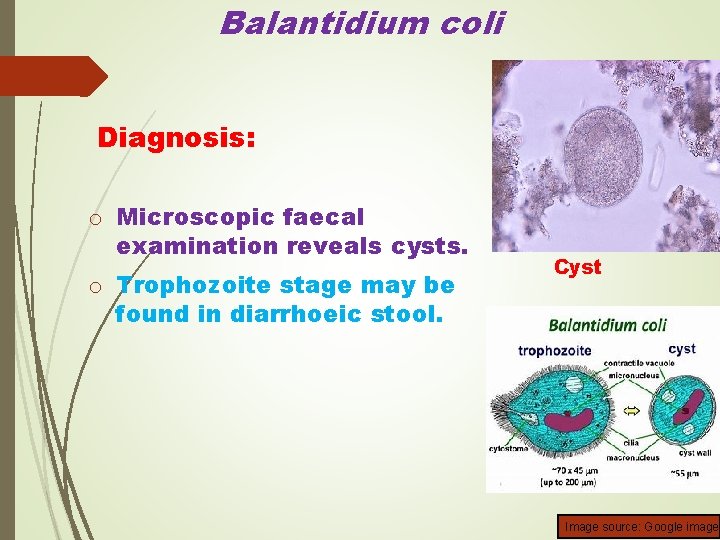
Balantidium coli Diagnosis: o Microscopic faecal examination reveals cysts. o Trophozoite stage may be found in diarrhoeic stool. Cyst Image source: Google image
Balantidium coli Treatment: o Tetracycline, Metronidazole etc. Control: o Good hygiene and proper sanitation. o Proper disposal of faces of pig and man.

THANK YOU
- Slides: 14