
Balancing EquationsWord Equations Agenda Day 1 Notes over
Balancing Equations/Word Equations
Agenda Day 1 • Notes over word equations and balancing equations • Types of Reactions POGIL • HW: Balancing Equations and Word Equations WS
By the end of today you should be able to: • Translate a chemical equation from words to formula and formula to words. • Balance a chemical equation. • Begin to recognize the 5 types of chemical reactions.
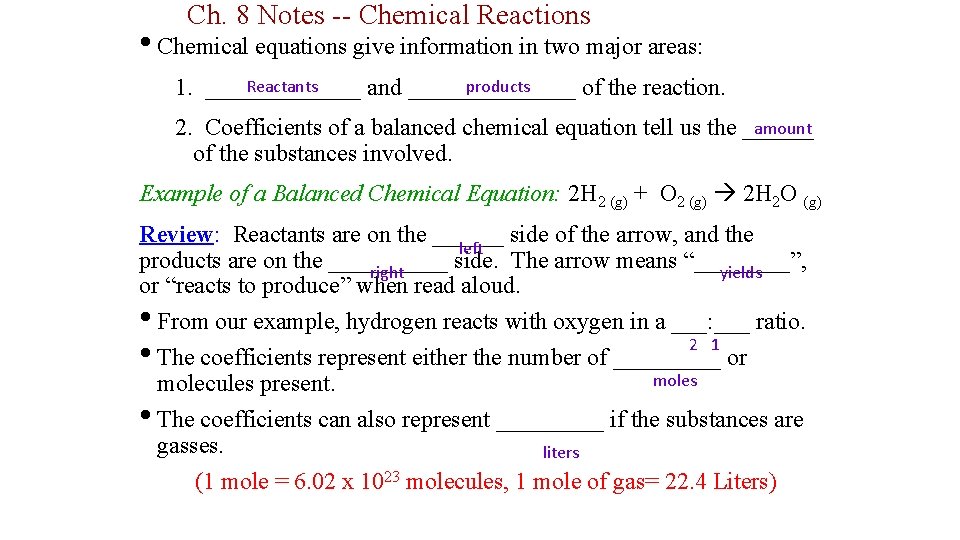
Ch. 8 Notes -- Chemical Reactions • Chemical equations give information in two major areas: Reactants products 1. _______ and _______ of the reaction. amount 2. Coefficients of a balanced chemical equation tell us the ______ of the substances involved. Example of a Balanced Chemical Equation: 2 H 2 (g) + O 2 (g) 2 H 2 O (g) Review: Reactants are on the ______ side of the arrow, and the left products are on the _____ side. The arrow means “____”, right yields or “reacts to produce” when read aloud. • From our example, hydrogen reacts with oxygen in a ___: ___ ratio. 2 1 • The coefficients represent either the number of _____ or moles molecules present. • The coefficients can also represent _____ if the substances are gasses. liters (1 mole = 6. 02 x 1023 molecules, 1 mole of gas= 22. 4 Liters)

Common Symbols used in Chemical Equations + (See Table 8. 1) = used to separate 2 reactants or 2 products from each other → = “yields” or “reacts to produce” = _______ reaction (like a rechargeable battery) reversible (s) (l) (g) (aq) = phase of matter: (solid, liquid, gas, or “aqueous”) = ______ supplied to the reaction heat Mn. O 2 = a catalyst, (in this case, Mn. O 2), is used to ____ the = _______ given off as a product = ______ precipitate produced gas solid reaction. speed up
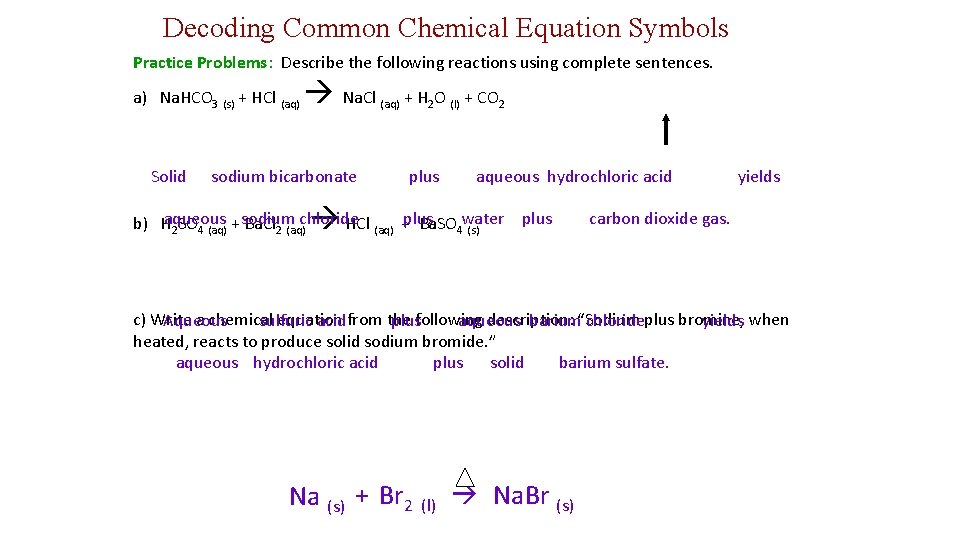
Decoding Common Chemical Equation Symbols Practice Problems: Describe the following reactions using complete sentences. a) Na. HCO 3 (s) + HCl (aq) Solid Na. Cl sodium bicarbonate (aq) + H 2 O (l) + CO 2 plus aqueous hydrochloric acid sodium chloride plus water plus b) Haqueous HCl (aq) + Ba. SO 2 SO 4 (aq) + Ba. Cl 2 (aq) 4 (s) yields carbon dioxide gas. c) Write a chemical equation from the following description: “Sodium plus bromine, when Aqueous sulfuric acid plus aqueous barium chloride yields heated, reacts to produce solid sodium bromide. ” aqueous hydrochloric acid plus solid barium sulfate. Na (s) + Br 2 (l) Na. Br (s)
Balancing Chemical Equations: • In your notes write down the rules for balancing a chemical equation from the next 2 slides.
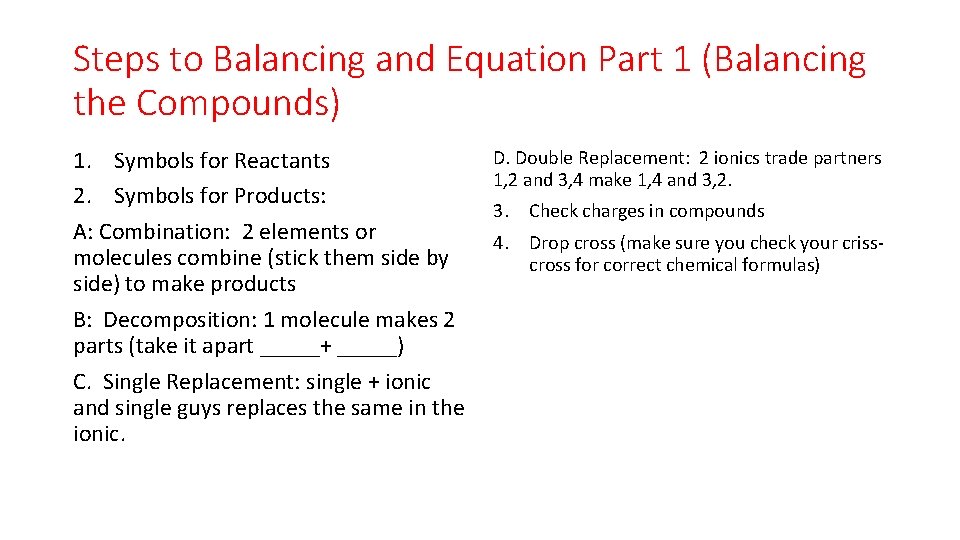
Steps to Balancing and Equation Part 1 (Balancing the Compounds) 1. Symbols for Reactants 2. Symbols for Products: A: Combination: 2 elements or molecules combine (stick them side by side) to make products B: Decomposition: 1 molecule makes 2 parts (take it apart _____+ _____) C. Single Replacement: single + ionic and single guys replaces the same in the ionic. D. Double Replacement: 2 ionics trade partners 1, 2 and 3, 4 make 1, 4 and 3, 2. 3. Check charges in compounds 4. Drop cross (make sure you check your crisscross for correct chemical formulas)
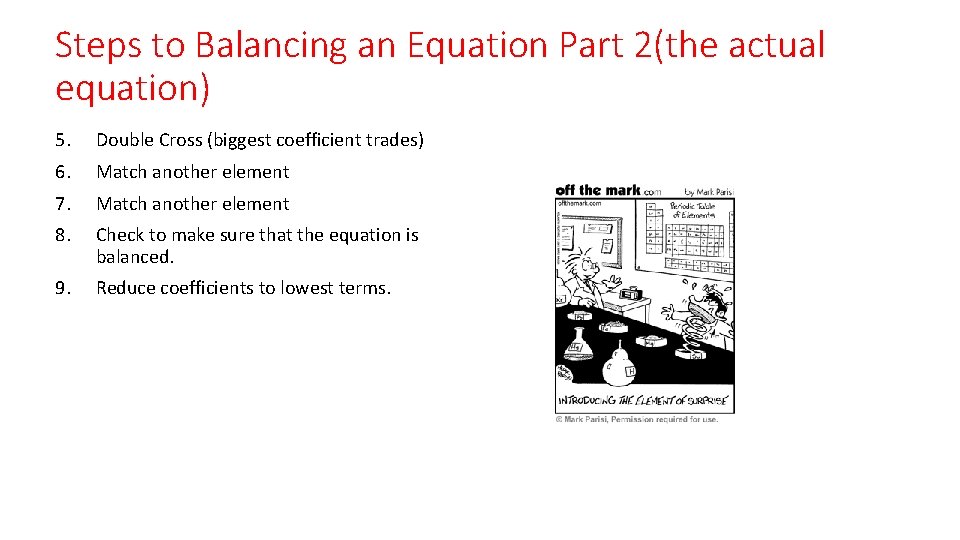
Steps to Balancing an Equation Part 2(the actual equation) 5. Double Cross (biggest coefficient trades) 6. Match another element 7. Match another element 8. Check to make sure that the equation is balanced. 9. Reduce coefficients to lowest terms.
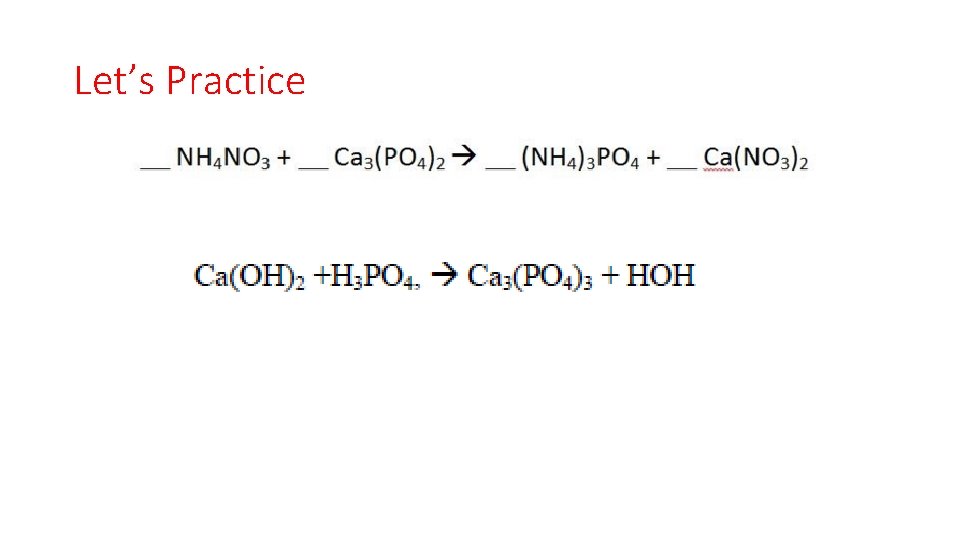
Let’s Practice

Balancing Chemical Equation Practice Problems: Balance the following reactions using complete sentences. Na. Cl + H O + CO (balanced ) a) Na. HCO 3 (s) + HCl (aq) b) H 2 SO 4 (aq) + Ba. Cl 2 (aq) HCl 2 HCl 2 2 (l) 2 2 (aq) + Ba. SO 4 (s) c) Write a chemical equation from the following description and balance the equation: “Calcium plus solid iodine, when heated, reacts to produce solid calcium iodide. ” Ca (s) + I 2 (s) Ca. I 2 (s)
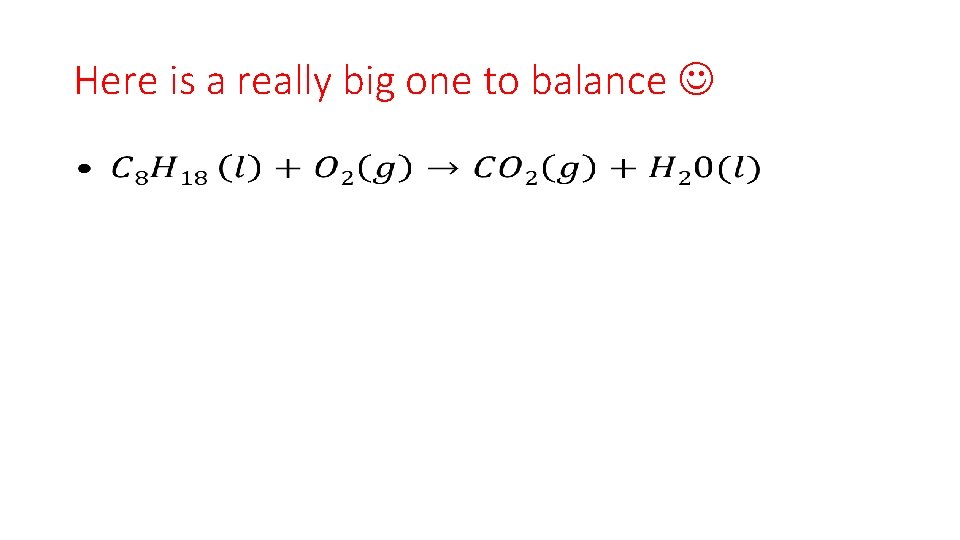
Here is a really big one to balance •
Time to Think • When balancing chemical equations it is important that we have the same number of each element on both sides of the yield sign. Why is this?
POGIL • You have been put into groups of 3 for the POGIL. • Elect a manager, recorder, and spokesman and write the names and roles on 1 POGIL (so you only write on 1 POGIL). • When you are done, please answer these questions and be prepared to have your spokesperson answer (see next slide).

POGIL Questions • What kinds of things do chemists use to classify chemical reactions into types? • What are some of the other important symbols that chemists use to identify important features of a chemical reactions (ex: states of matter)?
HW • Molecular Geometry Labs (if you still need to finish them) • Word Equations WS (Try all odds)
- Slides: 16