
Balances in water Electrolytic dissociation A substance break
Balances in water
Electrolytic dissociation A substance break down into ions, under the influence of the solvent. Substances undergoing electrolytic dissociation are called electrolytes.

Example
Lack of electrolytic dissociation Not all substances breaks down equally ions. Some molecules with a strong, poorly polarized atomic bonds do not dissociate. We call them non-electrolytes. An example may be a sugar molecule.
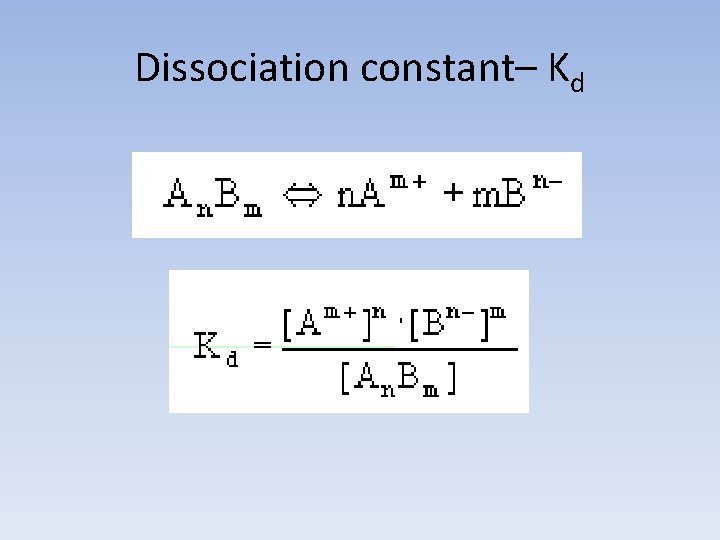
Dissociation constant– Kd
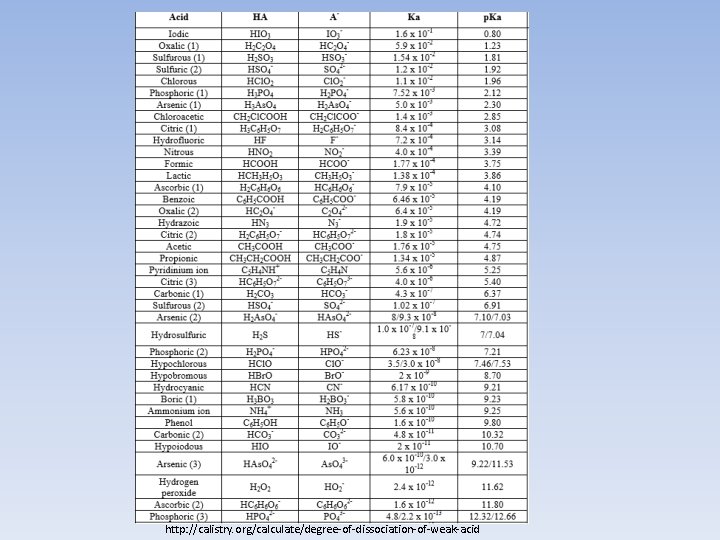
http: //calistry. org/calculate/degree-of-dissociation-of-weak-acid
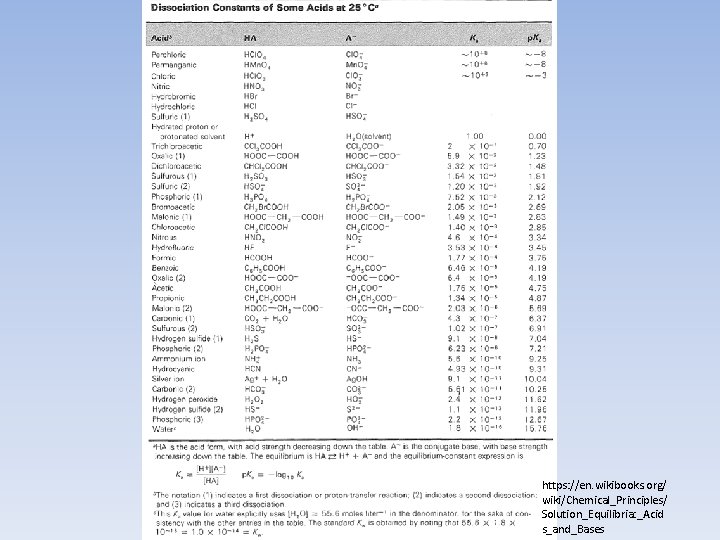
https: //en. wikibooks. org/ wiki/Chemical_Principles/ Solution_Equilibria: _Acid s_and_Bases
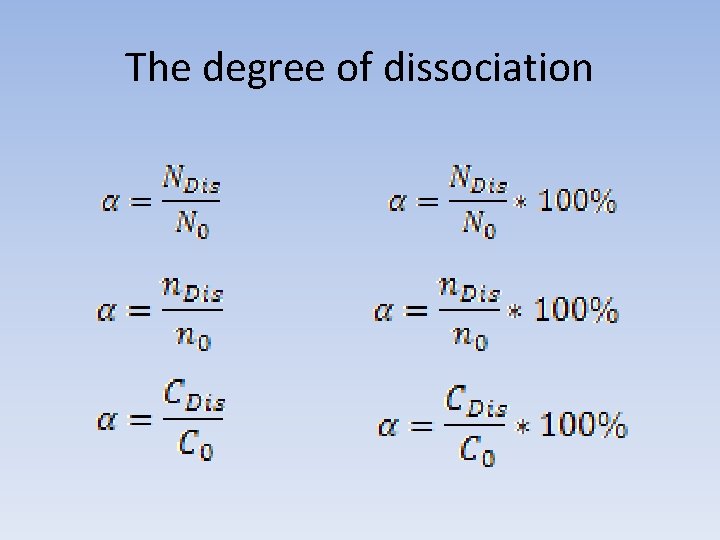
The degree of dissociation
The degree of dissociation There is another way of expressing ability of the substance to dissociate in a solvent. It is the degree of dissociation. The degree of dissociation is the ratio of the amount of a substance that disintegrated ions to the total (dissolved) the quantity of particles
Types of electrolites Electrolytes with the degree of dissociation close to unity are called strong electrolytes. Weak electrolytes are those, that have the degree of dissociation very small, generally less than 0. 1.
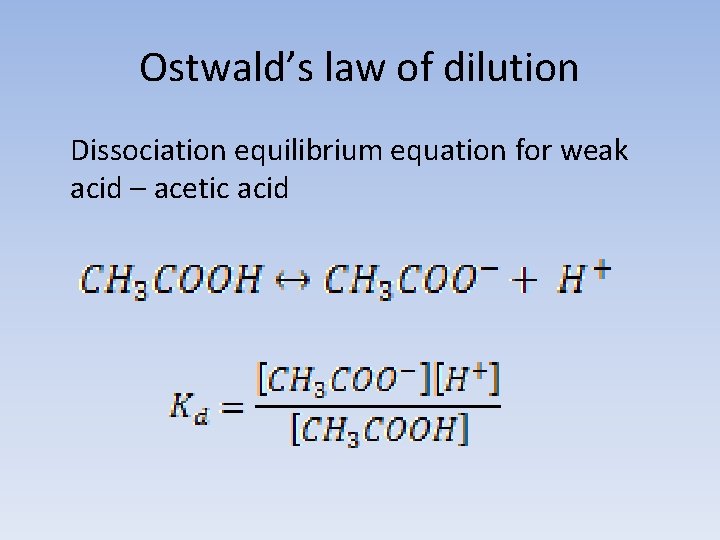
Ostwald’s law of dilution Dissociation equilibrium equation for weak acid – acetic acid
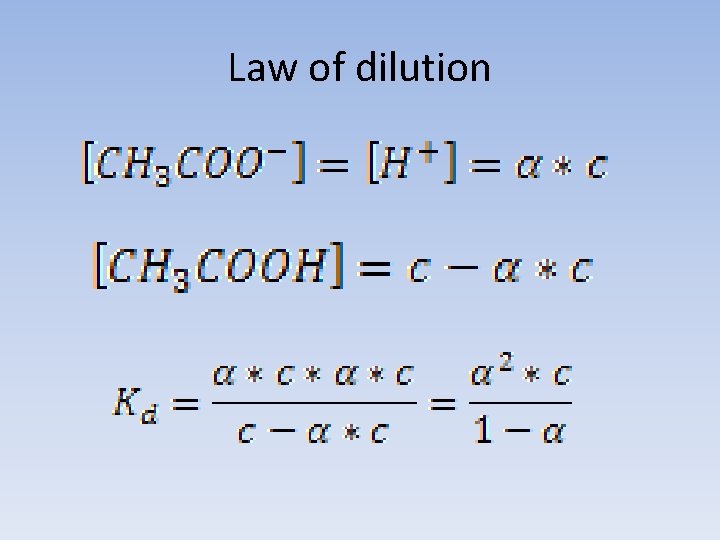
Law of dilution
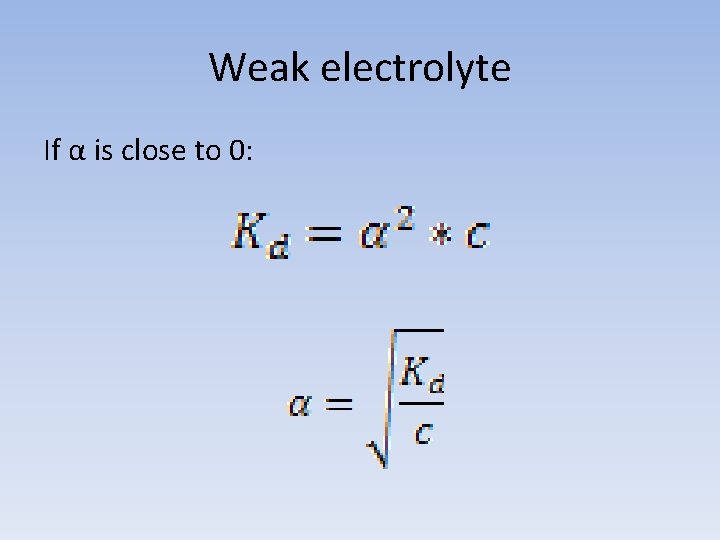
Weak electrolyte If α is close to 0:
Multistages electrolytic dissociation For molecules having a complex structure, composed of multivalent ions An. Bm, dissociation takes place in multiple stages and each stage can be described by the respective sub-equilibrium reactions.
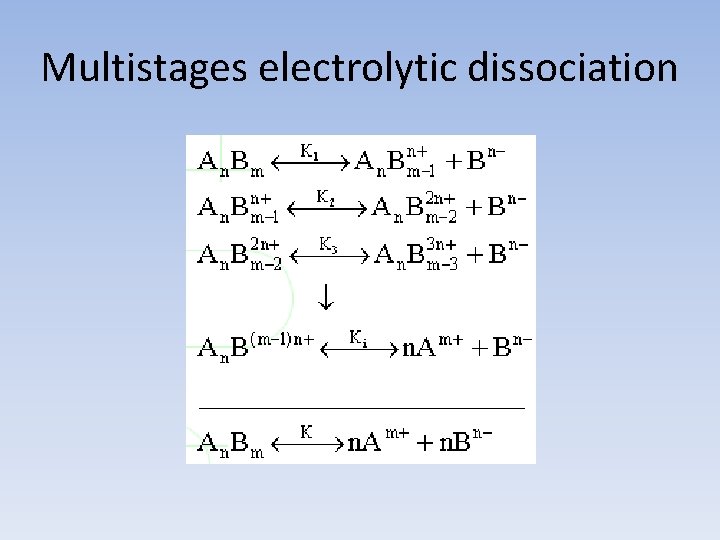
Multistages electrolytic dissociation
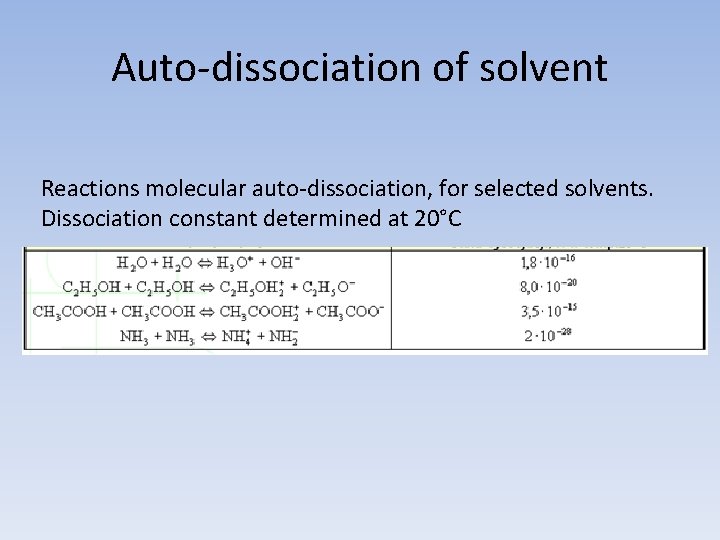
Auto-dissociation of solvent Reactions molecular auto-dissociation, for selected solvents. Dissociation constant determined at 20°C
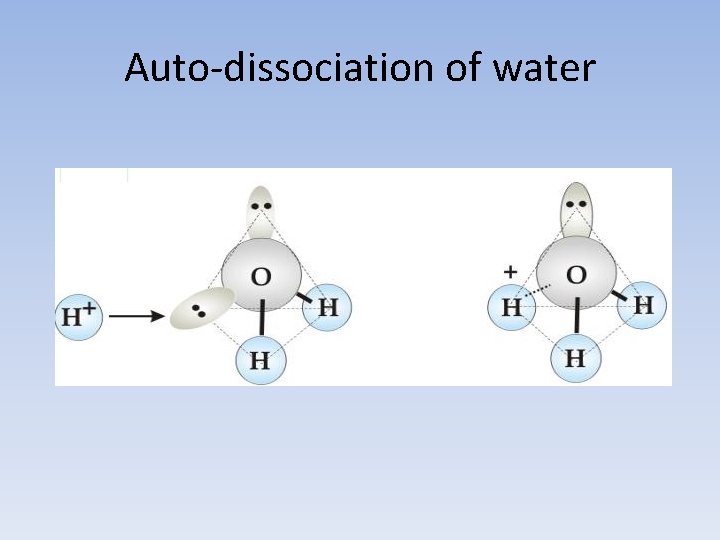
Auto-dissociation of water
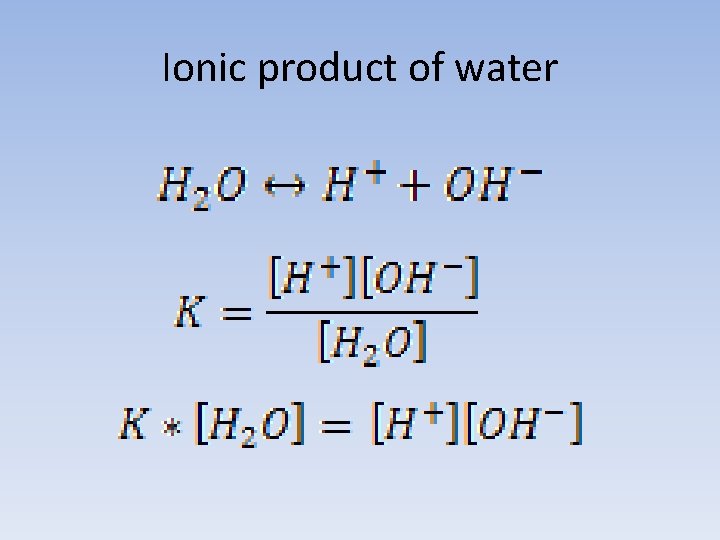
Ionic product of water
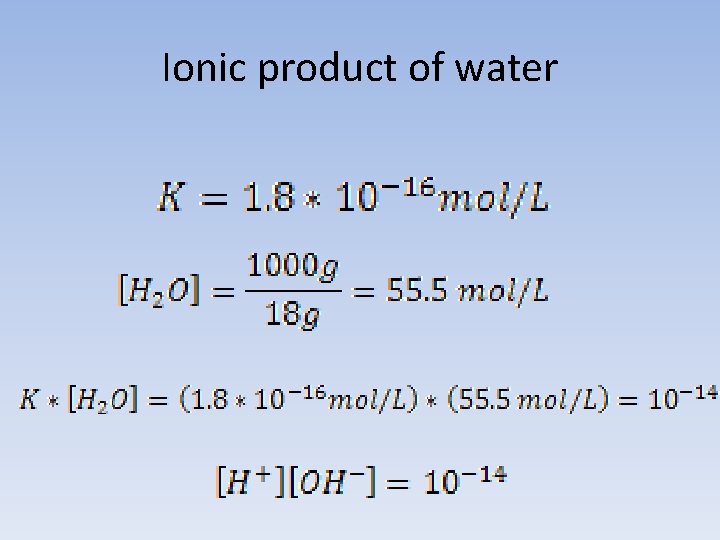
Ionic product of water
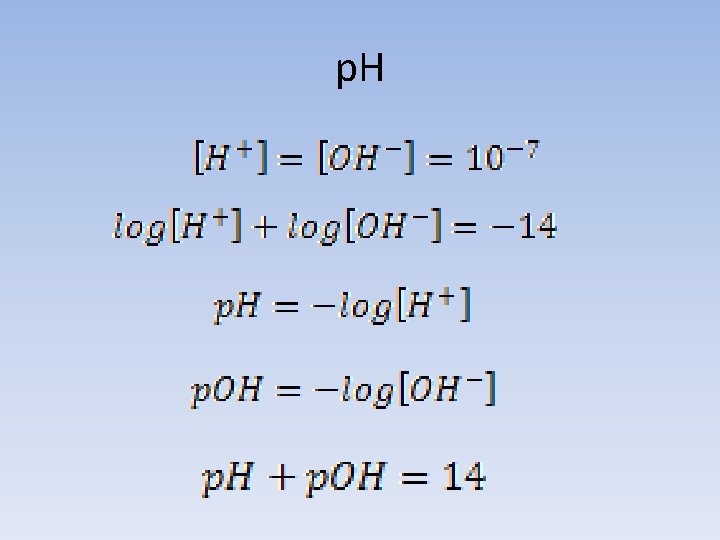
p. H
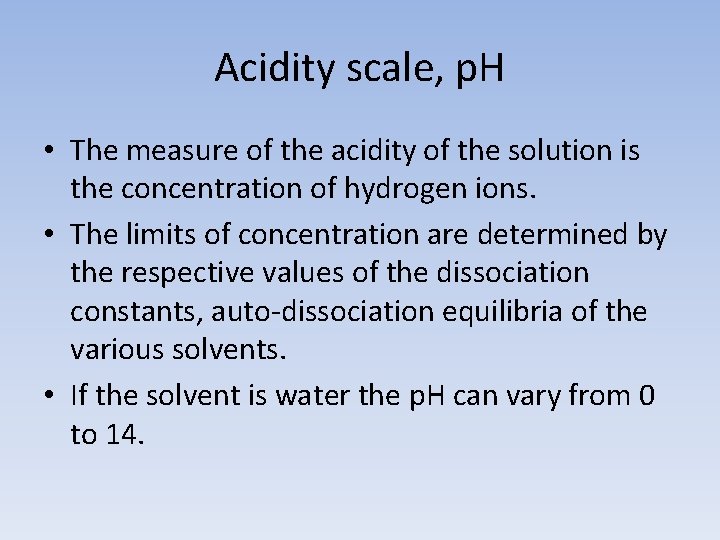
Acidity scale, p. H • The measure of the acidity of the solution is the concentration of hydrogen ions. • The limits of concentration are determined by the respective values of the dissociation constants, auto-dissociation equilibria of the various solvents. • If the solvent is water the p. H can vary from 0 to 14.
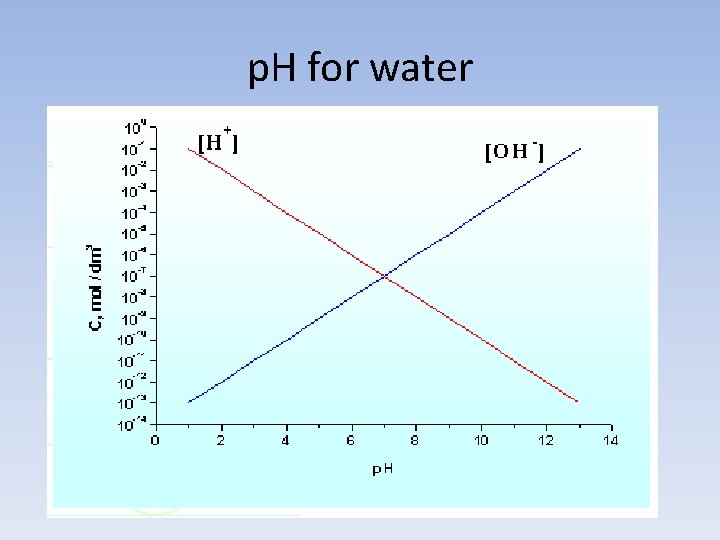
p. H for water
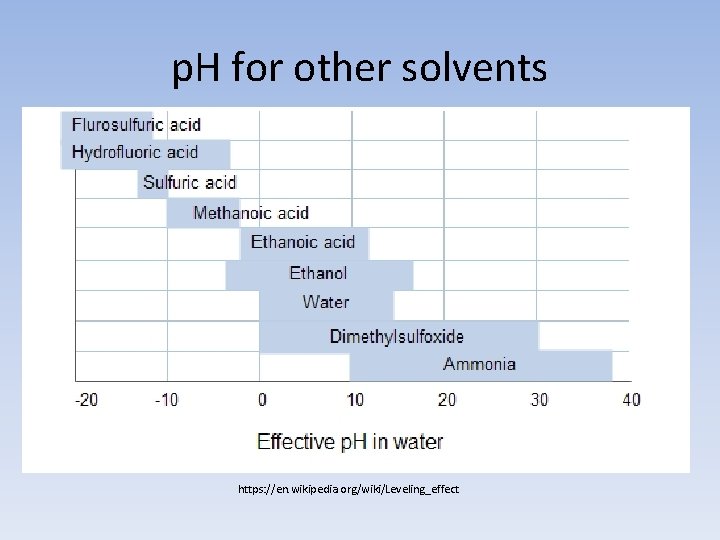
p. H for other solvents https: //en. wikipedia. org/wiki/Leveling_effect
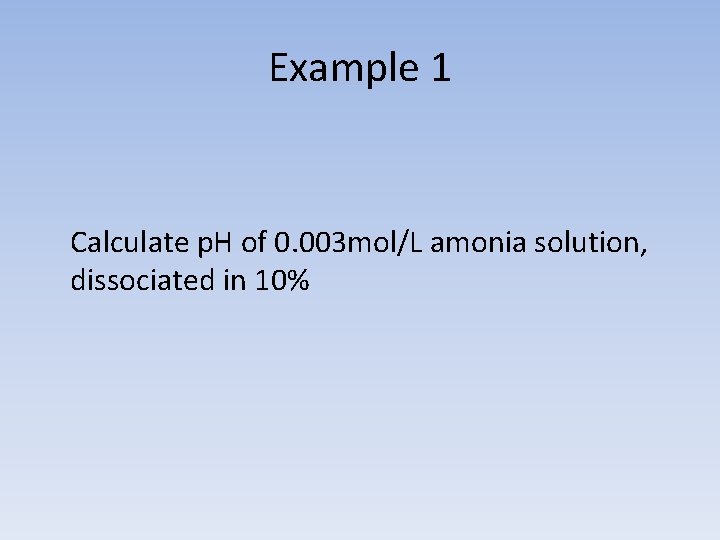
Example 1 Calculate p. H of 0. 003 mol/L amonia solution, dissociated in 10%
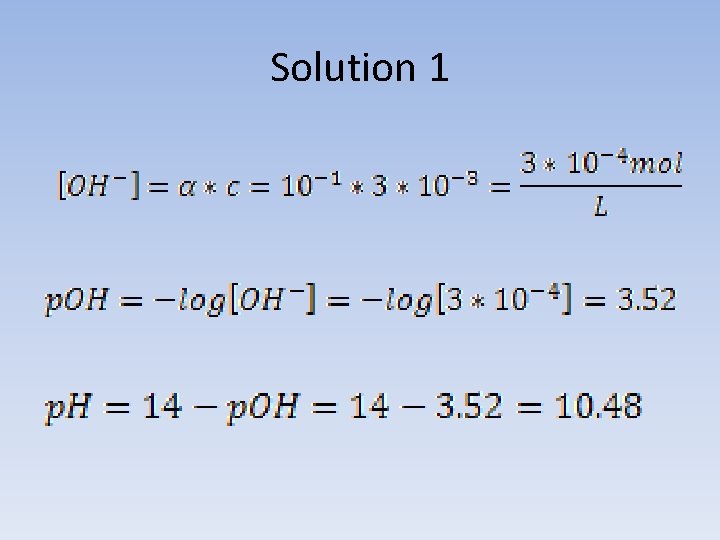
Solution 1
Example 2 Calculate OH- ions concentration, in p. H = 12. 20 solution.
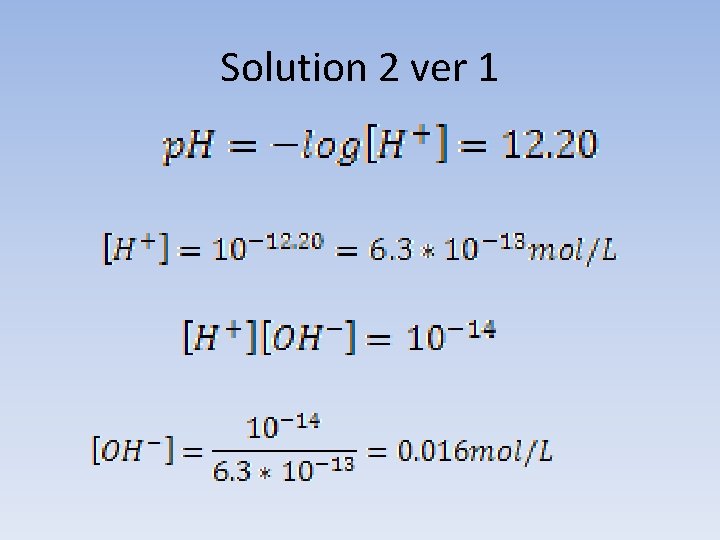
Solution 2 ver 1
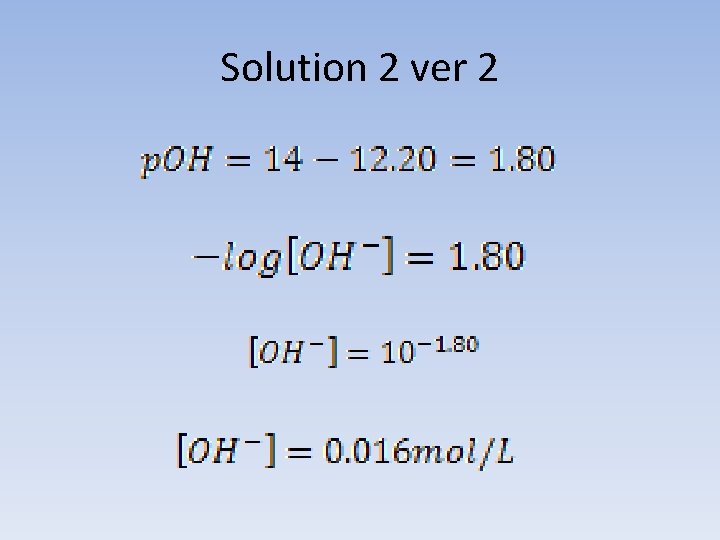
Solution 2 ver 2
Example 3 Hydrogen ions concentration is equal to 10 -3 gramion/l. Calculate hydroxyl ions concentration.
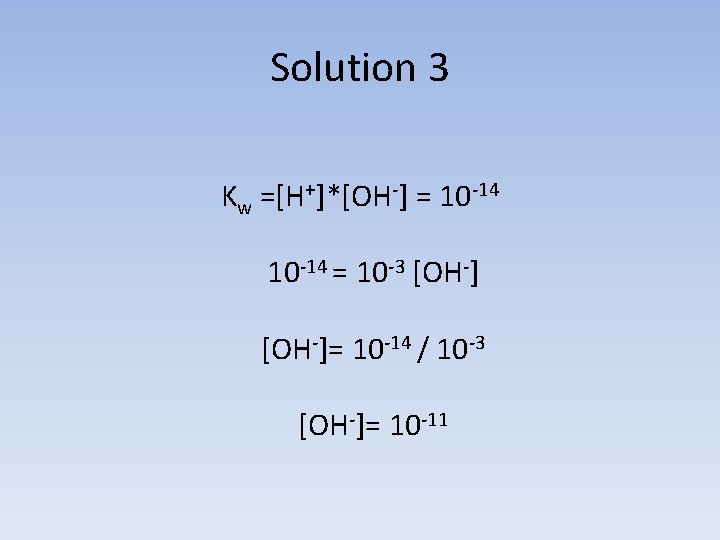
Solution 3 Kw =[H+]*[OH-] = 10 -14 = 10 -3 [OH-]= 10 -14 / 10 -3 [OH-]= 10 -11
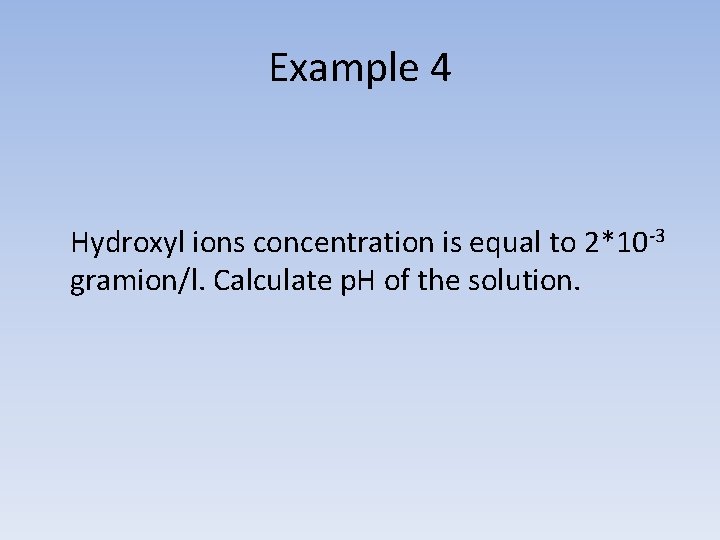
Example 4 Hydroxyl ions concentration is equal to 2*10 -3 gramion/l. Calculate p. H of the solution.
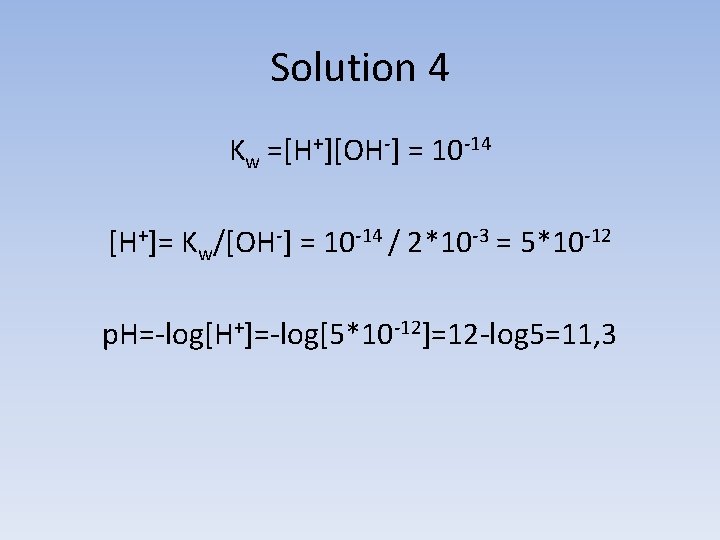
Solution 4 Kw =[H+][OH-] = 10 -14 [H+]= Kw/[OH-] = 10 -14 / 2*10 -3 = 5*10 -12 p. H=-log[H+]=-log[5*10 -12]=12 -log 5=11, 3
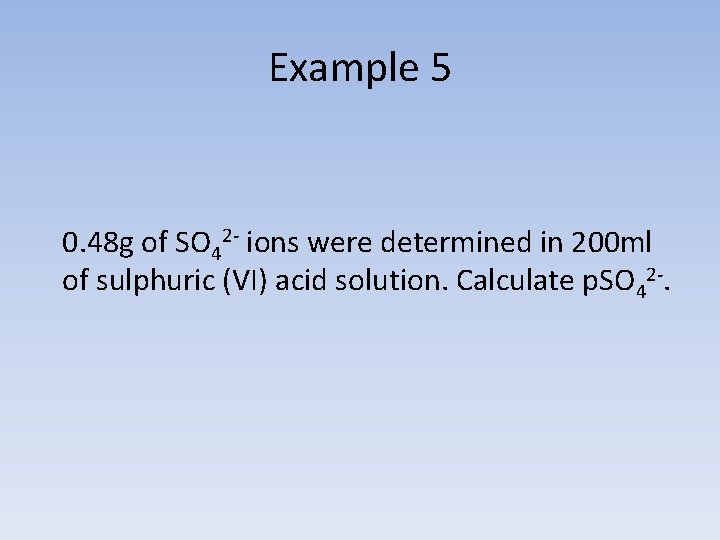
Example 5 0. 48 g of SO 42 - ions were determined in 200 ml of sulphuric (VI) acid solution. Calculate p. SO 42 -.
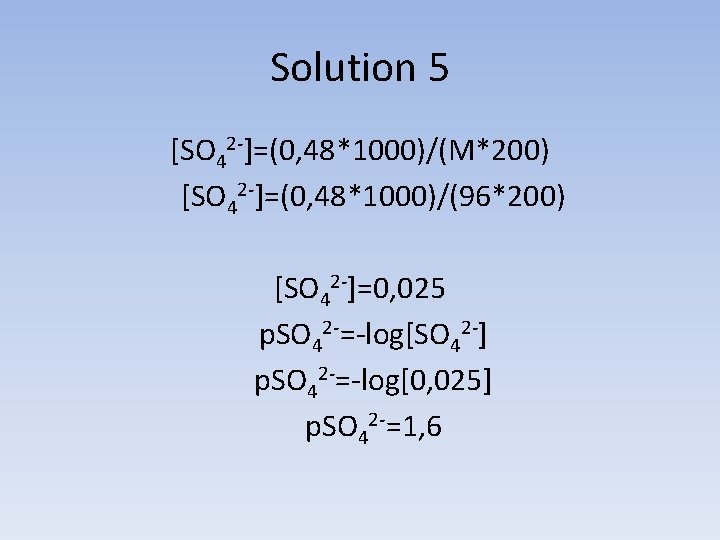
Solution 5 [SO 42 -]=(0, 48*1000)/(M*200) [SO 42 -]=(0, 48*1000)/(96*200) [SO 42 -]=0, 025 p. SO 42 -=-log[SO 42 -] p. SO 42 -=-log[0, 025] p. SO 42 -=1, 6
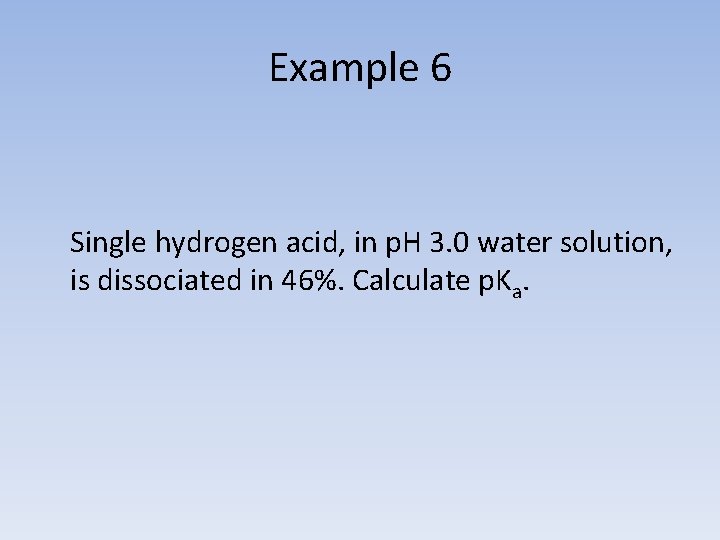
Example 6 Single hydrogen acid, in p. H 3. 0 water solution, is dissociated in 46%. Calculate p. Ka.
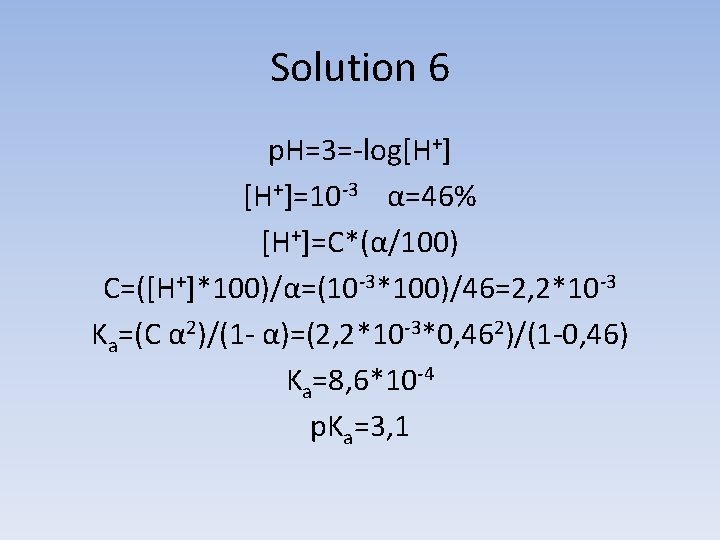
Solution 6 p. H=3=-log[H+]=10 -3 α=46% [H+]=C*(α/100) C=([H+]*100)/α=(10 -3*100)/46=2, 2*10 -3 Ka=(C α 2)/(1 - α)=(2, 2*10 -3*0, 462)/(1 -0, 46) Ka=8, 6*10 -4 p. Ka=3, 1
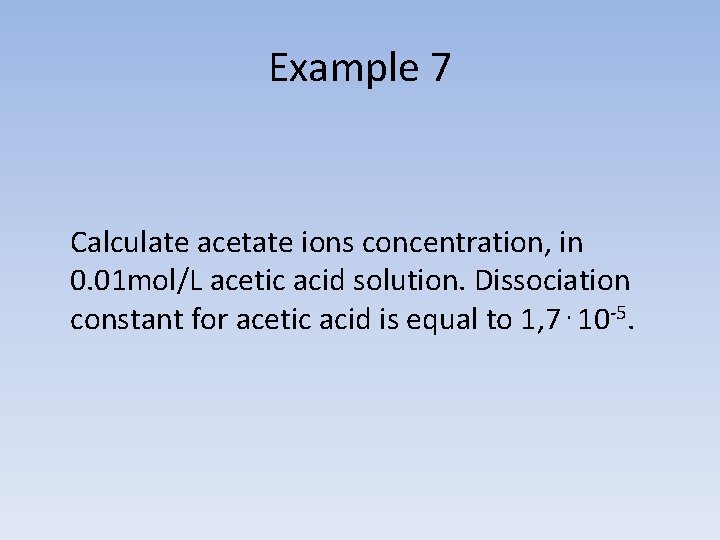
Example 7 Calculate acetate ions concentration, in 0. 01 mol/L acetic acid solution. Dissociation constant for acetic acid is equal to 1, 7⋅10 -5.
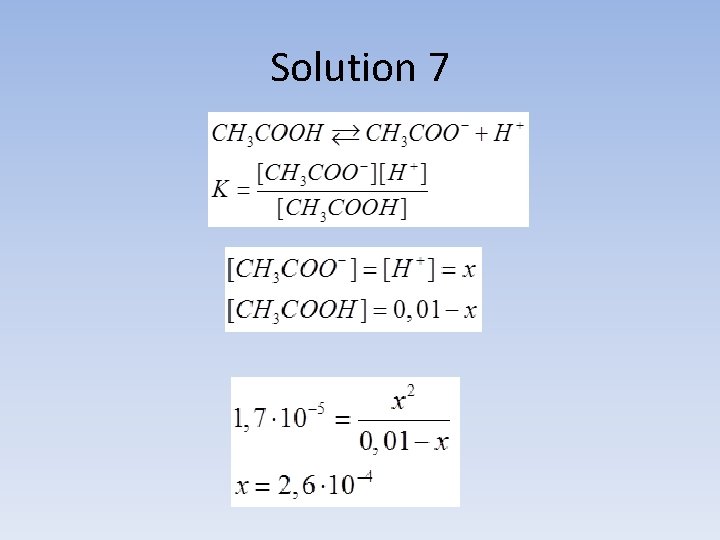
Solution 7
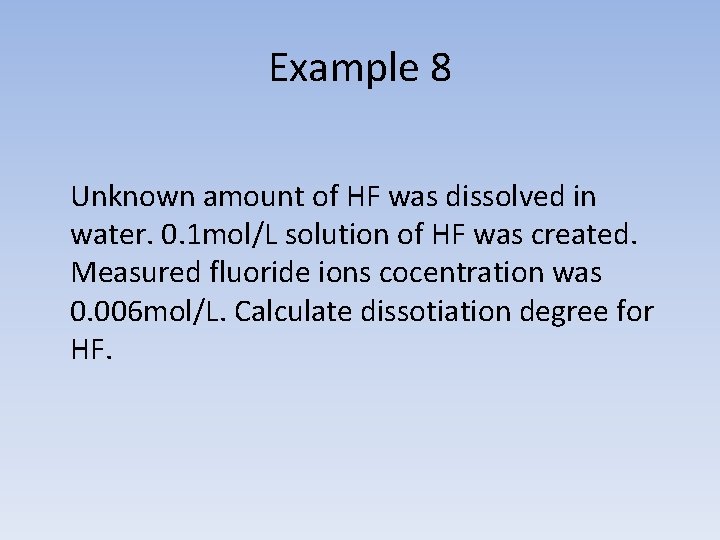
Example 8 Unknown amount of HF was dissolved in water. 0. 1 mol/L solution of HF was created. Measured fluoride ions cocentration was 0. 006 mol/L. Calculate dissotiation degree for HF.
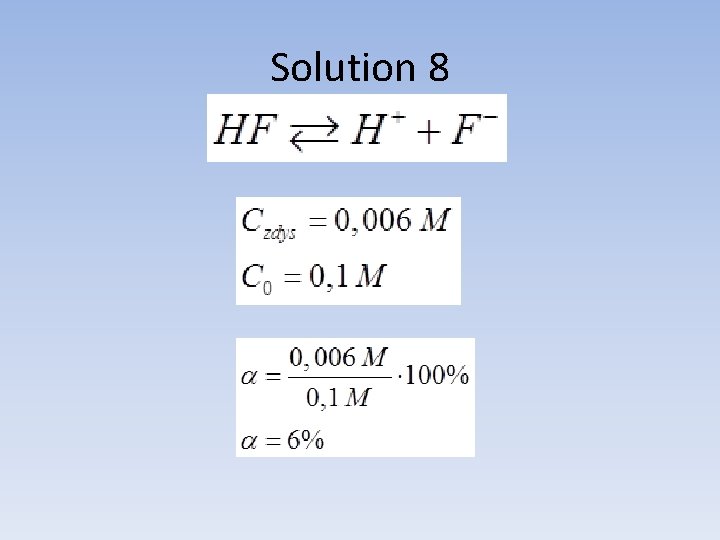
Solution 8
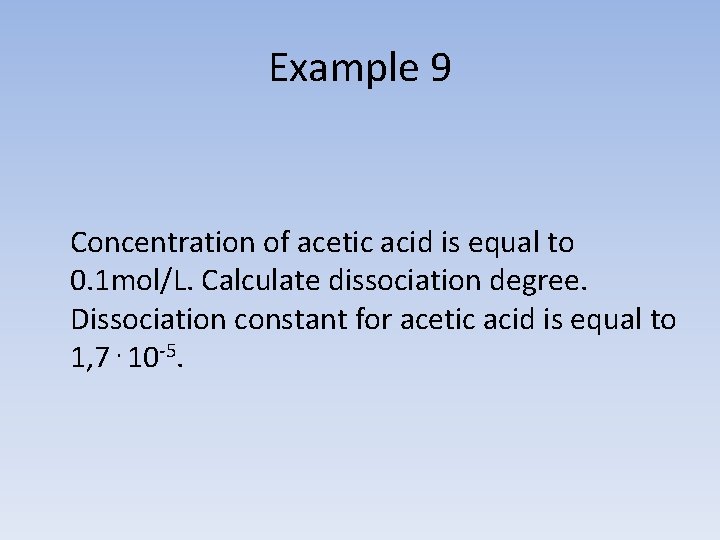
Example 9 Concentration of acetic acid is equal to 0. 1 mol/L. Calculate dissociation degree. Dissociation constant for acetic acid is equal to 1, 7⋅10 -5.
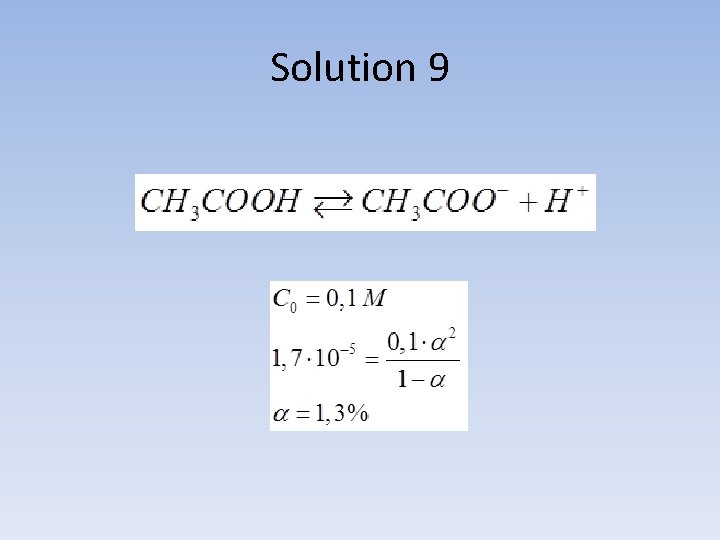
Solution 9
Example 10 Chloric (I) acid solution concentration is equal to 0. 01 mol/L. p. H value was determined as 4. 76. Calculate chloric (I) acid dissociation constant.
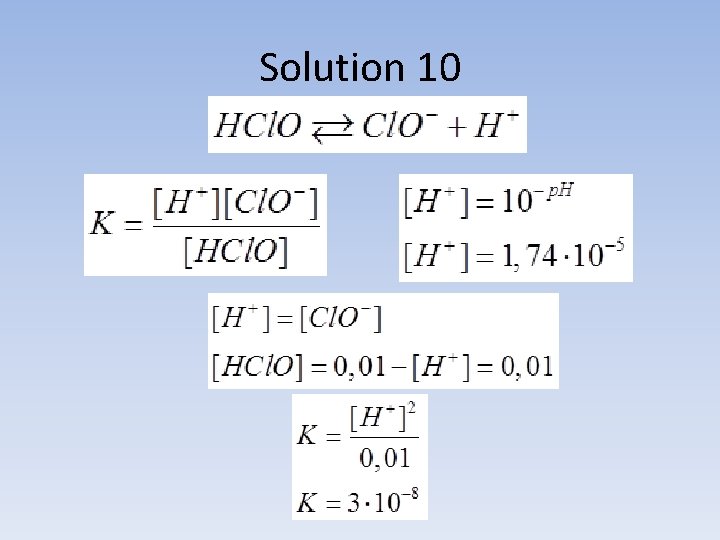
Solution 10
Źródła http: //zasoby 1. open. agh. edu. pl/dydaktyka/chemia/a_e_chemia/6_ chemia_roztworow/05_00_00. htm http: //zasoby 1. open. agh. edu. pl/dydaktyka/chemia/a_e_chemia/6_ chemia_roztworow/05_01_01. htm http: //zasoby 1. open. agh. edu. pl/dydaktyka/chemia/a_e_chemia/6_ chemia_roztworow/05_05_00. htm http: //zasoby 1. open. agh. edu. pl/dydaktyka/chemia/a_e_chemia/6_ chemia_roztworow/05_05_01. htm http: //zasoby 1. open. agh. edu. pl/dydaktyka/chemia/a_e_chemia/6_ chemia_roztworow/05_06_02. htm http: //zasoby 1. open. agh. edu. pl/dydaktyka/chemia/a_e_chemia/6_ chemia_roztworow/05_06_03 a. htm http: //little-chem-freak. blogspot. com/2013/02/16 -procesy-jonowe -staa-i-stopien. html
Balances in water
- Slides: 46