
Balanced Unbalanced Forces Newtons Second Law of Motion

Balanced & Unbalanced Forces
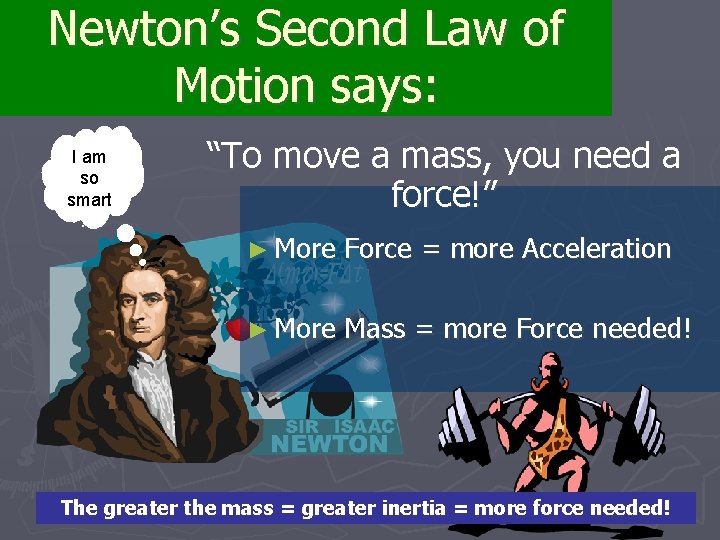
Newton’s Second Law of Motion says: I am so smart … “To move a mass, you need a force!” ► More Force = more Acceleration ► More Mass = more Force needed! The greater the mass = greater inertia = more force needed!
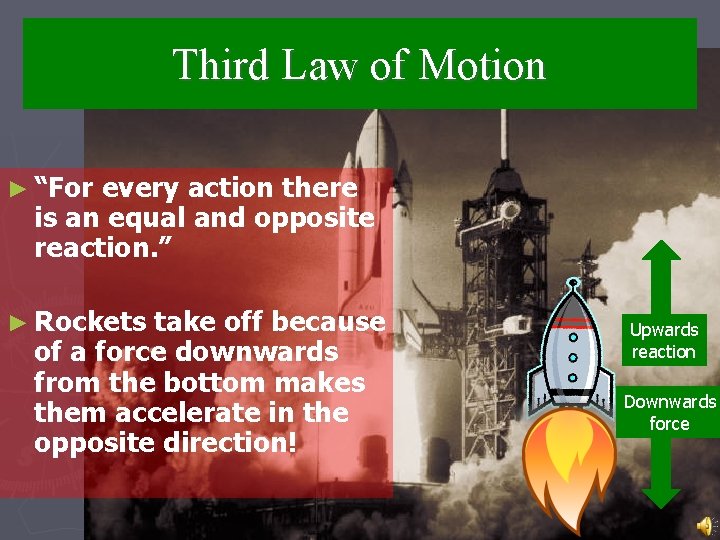
Third Law of Motion ► “For every action there is an equal and opposite reaction. ” ► Rockets take off because of a force downwards from the bottom makes them accelerate in the opposite direction! Upwards reaction Downwards force
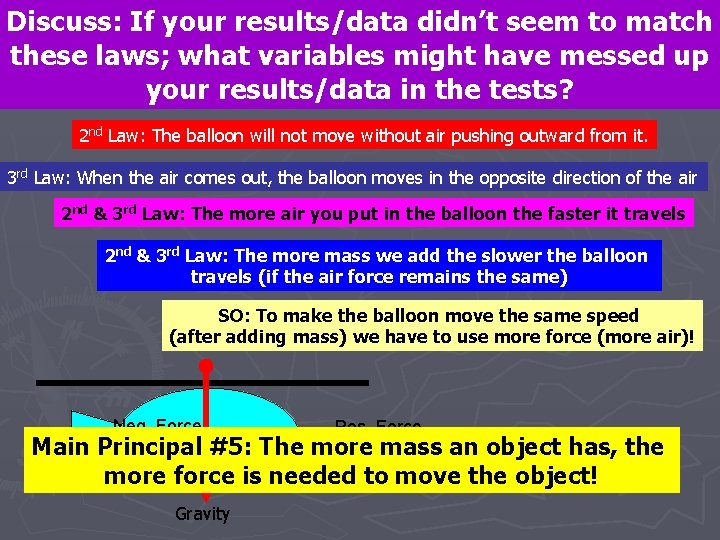
Discuss: If your results/data didn’t seem to match these laws; what might. Lab: have messed up Forcesvariables in the Balloon your results/data in the tests? 2 nd Law: The balloon will not move without air pushing outward from it. 3 rd Law: When the air comes out, the balloon moves in the opposite direction of the air 2 nd & 3 rd Law: The more air you put in the balloon the faster it travels 2 nd & 3 rd Law: The more mass we add the slower the balloon travels (if the air force remains the same) SO: To make the balloon move the same speed (after adding mass) we have to use more force (more air)! Neg. Force Pos. Force (Friction) (Thrust) Main Principal #5: The more mass an object has, the more force is needed to move the object! Gravity
Forces and Accelerations ► We have already learned that forces cause all accelerations (change of speed and/or direction) ► But they don’t have to… ► What if there are more than one force acting on an object at the same time (which is more realistic than just one)? ► The forces might balance each other out! ► How does this affect the motion of our object…? ► Well…let’s explore that now…go to next slide:
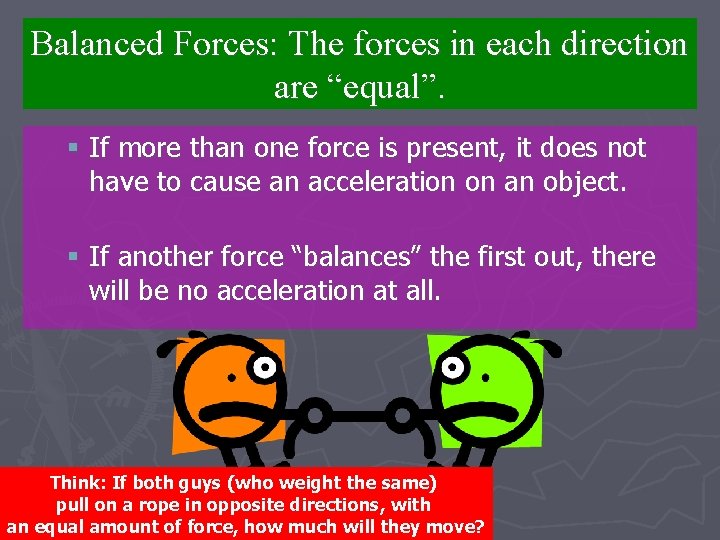
Balanced Forces: The forces in each direction are “equal”. § If more than one force is present, it does not have to cause an acceleration on an object. § If another force “balances” the first out, there will be no acceleration at all. Think: If both guys (who weight the same) pull on a rope in opposite directions, with an equal amount of force, how much will they move?
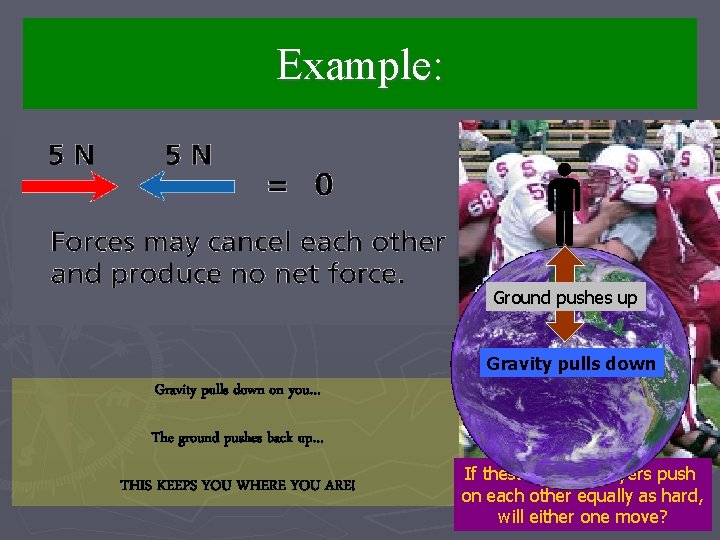
Example: Ground pushes up Gravity pulls down on you… The ground pushes back up… THIS KEEPS YOU WHERE YOU ARE! If these football players push on each other equally as hard, will either one move?
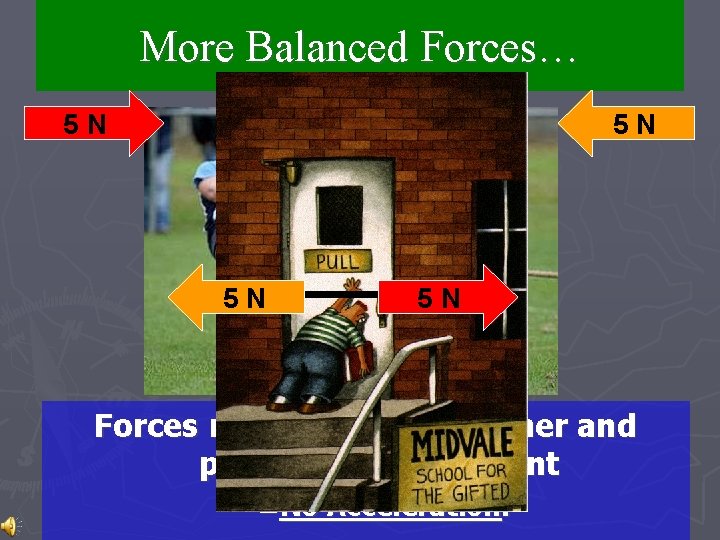
More Balanced Forces… 5 N 5 N Forces may cancel each other and produce no movement =No Acceleration!
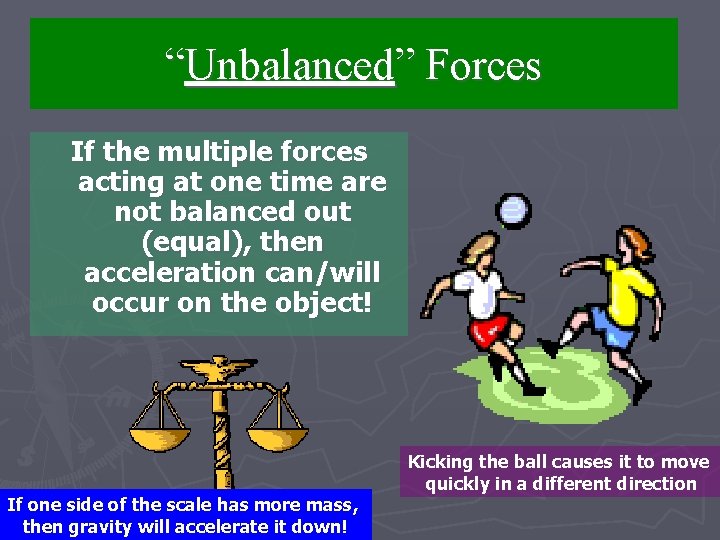
“Unbalanced” Forces If the multiple forces acting at one time are not balanced out (equal), then acceleration can/will occur on the object! If one side of the scale has more mass, then gravity will accelerate it down! Kicking the ball causes it to move quickly in a different direction
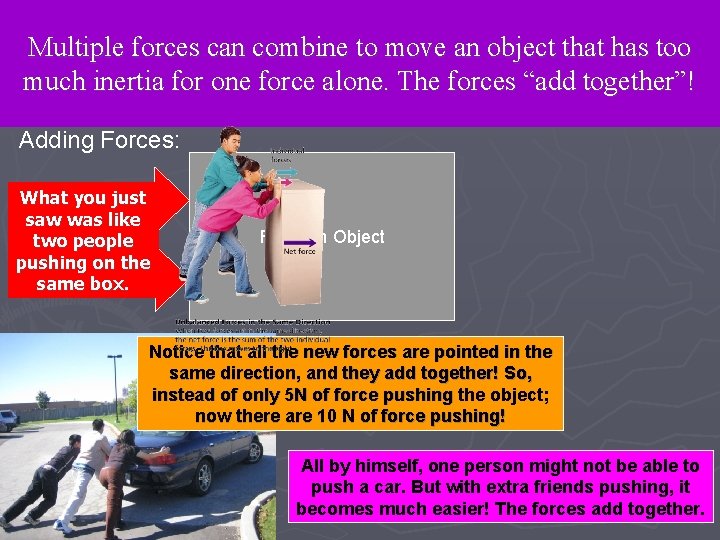
Forces Multiple forces Unbalanced can combine to move an object that has too much inertia for. Cause one force. Acceleration alone. The forces “add together”! Adding Forces: What you 5 just N saw was like two people pushing on the N same 5 box. Random Object Notice that all the new forces are pointed in the same direction, and they add together! So, instead of only 5 N of force pushing the object; now there are 10 N of force pushing! All by himself, one person might not be able to push a car. But with extra friends pushing, it becomes much easier! The forces add together.
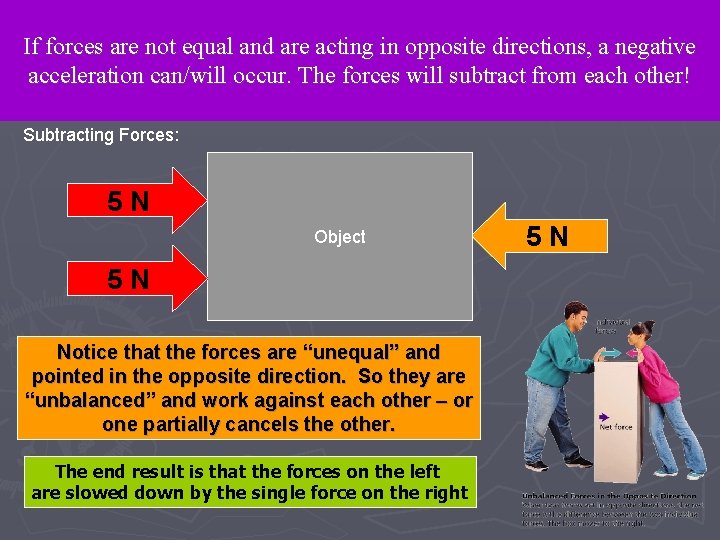
Unbalanced Forces Cause Acceleration If forces are not equal and are acting in opposite directions, a negative acceleration can/will occur. The forces will subtract from each other! Subtracting Forces: 5 N Object 5 N Notice that the forces are “unequal” and pointed in the opposite direction. So they are “unbalanced” and work against each other – or one partially cancels the other. The end result is that the forces on the left are slowed down by the single force on the right 5 N
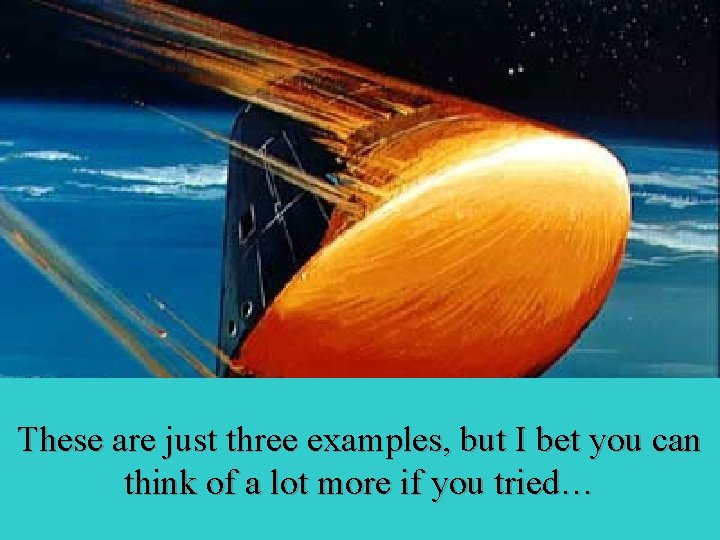
Why would you WANT a second force to slow down motion? Football players use force from their own bodies to slow If youaused therunning breaks with to slow down the car; maybe you down player the ball! The opposite force These are just three examples, but I bet you can The atmosphere creates an opposite force on a spaceship slowing it wouldn’t drive off the cliff you are aimed at…breaks create an from the first player will at least slow down the player down as itthink heads back down to Earth. if If it didn’t it would be almost of a lot more you tried… opposite to slow moving cars down. impossible to stop force the spacecraft it impacted the ground! with the before ball.
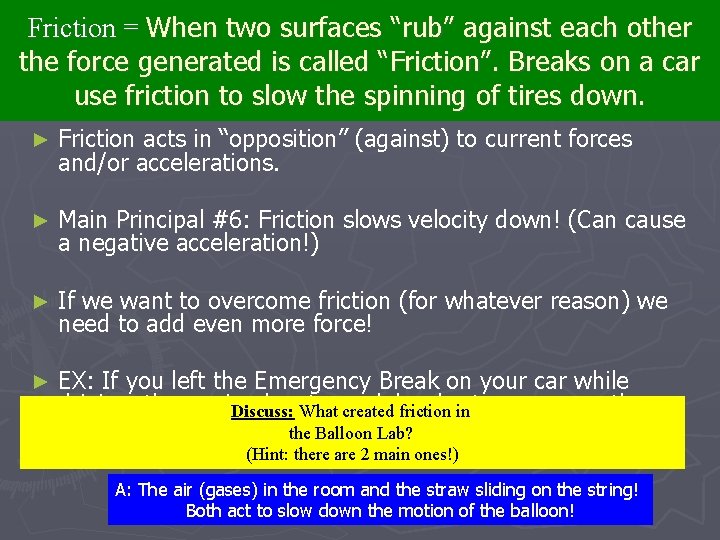
Friction = When two surfaces “rub” against each other the force generated called “Friction”. Breaks on a car Speakingis of slowing down! use friction to slow the spinning of tires down. ► Friction acts in “opposition” (against) to current forces and/or accelerations. ► Main Principal #6: Friction slows velocity down! (Can cause a negative acceleration!) ► If we want to overcome friction (for whatever reason) we need to add even more force! ► EX: If you left the Emergency Break on your car while driving, the engine has. What to work Discuss: created harder friction in to overcome the friction to make the car the move! Balloon Lab? (Hint: there are 2 main ones!) A: The air (gases) in the room and the straw sliding on the string! Both act to slow down the motion of the balloon!
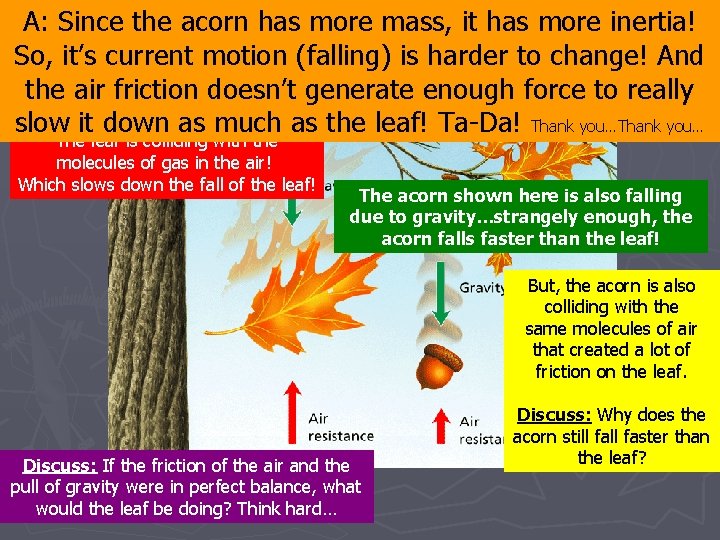
A: Since the acorn has more mass, it has more inertia! Gravity and Friction can combine in an So, it’s current motion (falling) is harder to unbalanced change! And force: enough force to really the air friction doesn’t generate slow it down as much as the leaf! Ta-Da! Thank you… The leaf is colliding with the molecules of gas in the air! Which slows down the fall of the leaf! The acorn shown here is also falling due to gravity…strangely enough, the acorn falls faster than the leaf! But, the acorn is also colliding with the same molecules of air that created a lot of friction on the leaf. Discuss: If the friction of the air and the pull of gravity were in perfect balance, what would the leaf be doing? Think hard… Discuss: Why does the acorn still faster than the leaf?
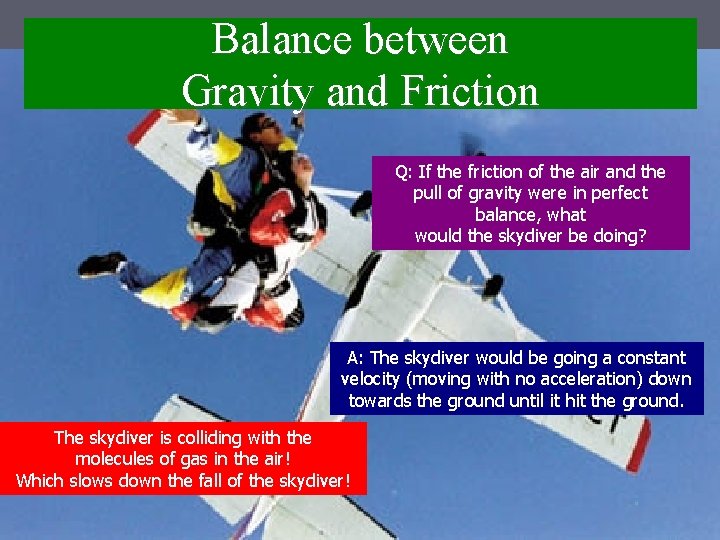
Balance between Gravity and Friction Q: If the friction of the air and the pull of gravity were in perfect balance, what would the skydiver be doing? A: The skydiver would be going a constant velocity (moving with no acceleration) down towards the ground until it hit the ground. The skydiver is colliding with the molecules of gas in the air! Which slows down the fall of the skydiver!
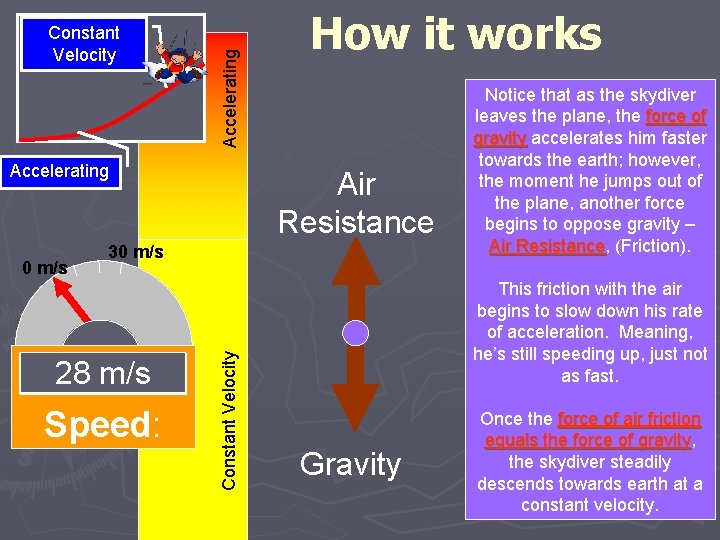
Accelerating Constant Velocity Accelerating Air Resistance 30 m/s 28 25 m/s 20 10 0 m/s Speed: Constant Velocity 0 m/s How it works Notice that as the skydiver leaves the plane, the force of gravity accelerates him faster towards the earth; however, the moment he jumps out of the plane, another force begins to oppose gravity – Air Resistance, Resistance (Friction). This friction with the air begins to slow down his rate of acceleration. Meaning, he’s still speeding up, just not as fast. Gravity Once the force of air friction equals the force of gravity, gravity the skydiver steadily descends towards earth at a constant velocity.
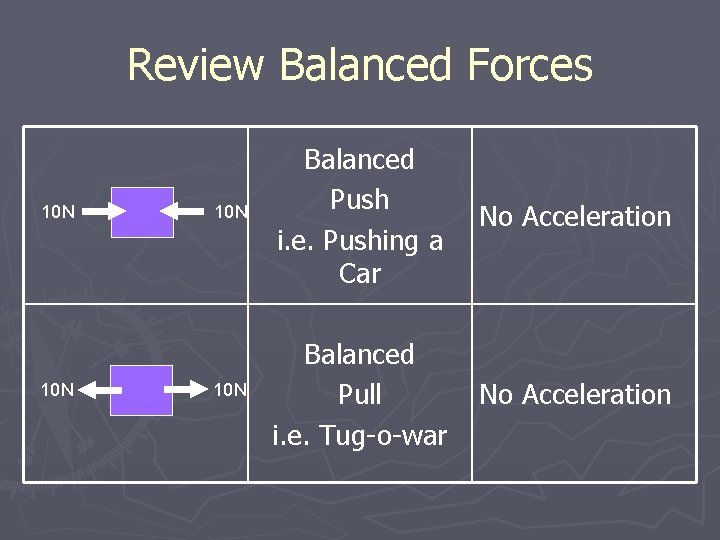
Review Balanced Forces 10 N 10 N Balanced Push i. e. Pushing a Car No Acceleration 10 N Balanced Pull i. e. Tug-o-war No Acceleration
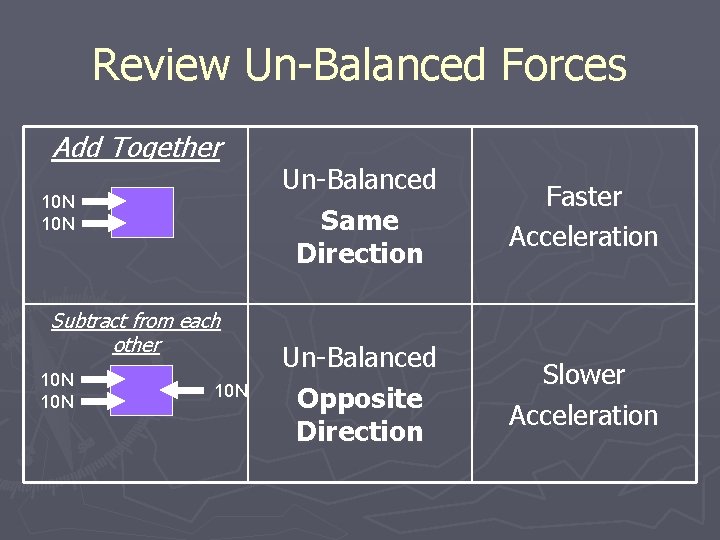
Review Un-Balanced Forces Add Together 10 N Subtract from each other 10 N 10 N Un-Balanced Same Direction Faster Acceleration Un-Balanced Opposite Direction Slower Acceleration
- Slides: 18