
Balanced Graph Partitioning Konstantin Andreev Harald Rcke k
Balanced Graph Partitioning Konstantin Andreev Harald Räcke
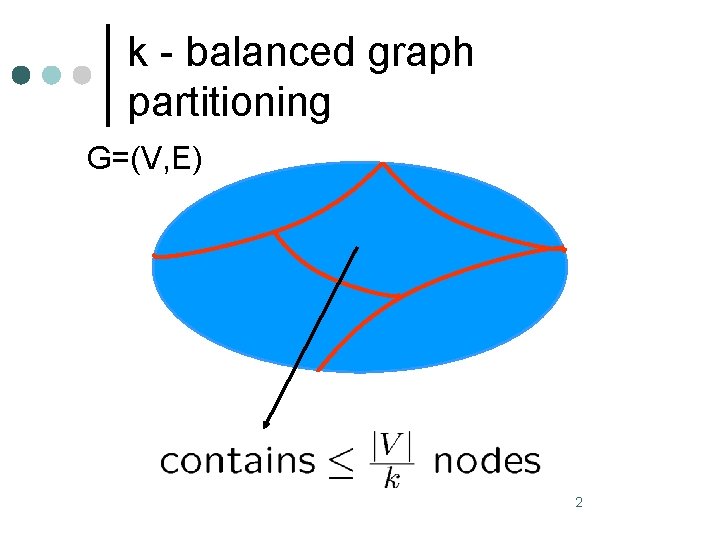
k - balanced graph partitioning G=(V, E) 2

Motivation ¢ Parallel Computing ¢ VLSI design ¢ Sparse Linear System Solving 3
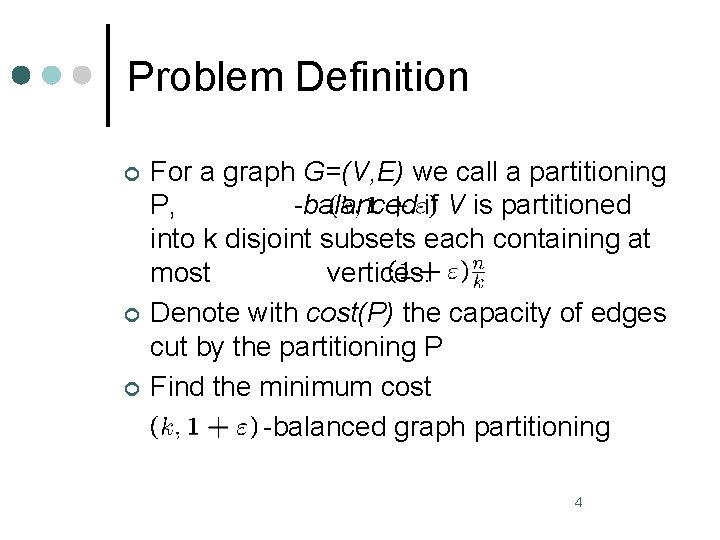
Problem Definition ¢ ¢ ¢ For a graph G=(V, E) we call a partitioning P, -balanced if V is partitioned into k disjoint subsets each containing at most vertices. Denote with cost(P) the capacity of edges cut by the partitioning P Find the minimum cost -balanced graph partitioning 4
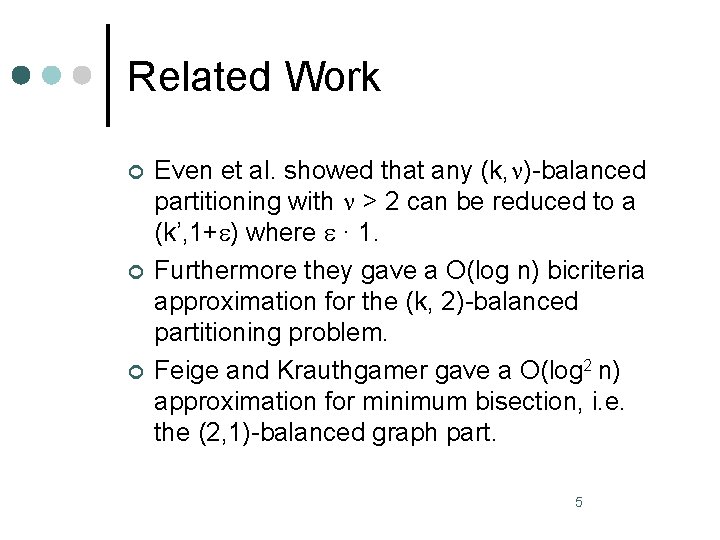
Related Work ¢ ¢ ¢ Even et al. showed that any (k, )-balanced partitioning with > 2 can be reduced to a (k’, 1+ ) where · 1. Furthermore they gave a O(log n) bicriteria approximation for the (k, 2)-balanced partitioning problem. Feige and Krauthgamer gave a O(log 2 n) approximation for minimum bisection, i. e. the (2, 1)-balanced graph part. 5
Our Results ¢ We prove that (k, 1)-balanced part. is inapproximable within any finite constant unless P=NP ¢ We present a O(log 2 n/ 4) factor bicriteria approximation for the (k, 1+ )balanced graph part. problem 6
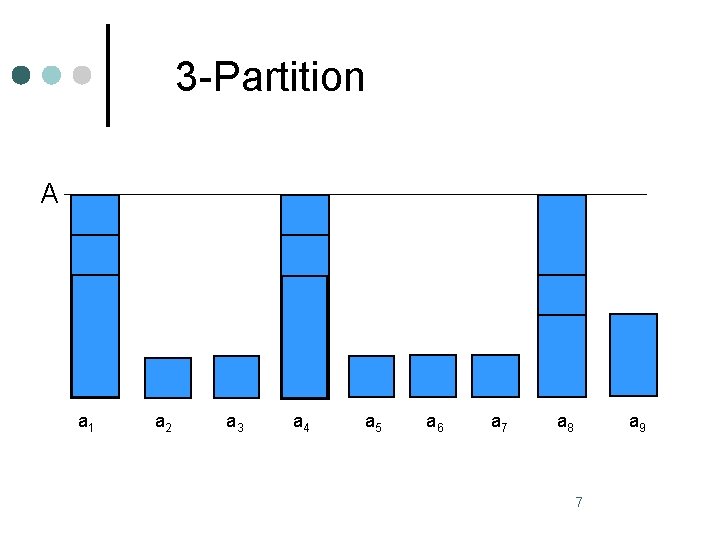
3 -Partition A a 1 a 2 a 3 a 4 a 5 a 6 a 7 a 8 a 9 7
Hardness Result ¢ 3 -Partition problem: Given a 1, a 2, . . , a 3 k integers, a threshold A s. t. A/4<ai<A/2 and ai = k. A, decide if the numbers can be partitioned into triples so that every triple sums up to exactly A. ¢ This problem is strongly NP-complete, i. e. it is NP-complete even if all ai and A are polynomialy bounded. 8
Reduction ¢ ¢ ¢ Assume we can approximate (k, 1)balanced graph part. within a finite factor. For an instance of 3 -Partition construct the graph G so that for every ai we have a clique of size ai and all of them are disconnected. 3 -Partition can be solved if the (k, 1)balanced graph part. algorithm can differentiate between not cutting edges and cutting at least one edge. 9
Hierarchical Decomposition 10
Decomposition Tree - T 11
Partitions induced by T 12
Partitions induced by T O(log n/ ) 13
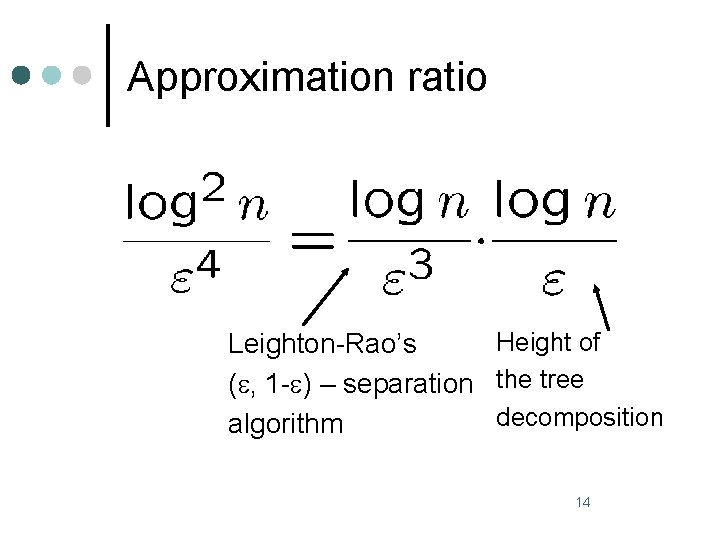
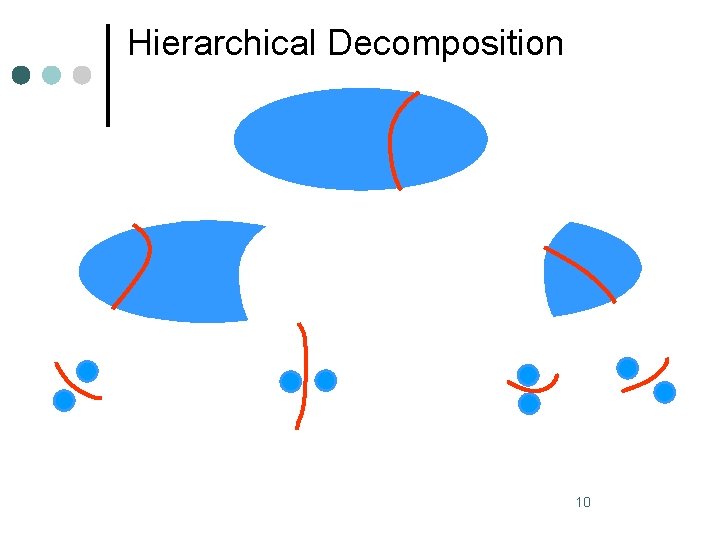
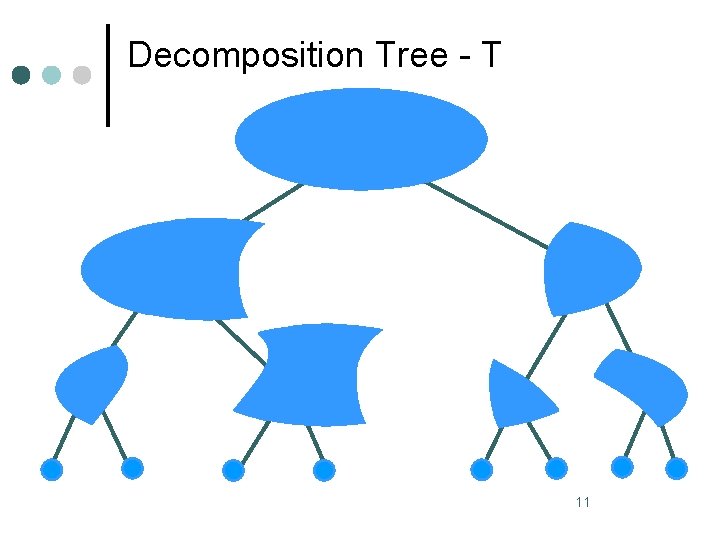
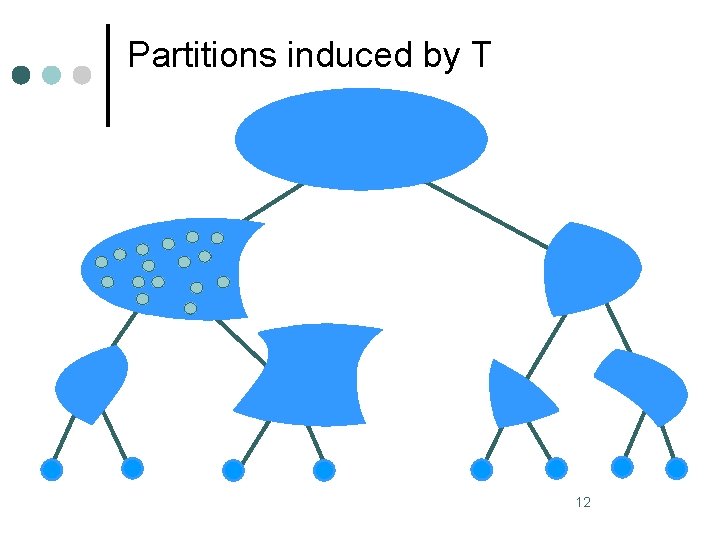
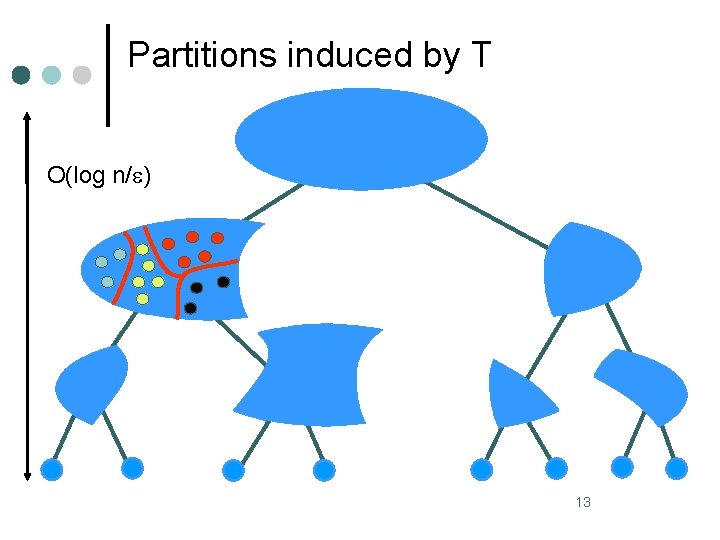
Approximation ratio Height of Leighton-Rao’s ( , 1 - ) – separation the tree decomposition algorithm 14
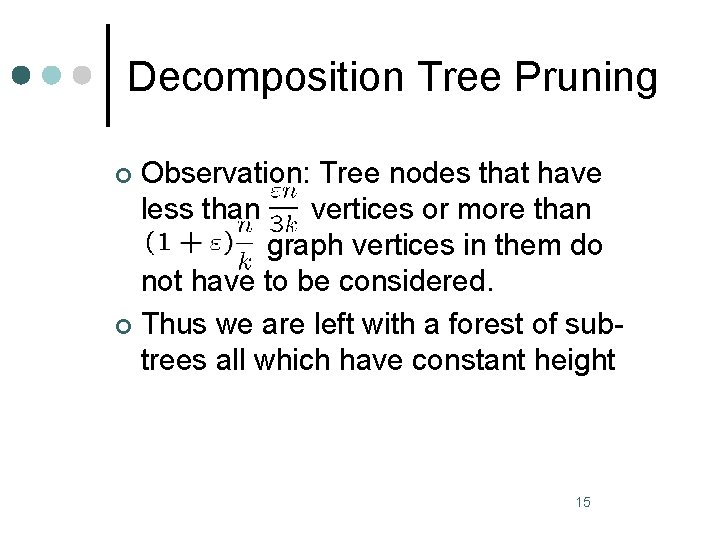
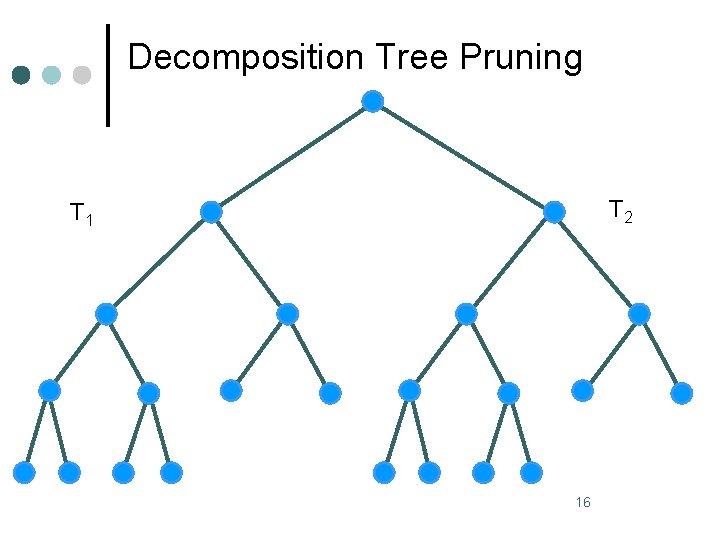
Decomposition Tree Pruning Observation: Tree nodes that have less than vertices or more than graph vertices in them do not have to be considered. ¢ Thus we are left with a forest of subtrees all which have constant height ¢ . 15
Decomposition Tree Pruning T 2 T 1 16
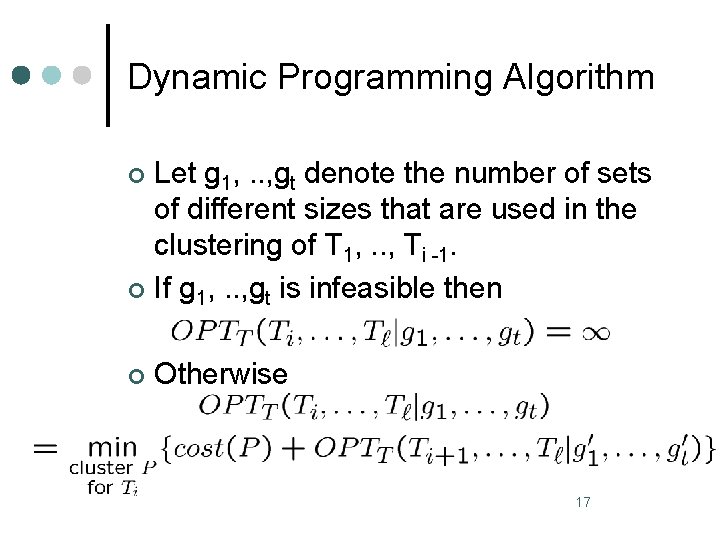
Dynamic Programming Algorithm Let g 1, . . , gt denote the number of sets of different sizes that are used in the clustering of T 1, . . , Ti -1. ¢ If g 1, . . , gt is infeasible then ¢ ¢ Otherwise 17
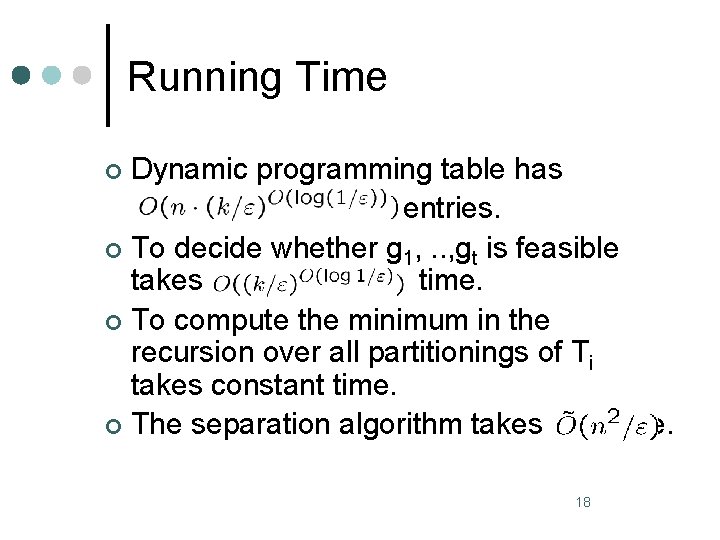
Running Time Dynamic programming table has entries. ¢ To decide whether g 1, . . , gt is feasible takes time. ¢ To compute the minimum in the recursion over all partitionings of Ti takes constant time. ¢ The separation algorithm takes time. ¢ 18
Future Work ¢ Solve the generalized problem when different partitions are required to have different sizes. ¢ Improve the dependence on 1/ of the approximation ratio or the running time. ¢ Improve the approximation ratio. 19

Thank you! 20
- Slides: 20