
BALANCED BINARY SEARCH TREE Happy Halloween SO FAR
BALANCED BINARY SEARCH TREE Happy Halloween!

SO FAR: • Lists: • Find: Worst case takes O(n) (bleh, ugh) • Binary Search Trees: • Each Node has 0 -2 successors • For Every Node: • The data in the left child is less than the data in the node • The data in the right child is greater than the data in the node

BST EXAMPLE 24 4 2 1 36 13 3 7 55 29 17 32 42 62 • With n being the number of nodes in a tree, and k being the number of levels in the tree: • if n is between 2 k-1 and 2 k (excluding 2 k), it will take at most k steps to find any node in the tree • which is O(log n) Every comparison, should eliminate half of the nodes necessary for future comparison … if tree is balanced 3
THIS IS ALSO A BINARY SEARCH TREE (BLEH, UGH!!!) [1 | 2 | 4 | 7 | 13 | 24 | 29 | 32 | 36 | 42 | 55] 1 2 4 7 13 24 This is not balanced. 29 Every advantage of finding in a binary search tree versus finding 32 in an array/linked list gets obliterated with this tree There are 11 nodes, and it could take 11 comparisons to find if a number is in the list. 36 42 55 Worst Case: O(n)! (bleh, ugh) 4 <- left right ->
MORE THAN ONE WAY TO MAINTAIN A BALANCED BINARY SEARCH TREE. • Red Black Trees • B-Tree • 2 -3 Tree • AVL Tree • All allow us to insert, delete, and find in O(log 2 n)

AVL TREES: • AVL Trees: Balanced binary search tree • Named after inventors: Adelson-Velskii and Landis • In AVL Trees, EVERY node is balanced • The height of the left subtree and the height of the right subtree differ by no more than one ---------------------------0002 lk 11 <- left YES! NO! 1 y `gfv 5 r right -> YES!
BALANCE • To find the balance of a node: • Take the Height of the left child • And the height of the right child • Remember, if there isn’t a child, the height is 0 • Subtract the height of the right node from the height of the left node • That is a node’s balance n->leftchild->height - n->rightchild->height • Remember, we see the tree wholistically. The computer sees one node at a time. So we can look at a tree and see that it’s pretty much balanced. The computer has to check one node at a time.
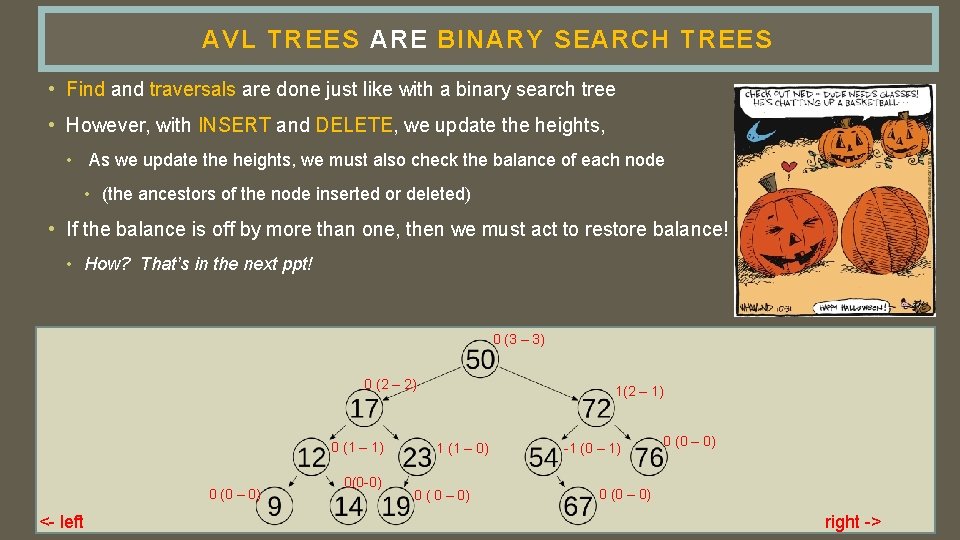
AVL TREES ARE BINARY SEARCH TREES • Find and traversals are done just like with a binary search tree • However, with INSERT and DELETE, we update the heights, • As we update the heights, we must also check the balance of each node • (the ancestors of the node inserted or deleted) • If the balance is off by more than one, then we must act to restore balance! • How? That’s in the next ppt! 0 (3 – 3) 0 (2 – 2) 0 (1 – 1) 0 (0 – 0) <- left 0(0 -0) 1(2 – 1) 1 (1 – 0) 0 ( 0 – 0) -1 (0 – 1) 0 (0 – 0) right ->
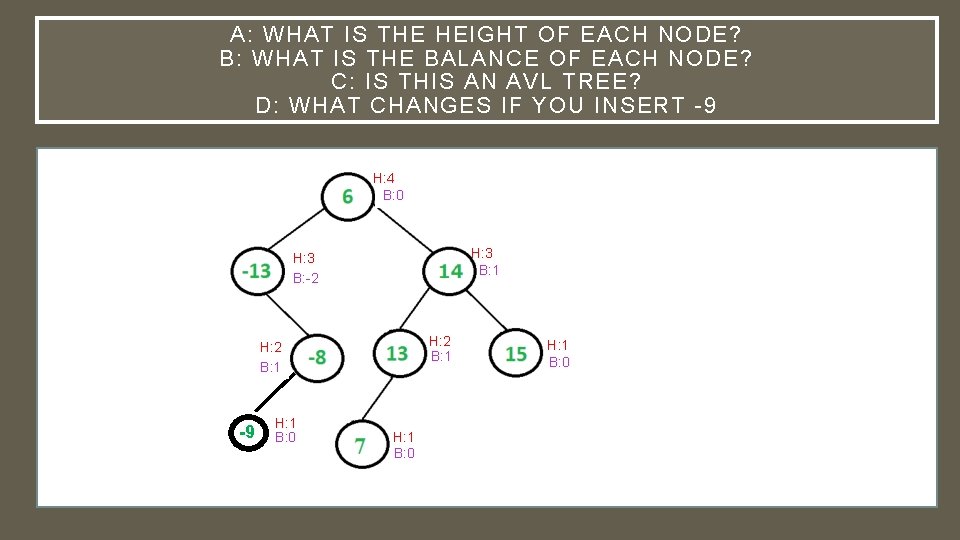
A: WHAT IS THE HEIGHT OF EACH NODE? B: WHAT IS THE BALANCE OF EACH NODE? C: IS THIS AN AVL TREE? D: WHAT CHANGES IF YOU INSERT -9 H: 4 B: -1 B: 0 H: 3 B: 1 H: 2 H: 3 B: -1 B: -2 H: 2 B: 1 H: 2 B: 0 B: 1 -9 H: 1 B: 0
TAKE-AWAYS! • Many Balanced Binary Search Trees • AVL – balance maintained by keeping track of balance of each node • Balance definition: when the height of the left subtree and the height of the right subtree differ by no more than one • Balance calculated – height of left child – height of right child • Balance Changes when we insert and delete • Because height might change
- Slides: 10