
Balanced And Unbalanced Growth Theory Introduction There are
Balanced And Unbalanced Growth Theory
Introduction There are two theories concerning strategy of economic development: • The central idea of the Balanced Growth Strategy (BGS) is that the best strategy to accelerating the growth process in the UDCs is to make investment in a large number of industries/sectors that are technologically and market-wise related. • On the other hand the central idea of the Unbalanced Growth Strategy (UGS) is that the best strategy to accelerating the growth process in the UDCs is deliberate unbalancing of the economy as per a pre-designed strategy.
Balanced Growth Strategy • The doctrine of Balanced Growth Strategy (BGS) has been ascribed by a galaxy of scholars. • This concept was first used by a leading 19 th-century German. American economist ‘Friedrich List’ and then by American economist ‘Allyn Abbott Young’ in 1928 . • There are three approached to theory of Balanced Growth that are commonly followed- First given by Nurkse, second given by W. A. Lewis and third approach is given by P. N. R. Rodan.
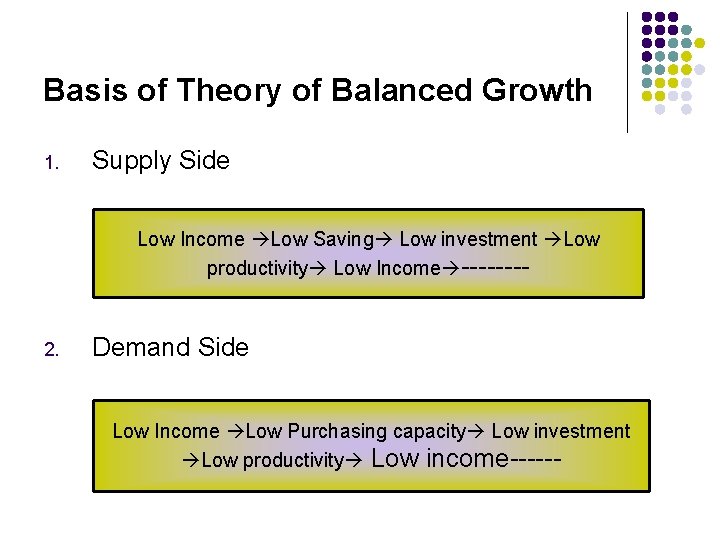
Basis of Theory of Balanced Growth 1. Supply Side Low Income Low Saving Low investment Low productivity Low Income ---- 2. Demand Side Low Income Low Purchasing capacity Low investment Low productivity Low income------
Nurkse’s Approach He argued that underdeveloped countries (UDCs) are in a firm grip of vicious circle of poverty where poverty seems to be the cause and effect of poverty. He looked at the problem of vicious circle of poverty from two sides which are operating simultaneously. They are: • • The supply side argument: explains that the capacity to save of UDCs is severely limited by their low level of income earned. The demand side argument: on the other hand explains the low level of income resulting in a lack of demand by the consumers and producers leading to a limited size of the market. Ø According to Nurkse, the UDCs also face one other circle of poverty that operates in terms of market imperfections. Ø So, in order to break the vicious circle of poverty in UDCs, the way out is to set up a number of factories producing different goods that are market-wise and technologically interdependent
Ø So that workers working in one firm are the buyers of another firm and viceversa i. e. there should be a synchronized application of capital in a number of factories simultaneously Ø So as to cater to the complementarities of demand. If such kind of investment is made then the size of the market will expand. Ø There’ll be no deficiency of demand all benefits will be realized terms of cheap goods both domestically and internationally. Ø According to him a single factory fails and many factories succeed to come out of the vicious circle of poverty through their forward and backward linkages. Ø He argued that it is the role of the state to undertake measures that promote industrial linkages, division of labour and hence expansion in the size of the markets. Ø These measures include investment in social overhead capital, reduction in transport cost and adoption of the policy of laissez faire in international trade. He also argued that as the domestic production rises, there is expansion of foreign markets also.
Rodenstein Rodan’s Approach According to an article ‘Notes on Big Push’(1957) by Rodan, if we want to pull out the underdeveloped economies from the low levels of equilibrium trap then we must choose a strategy that is market wise and technology wise interdependent. There are three mechanisms for generating big push in an economy. They are: (1) Indivisibility in production function: Production function explains a technological way in which inputs can be transformed into output. Rodan regards investment in social overhead capital (SOC) vital for this transformation. SOC is characterised by four indivisibilities, • it is irreversible in time and, therefore, must precede other directly productive investments. • Second, equipment of SOC has high minimum durability. • Third, development of SOC needs a long gestation period. • Last, it is an irreducible industry mix of different kinds of public utilities.
(2) Indivisibility of Demand: The indivisibility or complementarities of demand requires simultaneous setting up of interdependent industries in interdependent countries to enlarge the size of the market. (3) Indivisibility in savings: there is dearth of capital in the form of plant, machinery, equipment etc due to the low levels of savings in these economies. If these countries are able to accelerate their incremental savings ratio, then it could be translated into development of large stock of capital.
Lewis’s Theory According to Lewis “Balance growth means that all sectors of economy should grow simultaneously so as to keep a proper balance between industry and agriculture and between production for home consumption and production for exports. The truth is that all sectors should be expanded simultaneously. ” Lewis has given the following two arguments in favour of balanced growth: (1) In the absence of balanced growth, price in one sector may be more than the prices in others. Because of balanced growth, equality in comparative prices in all the sectors will be maintained and all the sectors will continue to grow. (2) When the economy grows then several bottlenecks appear in different sectors. However, in case of balanced growth it is possible to increase production of those goods whose income elasticity of demand is more. Consequently, chances of bottlenecks in different sectors will be remote.
Advantage of Theory of Balanced Growth ü Large size of Market ü External Economies ü Horizontal Economies ü Vertical Economies ü Better Division of Labour ü Better Use of Capital ü Rapid Rate of Development ü Encouragement of Private Enterprises ü Breaking of Vicious Circle of Poverty ü Encouragement of International Specialization ü Development of Social Overhead Costs
Criticism of Theory of Balanced Growth This theory Criticized by Fleming, Singer, Hirschman and Kurihara. l l l l l Unrealistic or Ignores Scarcity of Resources. Ignores the Need of Planning. External Diseconomies. Development from Scratch. Not a Theory of Development. Same Policy for Developed and Underdeveloped countries. Not supported by History. Scarcity of Factors of Production. Inflation. Contrary to the Theory of Comparative Costs.
Unbalanced Growth Strategy • Scholars like A. O. Hirschman, Rostow, Fleming and Singer propounded theory of unbalanced growth as a strategy of development to be used by the UDCs. • This theory stresses on the need of investment in strategic sectors of the economy instead of all the sectors simultaneously. According to this theory the other sectors would automatically develop themselves through what is known as “linkages effect”. • Competitions, tensions, pressures as well as inducements are inevitable outcomes of unbalancing growth.
Explanation of the Theory of Unbalanced Growth • Prof. Hirschman states in his book, “Strategies of Economic Development”, that creating imbalances in the system is the best strategy of growth. Accordingly, strategic sectors of the economy should get priority in matters of investment. • He defined two series of investment i. e Convergent series (investments that appropriate more economies from the proceeding investments than what they create) and Divergent series (investments that create economies which will be appropriated by their succeeding investments), out of which he prefers divergent series of investment over convergent series of investment. • Divergent series of investment are in Social Overhead Capital (SOC) which is high on social profitability rather than private profitability, whereas convergent series of investment is guided by Directly Productive Activities (DPA) whose main objective is private profitability.
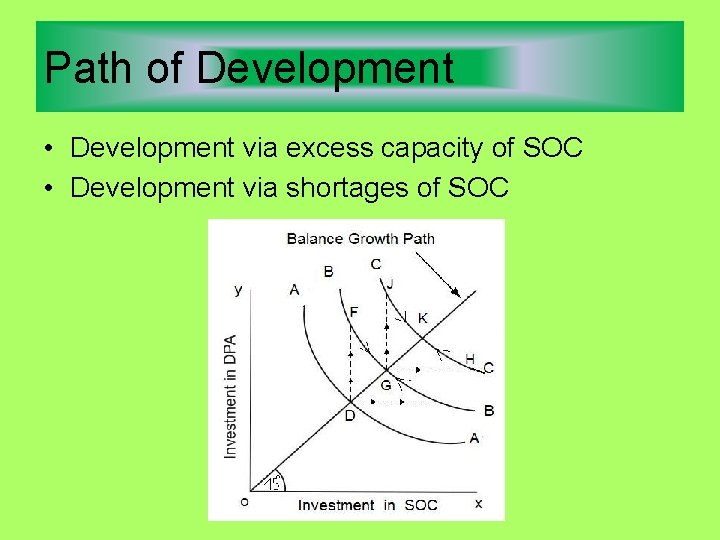
Path of Development • Development via excess capacity of SOC • Development via shortages of SOC
Forward and Backward Linkages How to identity the activities with which to create imbalances in the system. This necessitates the knowledge of inter-linkages across different sectors, Hirschman classifies theses linkages as: (1)Backward linkages (2) Forward linkages • Hirschman relied heavily on investing in SOC for creating imbalances because investment in SOC creates more external economies than what it appropriates. • Its backward linkages are weak but forward linkages are strong. • It encourages private investment in DPA and is safer than DPA. Its base is diversified and wider than that of DPA.
Feature of the Theory of Unbalanced Growth Ø Investment should first be made in the key sectors of the economy. Ø Based on the principle of inducement & pressures. Ø Based on Real life observations Ø Significance of the Public sector with regard to SOC activities
Merits of the Theory of Unbalanced Growth • The developing countries do not have the adequate capital to invest in all sectors of economy. So if investment is concentrated at the potential and selective sector only, then the developing countries can get their economy with better growth. • The unbalance condition of economy creates the balanced condition which further makes the economy unbalance and finally economy is balanced. It is a non- ending process. • This theory decentralises the mechanism of decision making and hence will be more useful for the underdeveloped areas.
Demerits of Unbalanced Growth Theory • This theory puts undue emphasis on industrialization notwithstanding the significance of agriculture sector. This reflects the possibility of lop-sided development in the society. • Due to long gestation period in the industries, in the short-run there might be some degree of inflationary pressures. • Thirlwall criticizes theory by arguing that it may lead to concentration of production in one or two commodities and this may adversely affect the BOP if these commodities are price inelastic and income inelastic in demand.
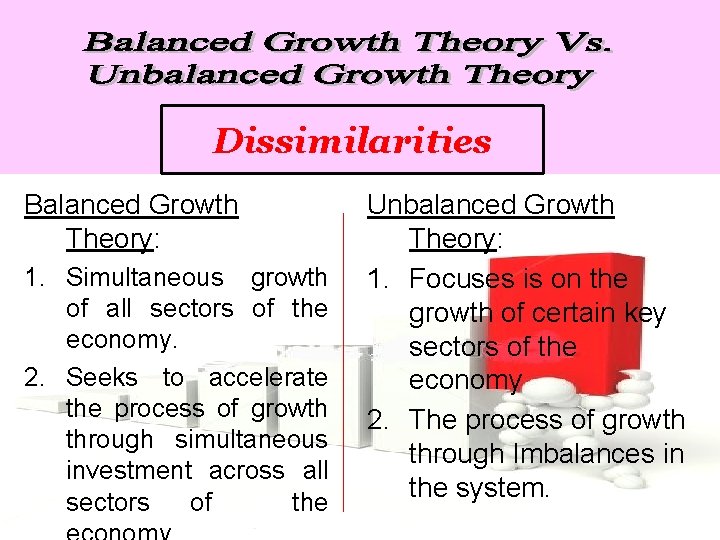
Dissimilarities Balanced Growth Theory: 1. Simultaneous growth of all sectors of the economy. 2. Seeks to accelerate the process of growth through simultaneous investment across all sectors of the Unbalanced Growth Theory: 1. Focuses is on the growth of certain key sectors of the economy 2. The process of growth through Imbalances in the system.
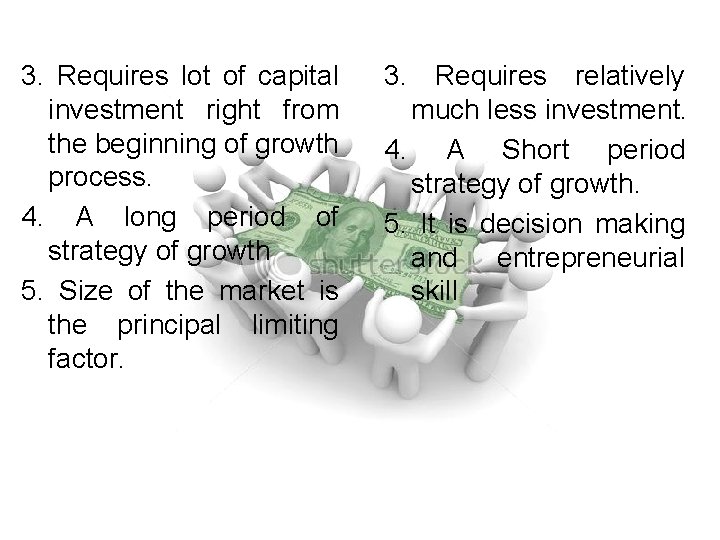
3. Requires lot of capital investment right from the beginning of growth process. 4. A long period of strategy of growth 5. Size of the market is the principal limiting factor. 3. Requires relatively much less investment. 4. A Short period strategy of growth. 5. It is decision making and entrepreneurial skill
Summary The BGS stresses on setting up a number of industries simultaneous to cater to complementarities of demand. By doing so, the size of the market will increase and hence economies of scale could be realized. And increase in the scale of production will lead to reduction of cost in the long run. • The theory of BGS neglects the role of technology as it lays more or undue emphasis on capital formation. • The theory of UGS decentralizes the mechanism of decision making and hence will be more useful for the underdeveloped areas. • The theory of UGS puts undue emphasis industrialization notwithstanding the significance of agriculture sector. This reflects the possibility of lop-sided development in the society.

- Slides: 22