
Balance Sheet and Statement of Cash Flows Chapter
Balance Sheet and Statement of Cash Flows Chapter 5 Intermediate Accounting 12 th Edition Kieso, Weygandt, and Warfield Chapter 5 -1 Prepared by Coby Harmon, University of California, Santa Barbara
Learning Objectives 1. Explain the uses and limitations of a balance sheet. 2. Identify the major classifications of the balance sheet. 3. Prepare a classified balance sheet using the report and account formats. 4. Determine which balance sheet information requires supplemental disclosure. 5. Describe the major disclosure techniques for the balance sheet. 6. Indicate the purpose of the statement of cash flows. 7. Identify the content of the statement of cash flows. 8. Prepare a statement of cash flows. 9. Understand the usefulness of the statement of cash flows. Chapter 5 -2

Balance Sheet and Statement of Cash Flows Balance Sheet Usefulness Limitations Classification Additional information reported Techniques of disclosure Chapter 5 -3 Statement of Cash Flows Purpose Content and format Preparation Usefulness
Balance Sheet Usefulness of the Balance Sheet Evaluating the capital structure. Assess risk and future cash flows. Analyze the company’s: Chapter 5 -4 Ø Liquidity, Ø Solvency, and Ø Financial flexibility. LO 1 Explain the uses and limitations of a balance sheet.
Balance Sheet Limitations of the Balance Sheet Most assets and liabilities are reported at historical cost. Use of judgments and estimates. Many items of financial value are omitted. Chapter 5 -5 LO 1 Understand the uses and limitations of an income statement.
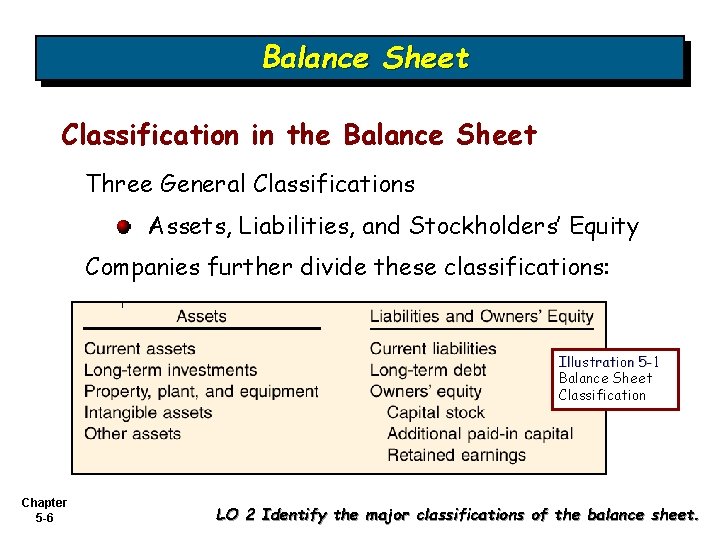
Balance Sheet Classification in the Balance Sheet Three General Classifications Assets, Liabilities, and Stockholders’ Equity Companies further divide these classifications: Illustration 5 -1 Balance Sheet Classification Chapter 5 -6 LO 2 Identify the major classifications of the balance sheet.
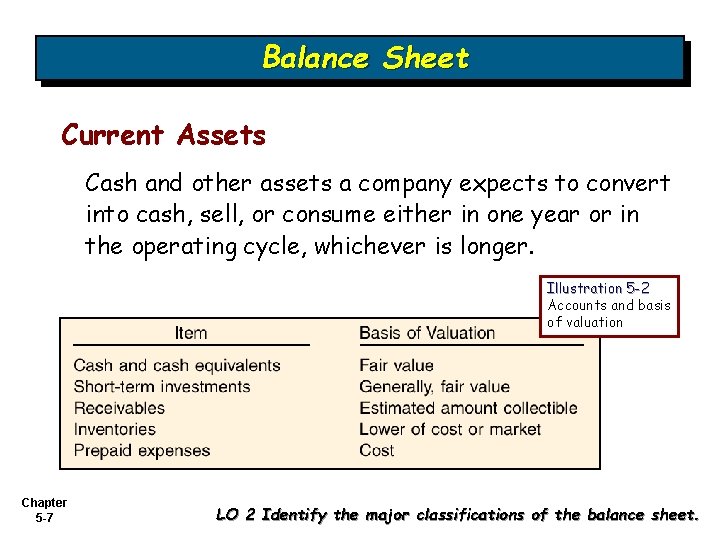
Balance Sheet Current Assets Cash and other assets a company expects to convert into cash, sell, or consume either in one year or in the operating cycle, whichever is longer. Illustration 5 -2 Accounts and basis of valuation Chapter 5 -7 LO 2 Identify the major classifications of the balance sheet.
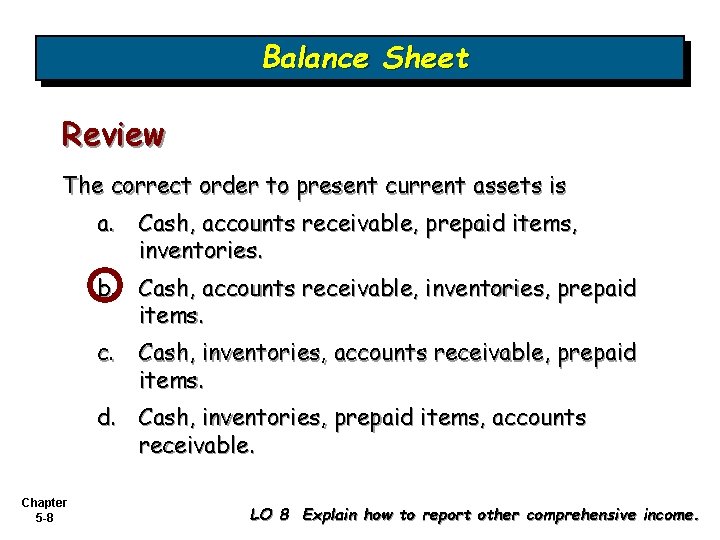
Balance Sheet Review The correct order to present current assets is a. Cash, accounts receivable, prepaid items, inventories. b. Cash, accounts receivable, inventories, prepaid items. c. Cash, inventories, accounts receivable, prepaid items. d. Cash, inventories, prepaid items, accounts receivable. Chapter 5 -8 LO 8 Explain how to report other comprehensive income.
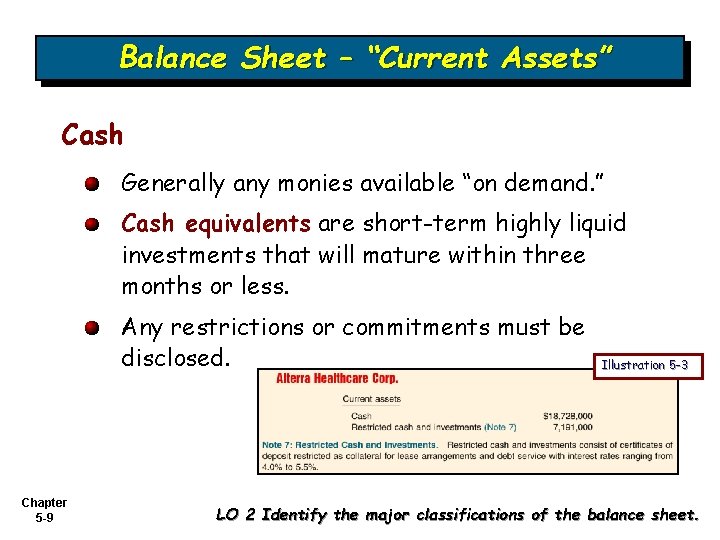
Balance Sheet – “Current Assets” Cash Generally any monies available “on demand. ” Cash equivalents are short-term highly liquid investments that will mature within three months or less. Any restrictions or commitments must be disclosed. Chapter 5 -9 Illustration 5 -3 LO 2 Identify the major classifications of the balance sheet.
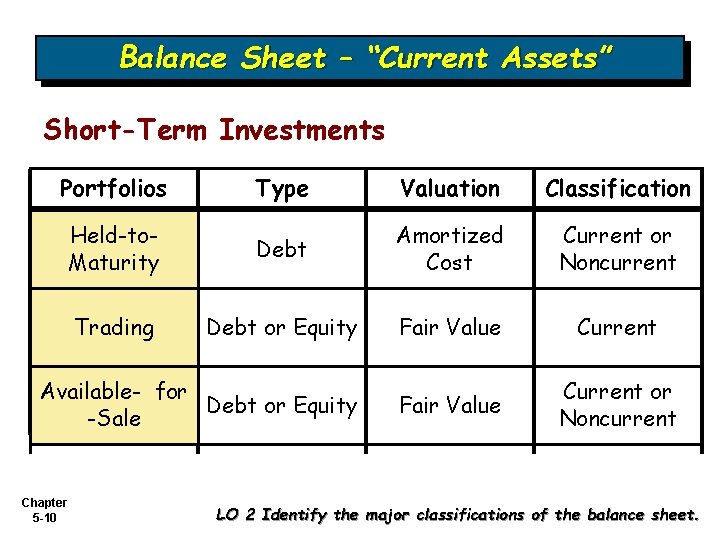
Balance Sheet – “Current Assets” Short-Term Investments Portfolios Type Valuation Classification Held-to. Maturity Debt Amortized Cost Current or Noncurrent Trading Debt or Equity Fair Value Current or Noncurrent Available- for Debt or Equity -Sale Chapter 5 -10 LO 2 Identify the major classifications of the balance sheet.
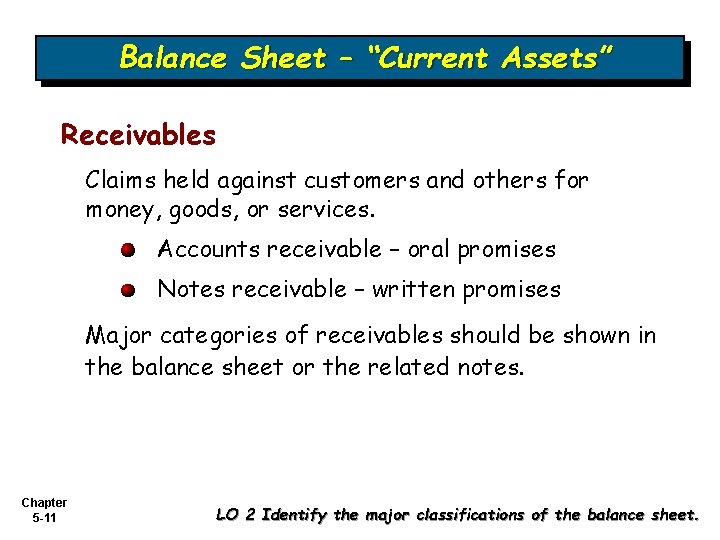
Balance Sheet – “Current Assets” Receivables Claims held against customers and others for money, goods, or services. Accounts receivable – oral promises Notes receivable – written promises Major categories of receivables should be shown in the balance sheet or the related notes. Chapter 5 -11 LO 2 Identify the major classifications of the balance sheet.
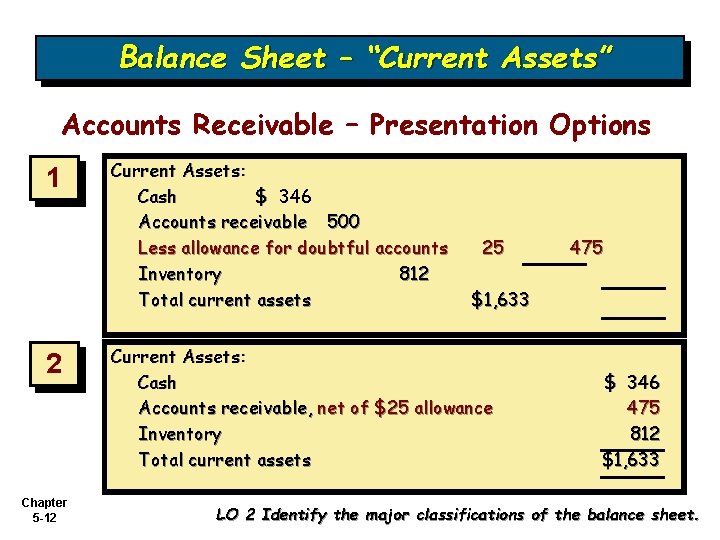
Balance Sheet – “Current Assets” Accounts Receivable – Presentation Options 1 2 Chapter 5 -12 Current Assets: Cash $ 346 Accounts receivable 500 Less allowance for doubtful accounts Inventory 812 Total current assets 25 475 $1, 633 Current Assets: Cash Accounts receivable, net of $25 allowance Inventory Total current assets $ 346 475 812 $1, 633 LO 2 Identify the major classifications of the balance sheet.
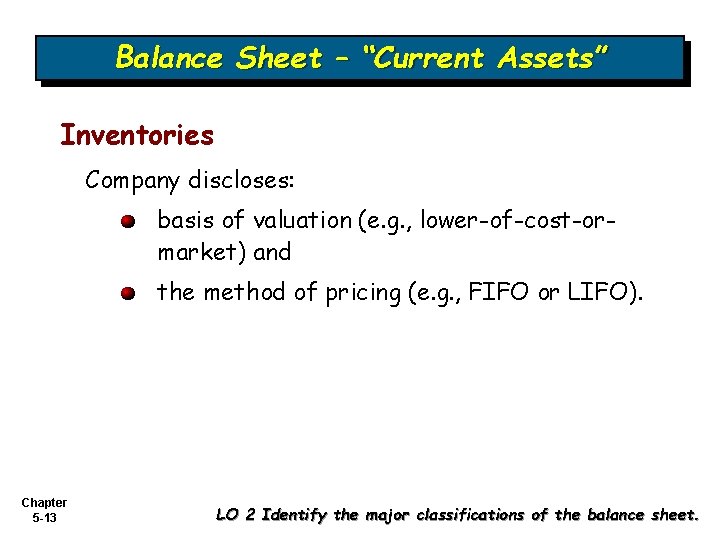
Balance Sheet – “Current Assets” Inventories Company discloses: basis of valuation (e. g. , lower-of-cost-ormarket) and the method of pricing (e. g. , FIFO or LIFO). Chapter 5 -13 LO 2 Identify the major classifications of the balance sheet.
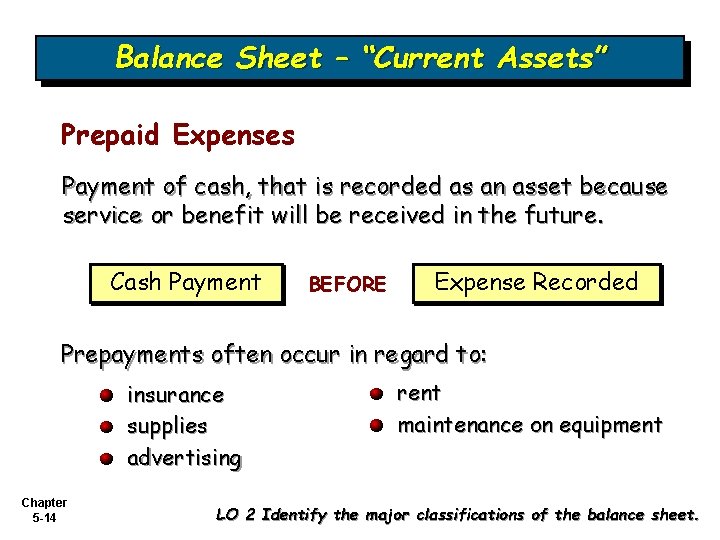
Balance Sheet – “Current Assets” Prepaid Expenses Payment of cash, that is recorded as an asset because service or benefit will be received in the future. Cash Payment BEFORE Expense Recorded Prepayments often occur in regard to: insurance supplies advertising Chapter 5 -14 rent maintenance on equipment LO 2 Identify the major classifications of the balance sheet.
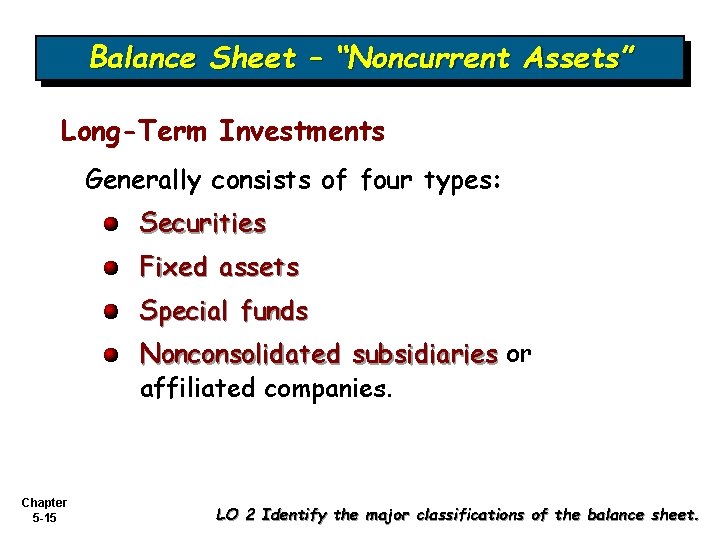
Balance Sheet – “Noncurrent Assets” Long-Term Investments Generally consists of four types: Securities Fixed assets Special funds Nonconsolidated subsidiaries or affiliated companies. Chapter 5 -15 LO 2 Identify the major classifications of the balance sheet.
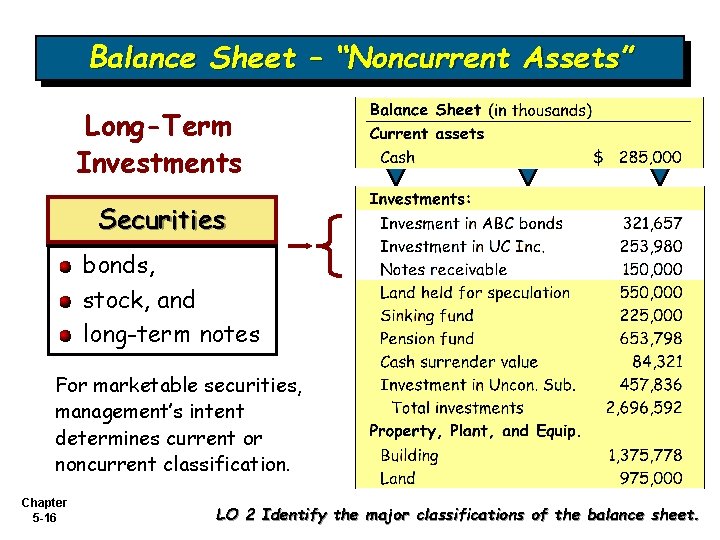
Balance Sheet – “Noncurrent Assets” Long-Term Investments Securities bonds, stock, and long-term notes For marketable securities, management’s intent determines current or noncurrent classification. Chapter 5 -16 LO 2 Identify the major classifications of the balance sheet.
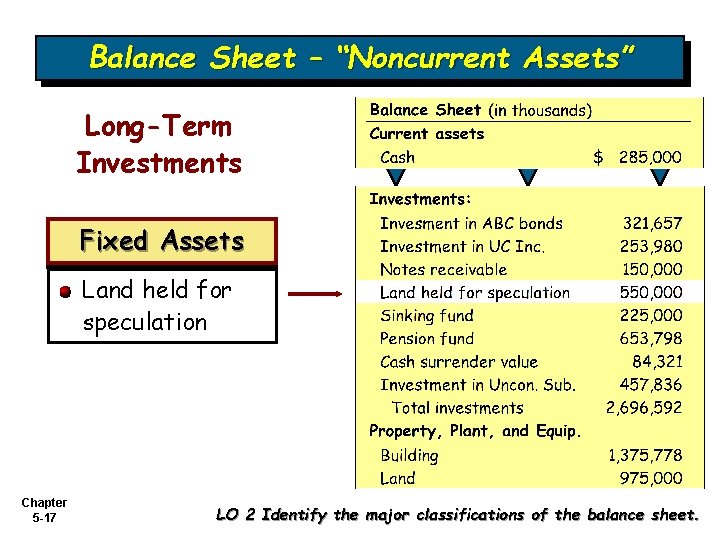
Balance Sheet – “Noncurrent Assets” Long-Term Investments Fixed Assets Land held for speculation Chapter 5 -17 LO 2 Identify the major classifications of the balance sheet.
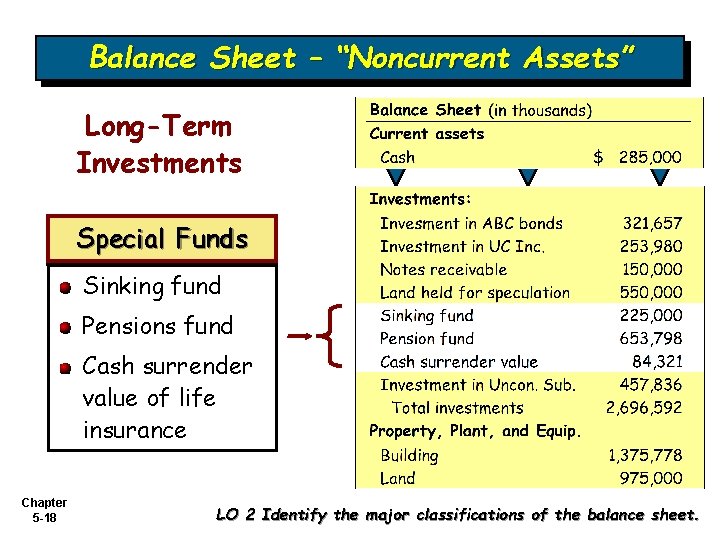
Balance Sheet – “Noncurrent Assets” Long-Term Investments Special Funds Sinking fund Pensions fund Cash surrender value of life insurance Chapter 5 -18 LO 2 Identify the major classifications of the balance sheet.
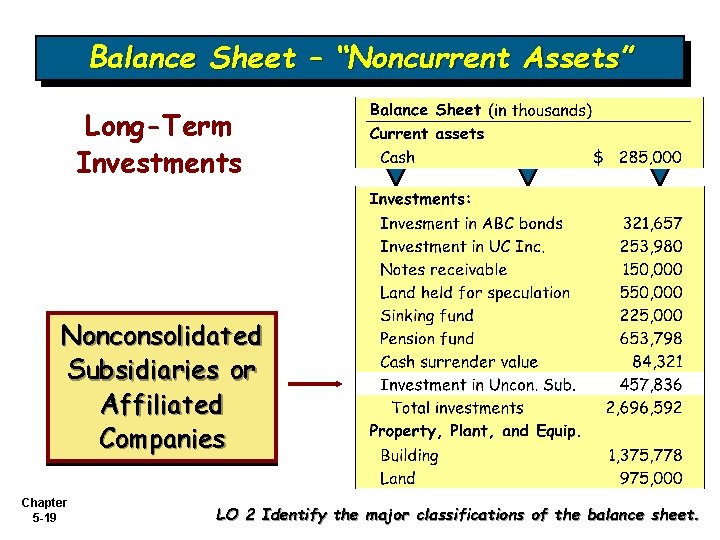
Balance Sheet – “Noncurrent Assets” Long-Term Investments Nonconsolidated Subsidiaries or Affiliated Companies Chapter 5 -19 LO 2 Identify the major classifications of the balance sheet.
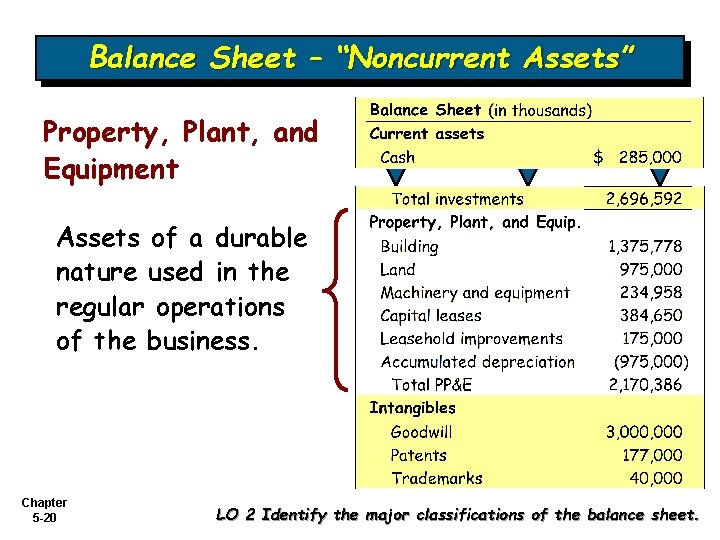
Balance Sheet – “Noncurrent Assets” Property, Plant, and Equipment Assets of a durable nature used in the regular operations of the business. Chapter 5 -20 LO 2 Identify the major classifications of the balance sheet.
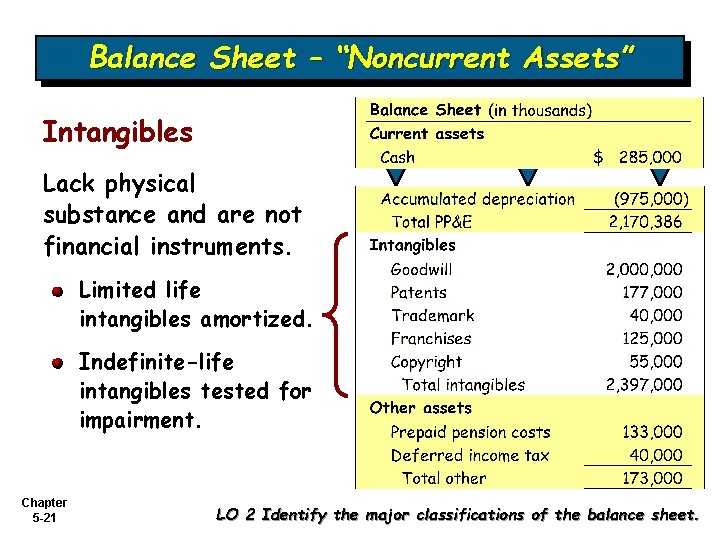
Balance Sheet – “Noncurrent Assets” Intangibles Lack physical substance and are not financial instruments. Limited life intangibles amortized. Indefinite-life intangibles tested for impairment. Chapter 5 -21 LO 2 Identify the major classifications of the balance sheet.
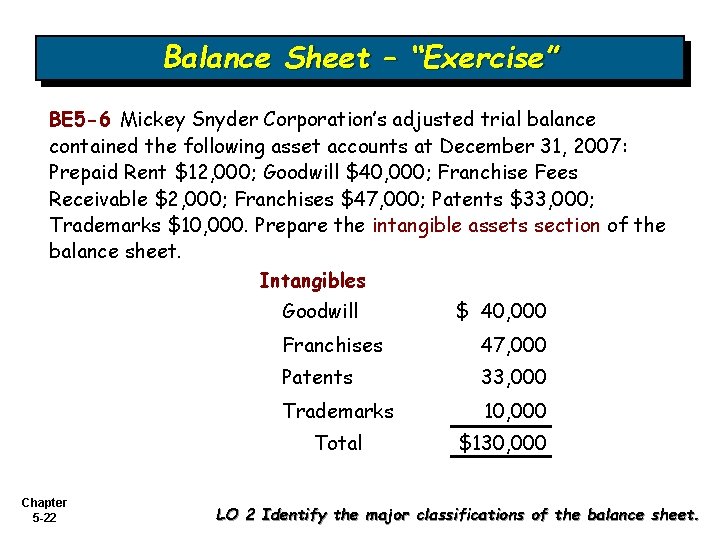
Balance Sheet – “Exercise” BE 5 -6 Mickey Snyder Corporation’s adjusted trial balance contained the following asset accounts at December 31, 2007: Prepaid Rent $12, 000; Goodwill $40, 000; Franchise Fees Receivable $2, 000; Franchises $47, 000; Patents $33, 000; Trademarks $10, 000. Prepare the intangible assets section of the balance sheet. Intangibles Goodwill Franchises 47, 000 Patents 33, 000 Trademarks 10, 000 Total Chapter 5 -22 $ 40, 000 $130, 000 LO 2 Identify the major classifications of the balance sheet.
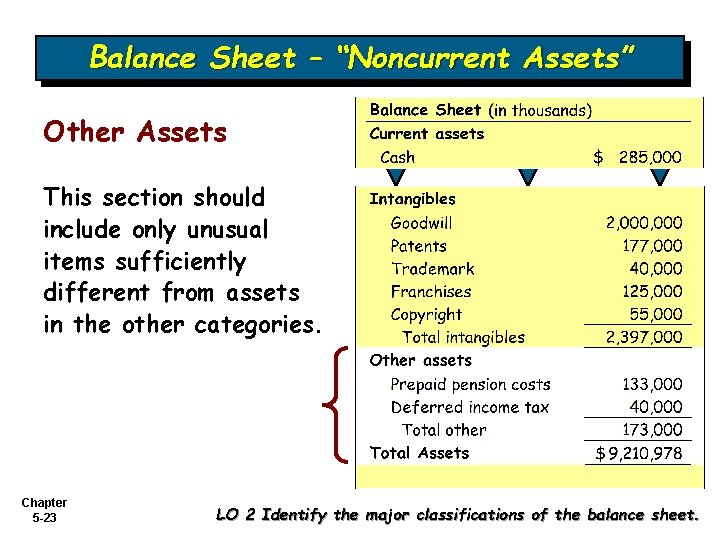
Balance Sheet – “Noncurrent Assets” Other Assets This section should include only unusual items sufficiently different from assets in the other categories. Chapter 5 -23 LO 2 Identify the major classifications of the balance sheet.
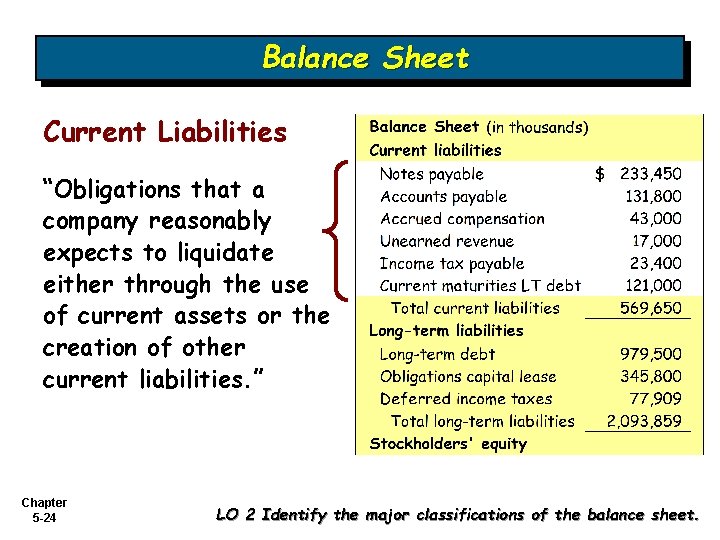
Balance Sheet Current Liabilities “Obligations that a company reasonably expects to liquidate either through the use of current assets or the creation of other current liabilities. ” Chapter 5 -24 LO 2 Identify the major classifications of the balance sheet.
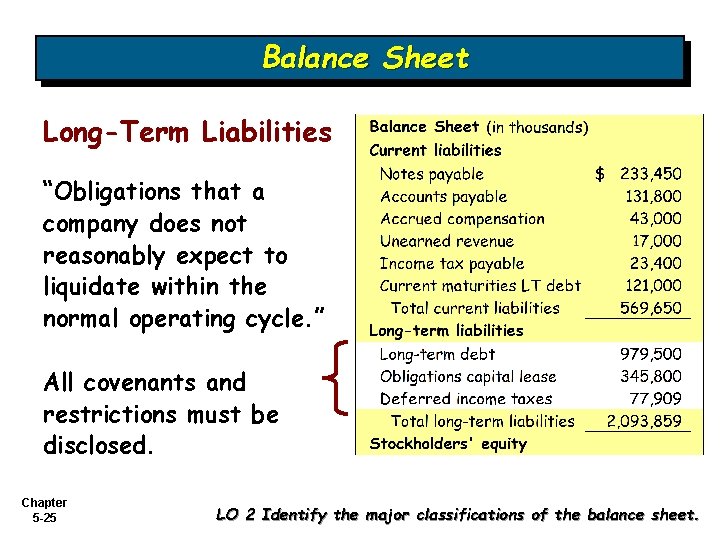
Balance Sheet Long-Term Liabilities “Obligations that a company does not reasonably expect to liquidate within the normal operating cycle. ” All covenants and restrictions must be disclosed. Chapter 5 -25 LO 2 Identify the major classifications of the balance sheet.
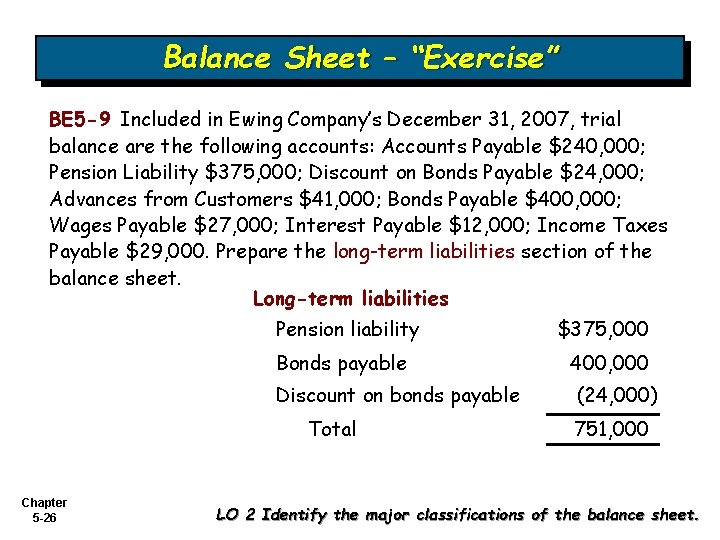
Balance Sheet – “Exercise” BE 5 -9 Included in Ewing Company’s December 31, 2007, trial balance are the following accounts: Accounts Payable $240, 000; Pension Liability $375, 000; Discount on Bonds Payable $24, 000; Advances from Customers $41, 000; Bonds Payable $400, 000; Wages Payable $27, 000; Interest Payable $12, 000; Income Taxes Payable $29, 000. Prepare the long-term liabilities section of the balance sheet. Long-term liabilities Pension liability Bonds payable Discount on bonds payable Total Chapter 5 -26 $375, 000 400, 000 (24, 000) 751, 000 LO 2 Identify the major classifications of the balance sheet.
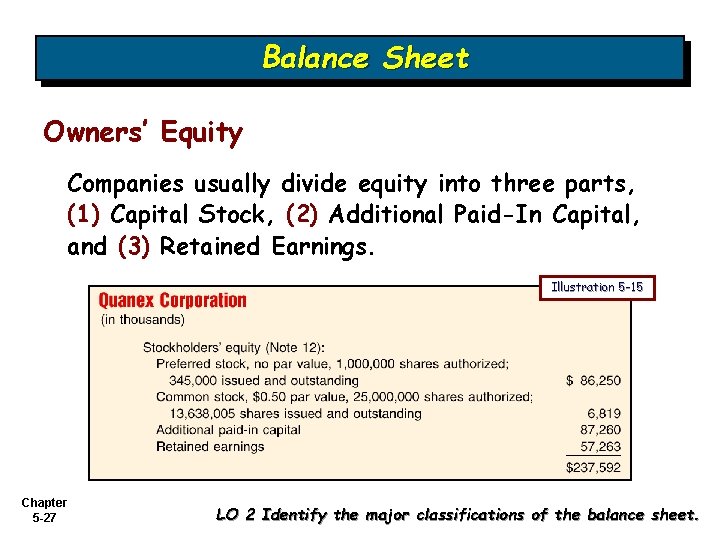
Balance Sheet Owners’ Equity Companies usually divide equity into three parts, (1) Capital Stock, (2) Additional Paid-In Capital, and (3) Retained Earnings. Illustration 5 -15 Chapter 5 -27 LO 2 Identify the major classifications of the balance sheet.
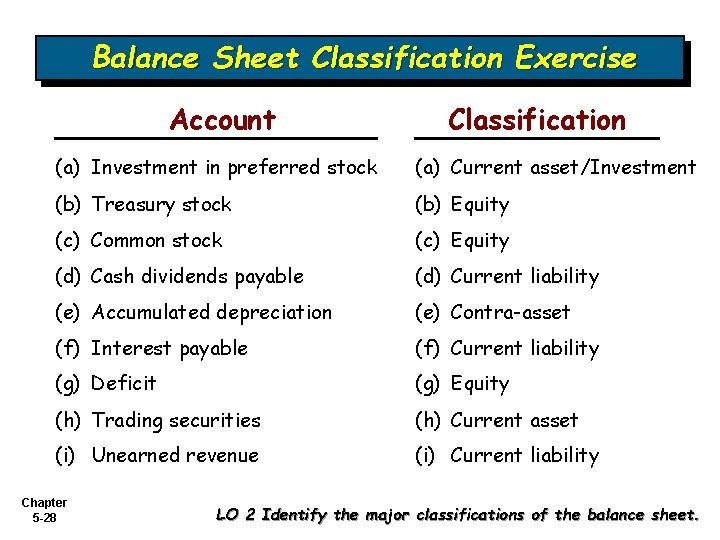
Balance Sheet Classification Exercise Account Classification (a) Investment in preferred stock (a) Current asset/Investment (b) Treasury stock (b) Equity (c) Common stock (c) Equity (d) Cash dividends payable (d) Current liability (e) Accumulated depreciation (e) Contra-asset (f) Interest payable (f) Current liability (g) Deficit (g) Equity (h) Trading securities (h) Current asset (i) Unearned revenue (i) Current liability Chapter 5 -28 LO 2 Identify the major classifications of the balance sheet.
Balance Sheet - Format Classified Balance Sheet Account form Report form Accounting Trends and Techniques— 2004 (New York: AICPA) indicates that all of the 600 companies surveyed use either the “report form” (506) or the “account form” (94), sometimes collectively referred to as the “customary form. ” Chapter 5 -29 LO 3 Prepare a classified balance sheet using the report and account formats.
Additional Information Reported There are normally four types of information that are supplemental to account titles and amounts presented in the balance sheet: Contingencies Accounting Policies Contractual Situations Fair Values Chapter 5 -30 LO 4 Determine which balance sheet information requires supplemental disclosure.
Techniques of Disclosure Parenthetical Explanations Notes Cross-Reference and Contra Items Supporting Schedules Terminology Chapter 5 -31 LO 5 Describe the major disclosure techniques for the balance sheet.
The Statement of Cash Flows One of the three basic objectives of financial reporting is “assessing the amounts, timing, and uncertainty of cash flows. ” Chapter 5 -32 LO 6 Indicate the purpose of the statement of cash flows.
The Statement of Cash Flows Purpose of the Statement To provide relevant information about the cash receipts and cash payments of an enterprise during a period. The statement provides answers to the following questions: 1. Where did the cash come from? 2. What was the cash used for? 3. What was the change in the cash balance? Chapter 5 -33 LO 6 Indicate the purpose of the statement of cash flows.
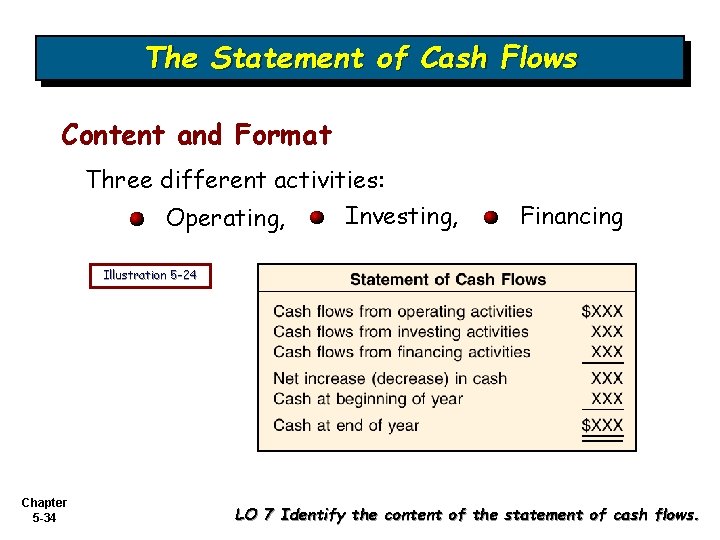
The Statement of Cash Flows Content and Format Three different activities: Investing, Operating, Financing Illustration 5 -24 Chapter 5 -34 LO 7 Identify the content of the statement of cash flows.
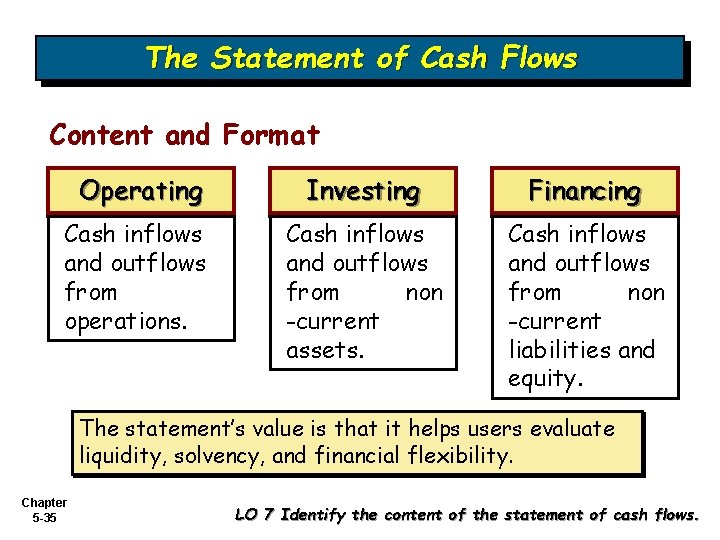
The Statement of Cash Flows Content and Format Operating Investing Financing Cash inflows and outflows from operations. Cash inflows and outflows from non -current assets. Cash inflows and outflows from non -current liabilities and equity. The statement’s value is that it helps users evaluate liquidity, solvency, and financial flexibility. Chapter 5 -35 LO 7 Identify the content of the statement of cash flows.
The Statement of Cash Flows Preparation Information obtained from several sources: (1) comparative balance sheets, (2) the current income statement, and (3) selected transaction data. Chapter 5 -36 LO 8 Prepare a statement of cash flows.
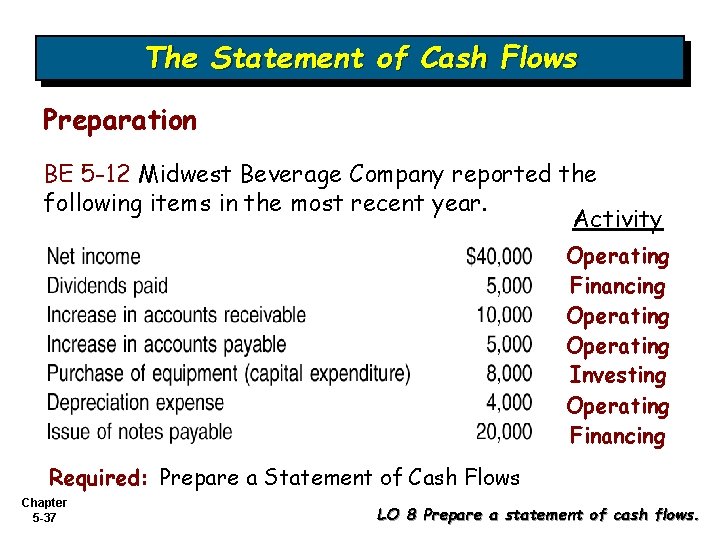
The Statement of Cash Flows Preparation BE 5 -12 Midwest Beverage Company reported the following items in the most recent year. Activity Operating Financing Operating Investing Operating Financing Required: Prepare a Statement of Cash Flows Chapter 5 -37 LO 8 Prepare a statement of cash flows.
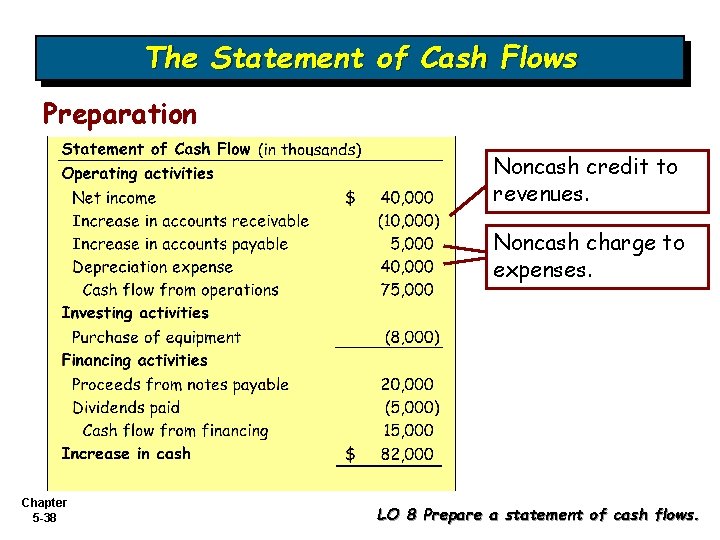
The Statement of Cash Flows Preparation Noncash credit to revenues. Noncash charge to expenses. Chapter 5 -38 LO 8 Prepare a statement of cash flows.
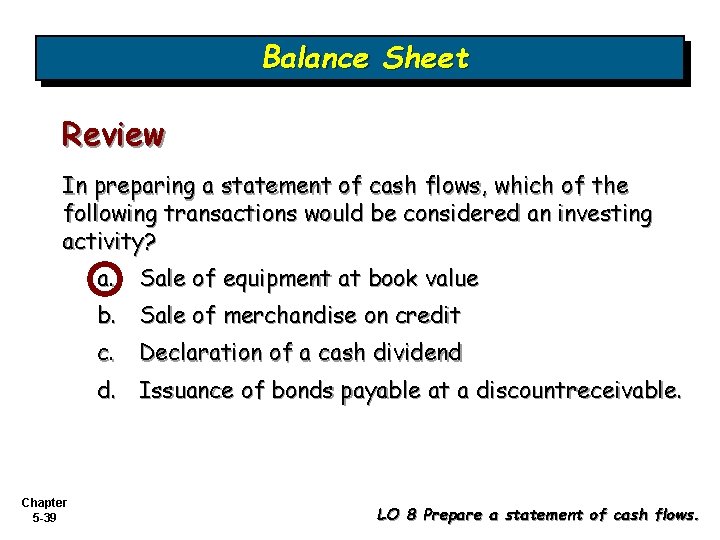
Balance Sheet Review In preparing a statement of cash flows, which of the following transactions would be considered an investing activity? a. Sale of equipment at book value b. Sale of merchandise on credit c. Declaration of a cash dividend d. Issuance of bonds payable at a discount receivable. Chapter 5 -39 LO 8 Prepare a statement of cash flows.
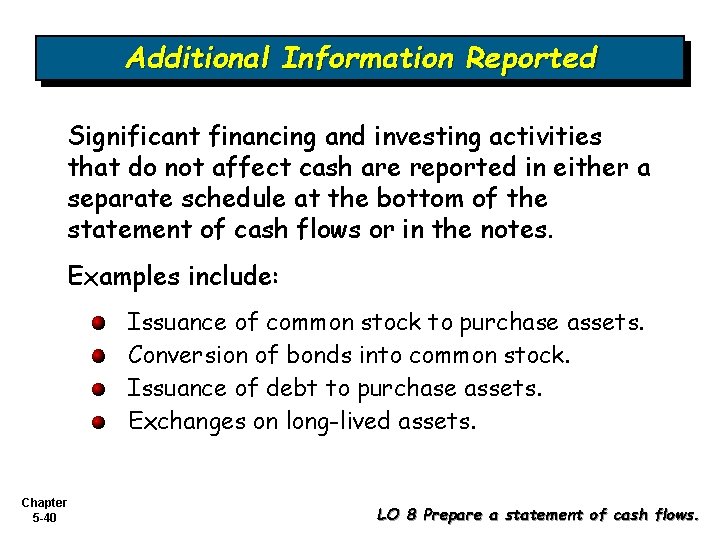
Additional Information Reported Significant financing and investing activities that do not affect cash are reported in either a separate schedule at the bottom of the statement of cash flows or in the notes. Examples include: Issuance of common stock to purchase assets. Conversion of bonds into common stock. Issuance of debt to purchase assets. Exchanges on long-lived assets. Chapter 5 -40 LO 8 Prepare a statement of cash flows.
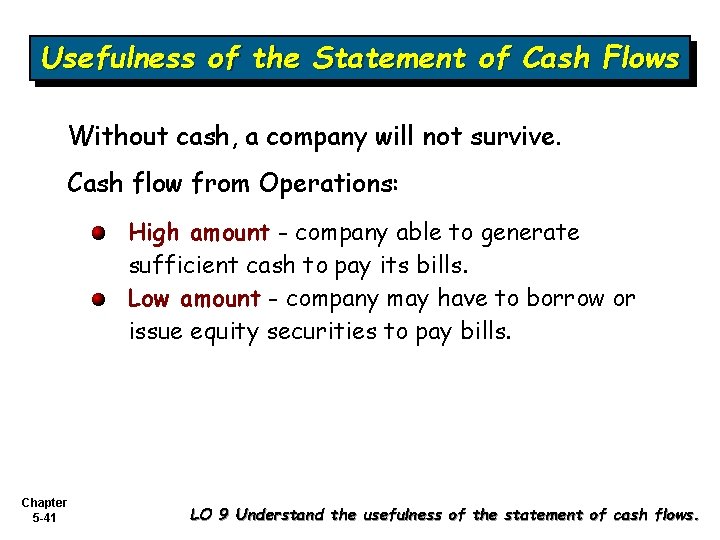
Usefulness of the Statement of Cash Flows Without cash, a company will not survive. Cash flow from Operations: High amount - company able to generate sufficient cash to pay its bills. Low amount - company may have to borrow or issue equity securities to pay bills. Chapter 5 -41 LO 9 Understand the usefulness of the statement of cash flows.
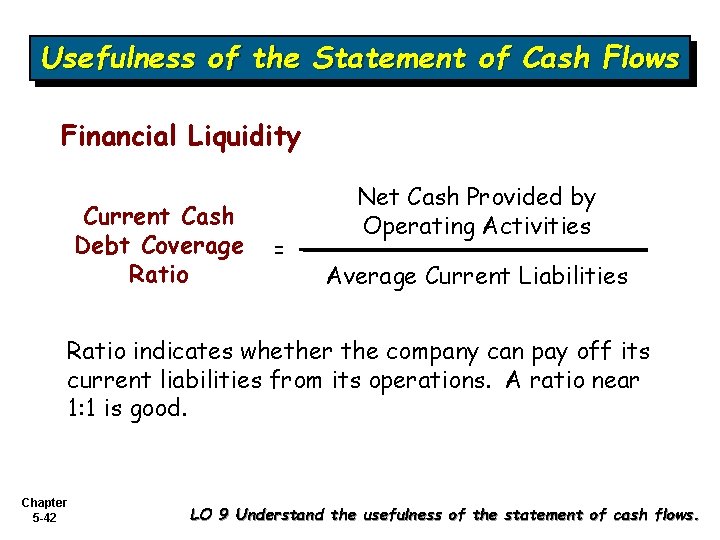
Usefulness of the Statement of Cash Flows Financial Liquidity Current Cash Debt Coverage Ratio = Net Cash Provided by Operating Activities Average Current Liabilities Ratio indicates whether the company can pay off its current liabilities from its operations. A ratio near 1: 1 is good. Chapter 5 -42 LO 9 Understand the usefulness of the statement of cash flows.
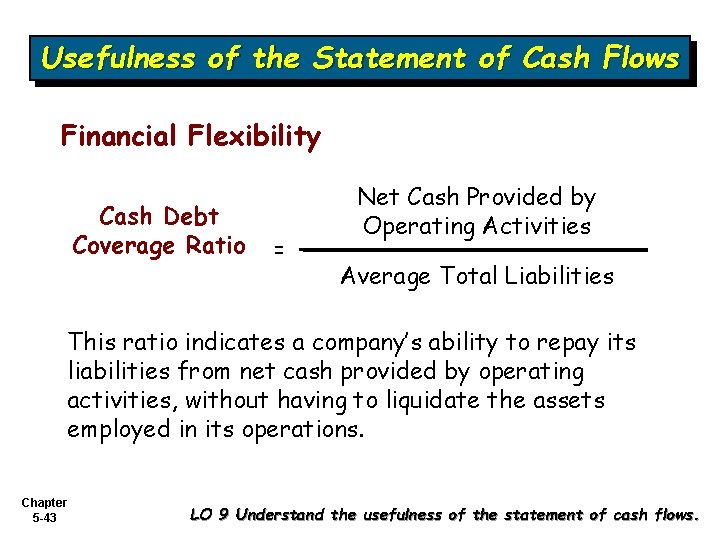
Usefulness of the Statement of Cash Flows Financial Flexibility Cash Debt Coverage Ratio = Net Cash Provided by Operating Activities Average Total Liabilities This ratio indicates a company’s ability to repay its liabilities from net cash provided by operating activities, without having to liquidate the assets employed in its operations. Chapter 5 -43 LO 9 Understand the usefulness of the statement of cash flows.
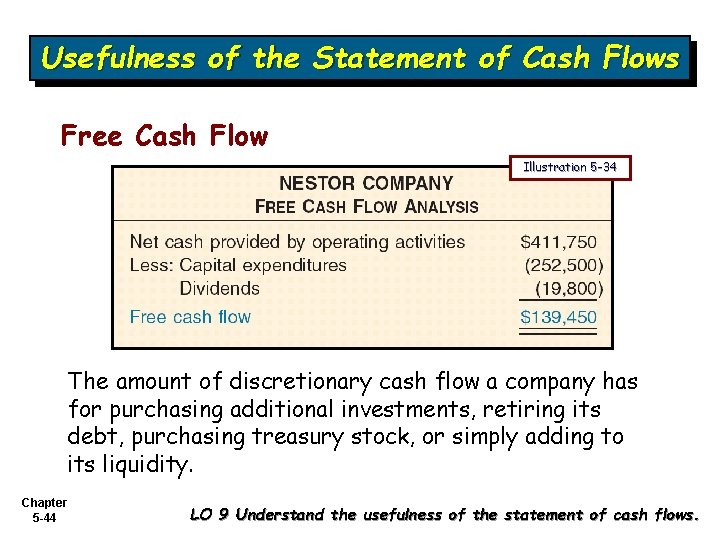
Usefulness of the Statement of Cash Flows Free Cash Flow Illustration 5 -34 The amount of discretionary cash flow a company has for purchasing additional investments, retiring its debt, purchasing treasury stock, or simply adding to its liquidity. Chapter 5 -44 LO 9 Understand the usefulness of the statement of cash flows.
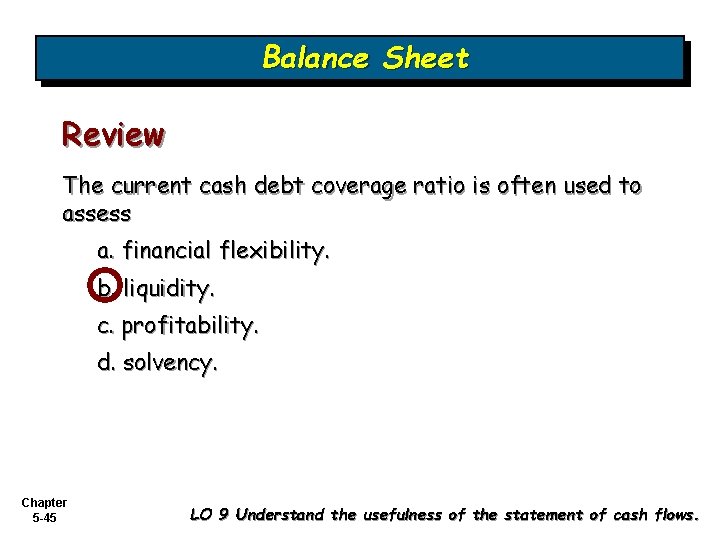
Balance Sheet Review The current cash debt coverage ratio is often used to assess a. financial flexibility. b. liquidity. c. profitability. d. solvency. Chapter 5 -45 LO 9 Understand the usefulness of the statement of cash flows.
Copyright © 2006 John Wiley & Sons, Inc. All rights reserved. Reproduction or translation of this work beyond that permitted in Section 117 of the 1976 United States Copyright Act without the express written permission of the copyright owner is unlawful. Request for further information should be addressed to the Permissions Department, John Wiley & Sons, Inc. The purchaser may make back-up copies for his/her own use only and not for distribution or resale. The Publisher assumes no responsibility for errors, omissions, or damages, caused by the use of these programs or from the use of the information contained herein. Chapter 5 -46
- Slides: 46