
Balance of State Co C Coordinated Entry 2
Balance of State Co. C Coordinated Entry 2. 0 CARRIE POSER, COC DIRECTOR JEANETTE PETTS, CHAIR OF COORDINATED ENTRY COMMITTEE, BOARD VP CORIN TUBRIDY, CO-CHAIR OF COORDINATED ENTRY COMMITTEE AUGUST 2017
Presentation Overview ◦ Overview of Coordinated Entry System Changes ◦ Proposed Homeless Prevention Services Coordinated Entry ◦ Accessing Emergency Services ◦ After Hour Plan ◦ Checklists and Timelines ◦ Questions
Coordinated Entry System Policy and Procedure Manual
This document replaces all previously approved Coordinated Entry policies. This document shall be incorporated into the WI Balance of State Continuum of Care’s Governance Charter. Any changes to the Appendices shall not impact the body of this document.
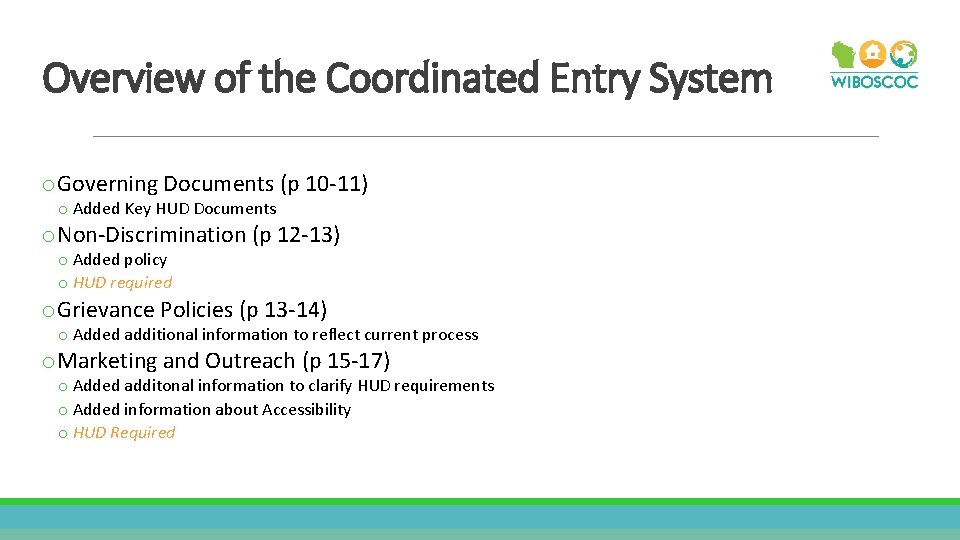
Overview of the Coordinated Entry System o. Governing Documents (p 10 -11) o Added Key HUD Documents o. Non-Discrimination (p 12 -13) o Added policy o HUD required o. Grievance Policies (p 13 -14) o Added additional information to reflect current process o. Marketing and Outreach (p 15 -17) o Added additonal information to clarify HUD requirements o Added information about Accessibility o HUD Required
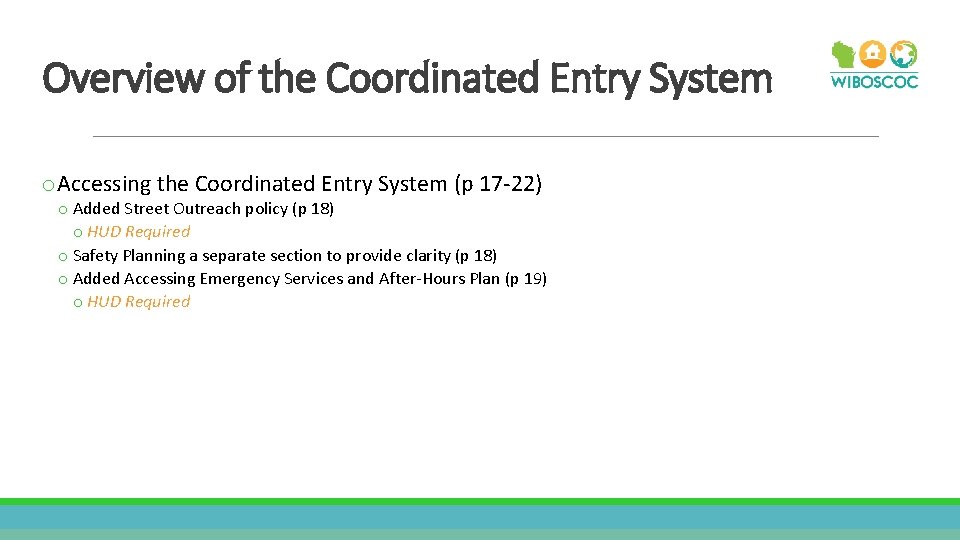
Overview of the Coordinated Entry System o. Accessing the Coordinated Entry System (p 17 -22) o Added Street Outreach policy (p 18) o HUD Required o Safety Planning a separate section to provide clarity (p 18) o Added Accessing Emergency Services and After-Hours Plan (p 19) o HUD Required
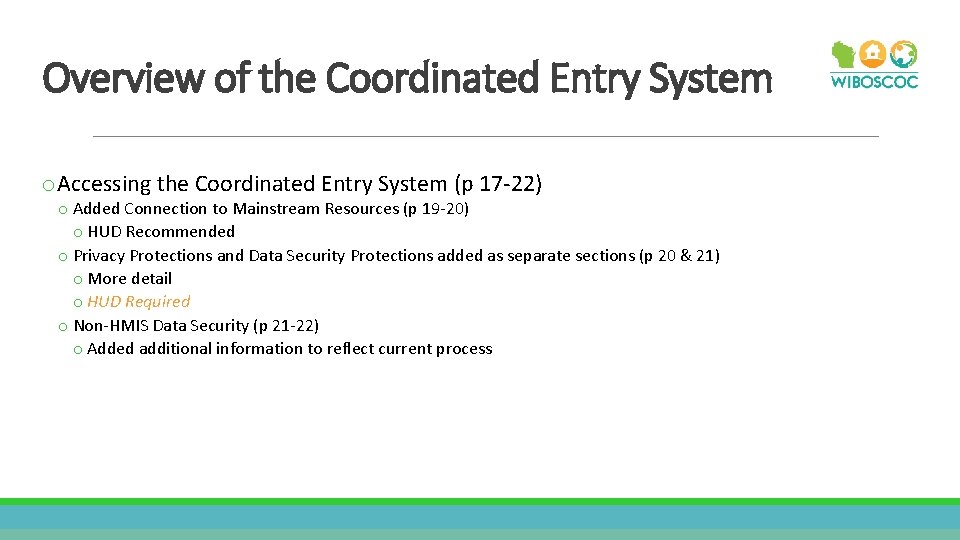
Overview of the Coordinated Entry System o. Accessing the Coordinated Entry System (p 17 -22) o Added Connection to Mainstream Resources (p 19 -20) o HUD Recommended o Privacy Protections and Data Security Protections added as separate sections (p 20 & 21) o More detail o HUD Required o Non-HMIS Data Security (p 21 -22) o Added additional information to reflect current process
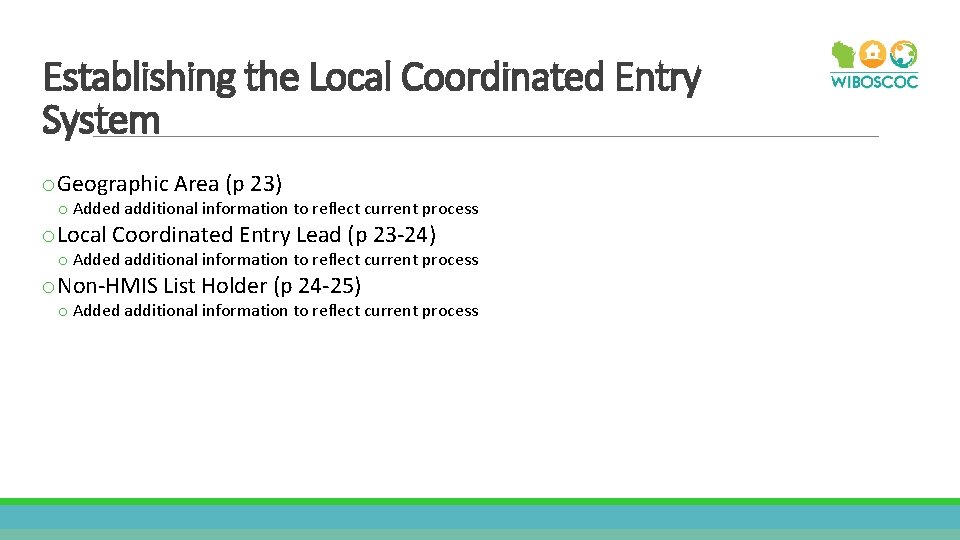
Establishing the Local Coordinated Entry System o. Geographic Area (p 23) o Added additional information to reflect current process o. Local Coordinated Entry Lead (p 23 -24) o Added additional information to reflect current process o. Non-HMIS List Holder (p 24 -25) o Added additional information to reflect current process
The Coordinated Entry Process o. Participant Consent and Pre-Screen (p 26 -27) o Added additional information to reflect current process o. Assessment (p 27 -28) o Added additional information o HUD Required o. Pre-Screen and Assessment of Domestic Violence Survivors (p 29) o No Changes
The Coordinated Entry Process o. Scoring (p 30) o Added additional information to reflect current process o HUD Required o. Referral (p 30 -31) o Added additional information to reflect current process o. Follow-Up (p 31 -32) o. Added additional information to reflect current process
The Coordinated Entry Process o. Prioritization (p 32) o Added additional information to reflect current process o HUD Required o. Determining Eligibility (p 33 -34) o Added additional information to reflect current process o HUD Required o. Project Enrollment (p 34 -35) o No Changes
The Coordinated Entry Process o. Homeless Prevention Services (p 35 -39) o Developed Coordinated Entry process for Prevention Services o HUD Required
Training o. Initial Training (p 40) o Added information to reflect current process o HUD Required o. On-Going Training (p 41) o. Added information to reflect current process o. HUD Required o. HMIS-Specific Training (p 41) o Added information to reflect current process
Evaluation o. HMIS Component (p 42 -44) o Added information to reflect current process o HUD Required o. Stakeholder Information (p 44) o. Added additional information o. HUD Required o. Ongoing Planning (p 44) o No change o HUD Required
Appendices A change to the Appendices may be approved by the majority of the WI BOSCOC Board and does not necessitate a full review or approval of the Coordinated Entry System Policies and Procedures. The Appendices will otherwise be updated annually.
Homeless Prevention Services Participant Consent and Pre-Screen Same process as the rest of Coordinated Entry Assessment Persons at Imminent Risk of Homelessness are 1 of 5 designated subpopulations that can have a customized assessment process and tools Developed in collaboration with ICA Scoring Completed in HMIS and automatically scored Referral Completed in HMIS Referred to the LCES Prevention Provider Follow-Up Same process as the rest of Coordinated Entry
Homeless Prevention Services Determining Eligibility Prevention Services provider is responsible for determining eligibility Criteria for Eligibility established in collaboration with DEHCR: ü Score of 10 or higher on the Homeless Prevention Assessment ü The person or persons served meet the criteria in paragraph (2), (3), or (4) of the homeless definition in § 576. 2 ü Annual income below 30% of area median family income for the area at admission for both ESG and HPP funds and documentation of a lack of sufficient resources or support networks to sustain housing without assistance
Homeless Prevention Services Criteria for Eligibility established in collaboration with DEHCR: ü The unit to be assisted must pass Habitability Standards and meet Fair Market Rent and Rent Reasonableness standards ü Legally binding, written lease ü The unit must be affordable for the person(s) requesting assistance ü An affordable unit is one in which the rent is no more than 50% of the household’s adjusted gross income. o If the rent is more than 50% of the household’s adjusted gross income, the agency can still determine the unit is affordable after completing a detailed budget with the person(s) demonstrating they are able to maintain the monthly housing expenses.
Homeless Prevention Services Documentation Requirements (Established in collaboration with DEHCR) ü ETH-funded projects must maintain documentation showing adherence to the established Order of Priority and the Coordinated Entry System ü All client entries after 1/1/18 should have a Pre-Screen Form in the file ü Copy of the Prevention Prioritization List from the day assistance was offered in the file ü Documentation that the assisted unit meets Habitability Standards and Fair Market Rent and Rent Reasonableness standards ü Documentation of income eligibility
Homeless Prevention Services Rejected Referrals o Must document reason for not taking highest prioritized household Declined Referrals o Client Choice o Name remains on Prioritization List
Homeless Prevention Services Project Enrollment o It is prohibited for any Co. C-funded or ESG-funded housing project to serve individuals and/or families without the household first going through the Coordinated Entry System and receiving a referral to the Prioritization List o Verify and document eligibility
Emergency Services The CE process must allow emergency services to operate with as few barriers to entry as possible. This includes: ● All DV and emergency services hotlines ● Drop-in service programs ● Emergency shelters, including DV shelters ● Other short-term crisis residential programs
After Hours Plan o The plan should be reasonable given the geographic area and availability of emergency services, and ensure persons experiencing homelessness are able to access the Coordinated Entry System during the operating hours of participating agencies in the LCES. o People must be able to access emergency services independent of the operating hours of the coordinated entry’s intake and assessment processes. o Policies and procedures must document a process by which persons are ensured access to emergency services during hours when the coordinated entry’s intake and assessment processes are not operating and how they will be connected, as necessary, to coordinated entry as soon as the intake and assessment processes are operating.
After Hours Plan o The After-Hours Plan must be communicated to all emergency service providers and crisis response systems, o Must be voted on and approved by the local homeless coalition.
After Hour Plan • Each Local Coordinated Entry System must develop an “After Hour Plan” for people that are experiencing homelessness when “regular” business is closed and how those people are connected to coordinated entry when it opens. • Deadline: September 30, 2017 • Submit: wiboscoc@gmail. com – the plan and the minutes of the meeting approving the plan • Requirement: Voted and approved by local homeless coalition • CE Implementation team will review and provide feedback • If you have multiple counties in your area, you can have a plan for each county. The package of plans has to be approved by your local homeless coalition.
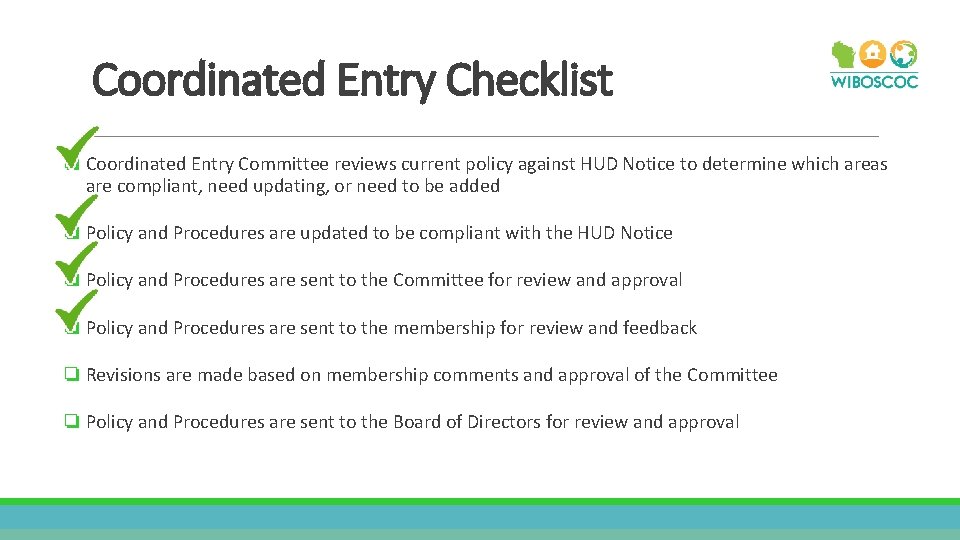
Coordinated Entry Checklist ❏ Coordinated Entry Committee reviews current policy against HUD Notice to determine which areas are compliant, need updating, or need to be added ❏ Policy and Procedures are updated to be compliant with the HUD Notice ❏ Policy and Procedures are sent to the Committee for review and approval ❏ Policy and Procedures are sent to the membership for review and feedback ❏ Revisions are made based on membership comments and approval of the Committee ❏ Policy and Procedures are sent to the Board of Directors for review and approval
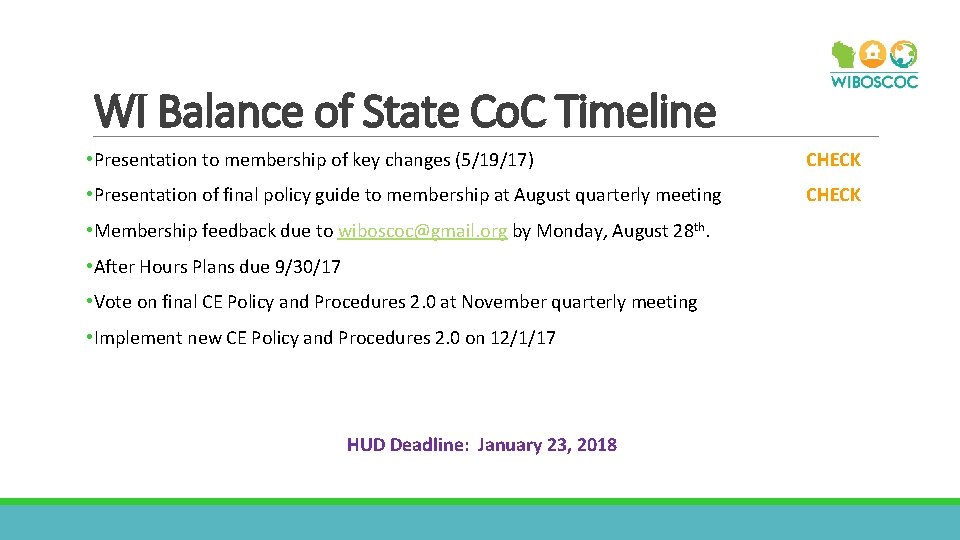
WI Balance of State Co. C Timeline • Presentation to membership of key changes (5/19/17) CHECK • Presentation of final policy guide to membership at August quarterly meeting CHECK • Membership feedback due to wiboscoc@gmail. org by Monday, August 28 th. • After Hours Plans due 9/30/17 • Vote on final CE Policy and Procedures 2. 0 at November quarterly meeting • Implement new CE Policy and Procedures 2. 0 on 12/1/17 HUD Deadline: January 23, 2018
Summary • Coordinated Entry Policy and Procedures are updated • Prevention Assessment developed • After Hour Plan • Each local continua submits approved plan by 9/30/17 • CE Implementation team reviews and provides feedback

Questions?
Resources and References HUD Notice CPD 17 -01 https: //www. hudexchange. info/resources/documents/Notice-CPD-17 -01 -Establishing-Additional-Requirements-or-a-Continuum-of. Care-Centralized-or-Coordinated-Assessment-System. pdf Co. C Interim Rule https: //www. gpo. gov/fdsys/granule/CFR-2013 -title 24 -vol 3 -sec 578 -7
- Slides: 30