
Balance of Power Dr Fayyaz Ahmad Faize Review
Balance of Power Dr. Fayyaz Ahmad Faize
Review of Previous Lecture- National Interests • Interest • National Interest • Development of National Interest of church, interest of the ruling class, interest of the people. • Kinds of National Interest 1. Primary 2. Secondary 3. Permanent 4. Variable 5. General 6. Specific
Summary cont. How to Promote NI? 1. Coercive method 2. Alliances 3. Diplomacy National Interest and Foreign Policy • The foreign policy ‘seeks the defence of NI through peaceful means • The government would never pursue a foreign policy which would harm NI • The national interests of other states are also kept into consideration • NI may result in conflict and tension in the international world due to conflicting interests • This kind of situation may lead to conflict or war • modification in foreign policy
Balance of Power Dr. Fayyaz Ahmad Faize
Balance of Power (BOP) • • Concept and definition Types Characteristics Techniques Benefits of BOP Limitations/Criticism Conclusion
Balance of Power (BOP) Concept Q Is power a threat to Peace? • May be. Q Can power bring peace? • May be Q Can power maintain peace? • May be Q Will you prefer to fight a strong wrestler more powerful than you? • May be not Q What about the strong Wrestler? Will he prefer to fight with you? Definitely
Balance of Power (BOP) Q • Q • • How can you stop him from not fighting you? Increasing your own power What will this do? It will balance your power against him. What does this mean? BOP can stop fight, stop war and maintain peace. The same principle applies for states as well.
BOP concept cont. • As long as there is balance of power, there is peace • War is the absence of BOP • So Excess power brings war • If power is not to be abuse, then it is in the nature of things that power be made a check to power (Montesquieu) • Power corrupts and absolute power corrupts absolutely. Great man are almost bad man (Lord Acton) • Power can be used for peace keeping and peace making.
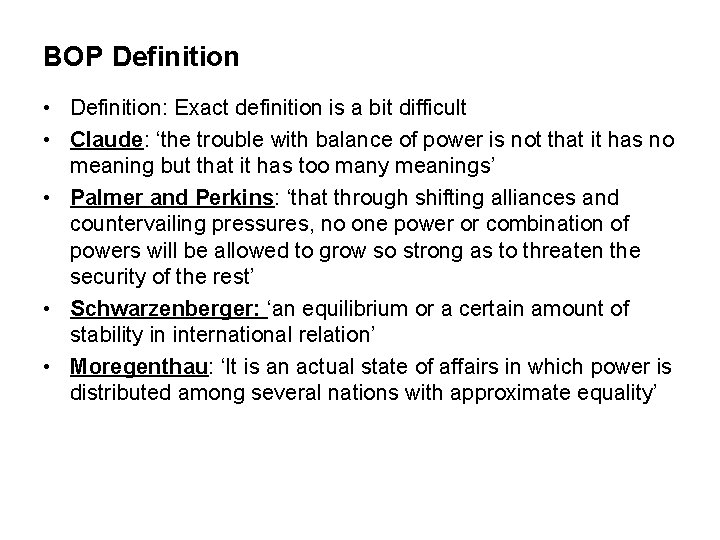
BOP Definition • Definition: Exact definition is a bit difficult • Claude: ‘the trouble with balance of power is not that it has no meaning but that it has too many meanings’ • Palmer and Perkins: ‘that through shifting alliances and countervailing pressures, no one power or combination of powers will be allowed to grow so strong as to threaten the security of the rest’ • Schwarzenberger: ‘an equilibrium or a certain amount of stability in international relation’ • Moregenthau: ‘It is an actual state of affairs in which power is distributed among several nations with approximate equality’
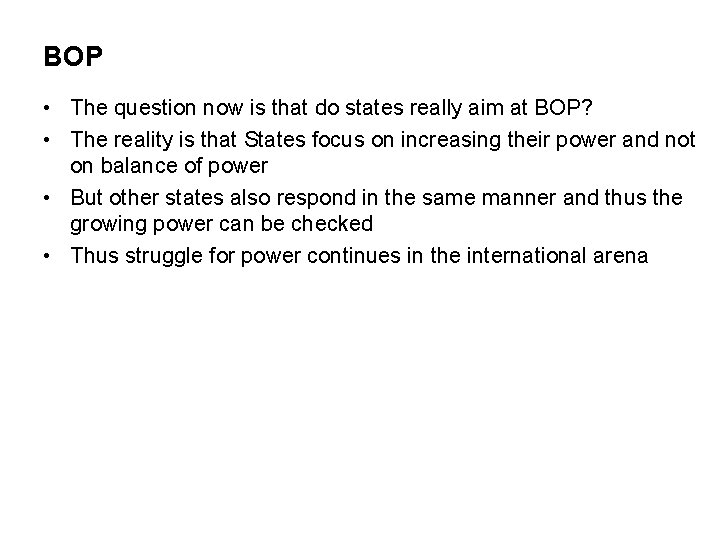
BOP • The question now is that do states really aim at BOP? • The reality is that States focus on increasing their power and not on balance of power • But other states also respond in the same manner and thus the growing power can be checked • Thus struggle for power continues in the international arena
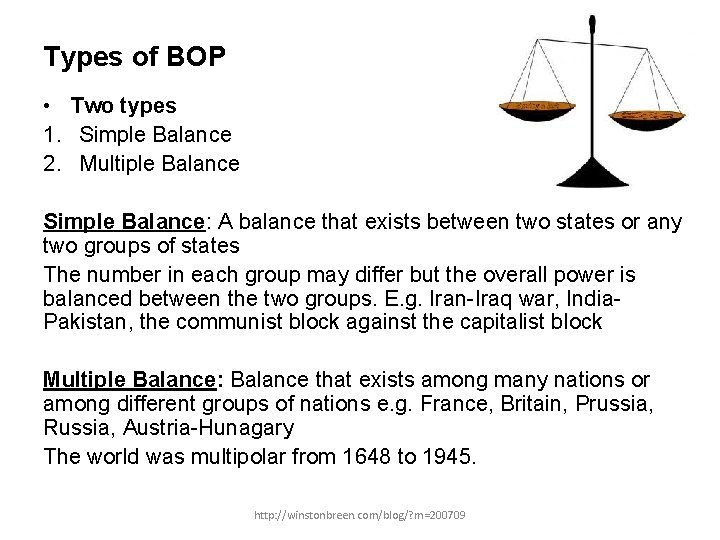
Types of BOP • Two types 1. Simple Balance 2. Multiple Balance Simple Balance: A balance that exists between two states or any two groups of states The number in each group may differ but the overall power is balanced between the two groups. E. g. Iran-Iraq war, India. Pakistan, the communist block against the capitalist block Multiple Balance: Balance that exists among many nations or among different groups of nations e. g. France, Britain, Prussia, Russia, Austria-Hunagary The world was multipolar from 1648 to 1945. http: //winstonbreen. com/blog/? m=200709
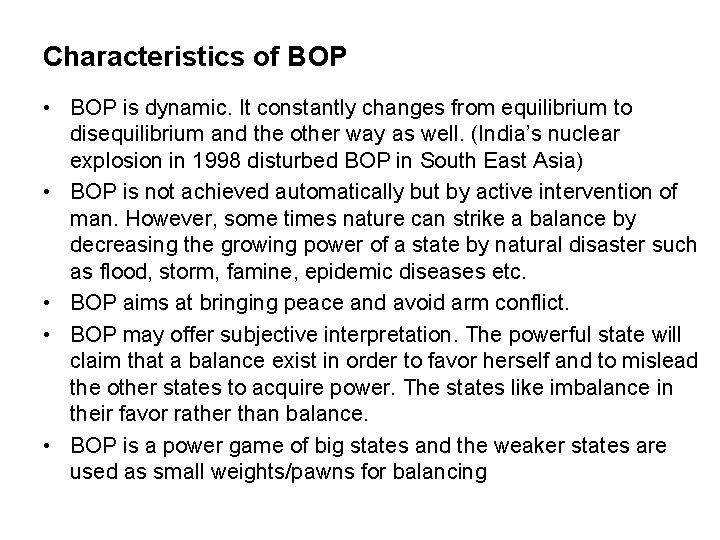
Characteristics of BOP • BOP is dynamic. It constantly changes from equilibrium to disequilibrium and the other way as well. (India’s nuclear explosion in 1998 disturbed BOP in South East Asia) • BOP is not achieved automatically but by active intervention of man. However, some times nature can strike a balance by decreasing the growing power of a state by natural disaster such as flood, storm, famine, epidemic diseases etc. • BOP aims at bringing peace and avoid arm conflict. • BOP may offer subjective interpretation. The powerful state will claim that a balance exist in order to favor herself and to mislead the other states to acquire power. The states like imbalance in their favor rather than balance. • BOP is a power game of big states and the weaker states are used as small weights/pawns for balancing
Characteristics of BOP • A balancing power is required to keep BOP in the region. England served this role in Europe in 18 th and 19 th century. At present, no real balancer exist.
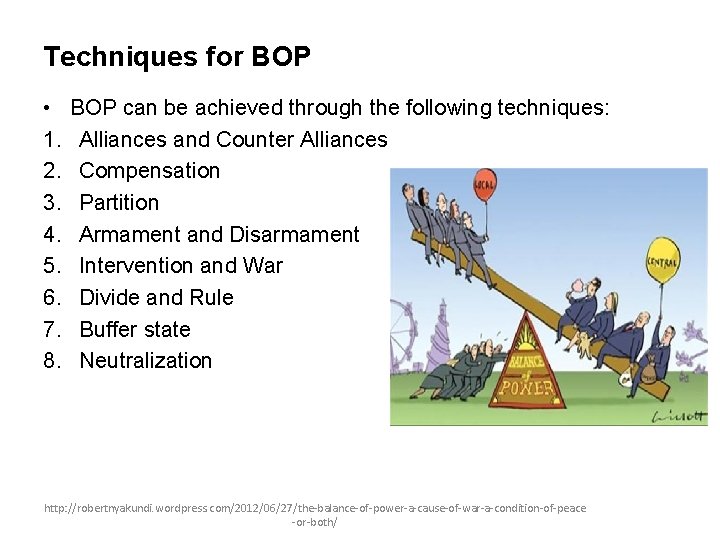
Techniques for BOP • 1. 2. 3. 4. 5. 6. 7. 8. BOP can be achieved through the following techniques: Alliances and Counter Alliances Compensation Partition Armament and Disarmament Intervention and War Divide and Rule Buffer state Neutralization http: //robertnyakundi. wordpress. com/2012/06/27/the-balance-of-power-a-cause-of-war-a-condition-of-peace -or-both/
Techniques for BOP cont. 1. Alliances and Counter Alliances: ﻣﻌﺎہﺪہ • When the BOP is disturbed or the weaker states feel insecure, they make alliance with another weaker or powerful state • The Alliance may be defensive or offensive • A defensive alliance tries to restore BOP and maintain peace • Offensive alliance aims at disturbing BOP by adopting different coercive measures (Germany, Italy in WWII) • Alliances will be successful if mutual interest exists e. g. common enemy, common ideology, cultural similarity, common economic interests etc. e. g. Capitalistic Block during cold war • In response to alliance, counter alliance is made to bring BOP • Triple Alliance (1882)- Germany, Austria-Hungary, Italy • Triple Entente (1907)- England, France and Russia
Techniques for BOP cont. • NATO (1949) vs. Warsaw Pact (1955) during cold war • However, alliances and counter alliances results in suspicion, fear, tension and thus war 2. Compensation ( )ہﺮﺟﺎﻧہ • In order to achieve BOP, the victor nations may divide the territory of the defeated state or annex it • Mostly used in 18 th and 19 th century • The areas in Ottoman empire was used by victor states as compensation • After WWI, this method was used in the form of mandate system due to opposition of President Wilson of US
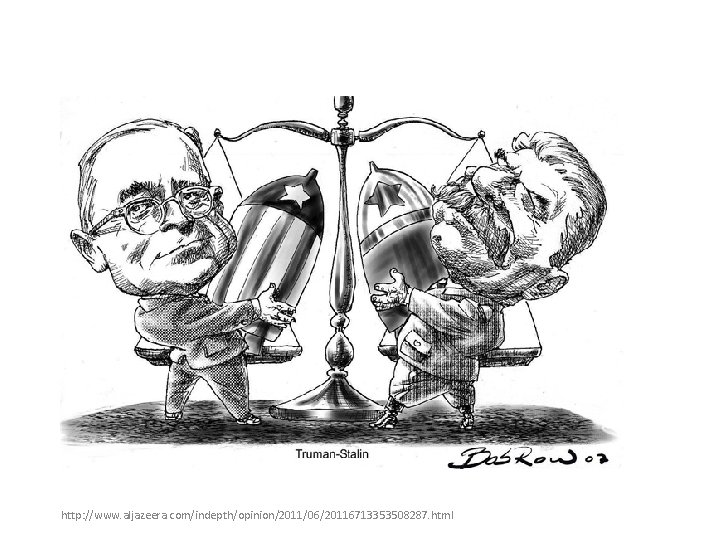
Techniques for BOP cont. 3. Partition: • The territory of a state is divided between the major actors in such a way as to maintain the power equation in the region • In 1772, Poland was divided between Russia, Prussia and Austria-Hungary to maintain BOP among them • Germany was divided in to East and West Germany after WWII, 4. Armament and Disarmament • Armament is acquiring arms and weapons • BOP can be achieve through armaments by which a weaker state may become powerful e. g. Germany after WWI armed itself heavily and thus prepared herself for WWII. • The colonies that got independence acquired arms for national security and neighboring threats e. g. Pakistan, India, North Korea, China, etc.
http: //www. aljazeera. com/indepth/opinion/2011/06/20116713353508287. html
Techniques for BOP cont. • Arms race at present may lead to destruction due to deadly effect • Race for Armament also leads to wastage of resources and economic backwardness • So Disarmament is introduced • The states disarm herself and reduce the quantity of weapons though mutual agreement to maintain BOP • 1 st started in treaty of Versailles • After WWII, many efforts for nuclear disarmament e. g. SALT, START, NPT, CTBT • US Intervention in gulf war on the reason to disarm Iraq from some strategic weapons
Techniques for BOP cont. 5. Intervention and War • The states intervene in the internal affairs of another state for gaining some benefits and to protect its national interests • Intervention may result in war • Examples: Italy and Germany intervened in Spanish Civil war, • US intervened in gulf war in 1991 against Iraq to free Kuwait • SU intervened in N. Korea, Hungary and Eastern Europe to combat capitalistic ideology • SU intervene in Afghanistan and US start supporting Afghanistan
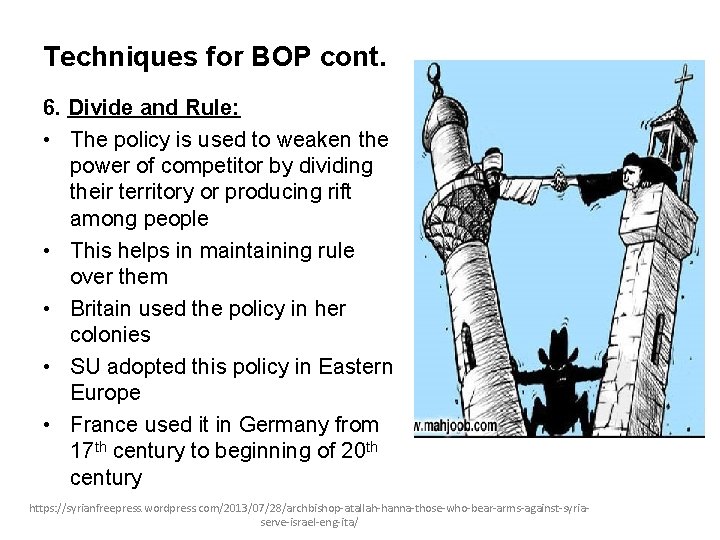
Techniques for BOP cont. 6. Divide and Rule: • The policy is used to weaken the power of competitor by dividing their territory or producing rift among people • This helps in maintaining rule over them • Britain used the policy in her colonies • SU adopted this policy in Eastern Europe • France used it in Germany from 17 th century to beginning of 20 th century https: //syrianfreepress. wordpress. com/2013/07/28/archbishop-atallah-hanna-those-who-bear-arms-against-syriaserve-israel-eng-ita/
Techniques for BOP cont. 7. Buffer State: • Buffer state is a state that lies between two hostile states • the conflicting states may agree over policy of non-interference towards the buffer state • The non-interference may be due to mutual interest in buffer state or to maintain BOP • Afghanistan acted as buffer state between Britain and Russia during 19 th and beginning of 20 th century • Rhineland as buffer state between France and Germany • Canada as buffer state between US and SU during cold war
Benefit of BOP 1. Helped in maintaining and brining peace. Peace in Europe existed in 19 th century due to BOP. Peace between Pakistan and India exists for the same reason. 2. Helped in preservation of independence of smaller states post WWII. The smaller states joined with one of the block to ensure its security during cold war. While, some states formed Non Aligned Movement to become neutral during cold war and ensure their security. The big powers will also not say any thing to smaller states otherwise, the BOP will be disturbed. Thus, the modern nation state system was strengthened by BOP.
Benefit of BOP cont. 3. The BOP acted as an agent in observing respect and obedience for international law in the absence of any other agency. The states would observe international law to avoid any unpleasant situation and international criticism and for its own benefit and interest. If a state is very powerful, then it will not care about any international law or principle and would follow ‘might is right’ principle.
Criticism of BOP 1. BOP did not bring peace rather it encouraged war e. g. WWI and WWII. Peace exists because of preponderance of power 2. BOP theory assumes that states actions are always aimed at seeking power. However, power is not the sole aim and actions are not always motivated to increase power. E. g. promotion of ideology, culture, trade, games tournament etc. 3. Power is not increased through alliances, armaments, divide and rule and other factors discussed. It can also be increased through industrialization, national character and morale, improving education, charismatic leadership etc. 4. Theory assumes that BOP has been prevalent through out ages which is wrong. Preponderance of power had been the rule throughout. E. g. Roman empire, Great Britain and now USA
Criticism of BOP 5. Peace was disturbed by weaker states and their desire to increase their power. While preponderance of power is not a threat rather peace was established by big powers. Peace in Europe from 1815 to 1914 existed because of preponderance of Great Britain and France power. 6. Its very difficult to measure power position and then ascertain that balance of power exist. It can be measured accurately through the result after the war which is not a proper and justified method. 7. The BOP theory assumes that state can take side as they wish to bring BOP which is not true. The states will not much care about balancing but will be driven by its national interest and goals to choose allies.
Criticism of BOP 8. The theory assumes the presence of a ‘balancer’ that will side with the weak to bring balance. This never has been. The balancer would not take side to maintain BOP rather would be driven by her own interests and goals. E. g. Britain as a balancer used to safeguard her interests
Conclusion • BOP is responsible for power struggle and power politics • Power is dynamic and thus the states are forcefully driven into power game for their security • Creates hatred, suspicion and arms race • However, it also contributed to promoting international peace and collective security • Thus, the concept of BOP has utility as well and can not be abandoned • Palmer and Perkins: ‘as long as the nation state system is the prevailing pattern of international society, balance of power policies will be followed in practice’
Summary • • Concept and definition Types- Simple and Complex Characteristics Techniques: Alliances and Counter Alliances, Compensation, Partition,
Review Questions Q. Define the concept of balance of power and its types? Q. Mention some of the characteristics of balance of power? Q. What are the techniques for achieving balance of power? Q. Balance of power has utility as well as criticism. Discuss.
- Slides: 30