
Balance of Payments Open Market Economies NX 0
Balance of Payments Open Market Economies

NX < 0 Trade Deficit (Goods in, $ flows out) NX > 0 Trade Surplus (Goods out , $ flows in) Imports => Goods flo NX = (X-M) w from China to U. S. ds a to pay for goo U. S. to Chin $ must flow from Red = Trade Deficit (import more than export) Blue = Trade Surplus (export more than import) *Grey = no data
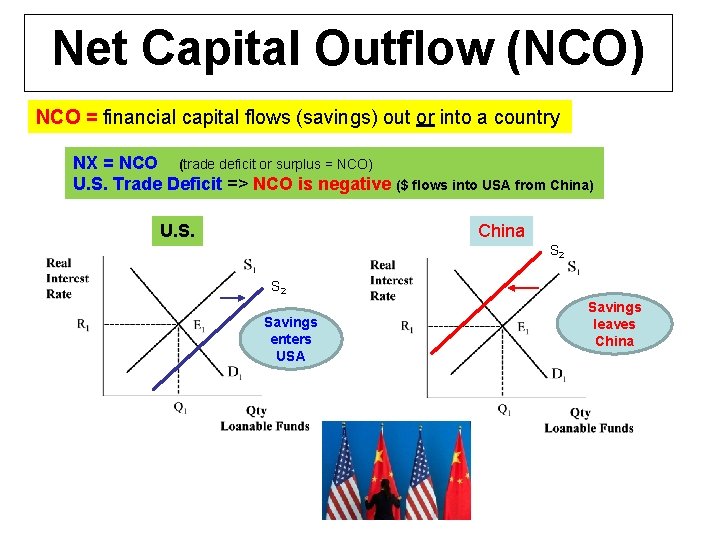
Net Capital Outflow (NCO) NCO = financial capital flows (savings) out or into a country NX = NCO (trade deficit or surplus = NCO) U. S. Trade Deficit => NCO is negative ($ flows into USA from China) U. S. China S 2 Savings enters USA Savings leaves China
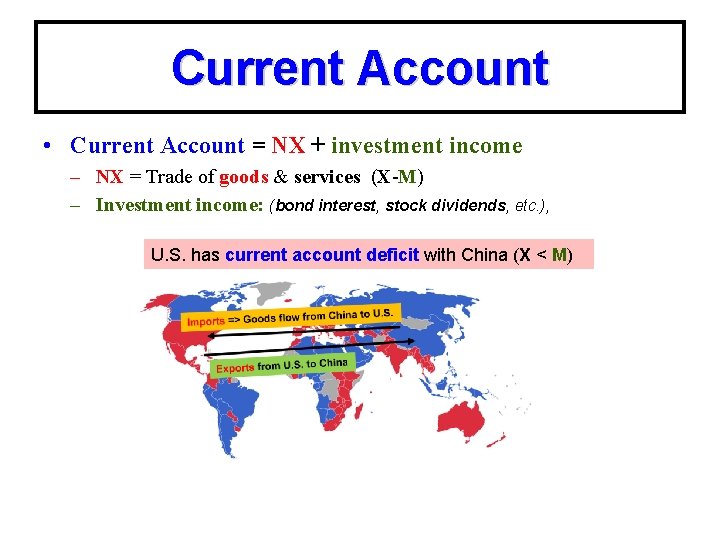
Current Account • Current Account = NX + investment income – NX = Trade of goods & services (X-M) – Investment income: (bond interest, stock dividends, etc. ), U. S. has current account deficit with China (X < M)
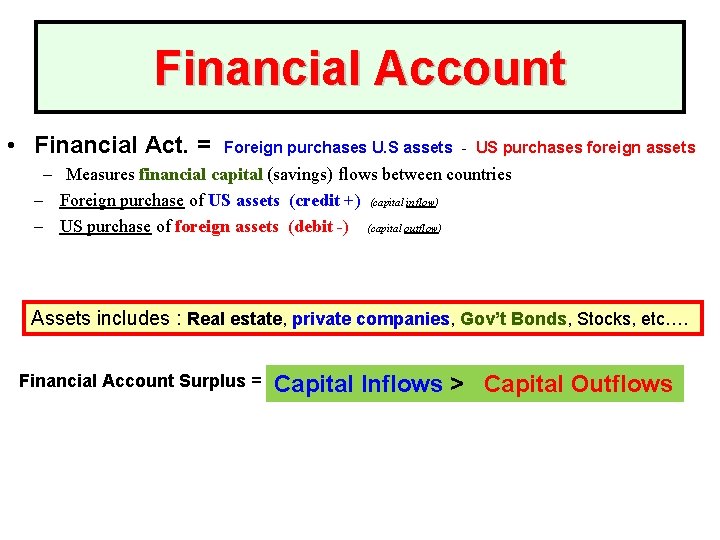
Financial Account • Financial Act. = Foreign purchases U. S assets - US purchases foreign assets – Measures financial capital (savings) flows between countries – Foreign purchase of US assets (credit +) (capital inflow) – US purchase of foreign assets (debit -) (capital outflow) Assets includes : Real estate, private companies, Gov’t Bonds, Stocks, etc…. Financial Account Surplus = Capital Inflows > Capital Outflows

Current + Financial = ZERO • Every transaction is recorded in both the current account & financial account. Example: • You buy a T. V. made in China $500: Current Account deficit (Debit -) • $500 flows into U. S. financial Assets Financial Account Surplus (Credit +) • Notice that the two transactions offset each other. – Theoretically, the BOP should always equal zero
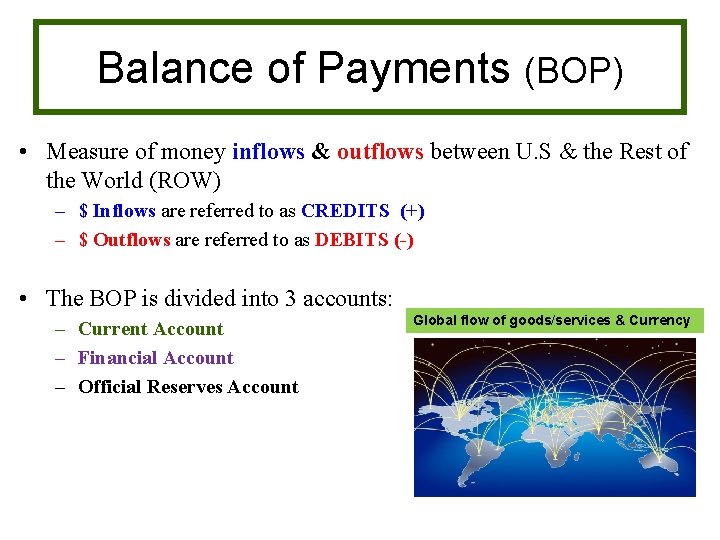
Balance of Payments (BOP) • Measure of money inflows & outflows between U. S & the Rest of the World (ROW) – $ Inflows are referred to as CREDITS (+) – $ Outflows are referred to as DEBITS (-) • The BOP is divided into 3 accounts: – Current Account – Financial Account – Official Reserves Account Global flow of goods/services & Currency

Balance of Payments = Zero • Current Account (NX) If one is positive the other is negative. They generally sum to ZERO! If both accounts do Not sum to zero, reserves are used to Offset minor difference – Trace Deficit/Surplus & Investment Income • Financial Account (formerly called capital account) – Foreign purchase of US assets – U. S. purchase of foreign assets – Example: Financial Surplus = Capital ($) flows into US • Official Reserves – Fed holds quantities of foreign currency called reserves – Used to offset discrepancy in BOP (current vs. financial account) • • BOP Surplus: More $ coming in than flowing out BOP Deficit: More $ flowing out than coming in
- Slides: 8