
Balance in Language Teaching Dr Rob Waring Jeju
Balance in Language Teaching Dr Rob Waring Jeju SETA November 25, 2011
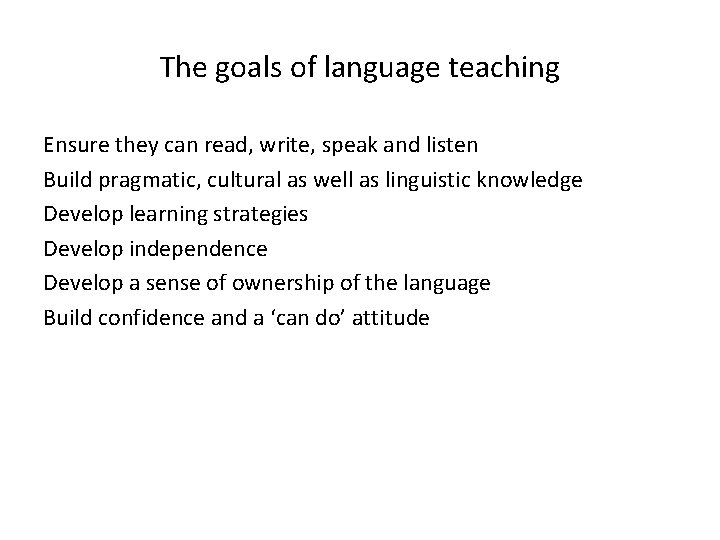
The goals of language teaching Ensure they can read, write, speak and listen Build pragmatic, cultural as well as linguistic knowledge Develop learning strategies Develop independence Develop a sense of ownership of the language Build confidence and a ‘can do’ attitude
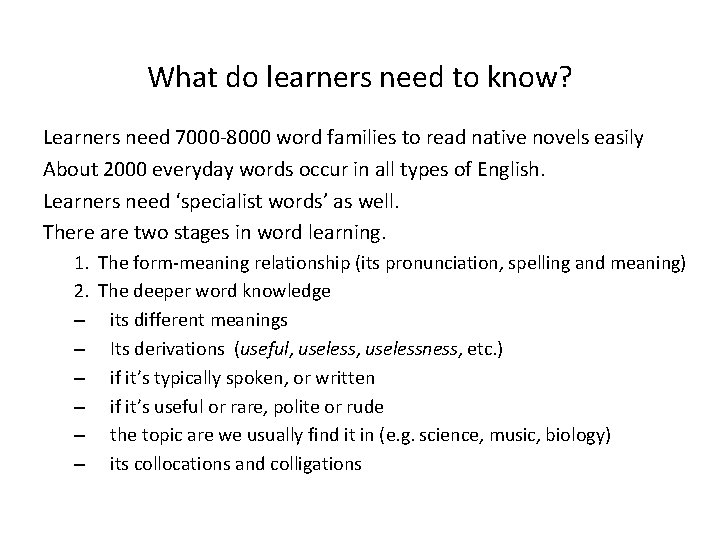
What do learners need to know? Learners need 7000 -8000 word families to read native novels easily About 2000 everyday words occur in all types of English. Learners need ‘specialist words’ as well. There are two stages in word learning. 1. The form-meaning relationship (its pronunciation, spelling and meaning) 2. The deeper word knowledge – its different meanings – Its derivations (useful, uselessness, etc. ) – if it’s typically spoken, or written – if it’s useful or rare, polite or rude – the topic are we usually find it in (e. g. science, music, biology) – its collocations and colligations
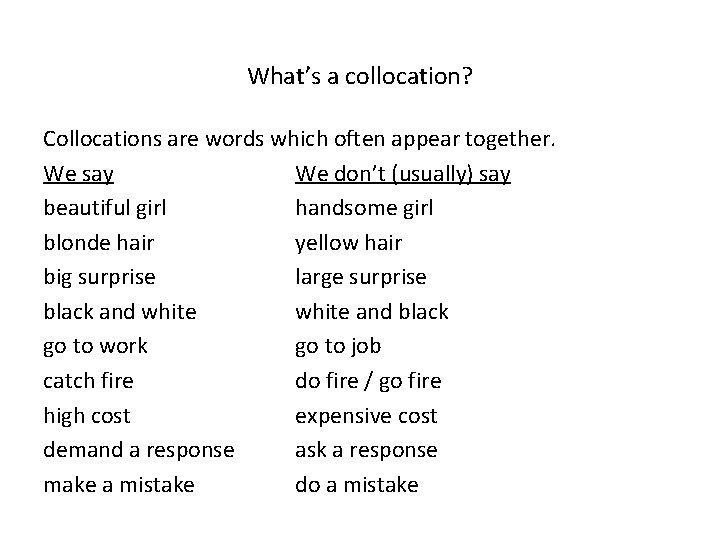
What’s a collocation? Collocations are words which often appear together. We say We don’t (usually) say beautiful girl handsome girl blonde hair yellow hair big surprise large surprise black and white and black go to work go to job catch fire do fire / go fire high cost expensive cost demand a response ask a response make a mistake do a mistake
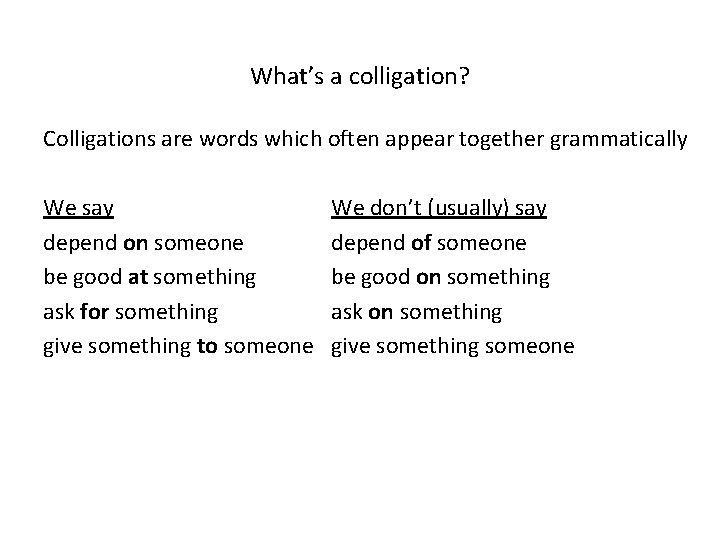
What’s a colligation? Colligations are words which often appear together grammatically We say depend on someone be good at something ask for something give something to someone We don’t (usually) say depend of someone be good on something ask on something give something someone
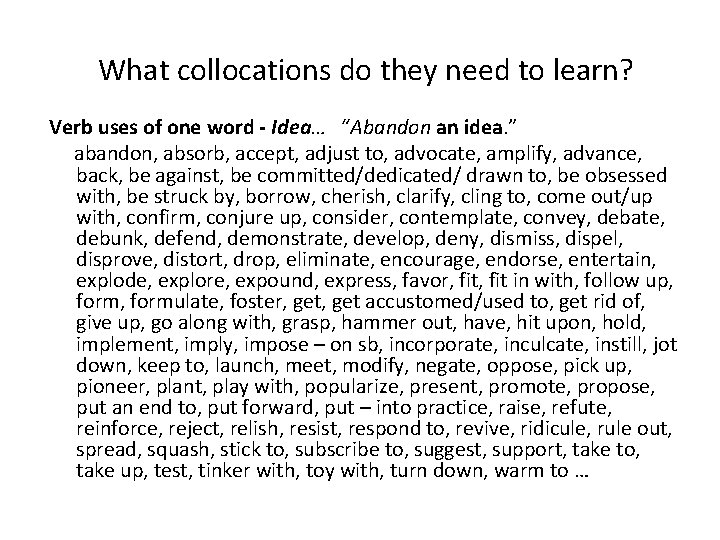
What collocations do they need to learn? Verb uses of one word - Idea… “Abandon an idea. ” abandon, absorb, accept, adjust to, advocate, amplify, advance, back, be against, be committed/dedicated/ drawn to, be obsessed with, be struck by, borrow, cherish, clarify, cling to, come out/up with, confirm, conjure up, consider, contemplate, convey, debate, debunk, defend, demonstrate, develop, deny, dismiss, dispel, disprove, distort, drop, eliminate, encourage, endorse, entertain, explode, explore, expound, express, favor, fit in with, follow up, formulate, foster, get accustomed/used to, get rid of, give up, go along with, grasp, hammer out, have, hit upon, hold, implement, imply, impose – on sb, incorporate, inculcate, instill, jot down, keep to, launch, meet, modify, negate, oppose, pick up, pioneer, plant, play with, popularize, present, promote, propose, put an end to, put forward, put – into practice, raise, refute, reinforce, reject, relish, resist, respond to, revive, ridicule, rule out, spread, squash, stick to, subscribe to, suggest, support, take to, take up, test, tinker with, toy with, turn down, warm to …
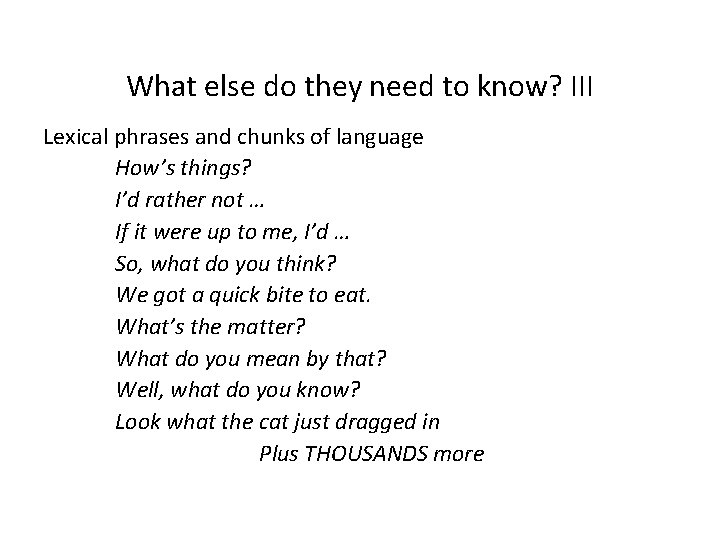
What else do they need to know? III Lexical phrases and chunks of language How’s things? I’d rather not … If it were up to me, I’d … So, what do you think? We got a quick bite to eat. What’s the matter? What do you mean by that? Well, what do you know? Look what the cat just dragged in Plus THOUSANDS more
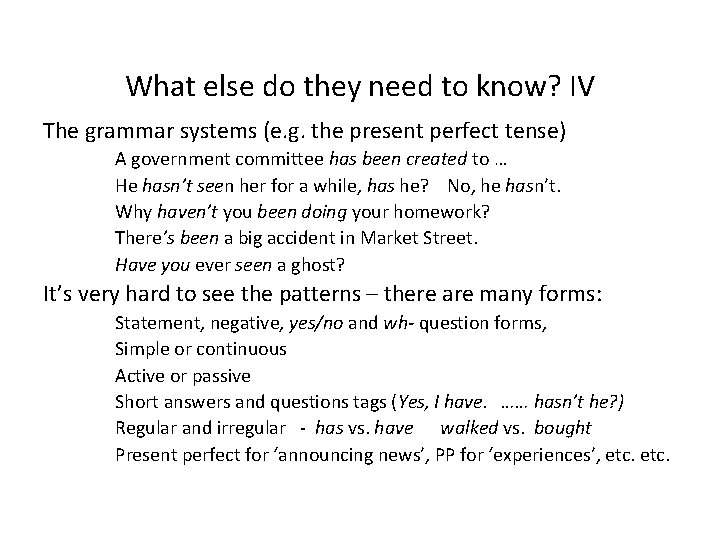
What else do they need to know? IV The grammar systems (e. g. the present perfect tense) A government committee has been created to … He hasn’t seen her for a while, has he? No, he hasn’t. Why haven’t you been doing your homework? There’s been a big accident in Market Street. Have you ever seen a ghost? It’s very hard to see the patterns – there are many forms: Statement, negative, yes/no and wh- question forms, Simple or continuous Active or passive Short answers and questions tags (Yes, I have. …… hasn’t he? ) Regular and irregular - has vs. have walked vs. bought Present perfect for ‘announcing news’, PP for ‘experiences’, etc.
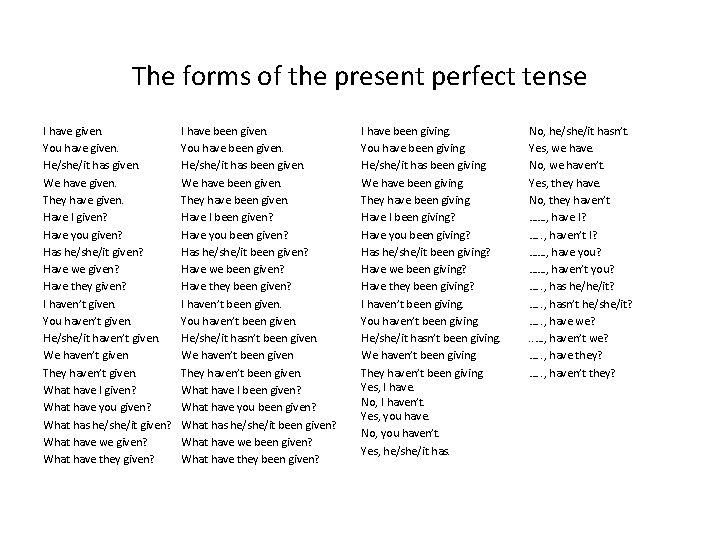
The forms of the present perfect tense I have given. You have given. He/she/it has given. We have given. They have given. Have I given? Have you given? Has he/she/it given? Have we given? Have they given? I haven’t given. You haven’t given. He/she/it haven’t given. We haven’t given They haven’t given. What have I given? What have you given? What has he/she/it given? What have we given? What have they given? I have been given. You have been given. He/she/it has been given. We have been given. They have been given. Have I been given? Have you been given? Has he/she/it been given? Have we been given? Have they been given? I haven’t been given. You haven’t been given. He/she/it hasn’t been given. We haven’t been given They haven’t been given. What have I been given? What have you been given? What has he/she/it been given? What have we been given? What have they been given? I have been giving. You have been giving. He/she/it has been giving. We have been giving. They have been giving. Have I been giving? Have you been giving? Has he/she/it been giving? Have we been giving? Have they been giving? I haven’t been giving. You haven’t been giving. He/she/it hasn’t been giving. We haven’t been giving They haven’t been giving. Yes, I have. No, I haven’t. Yes, you have. No, you haven’t. Yes, he/she/it has. No, he/she/it hasn’t. Yes, we have. No, we haven’t. Yes, they have. No, they haven’t ……, have I? …. . , haven’t I? ……, have you? ……, haven’t you? …. . , has he/he/it? …. . , hasn’t he/she/it? …. . , have we? . . …, haven’t we? …. . , have they? …. . , haven’t they?
How long will it take to teach them? • An average word needs 30 -50 meetings for it to be learnt receptively from reading (more for productive use) • An average word’s meaning takes 10 -15 meetings to learn from word cards or word lists • To learn the collocations and ‘deeper’ aspects of language learning takes MUCH longer. • There’s little research into the rate learning of collocation, colligation or lexical phrases from reading • We know nothing at all about how long it takes to master a particular grammatical form e. g. a tense
How well are our courses presenting the language students need? Research suggests an average language course: • does not systematically recycle the grammatical forms outside the presentation unit / lesson • has an almost random vocabulary selection without much regard to frequency or usefulness (mostly based on topic) • rarely, if ever, recycles taught words either later in the unit, the book, or the series • provide little additional practice in review units or workbooks • has an overwhelming focus on new material in each lesson
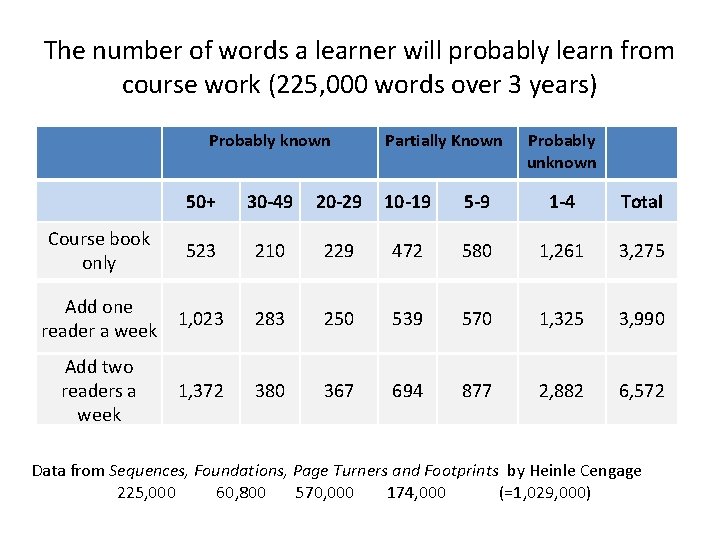
The number of words a learner will probably learn from course work (225, 000 words over 3 years) Probably known Partially Known Probably unknown 50+ 30 -49 20 -29 10 -19 5 -9 1 -4 Total Course book only 523 210 229 472 580 1, 261 3, 275 Add one reader a week 1, 023 283 250 539 570 1, 325 3, 990 Add two readers a week 1, 372 380 367 694 877 2, 882 6, 572 Data from Sequences, Foundations, Page Turners and Footprints by Heinle Cengage 225, 000 60, 800 570, 000 174, 000 (=1, 029, 000)
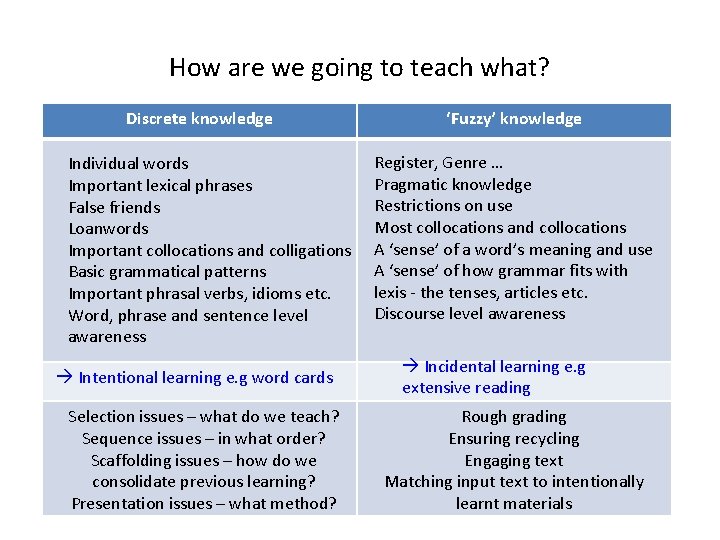
How are we going to teach what? Discrete knowledge Individual words Important lexical phrases False friends Loanwords Important collocations and colligations Basic grammatical patterns Important phrasal verbs, idioms etc. Word, phrase and sentence level awareness Intentional learning e. g word cards Selection issues – what do we teach? Sequence issues – in what order? Scaffolding issues – how do we consolidate previous learning? Presentation issues – what method? ‘Fuzzy’ knowledge Register, Genre … Pragmatic knowledge Restrictions on use Most collocations and collocations A ‘sense’ of a word’s meaning and use A ‘sense’ of how grammar fits with lexis - the tenses, articles etc. Discourse level awareness Incidental learning e. g extensive reading Rough grading Ensuring recycling Engaging text Matching input text to intentionally learnt materials
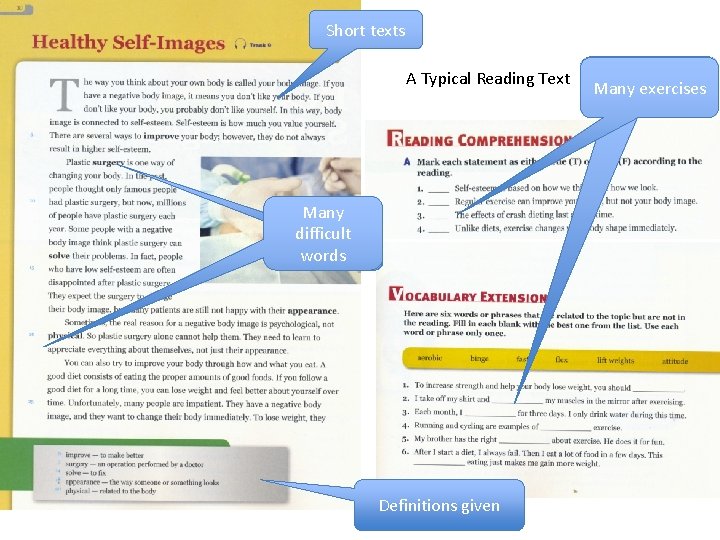
Short texts A Typical Reading Text Many difficult words Definitions given Many exercises
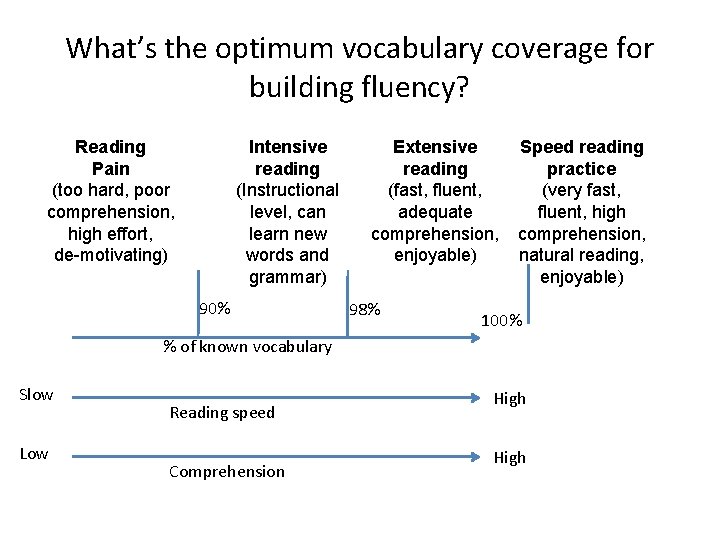
What’s the optimum vocabulary coverage for building fluency? Reading Pain (too hard, poor comprehension, high effort, de-motivating) Intensive reading (Instructional level, can learn new words and grammar) 90% Extensive reading (fast, fluent, adequate comprehension, enjoyable) 98% Speed reading practice (very fast, fluent, high comprehension, natural reading, enjoyable) 100% % of known vocabulary Slow Low Reading speed Comprehension High
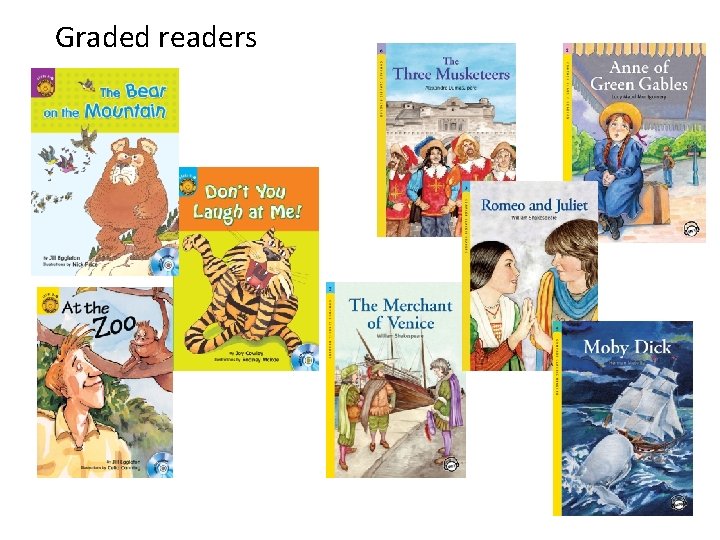
Graded readers
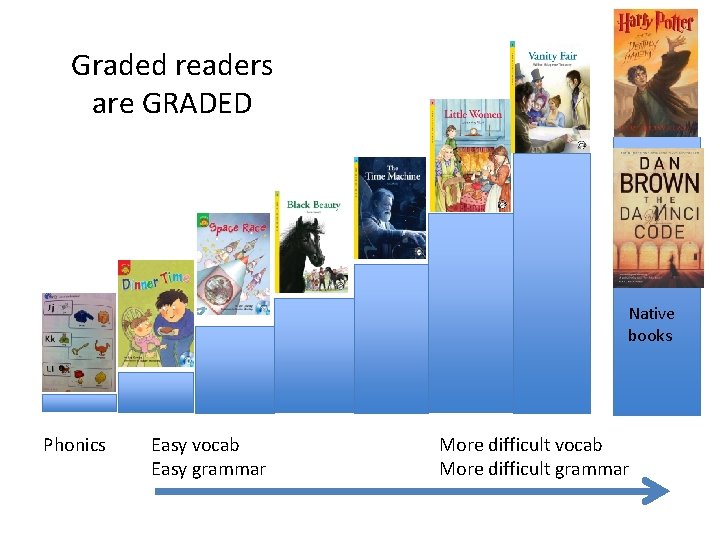
Graded readers are GRADED Native books Phonics Easy vocab Easy grammar More difficult vocab More difficult grammar
Why can’t Korean students read, listen, speak and write well? Their language knowledge is often abstract, separated, discrete and very fragile to forgetting There’s too much work on “the pieces-of-language” and not enough comprehensible, meaningful discourse They haven’t met the words and grammar enough times to feel comfortable using it They CANNOT speak until they feel comfortable using their knowledge Not enough exposure. To acquire a 7000 word vocabulary requires them to meet about 10 -15, 000 words. A typical Junior high 3 year course book series has 250, 000 words. They haven’t developed a ‘sense’ of language yet
Questions Make a list of say 20 activities you (or your students) most often do in your classes. e. g. explain things on the board, use the course book, discussions, pronunciation practice, read aloud, ……. Compare with a partner
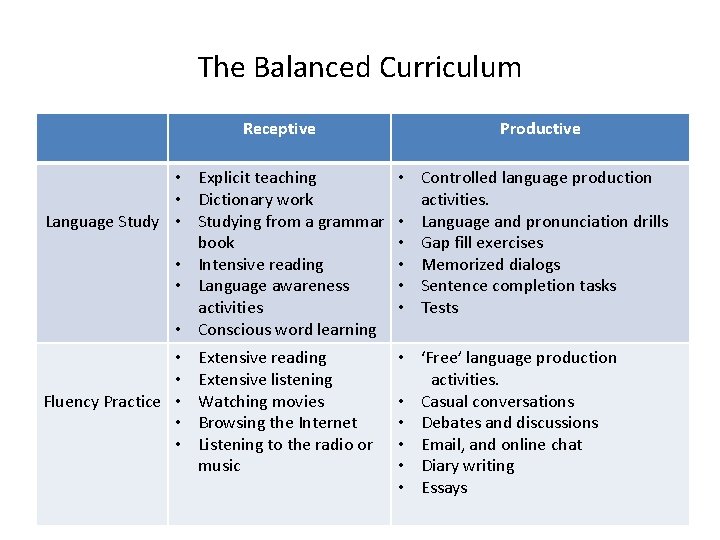
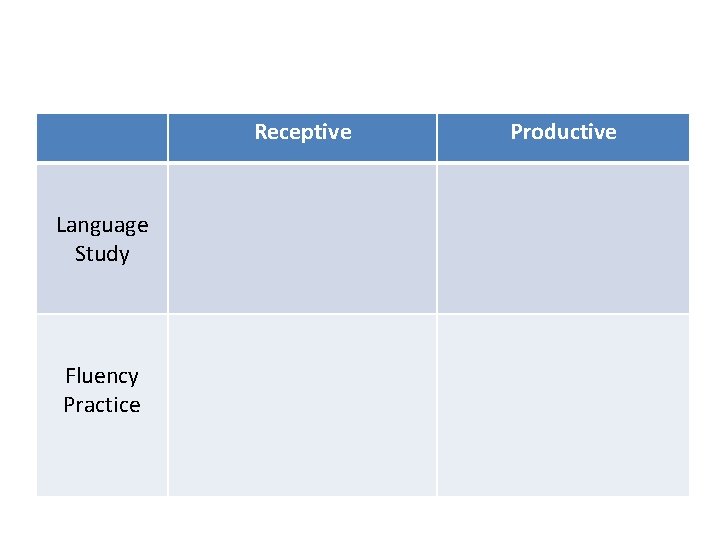
The Balanced Curriculum Receptive • Explicit teaching • Dictionary work Language Study • Studying from a grammar book • Intensive reading • Language awareness activities • Conscious word learning • • Fluency Practice • • • Extensive reading Extensive listening Watching movies Browsing the Internet Listening to the radio or music Productive • Controlled language production activities. • Language and pronunciation drills • Gap fill exercises • Memorized dialogs • Sentence completion tasks • Tests • ‘Free’ language production activities. • Casual conversations • Debates and discussions • Email, and online chat • Diary writing • Essays
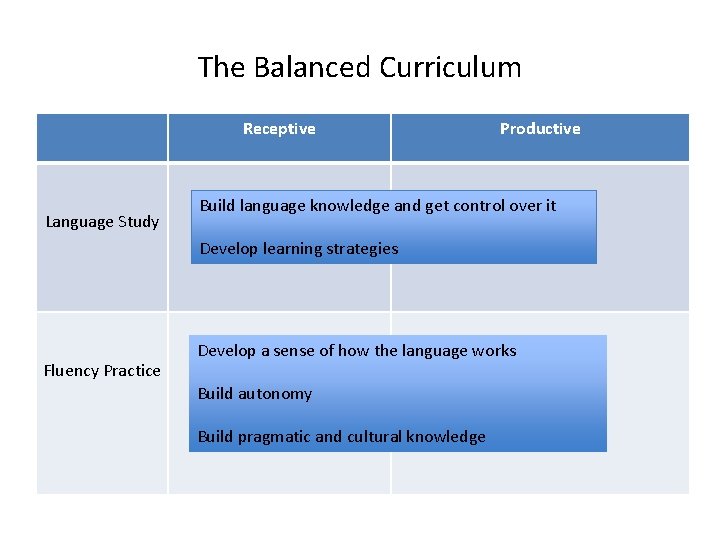
The Balanced Curriculum Receptive Language Study Productive Build language knowledge and get control over it Develop learning strategies Fluency Practice Develop a sense of how the language works Build autonomy Build pragmatic and cultural knowledge
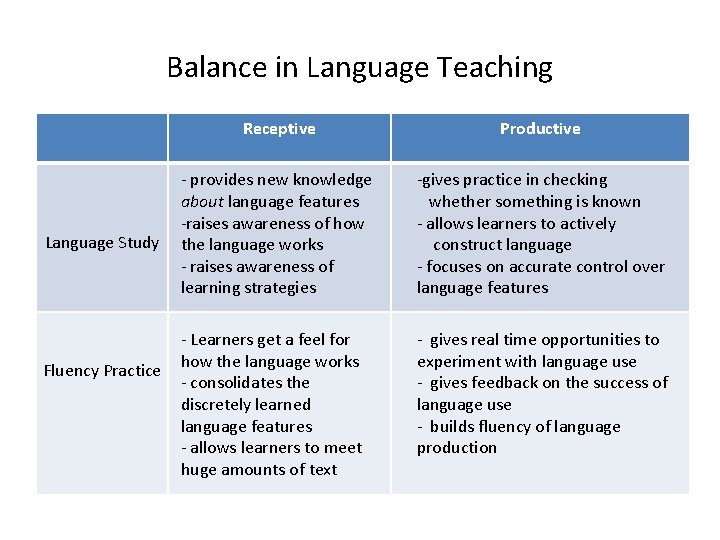
Balance in Language Teaching Language Study Fluency Practice Receptive Productive - provides new knowledge about language features -raises awareness of how the language works - raises awareness of learning strategies -gives practice in checking whether something is known - allows learners to actively construct language - focuses on accurate control over language features - Learners get a feel for how the language works - consolidates the discretely learned language features - allows learners to meet huge amounts of text - gives real time opportunities to experiment with language use - gives feedback on the success of language use - builds fluency of language production
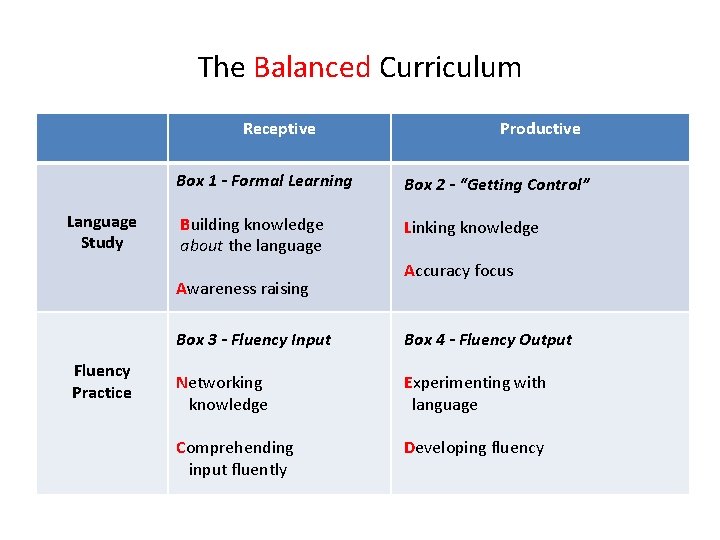
The Balanced Curriculum Receptive Language Study Box 1 - Formal Learning Box 2 - “Getting Control” Building knowledge about the language Linking knowledge Awareness raising Fluency Practice Productive Accuracy focus Box 3 - Fluency Input Box 4 - Fluency Output Networking knowledge Experimenting with language Comprehending input fluently Developing fluency
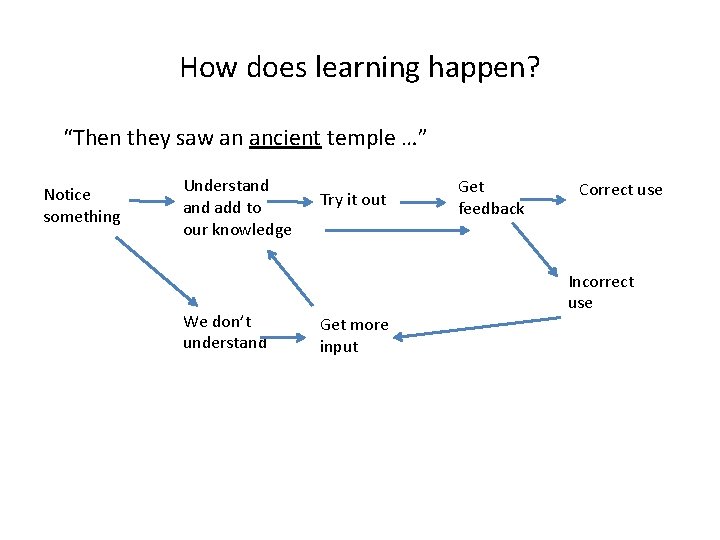
How does learning happen? “Then they saw an ancient temple …” Notice something Understand add to our knowledge We don’t understand Try it out Get more input Get feedback Correct use Incorrect use
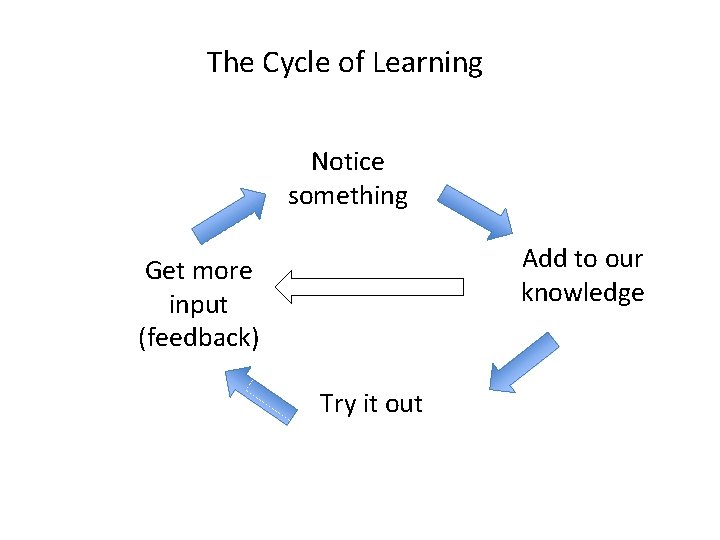
The Cycle of Learning Notice something Add to our knowledge Get more input (feedback) Try it out
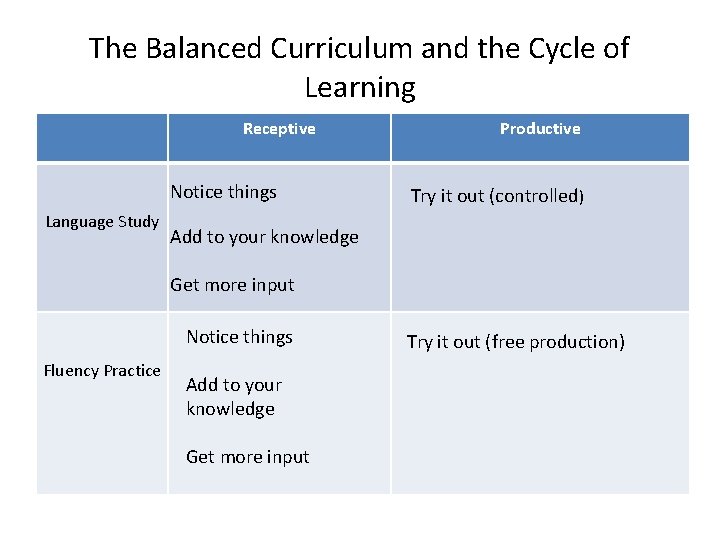
The Balanced Curriculum and the Cycle of Learning Receptive Notice things Language Study Productive Try it out (controlled) Add to your knowledge Get more input Notice things Fluency Practice Add to your knowledge Get more input Try it out (free production)
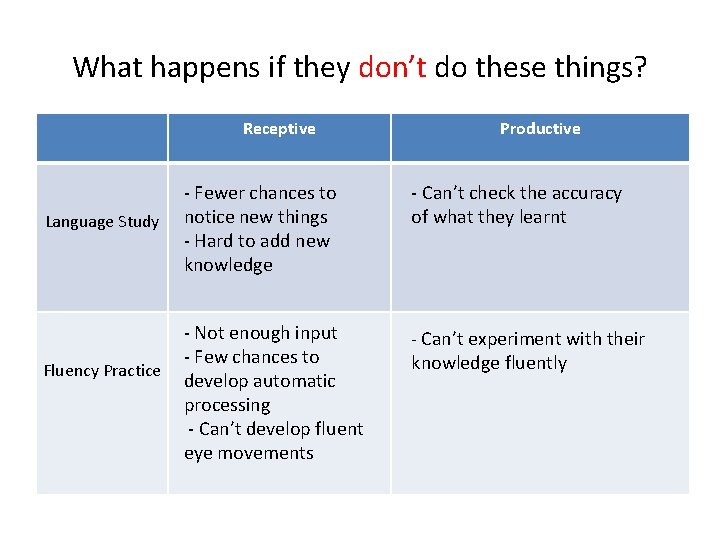
What happens if they don’t do these things? Receptive Language Study Fluency Practice Productive - Fewer chances to notice new things - Hard to add new knowledge - Can’t check the accuracy of what they learnt - Not enough input - Few chances to develop automatic processing - Can’t develop fluent eye movements - Can’t experiment with their knowledge fluently
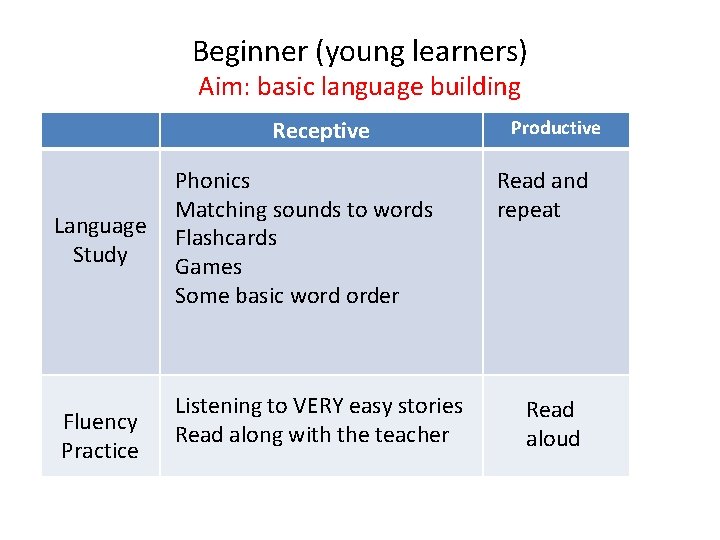
Beginner (young learners) Aim: basic language building Receptive Language Study Fluency Practice Phonics Matching sounds to words Flashcards Games Some basic word order Listening to VERY easy stories Read along with the teacher Productive Read and repeat Read aloud
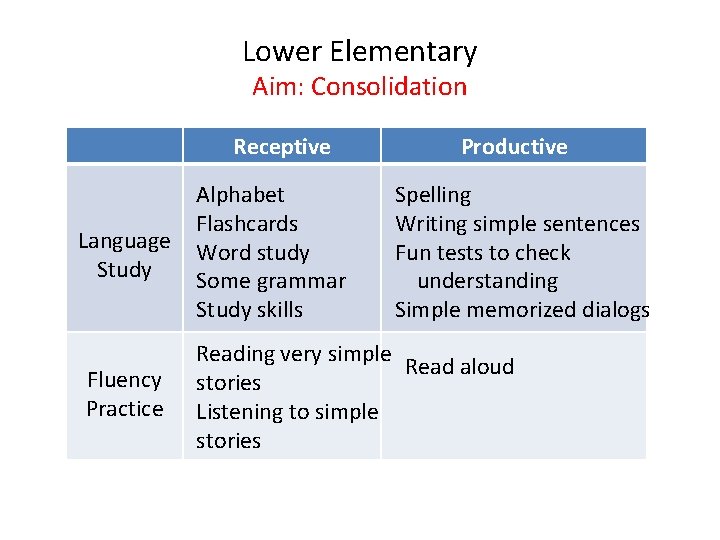
Lower Elementary Aim: Consolidation Receptive Language Study Fluency Practice Alphabet Flashcards Word study Some grammar Study skills Productive Spelling Writing simple sentences Fun tests to check understanding Simple memorized dialogs Reading very simple Read aloud stories Listening to simple stories
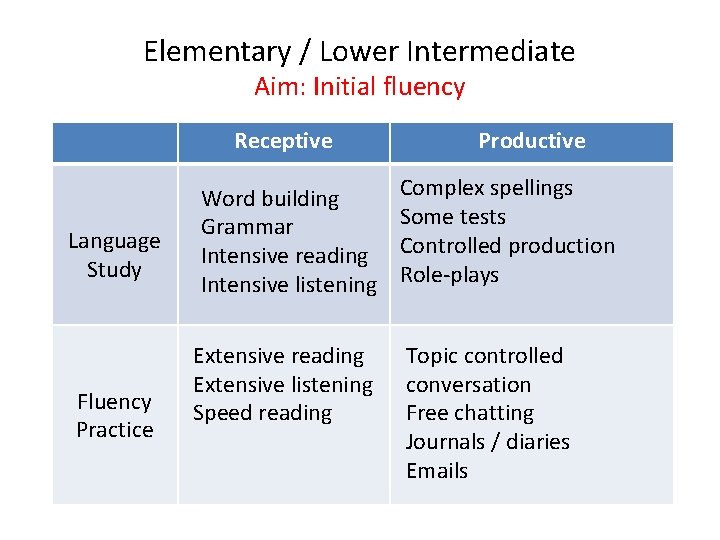
Elementary / Lower Intermediate Aim: Initial fluency Receptive Language Study Fluency Practice Word building Grammar Intensive reading Intensive listening Extensive reading Extensive listening Speed reading Productive Complex spellings Some tests Controlled production Role-plays Topic controlled conversation Free chatting Journals / diaries Emails
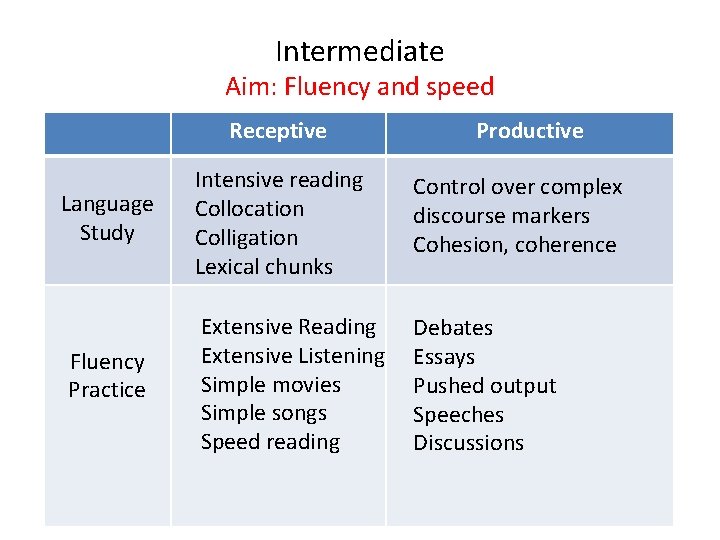
Intermediate Aim: Fluency and speed Receptive Language Study Fluency Practice Productive Intensive reading Collocation Colligation Lexical chunks Control over complex discourse markers Cohesion, coherence Extensive Reading Extensive Listening Simple movies Simple songs Speed reading Debates Essays Pushed output Speeches Discussions
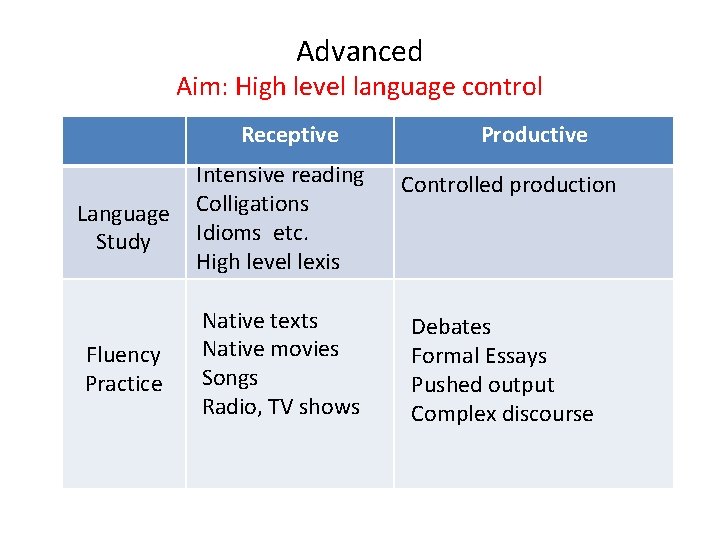
Advanced Aim: High level language control Receptive Productive Language Study Intensive reading Colligations Idioms etc. High level lexis Controlled production Fluency Practice Native texts Native movies Songs Radio, TV shows Debates Formal Essays Pushed output Complex discourse
Making them fluent Give opportunities for fluency…. F ast and efficient reading and listening practice L ink their practice to real tasks U nderstanding is primary E ncourage speed development work N urture confidence and motivation T ry extensive reading and listening
Be careful about using Native-level (L 1) materials to build fluency Native books, magazines etc. are too hard to read fluently for MOST Korean learners Children’s books for natives are full of difficult words, phrases and concepts Native children already know 5000 words and almost all the grammar BEFORE they start to read Korean children know almost no English words and no grammar before they start English. Native texts usually are NOT suitable. Don’t confuse the final target (to read native texts) with the starting point and the way to get there.
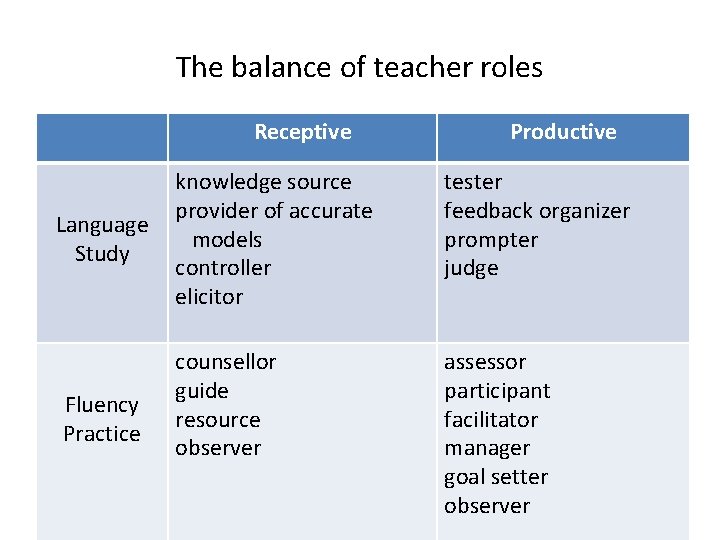
The balance of teacher roles Receptive Language Study Fluency Practice Productive knowledge source provider of accurate models controller elicitor tester feedback organizer prompter judge counsellor guide resource observer assessor participant facilitator manager goal setter observer
True or false? The balanced curriculum tells us what needs to be done. The balanced curriculum suggests activities be done in the order, Box 1, 2, 3 and then 4. The balanced curriculum should replace your curriculum. Students can easily understand the balanced curriculum. TBC is an ideational framework for teachers planning curriculums and lessons.
Thank you for your time Dr. Rob Waring waring_robert@yahoo. com http: //www. robwaring. org/presentations/ www. keera. or. kr
Receptive Language Study Fluency Practice Productive
- Slides: 38