
Balance Flow Controller load balancing for Open Flow
Balance. Flow: Controller load balancing for Open. Flow networks Hu, Yannan ; Wang, Wendong ; Gong, Xiangyang ; Que, Xirong ; Cheng, Shiduan Cloud Computing and Intelligent Systems (CCIS), 2012 IEEE 2 nd International Conference on 1
Outline • Introduction – Controller may be bottleneck in Open. Flow – Existd solution • • System architecture Simulated results Conclusion Reference 2
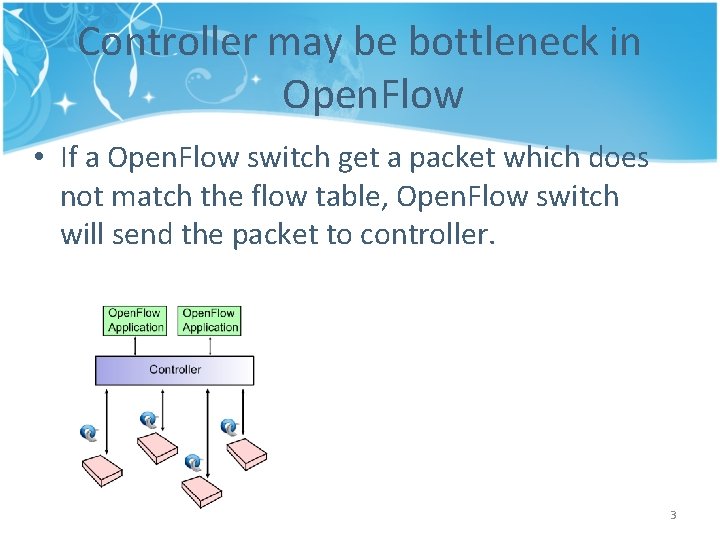
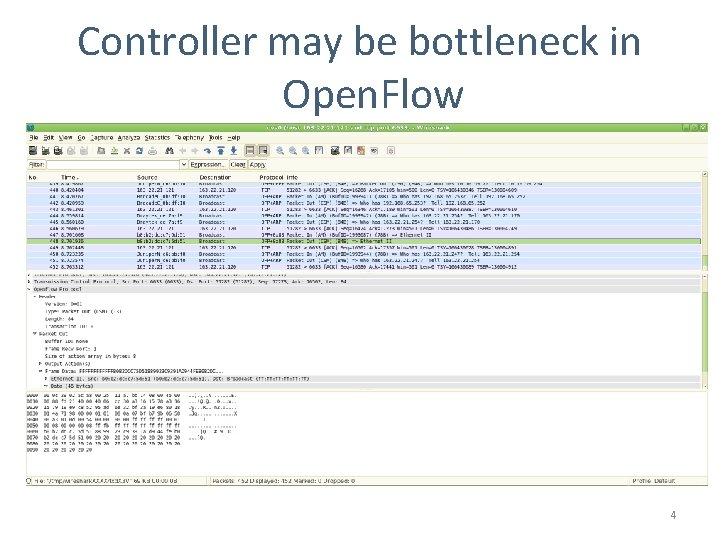
Controller may be bottleneck in Open. Flow • If a Open. Flow switch get a packet which does not match the flow table, Open. Flow switch will send the packet to controller. 3
Controller may be bottleneck in Open. Flow 4
Existd mechanism- Open. Flow 1. 2 • Open. Flow 1. 2 supports multiple controller connection for one switch. – Each controller may send a OFPT_ROLE_REQUEST message to communicate its role to the switch • OFPCR_ROLE_MASTER • OFPCR_ROLE_SLAVE – But there is not any mechanism for the communication and flow-request load balancing. 5
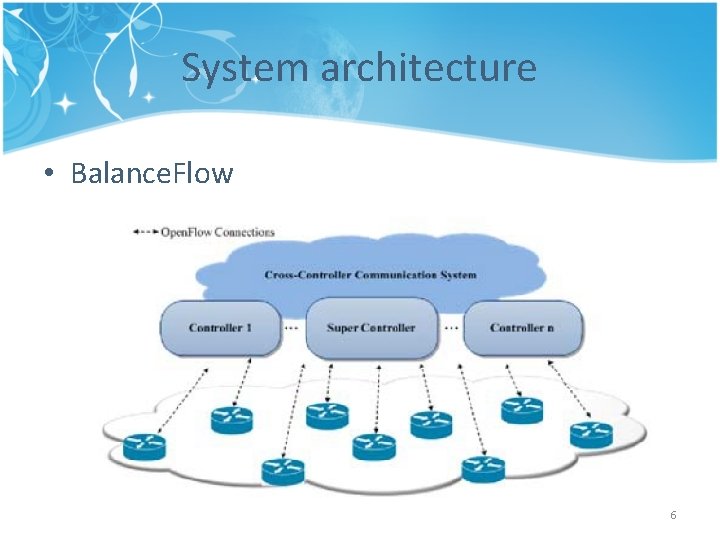
System architecture • Balance. Flow 6
Controller’s job • Each controller k maintains an N × N matrix M k, where N is the number of switches in the network. The element in the ith row, jth column denotes the average number of flow -requests from switch i to switch j. • The super controller is responsible for collecting the flow-requests matrixes published by all controllers. 7
Detecting imbalance • The super controller detects controller load imbalance when the average number of flowrequests handled by any controller contributes more than some threshold of the total flow-requests rate in the network. 8
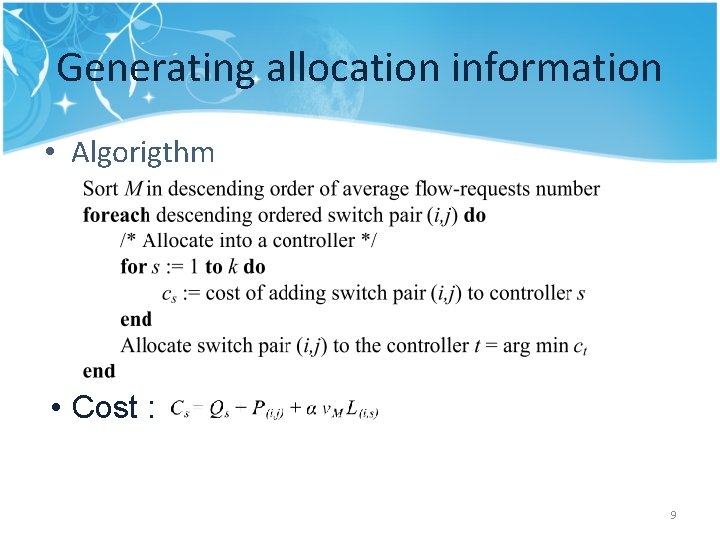
Generating allocation information • Algorigthm • Cost : 9
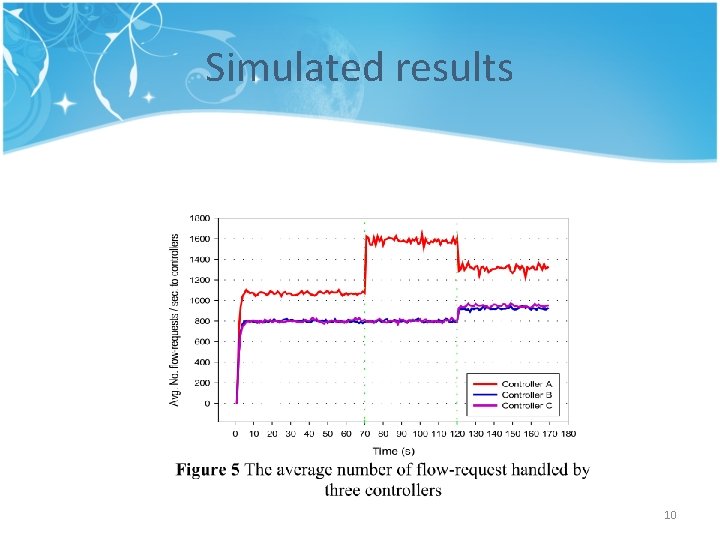
Simulated results 10
Conclusion • The super controller runs partition algorithm and reallocates the load of different controller by distributing allocation rules to switches. • Balance. Flow can handle controller load balancing entirely at the controller level. 11
Reference • Open. Flow Switch Specification 1. 3. 2 - Open Networking Foundation 12

13
- Slides: 13