
Balance Confidence and Fear of Falling Avoidance Behavior
Balance Confidence and Fear of Falling Avoidance Behavior Are Most Predictive of Falling in Older Adults: Prospective Analysis by Merrill R. Landers, Sarrie Oscar, Jessica Sasaoka, and Kyle Vaughn ptjournal Volume 96(4): 433 -442 March 31, 2016 © 2016 American Physical Therapy Association
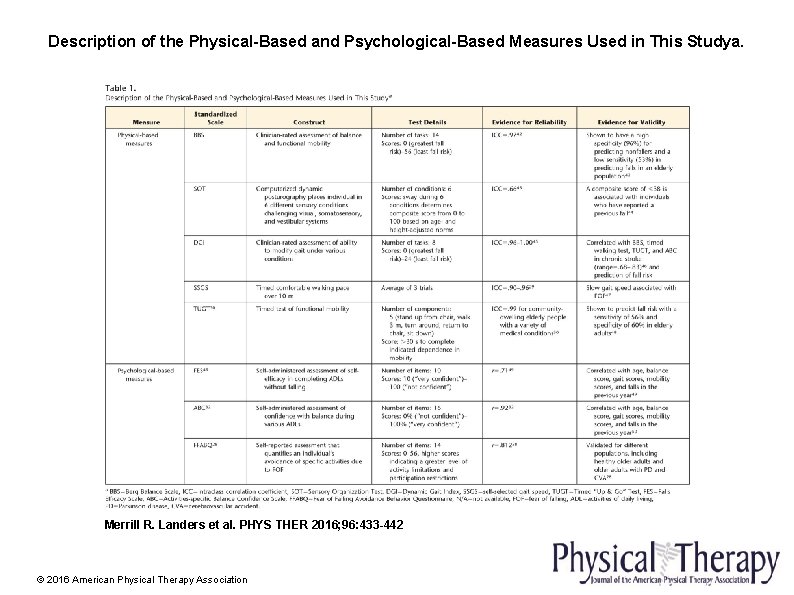
Description of the Physical-Based and Psychological-Based Measures Used in This Studya. Merrill R. Landers et al. PHYS THER 2016; 96: 433 -442 © 2016 American Physical Therapy Association

Fall Categories and Respective Health Conditions for Initial 64 Participantsa. Merrill R. Landers et al. PHYS THER 2016; 96: 433 -442 © 2016 American Physical Therapy Association

Areas Under the Curve (AUC) for Each of the Predictor Variables for Faller and Frequent Faller Status at 1 Yeara. Merrill R. Landers et al. PHYS THER 2016; 96: 433 -442 © 2016 American Physical Therapy Association

Receiver operating characteristic curve for fall history 1 year after assessment for each of the following predictor variables: Fear of Falling Avoidance Behavior Questionnaire (FFABQ), Falls Efficacy Scale (FES), and Timed “Up & Go” Test (TUGT). Merrill R. Landers et al. PHYS THER 2016; 96: 433 -442 © 2016 American Physical Therapy Association

Receiver operating characteristic curve for fall history status 1 year after assessment for each of the following predictor variables: fall history (number of falls in the year before assessment), Activities-specific Balance Confidence Scale (ABC), Berg Balance Scale (BBS), Dynamic Gait Index (DGI), self-selected gait speed (SSGS), and Sensory Organization Test (SOT). Merrill R. Landers et al. PHYS THER 2016; 96: 433 -442 © 2016 American Physical Therapy Association
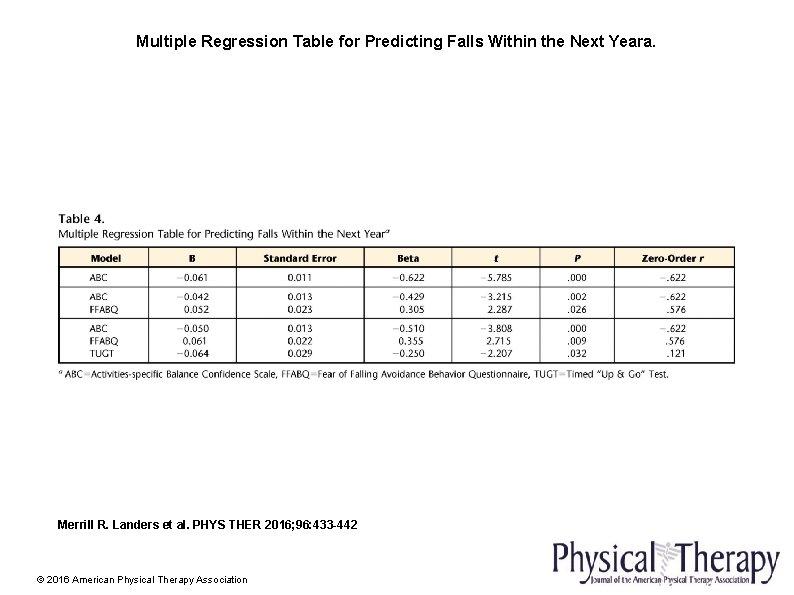
Multiple Regression Table for Predicting Falls Within the Next Yeara. Merrill R. Landers et al. PHYS THER 2016; 96: 433 -442 © 2016 American Physical Therapy Association
- Slides: 7