
Balance and Truth in News Reporting Current Affairs
Balance and Truth in News Reporting & Current Affairs Analysing Journalism Week 3
Aims To analyse competing approaches to ‘objectivity’, ‘truth’ and ‘balance’ § To identify underlying pressures encouraging changes in approach to ‘objectivity’ § To consider the crisis of Public Service Broadcasting in this context
What is news? • what important people do • Something out of the ordinary • Disruption of the status quo • Man bites dog • Events of consequence • Truth that is uncovered (by news hounds) • Stories that ruffle feathers (accountability) • essential service to society
What is news? • The core of media operations • Duty / Public service “The primary purpose of journalism (news) is to provide citizens with the information they need to be free and self governing” Bill Kovach & Tom Rosentiel (2003) The Elements of Journalism London Atlantic Books • News is a media form that varies within formats and contexts of production
Early Approaches in Journalism (Recap) • Journalism as a ‘mirror on the world’ • Implies an objective and ‘complete’ account • But selection is inevitable? • And therefore values or bias inevitably present?
What is news for? • Surveillance – window on the world • Need to know (awareness) • Local & Global • Community - conformity • common language • security • Decision making - goals and aspirations information • socialisation • Progress (consensus) •
Determinants of News • Impact/ Magnitude/Consequence • How many people are affected in/by the occurrence/idea • How intensely/seriously will the repercussions be • Proximity (Geographical/Mental) • How close to home is the occurrence • What are the odds of being affected • Timeliness/Urgency – (Topical) • How imminent is the event/occurrence or its repercussion • What patterns of coincidence have emerged
Determinants of News • Prominence/Importance/ Significance • How well known are the persons /institutions involved • Do these depend on the patronage of the public • Novelty /Oddity • How strange (far from the norm) is the phenomenon • Conflict – (war, sports, crime, economic, social) • What is the nature and extent of the disruption • Interest • What appeals to the specific audience and the media organisation
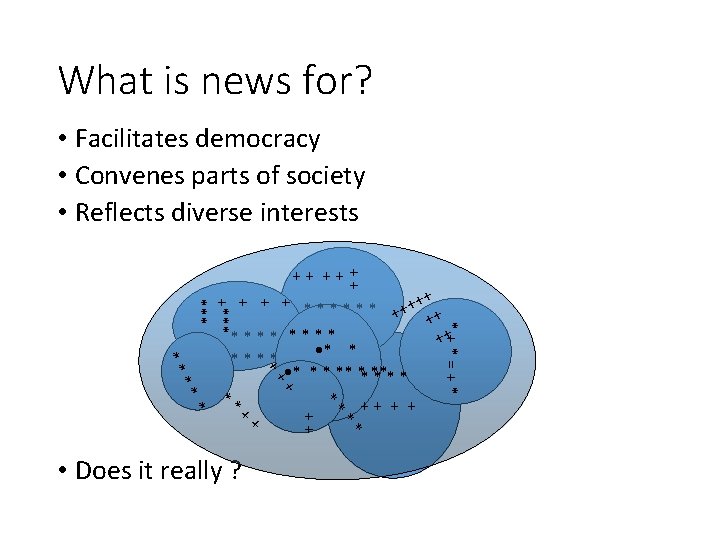
What is news for? • Facilitates democracy • Convenes parts of society • Reflects diverse interests + +*** ****** • * * * ** *** ** ++ + + ++ + ** ++ ** ** ** ++ * • Does it really ? *+*=+* ++ +++ ++
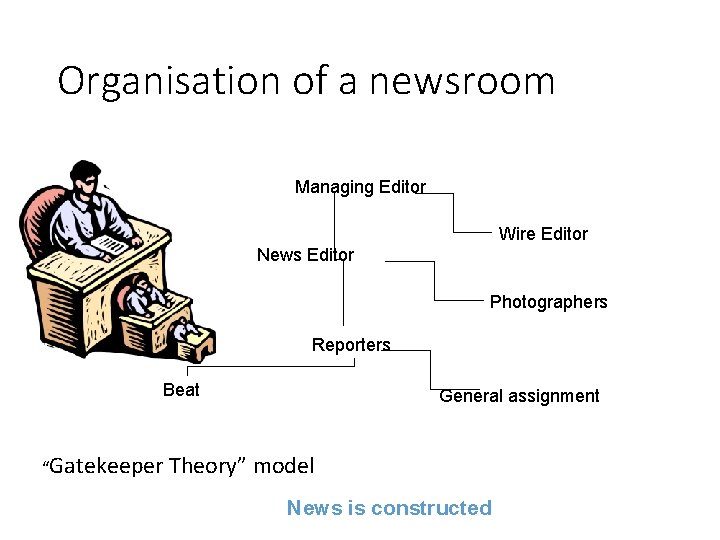
Organisation of a newsroom Managing Editor Wire Editor News Editor Photographers Reporters Beat “Gatekeeper General assignment Theory” model News is constructed
Gatekeeper model - further developments Early academic studies of journalism developed “Gatekeeper Theory” (D. M. White in Tumber ‘News: a reader’. • Focus on the role of editors and subs within the news organisation but this is further developed • Gayle Tuchman ‘Objectivity as a Strategic Ritual’ (AJS 1972) • Observation study of two newsroom in USA • ‘Real’ Objectivity is never achieved • Within journalism ‘objectivity’ becomes a “ritual” (like a rain dance)
Constructing ‘truth’? • Tuchman: Journalists substitute ‘balance’ for objectivity • And use ‘rule of thumb’ measures to support claims for accuracy and truth in copy • More recently Allan (1999) ‘News Cultures’ argues journalists include textual devices within news texts to support claims for ‘truth’ • ‘the will to facticity’ (Allan) • e. g. symbols of ‘authority’ in news broadcasts. . . • https: //www. youtube. com/watch? v=demh. L 0 Bj. Cg. U • https: //www. youtube. com/watch? v=xyy. Ldf. H 6 XBA
Constructing ‘truth’? • Similarly Starkey (2007): • “ A range of technical and symbolic codes are consistently deployed in [news] output to signify …importance, seriousness, urgency, sincerity, rigour …authenticity of content” (2007: 3) • e. g. the globe turning at beginning of news broadcasts.
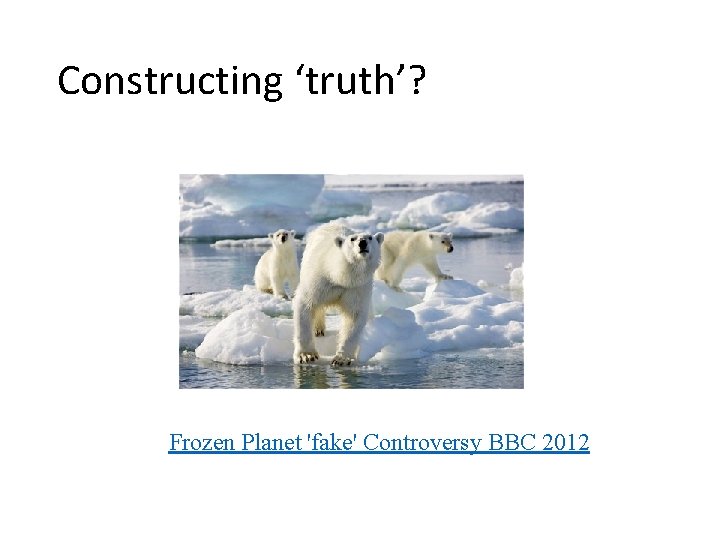
Constructing ‘truth’? Frozen Planet 'fake' Controversy BBC 2012
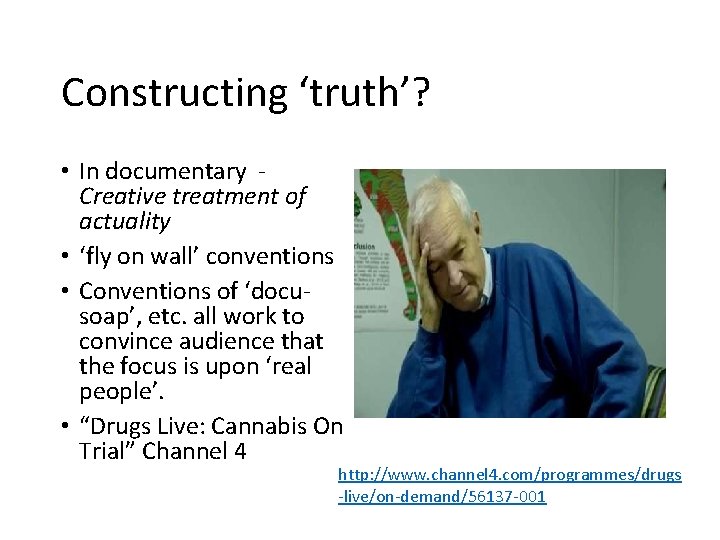
Constructing ‘truth’? • In documentary Creative treatment of actuality • ‘fly on wall’ conventions • Conventions of ‘docusoap’, etc. all work to convince audience that the focus is upon ‘real people’. • “Drugs Live: Cannabis On Trial” Channel 4 http: //www. channel 4. com/programmes/drugs -live/on-demand/56137 -001
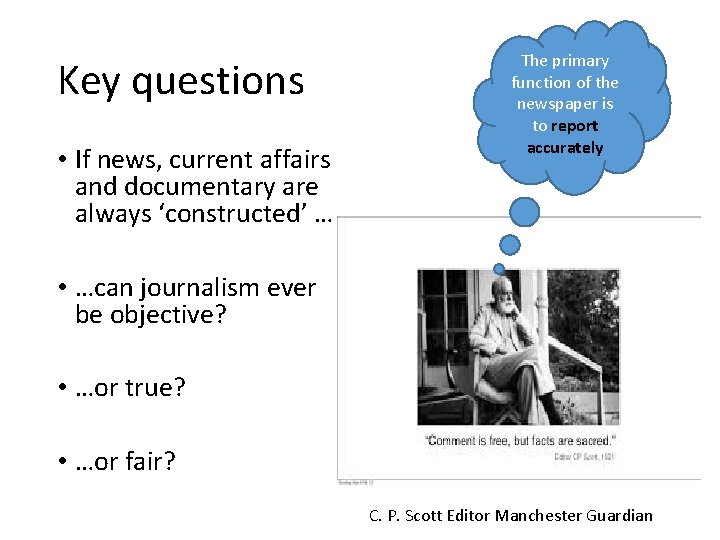
Key questions • If news, current affairs and documentary are always ‘constructed’ … The primary function of the newspaper is to report accurately • …can journalism ever be objective? • …or true? • …or fair? C. P. Scott Editor Manchester Guardian
Broadcast Journalism • Broadcasting understood as more powerful and therefore different to press • 1926 Crawford Committee grants monopoly to BBC (contrast to US etc. ) • “Scrupulous fairness” required of the BBC and encoded in first charter • Reith demanded “due impartiality” of his producers
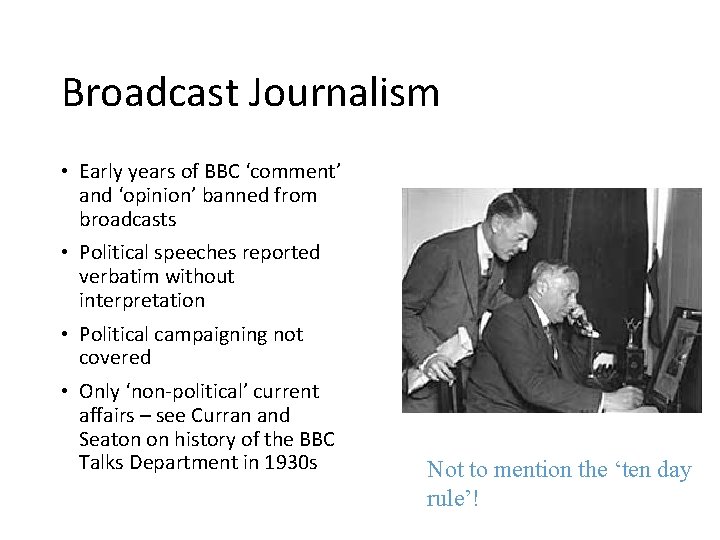
Broadcast Journalism • Early years of BBC ‘comment’ and ‘opinion’ banned from broadcasts • Political speeches reported verbatim without interpretation • Political campaigning not covered • Only ‘non-political’ current affairs – see Curran and Seaton on history of the BBC Talks Department in 1930 s Not to mention the ‘ten day rule’!
Broadcast Journalism • 1950 s controls on ‘comment’ slowly erode • The ‘new’ Independent Television News covers a bye-election in 1957 • But all broadcasting including ITN still required to maintain “due balance and impartiality” with the regulatory frameworks of PSB
What Happened to Objectivity? • In practice both BBC and ITN have side-stepped the issue of objectivity • Balance is a substitute • As Starkey (2007) and Mc. Nair (2001)argue in liberal democracies balance is interpreted as ‘balance between the main political parties’
Some Problems… • The relationship with the state is always problematic • Should national broadcasters remain ‘balanced’ in times of war or national crisis? • 1926 General Strike • 1984 -85 Coal Strike • WW 2 but what about the 2003 Iraq War? • Brexit Negotiations : How much is right to be revealed openly?
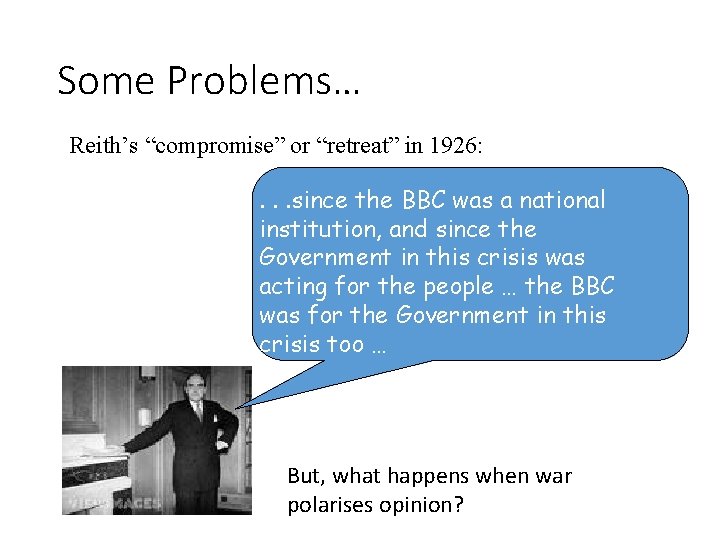
Some Problems… Reith’s “compromise” or “retreat” in 1926: . . . since the BBC was a national institution, and since the Government in this crisis was acting for the people … the BBC was for the Government in this crisis too … But, what happens when war polarises opinion?
Some Problems… • How to measure ‘balance’? • Measures of public opinion? • Problems if opinion is polarized • And is majority opinion ‘the truth’? • Does ‘balance’ mean reflecting the main political parties? • Does ‘balance’ mean reflecting the political consensus?
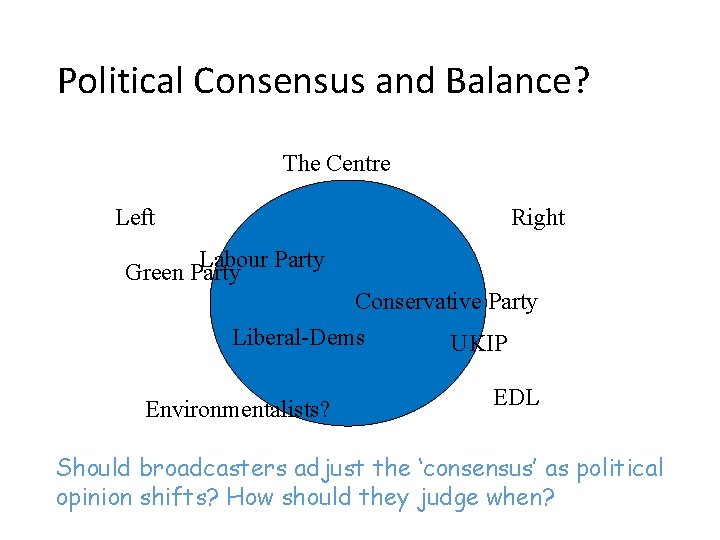
Political Consensus and Balance? The Centre Left Right Labour Party Green Party Conservative Party Liberal-Dems UKIP Environmentalists? EDL Should broadcasters adjust the ‘consensus’ as political opinion shifts? How should they judge when?
Political Consensus and Balance? • Consensus attacked from both right and left • But post-Gilligan BBC on the defensive • Concedes ground to critics from right • 2010 Internal report ‘accepts’ evidence of a ‘liberal consensus’ • http: //media. guardian. co. uk/site/story/0, , 2105978, 00. html • But in 2014 BBC commission’s another report – see the Cardiff University report
The argument so far… • Objectivity in journalism difficult to achieve • PSB journalism has traditionally substituted ‘balance’ for objectivity • But there are serious difficulties in doing this… • An alternative model:
Nick Davies • Also challenges conventional views of ‘balance’ • https: //www. youtube. com/watch? v=Skl. GNNLZOkw
‘Balance’ through ‘diversity’ • Post-war Italy: lottizazzione (Each of the main political parties / religious groups given their own channel) • Diverse Reports (Channel Four) • Channel Four News offering Scargill and Mc. Gregor opportunities to make their own news reports on Coal Strike • Citizens’ Journalism, Bloggers. . . • Note: shift towards relativism and constructionism – whose truth
Three Possible Models for Achieving Balance in Broadcast News and Current Affairs • The Panorama model • Panorama BBC flagship still works on assumption that ‘one’ objective account can be provided • Emphasises the ‘authority’ of the reporter (professionalism restored )
Model 2: Diverse Reports • Diverse Reports = a publishing platform for a diverse range of potentially polemical reports • …which achieve ‘balance’ over the duration of a season • But which do not claim one ‘truth’
Model 3 • The (2014) BBC Report recommends a ‘wagon wheel’ approach • Recognition of the complexity of political perspectives • And the collapse of the ‘two party’ system
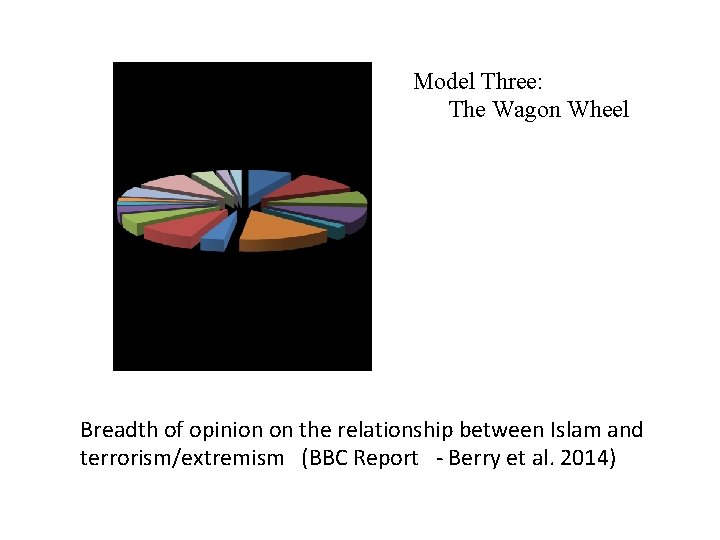
Model Three: The Wagon Wheel Breadth of opinion on the relationship between Islam and terrorism/extremism (BBC Report - Berry et al. 2014)
Summary • Problems with the traditional PSB model of ‘objective’, ‘balanced’ reporting • But equally models 2 and 3 open up a world where all perspectives are ‘equally true’ or ‘valid’ • Can journalism hold the powerful to account if we abandon the search for one objective, truth? • e. g. Tony Blair’s version of the reasons for the 2003 Iraq War – just one ‘equally valid’ perspective? • How best do we achieve the mission of news?
For Discussion • Does the presentation of the ‘truth’ require the presentation of the literally evident? • Or can ‘truth’ be represented to capture a more profound truth? • Does the photo-shopped or touched up image matter? • Or is a slippery slope towards ‘factual recreation’ e. g. Rogue Males
Examples for analysis • https: //www. youtube. com/watch? v=demh. L 0 Bj. Cg. U • • https: //www. youtube. com/watch? v=xyy. Ldf. H 6 XBA • http: //www. channel 4. com/programmes/drugs-live/ondemand/56137 -001
BBC Editorial Guidelines http: //www. bbc. co. uk/guidelines/editorialguidelines/edgu ide/ Note ‘truth’ and ‘objectivity’ do not appear – ‘balance’ and ‘impartiality’ operate as substitutes
- Slides: 36