
BALANCE AND POSTURAL ADJUSTMENTS Implications for Amputee Rehabilitation
BALANCE AND POSTURAL ADJUSTMENTS Implications for Amputee Rehabilitation NSWPAR, March 2007
SEARCH STRATEGY n n Searched Medline, Cinahl, Embase Keywords amputee (816) n rehabilitation (96126) n posture n balance n Limit to human, english = 17 n
DIFFERENCES BETWEEN AMPUTEES AND NORMALS n n n Loss of sensory feedback Loss of proprioception Altered postural sway (Buckley et al, 2002; Miller and Deathe, 2004)
DIFFERENCES BETWEEN AMPUTEES AND NORMALS n Biomechanical differences n GAIT n n n Heel contact – hip muscle activity in abductors, eccentric knee extensors (shock absorption) Midstance – dynamic stability maintained by hip abductors Push off – hip flexor activity for propulsion Swing – normal muscle activity (Sadeghi et al, 2001) BALANCE n n n ↓ WB’ing on prosthetic side Greater problems maintaining dynamic balance esp. in the a-p direction Lack of ‘ankle strategies’ are partially compensated by ‘hip strategies’ More dependant on vision More prone to interference from concurrent attention demanding tasks (Buckley et al, 2002)
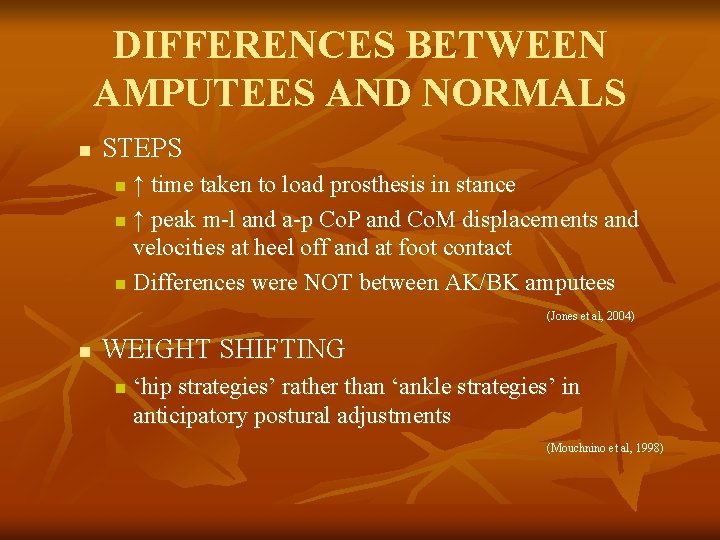
DIFFERENCES BETWEEN AMPUTEES AND NORMALS n STEPS ↑ time taken to load prosthesis in stance n ↑ peak m-l and a-p Co. P and Co. M displacements and velocities at heel off and at foot contact n Differences were NOT between AK/BK amputees n (Jones et al, 2004) n WEIGHT SHIFTING n ‘hip strategies’ rather than ‘ankle strategies’ in anticipatory postural adjustments (Mouchnino et al, 1998)
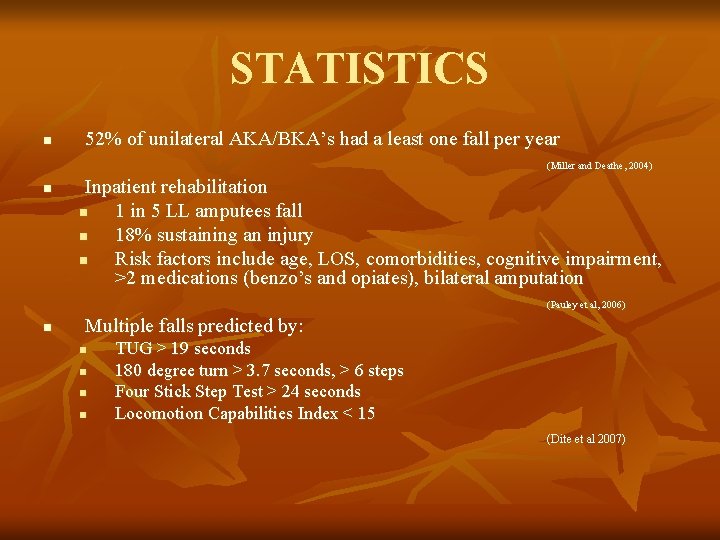
STATISTICS n 52% of unilateral AKA/BKA’s had a least one fall per year (Miller and Deathe, 2004) n Inpatient rehabilitation n 1 in 5 LL amputees fall n 18% sustaining an injury n Risk factors include age, LOS, comorbidities, cognitive impairment, >2 medications (benzo’s and opiates), bilateral amputation (Pauley et al, 2006) n Multiple falls predicted by: n n TUG > 19 seconds 180 degree turn > 3. 7 seconds, > 6 steps Four Stick Step Test > 24 seconds Locomotion Capabilities Index < 15 (Dite et al 2007)
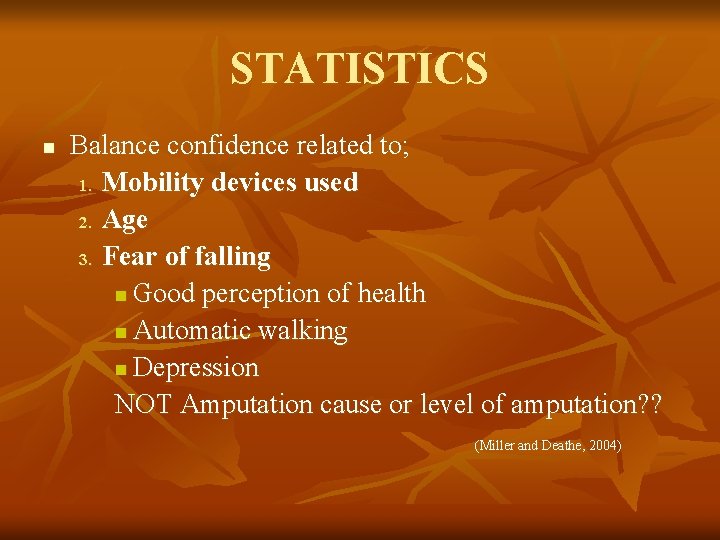
STATISTICS n Balance confidence related to; 1. Mobility devices used 2. Age 3. Fear of falling n Good perception of health n Automatic walking n Depression NOT Amputation cause or level of amputation? ? (Miller and Deathe, 2004)

MEASUREMENT OF BALANCE n Activities-specific Balance Score (ABC scale) (Powell and Myers, 1995) n L-Test of Functional mobility (Deathe and Miller, 2005) n n n Step Test Berg Balance Scale Functional Reach Frenchay Activities Index (FAI) Prosthetic evaluation questionaire – mobility scale (PEQ-MS) 4 stick step test
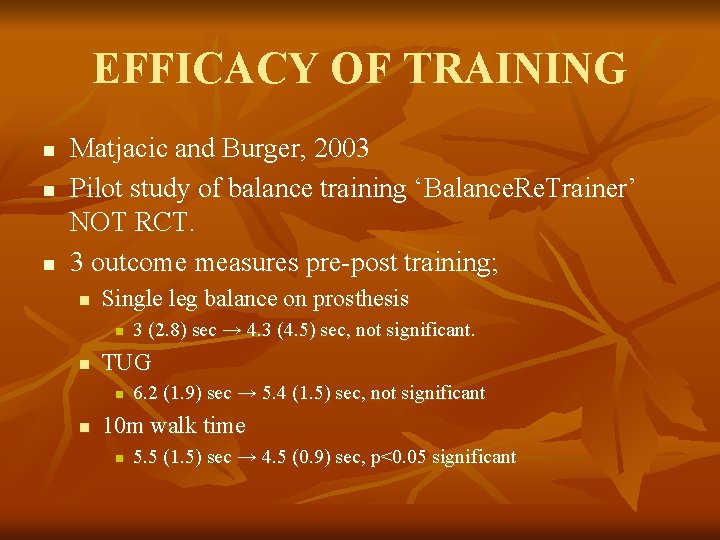
EFFICACY OF TRAINING n n n Matjacic and Burger, 2003 Pilot study of balance training ‘Balance. Re. Trainer’ NOT RCT. 3 outcome measures pre-post training; n Single leg balance on prosthesis n n TUG n n 3 (2. 8) sec → 4. 3 (4. 5) sec, not significant. 6. 2 (1. 9) sec → 5. 4 (1. 5) sec, not significant 10 m walk time n 5. 5 (1. 5) sec → 4. 5 (0. 9) sec, p<0. 05 significant
EFFICACY OF TRAINING n n n Geurts et al, 1992, (Netherlands) Not an RCT, pre-post rehab measures cf. age matched controls Force platform measures (GRF and Co. P) n Eyes open n Partial vision n Eyes closed Conclusion “…a central reorganization of postural control takes place, in which sensory determinants of motor recovery may play a critical role…” Isakov et al, 1992 (Israel) V. similar study, no difference in postural sway eyes open or closed post 34 weeks rehab
EFFICACY OF TRAINING n n Geurts et al, 1991(Netherlands) Not an RCT, pre-post rehab measures cf. age matched controls Force platform measures (GRF and Co. P) n Concurrent cognitive task n Standing, no cognitive task Conclusion; “…restoration of automaticity of postural control”
IMPLICATIONS FOR AMPUTEE REHABILITATION 1. 2. Anticipatory postural adjustment strategies are unique for amputees and are task specific Balance confidence is the biggest predictor for mobility outcomes in amputees – we need to train relevant ADL balance tasks for amputees to re-gain confidence
REFERENCES n n n n n Buckley JG, O’Driscoll D, Bennett S (2002): ‘ Postural Sway and Active Balance performance in Highly Active Lower-Limb Amputees’ American Journal Physical medicine and Rehabilitation 81(1): 13 -20. Dite W, Connor HJ and Curtis HC (2007) Clinical Identification of Multiple Fall Risk After Unilateral Transtibial Amputation. Archives of Physical Medicine Rehabilitation 88: 109 -114. Evans WE, Hayes JP and Vermilion BD (1987): Rehabilitation of the bilateral amputee’ Journal of Vascular Surgery 5(4): 589 -93. Geurts ACH, Milder TW, Neinhuis B and Rijken RAJ (1991): Dual-Task assessment of reorganization of posutal control in persons with lower limb amputation’ Archives Physical medicen and rehaibilaton 72, 1059 -1064. Geurts ACH, Milder TW, Nienhuis B and Rijken AJ (1992): ‘Postural reorganization following lower limb Amputation’ Scandinavian Journal of Rehabilitation Medicine 24: 83 -90. Hoffman MD, Sheldahl LM, Buley KJ, Sandford PR (1997). Physiological Comparison of Walking among bilateral Above. Knee amputee and Able-bodied subjects and a model to account for the differences in metabolic cost’ Archives Physical medicine and rehabilitation 78, 385 -92 Isakov E, Mizrahi J, Ring H, susak Z and Hakim N (1992): ‘Standing Sway and weight bearing distribution in people with below knee amputations” Archives Physical Medicine and rehabilitation 73: 174 -178. Jones SF, Twigg PC, Scally AJ, Buckley JG (2005): ‘The gait initiation process in unilateral lower-limb amputees when stepping up and stepping down to a new level’ Clinical Biomechanics 20(4): 405 -13. Majacic Z and Burger H (2003): ‘Dynamic balance training during standing in people with trans-tibial amputation: a pilot study’ Prosthetics and Orthotics International 27, 214 -220. Millar WC and Deathe AB (2004): ‘A prospective study examining balance confidence among individuals with lower limb amputation’. Disability and Rehabilitation 26: 14/15; 875 -881.
• Millar WC, Deathe AB, Speechley M. , Koval J (2001): The influence of falling, fear of falling, and balance confidence on prosthetic mobility and social activity among individuals with a lower extremity amputation’ Archives of Physical medicine and rehabilitation 82: 1238 -44. • Mouchnino L, Mille ML, Cincera M, Bardot A, Delarque A, Pedotti A Massion J (1998): ‘ Postural reorganization of weight-shifting in below-knee amputees during leg raising’ Experimental Brain Research 121(2): 205 -14 • Nadollek H, Brauer S and Isles R (2002) Outcomes after trans-tibial amputation: the relationship between quiet stance ability, strength of hip abductor muscles and gait. Physiotherapy Research International 7(4) 203 -214. • Pauley T, Devlin M, Heslin K (2006): ‘Falls Sustained during inpatient Rehabilitation After Lower limb amputation: Prevalence and Predictors’ American Journal Physical medicine and rehabilitation, 85(6): 521 -532. • Powell L ad Myers A (1995): ‘The Activities-specific Balance confidence (ABC) scale’ Journal of Gerontology, 50: M 28 -M 34. • Sadegi H, Allard P and Dunhaime M (2001): Muscle Power Compensatory Mechanisms in Below-Knee Amputee Gait. American Journal of Physical Medicine 80 (1): 25 -32. • Viton JM, Mouchnino L, Mille ML, Cincera M, Delarque A, Pedotti A, Bardot A and Massion J (2000): Equilibrium and movement control strategies in trans-tibial amputees’ Prosthetics and Orthotics International, 24: 108 -116
Questions for panel n n Upper limb support – acute and training phases Core stability training Balance training v’s mobility training Measurement of balance in the clinical setting
- Slides: 15