
BAKING BREAD THE TASK DISTINCTLY DIFFERENT TYPES OF
BAKING BREAD
THE TASK DISTINCTLY DIFFERENT TYPES OF BREAD ARE PRODUCED BY VARYING METHODS OF BAKING , PROPORTIONS OF INGREDIENTS , AND TYPES OF FLOUR. SUGGEST AN EXPERIMENTAL AND THEORETICAL STUDY OF HOW ONE OR SEVERAL BREAD VARIETIES ARE BAKED.
PLAN • About bread • Biochemical processes • Physical processes • Chemical processses • Microbiological and biochemical processes • Conclusion
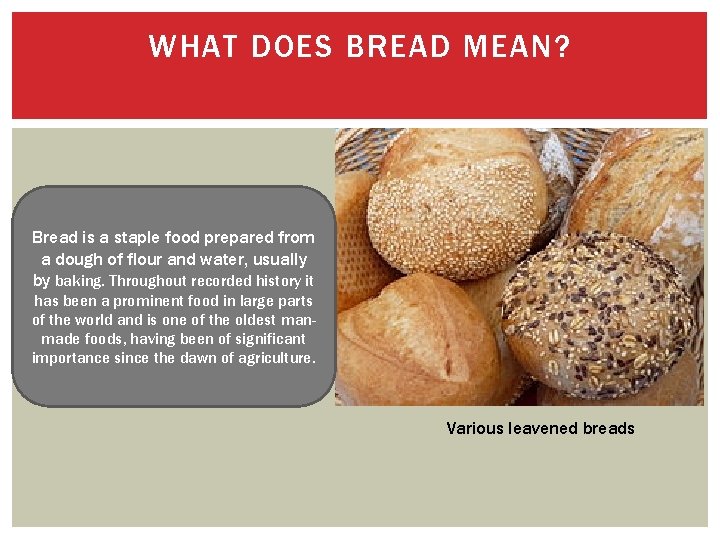
WHAT DOES BREAD MEAN? Bread is a staple food prepared from a dough of flour and water, usually by baking. Throughout recorded history it has been a prominent food in large parts of the world and is one of the oldest manmade foods, having been of significant importance since the dawn of agriculture. Various leavened breads

BAKING WHAT HAPPENS WHILE BAKING? Baking is the process of turning dough pieces into finished products, as a result of which their quality is finally formed. Baking bread is carried out in baking ovens of various designs.
IN THE BAKING PROCESS, THE FOLLOWING CHANGES OCCUR WITH THE DOUGH: - warming up; - formation of a crust and crumb; - the formation of taste and aroma; - volume increase; - weight red
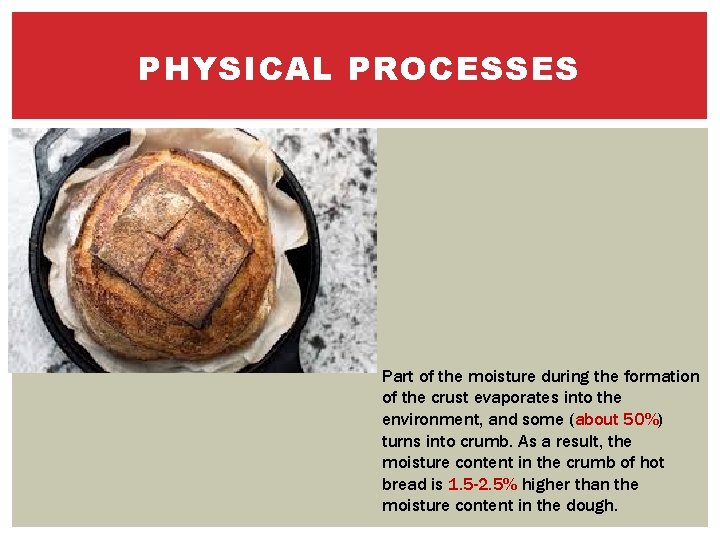
PHYSICAL PROCESSES Part of the moisture during the formation of the crust evaporates into the environment, and some (about 50%) turns into crumb. As a result, the moisture content in the crumb of hot bread is 1. 5 -2. 5% higher than the moisture content in the dough.
MICROBIOLOGICAL AND BIOCHEMICAL PROCESSES In the first minutes of baking, the alcoholic fermentation inside the dough accelerates and reaches a maximum at 35 ° C. alcohol. fermentation C 6 H 12 O 6 → 2 C 2 H 5 ON + 2 CO 2 Further, the fermentation fades out and stops at 50 ° C, since the yeast cells die off, and at 60 ° C, the activity of acidforming bacteria stops. As a result of the residual microflora activity during baking in dough - bread, the content of alcohol C 2 H 5 OH, carbon dioxide CO 2 and acids increases, which increases the volume of bread and improves its taste.
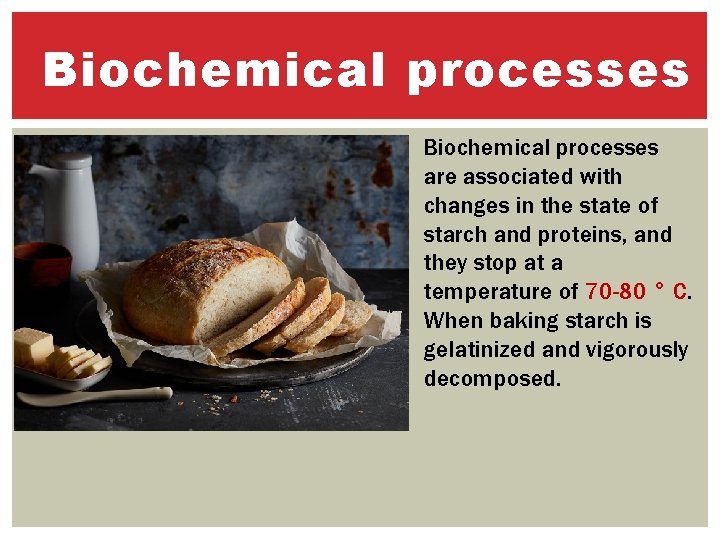
Biochemical processes are associated with changes in the state of starch and proteins, and they stop at a temperature of 70 -80 ° C. When baking starch is gelatinized and vigorously decomposed.
COLLOID PROCESSES Proteins and starch undergo significant changes during baking. At 50 -70 ° С, the processes of protein denaturation (coagulation) and starch gelatinization proceed simultaneously. The process proceeds relatively slowly and ends when the crumb is heated to 95 -97 ° C. Gelatinized starch grains firmly bind moisture, so the crumb of bread seems to be more dry than the dough.
CONCLUSION 1) Baking is the process of turning dough pieces into finished products, as a result of which their quality is finally formed. Baking bread is carried out in baking ovens of various designs. 2) In the baking process, the following changes occur with the dough piece: warming up; crust and crumb formation; the formation of taste and aroma; volume increase; weight reduction. 3) The changes that characterize the transition of the dough in the process of baking into bread are the result of a whole complex of processes: physical, microbiological, colloidal and biochemical. 4) All processes are based on physical phenomena - warming of the dough and, caused by it, external moisture exchange between the dough - bread and the vaporair medium of the baking chamber and internal heat and mass transfer in the dough - bread. 5) Bread baked in the baking chamber of baking ovens at a temperature of 200 -280 ° C. Baking 1 kg of bread requires about 300 -550 k. J.
- Slides: 11