
Bail Detention and Preventive Detention Class 13 Right
Bail, Detention and Preventive Detention Class 13
Right to Bail • Juveniles do not have an absolute constitutional or statutory right to bail (L. O. W. v District Court) – Protective purposes of juvenile court intervention supercede individual rights – Due process then, is limited to “fundamental fairness” in the trial proceeding (Gault, Winship) – Does denial of bail weaken pre-trial preparations and unduly disadvantage youthful defendant? – Does (informal) pretrial hearings provide ample opportunity for judge to consider factors relevant to pretrial release or other forms of release (i. e. , “the child’s needs and welfare”)?
• Bail can be set, for the usual reasons • Some juvenile courts assume that the regulatory function of the juvenile detention hearing is a substitute for bail – Presumption of innocence/release limits use of detention – Explicit consideration of child welfare issues – Tacit consideration of child’s assistance in his or her defense – Statutory standards for detention also mitigate its harm vis-à-vis child’s welfare
Bail Raises Difficult Questions about the Juvenile Court • If we have a bail system, why then have a juvenile court? Isn’t the purpose to use the law’s teeth to protect children, not just ensure that they make their court date? • Doesn’t a bail system reproduce the same inequalities for juveniles as for adults? Isn’t it double punishment for children (poor parents lead to delinquency, then poor parents increase risk of detention)? • Presumption of guilt • Remedial value of detention?
DETENTION • Case Law – Bell v Wolfish – use of detention to ensure appearance at trial, a regulatory function and not a penal one – Barefoot v Estelle – validity of individualized predictions of dangerousness based on clinical criteria – Schall v Martin – since it was regulatory, time limited and not punitive, detention did not violate due process – is this an excuse for minimal services in detention? (despite litigation over conditions)
ABA Juvenile Detention Standards • Purposes of Detention are: – Protect the jurisdiction and process of courts – Public safety – Protect juvenile from bodily harm • Purposes are NOT: – Punishment – Allow parents to avoid responsibility – Satisfy victim or police demands – Ease administrative access to juvenile – Facilitate interrogation – Substitute for inadequate alternatives
Schall v Martin (1984) • NYS Court of Appeals found that detention was used for punishment, since most petitions were dismissed or defendants were released • US Supreme Court: Judges can predict future danger best (reject social science claim) • State interest in protecting juveniles justifies use of detention to help juveniles themselves avoid future crimes that would expose them to further court action and other harms (“his own folly”) • Schall blamed for much overcrowding, leading to significant litigation all across the country – Schall narrowed and simplified standards for detention, substituted procedural standards for substantive standards
Validity of Predictions • Fagan & Guggenheim Research on Schall Sample – Short-term test – 14 days, 30 days – no significant differences for violent offenses – Significant differences for all offense types – High rates of false positives among Schall sample – FTA rates not significantly different – Long-term predictions were useless
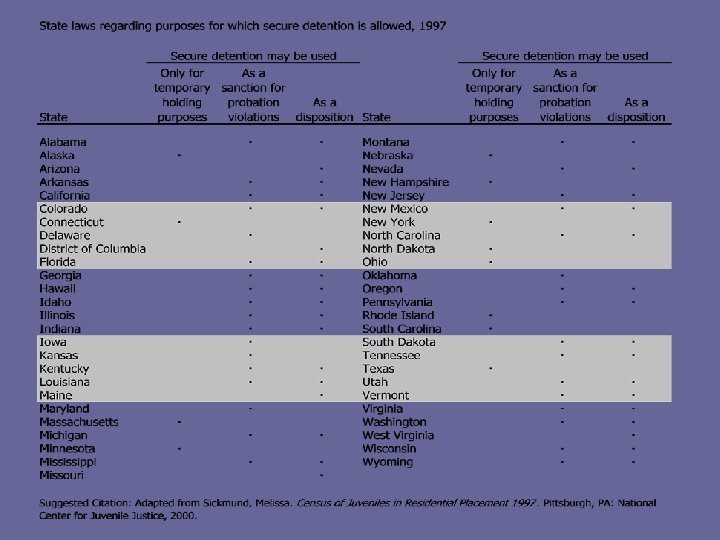
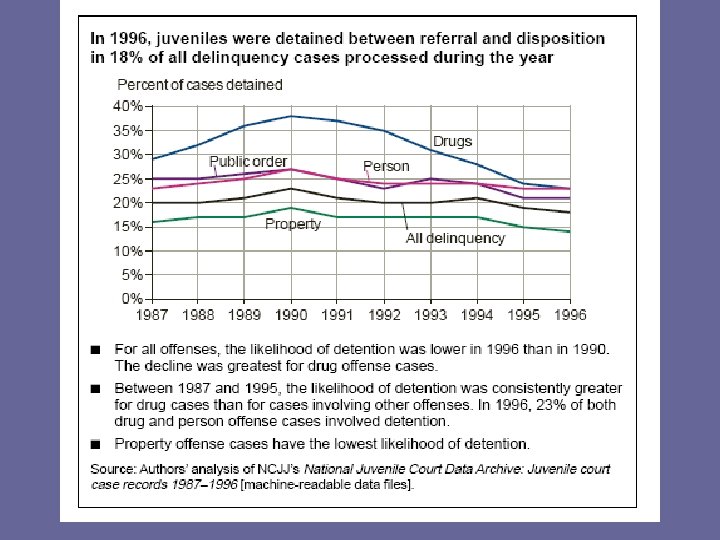
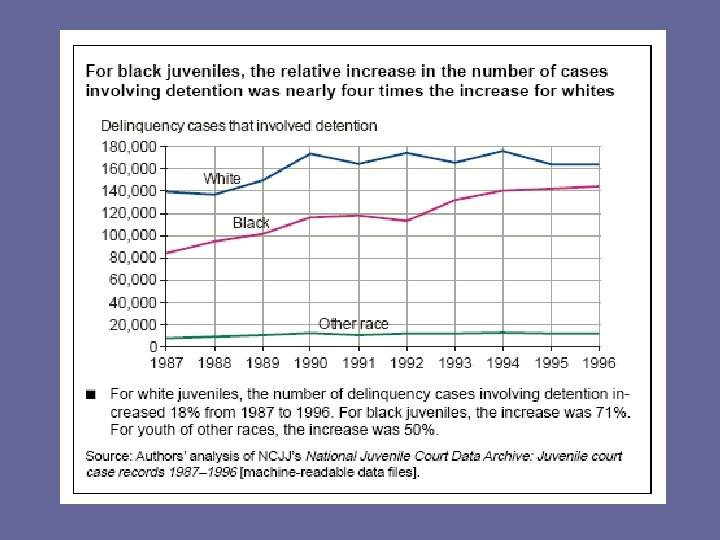
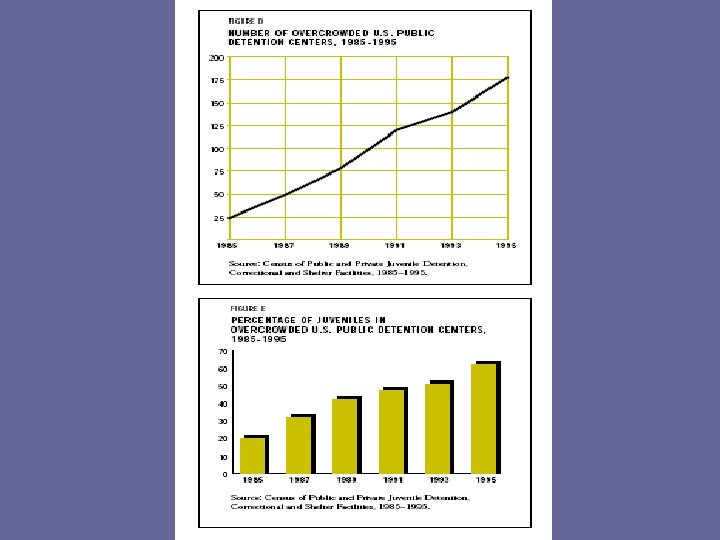

Impacts of Detention • Strongest predictor of severity of sentence (disposition) • Primary source of racial disparities and disproportionate minority confinement • Unregulated punishment – generally poor services, poor staff, chaotic and violent places • Remediation – race-blind screening, alternatives to detention, development of standards that invite regulation (See, Feld, at 355 -7
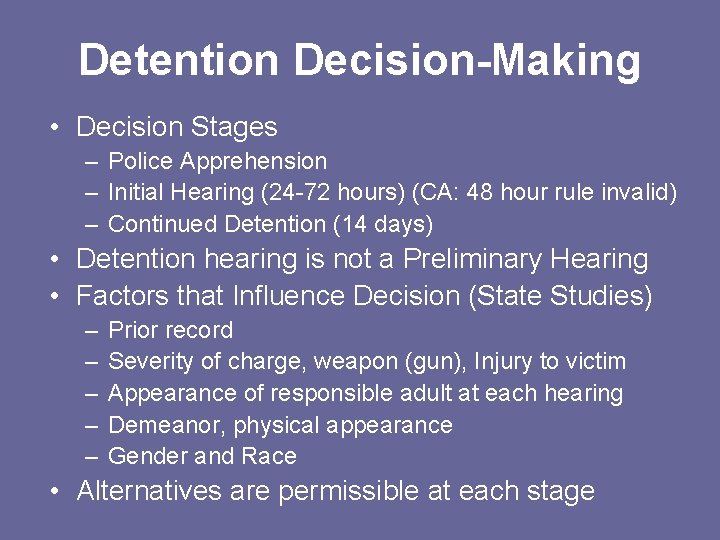
Detention Decision-Making • Decision Stages – Police Apprehension – Initial Hearing (24 -72 hours) (CA: 48 hour rule invalid) – Continued Detention (14 days) • Detention hearing is not a Preliminary Hearing • Factors that Influence Decision (State Studies) – – – Prior record Severity of charge, weapon (gun), Injury to victim Appearance of responsible adult at each hearing Demeanor, physical appearance Gender and Race • Alternatives are permissible at each stage
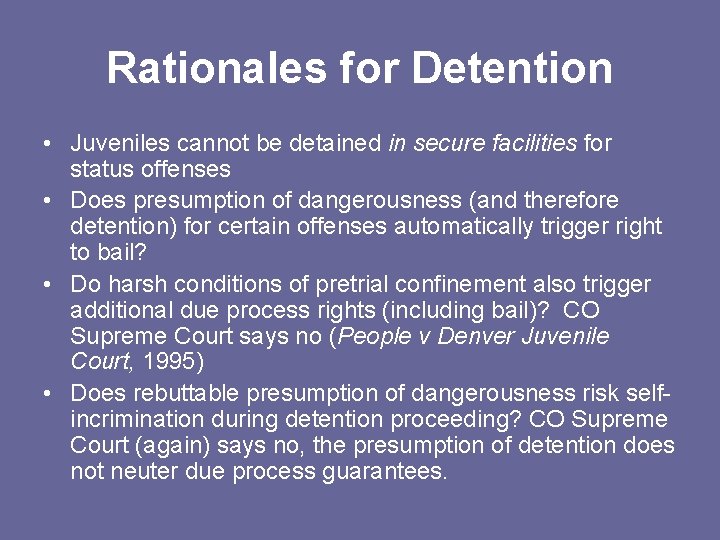
Rationales for Detention • Juveniles cannot be detained in secure facilities for status offenses • Does presumption of dangerousness (and therefore detention) for certain offenses automatically trigger right to bail? • Do harsh conditions of pretrial confinement also trigger additional due process rights (including bail)? CO Supreme Court says no (People v Denver Juvenile Court, 1995) • Does rebuttable presumption of dangerousness risk selfincrimination during detention proceeding? CO Supreme Court (again) says no, the presumption of detention does not neuter due process guarantees.
- Slides: 15