
Bagian 4 Teori Motivasi Content Theories Perilaku Dalam

Bagian 4. Teori Motivasi: Content Theories Perilaku Dalam Organisasi STMIK STIKOM BALI 2009 22 Januari 2022 1
Tujuan Pengajaran Pengertian dan Model Motivasi Teori hirarki kebutuhan Maslow Teori dua faktor Frederick Herzberg Teori kebutuhan Mc. Clelland Alderfer’s ERG theory STIKOM BALI 2009 22 Januari 2022 2
Pengertian dan Model Motivasi Pengertian The willing to exert high levels of effort toward organization goals, conditioned by effort to satisfy some individual need Model Motivasi v Teori hirarki kebutuhan Maslow v Teori dua faktor Frederick Herzberg v Teori kebutuhan Mc. Clelland v Alderfer’s ERG theory Source : Stephen P. Robbins STIKOM BALI 2009 22 Januari 2022 3
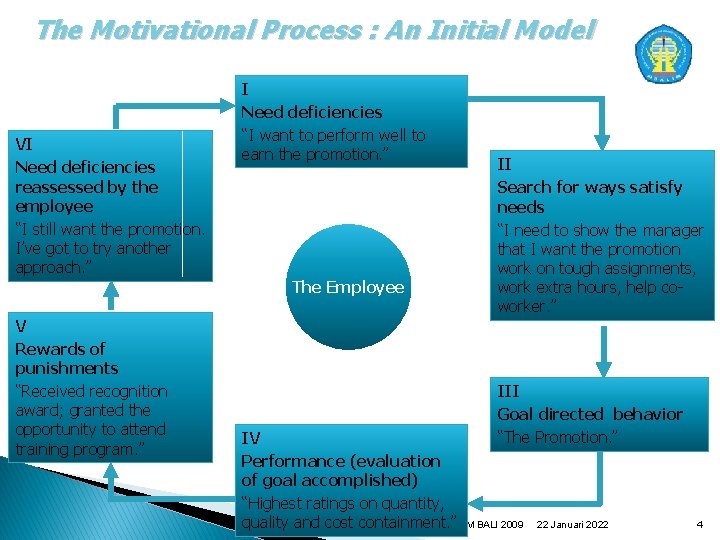
The Motivational Process : An Initial Model VI Need deficiencies reassessed by the employee “I still want the promotion. I’ve got to try another approach. ” I Need deficiencies “I want to perform well to earn the promotion. ” The Employee V Rewards of punishments “Received recognition award; granted the opportunity to attend training program. ” II Search for ways satisfy needs “I need to show the manager that I want the promotion work on tough assignments, work extra hours, help coworker. ” III Goal directed behavior “The Promotion. ” IV Performance (evaluation of goal accomplished) “Highest ratings on quantity, STIKOM BALI 2009 quality and cost containment. ” 22 Januari 2022 4
Teori hirarki kebutuhan Maslow “That people’s needs depend on what they already have. In a sense, then, a satisfied needs isn’t a motivator. Human needs, organized in a hierarchy of importance, are physiological, safety, belongingness, esteem, and self actualization” Source : Gibson STIKOM BALI 2009 22 Januari 2022 5
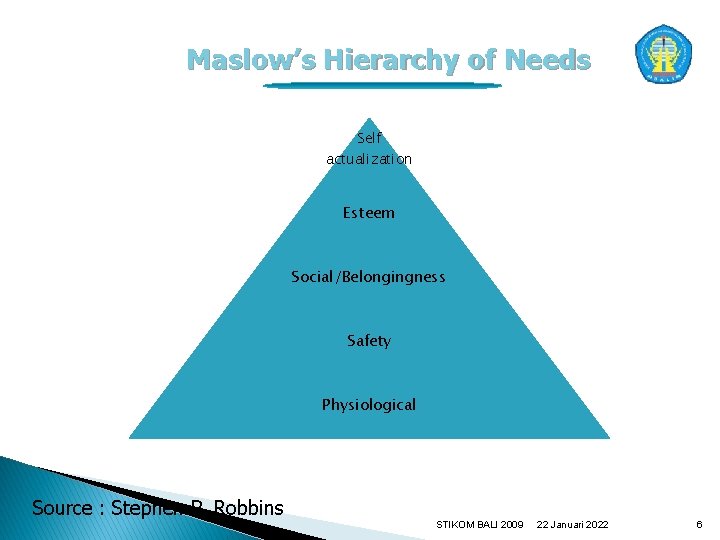
Maslow’s Hierarchy of Needs Self actualization Esteem Social/Belongingness Safety Physiological Source : Stephen P. Robbins STIKOM BALI 2009 22 Januari 2022 6

TEORI DUA FAKTOR FREDERICK HERZBERG View that job satisfaction results from the presence of intrinsic motivators and that job dissatisfaction stems from not having extrinsic factors Source : Gibson STIKOM BALI 2009 22 Januari 2022 7
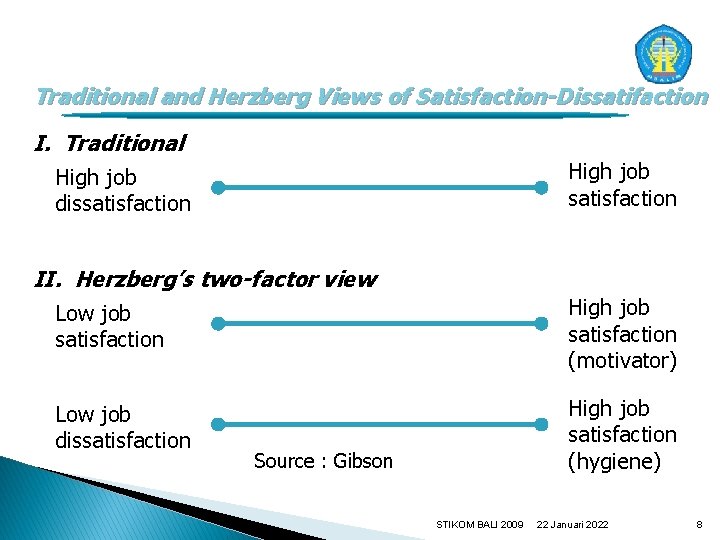
Traditional and Herzberg Views of Satisfaction-Dissatifaction I. Traditional High job satisfaction High job dissatisfaction II. Herzberg’s two-factor view Low job satisfaction High job satisfaction (motivator) Low job dissatisfaction High job satisfaction (hygiene) Source : Gibson STIKOM BALI 2009 22 Januari 2022 8
Teori Kebutuhan Mc. Clelland Learned Needs Theory that proposes that a person with a strong need will be motivated to use appropriate behaviors to satisfy the need. A person’s needs are learned from the culture of a society Thematis Apperception Test (TAT) Projective test that uses a person’s analysis of picture to evaluate such individual differences as need for achivement, need for power, and need for affiliation Source : Gibson STIKOM BALI 2009 22 Januari 2022 9
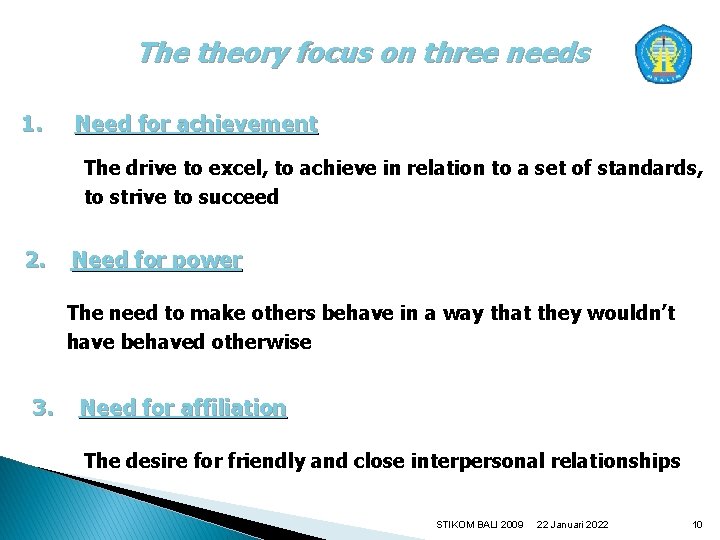
The theory focus on three needs 1. Need for achievement The drive to excel, to achieve in relation to a set of standards, to strive to succeed 2. Need for power The need to make others behave in a way that they wouldn’t have behaved otherwise 3. Need for affiliation The desire for friendly and close interpersonal relationships STIKOM BALI 2009 22 Januari 2022 10
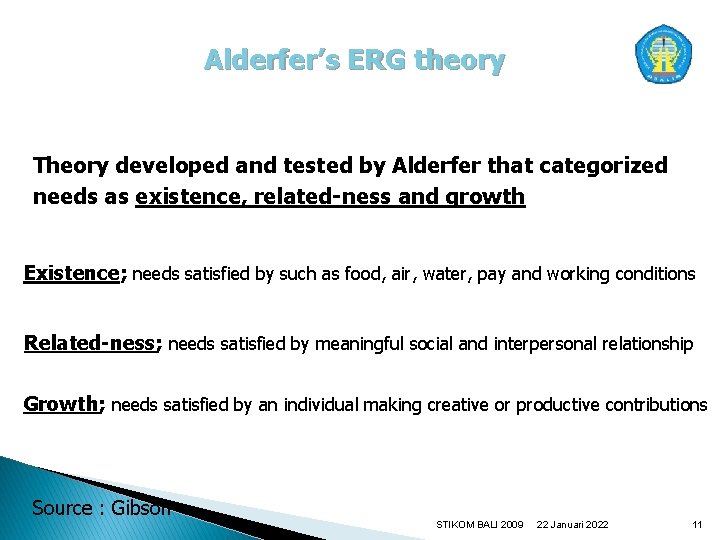
Alderfer’s ERG theory Theory developed and tested by Alderfer that categorized needs as existence, related-ness and growth Existence; needs satisfied by such as food, air, water, pay and working conditions Related-ness; needs satisfied by meaningful social and interpersonal relationship Growth; needs satisfied by an individual making creative or productive contributions Source : Gibson STIKOM BALI 2009 22 Januari 2022 11
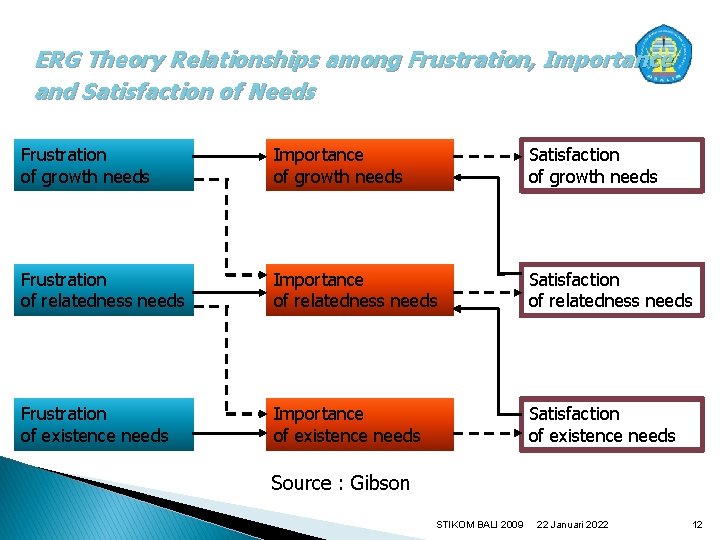
ERG Theory Relationships among Frustration, Importance and Satisfaction of Needs Frustration of growth needs Importance of growth needs Satisfaction of growth needs Frustration of relatedness needs Importance of relatedness needs Satisfaction of relatedness needs Frustration of existence needs Importance of existence needs Satisfaction of existence needs Source : Gibson STIKOM BALI 2009 22 Januari 2022 12

A graphic Comparison of Four Content Theories of Motivation Maslow (need hierarchy) Self-actualization Higher order Esteem needs Belongingness, social and love Physiological Basic needs Herzberg (two factor theory) The work itself - Responsibility - Advancement Motivators - Growth Alderfer Mc Clelland Growth Need for achievement Relatedness Need for power Existence Need for affiliation Achievement Recognition Quality of interpersonal relations among peers, with Hygiens supervisor, with conditions subordinates Job security Working conditions Salary STIKOM BALI 2009 22 Januari 2022 13

Bagian 4 selesai. . Lanjut ke bagian 5. . STIKOM BALI 2009 22 Januari 2022 14
- Slides: 14