
BAE SYSTEMS Global Health and Safety Benchmarking Study
BAE SYSTEMS Global Health and Safety Benchmarking Study 2014 © Corporate Benchmarking Services Limited (Scotland)
Safety Performance Rates BAE SYSTEMS STUDY May 2014 © Corporate Benchmarking Services Limited (Scotland) 2

Safety Performance Rates Major Injuries - Based on the UK RIDDOR definition, i. e. fatality, fracture, amputation, etc. BAE SYSTEMS STUDY May 2014 © Corporate Benchmarking Services Limited (Scotland) 3
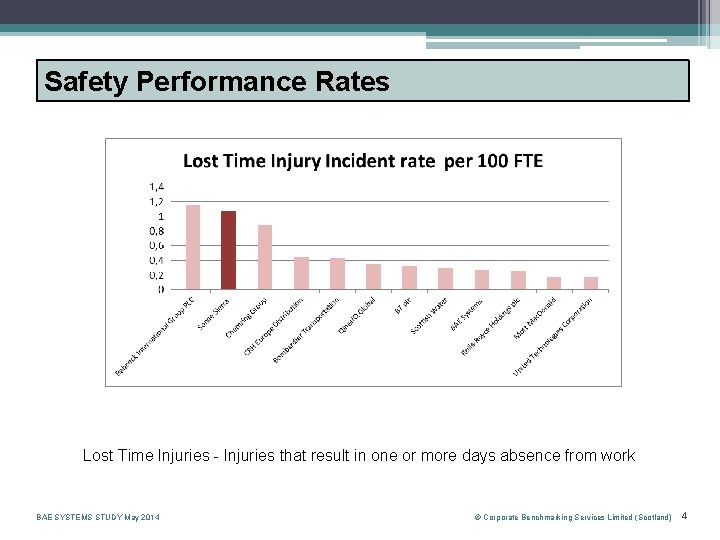
Safety Performance Rates Lost Time Injuries - Injuries that result in one or more days absence from work BAE SYSTEMS STUDY May 2014 © Corporate Benchmarking Services Limited (Scotland) 4

Safety Performance Rates Recordable Injuries - injuries resulting in treatment beyond first aid as defined by the OSHA definition BAE SYSTEMS STUDY May 2014 © Corporate Benchmarking Services Limited (Scotland) 5
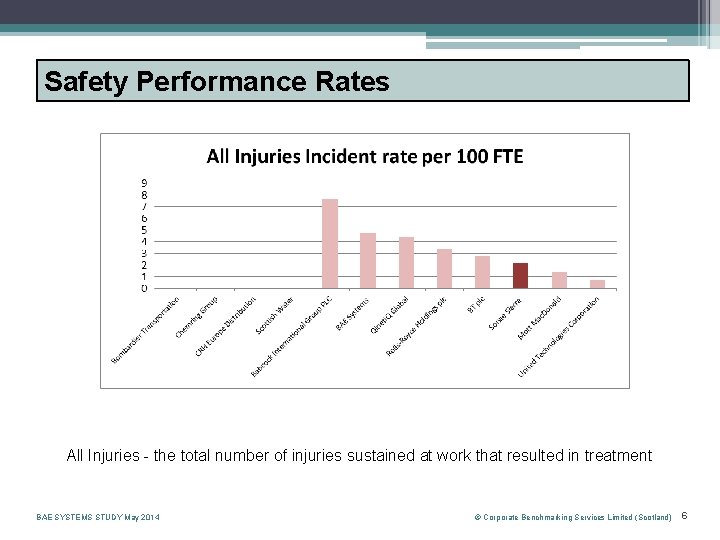
Safety Performance Rates All Injuries - the total number of injuries sustained at work that resulted in treatment BAE SYSTEMS STUDY May 2014 © Corporate Benchmarking Services Limited (Scotland) 6
Participant Key Drivers giving Improved and Sustainable Performance BAE SYSTEMS STUDY May 2014 © Corporate Benchmarking Services Limited (Scotland) 7
Key Drivers – BAE Systems • Globalisation of our approach to safety management, through a common (and incentivised) safety maturity matrix • Leaders visibly engaging with employees on safety, through safety conversation • Systems established/reinforced that actively involve and engage employees in making safety improvement • Investment in sustained, high profile, safety communication programmes • Improved capability of professional SHE resource, particularly as advocates of change BAE SYSTEMS STUDY May 2014 © Corporate Benchmarking Services Limited (Scotland) 8
Key Drivers – Babcock International Group PLC • Divisional Chief Executives ensure sufficient professional expertise is available to advise line management • Management team engaged at all levels by active participation • Group H&S motto “Home Safe Everyday” getting people to think about Safety and to carry out activities safely, not just at work • Visibility of organisation’s expectations of its employees at all levels • Communications driven by Divisions for their specific areas: tool box talks, time out for safety, “hi viz” visits • Employee’s remit to look after themselves and their colleagues • Safety Culture Improvement team drawn from the businesses and TUs BAE SYSTEMS STUDY May 2014 © Corporate Benchmarking Services Limited (Scotland) 9
Key Drivers – Bombardier Transportation • Integrated Management Systems based on ISO 14001/EMAS and OHSAS 18001 • Making safety performance visible, comparable and the criteria for leadership assessment • Focus on a non-financial award scheme that targets sites and individuals rather than purely financial incentives • Special focus on “walk the talk” by senior leaders - mandatory for all leadership teams at site level • Consistent communication i. e. the same message from the top of the organisation down to the supervisors • Develop a career path for line management & HSE which describes their main HSE functions and capabilities • Annual HSE Leadership Conferences facilitating a dialogue between the top Aerospace & Rail Transportation HSE leaders & the CEO BAE SYSTEMS STUDY May 2014 © Corporate Benchmarking Services Limited (Scotland) 10
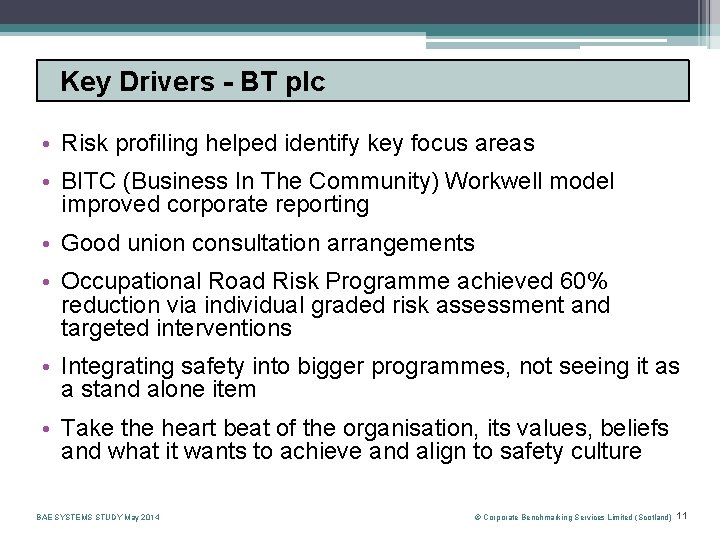
Key Drivers - BT plc • Risk profiling helped identify key focus areas • BITC (Business In The Community) Workwell model improved corporate reporting • Good union consultation arrangements • Occupational Road Risk Programme achieved 60% reduction via individual graded risk assessment and targeted interventions • Integrating safety into bigger programmes, not seeing it as a stand alone item • Take the heart beat of the organisation, its values, beliefs and what it wants to achieve and align to safety culture BAE SYSTEMS STUDY May 2014 © Corporate Benchmarking Services Limited (Scotland) 11
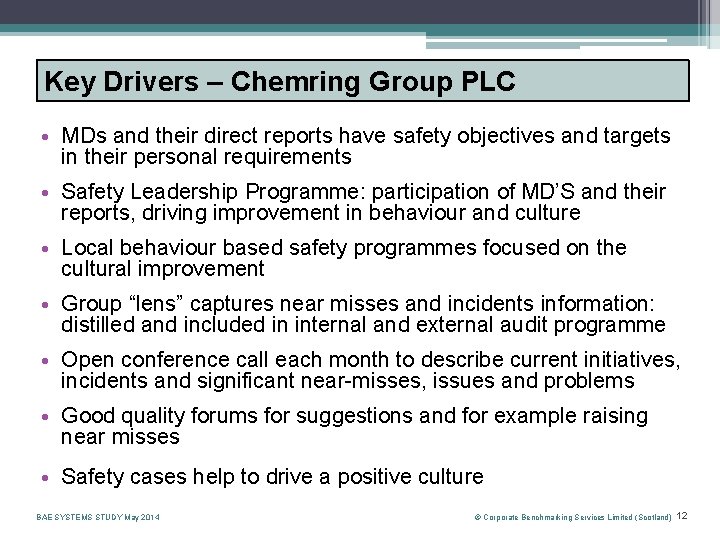
Key Drivers – Chemring Group PLC • MDs and their direct reports have safety objectives and targets in their personal requirements • Safety Leadership Programme: participation of MD’S and their reports, driving improvement in behaviour and culture • Local behaviour based safety programmes focused on the cultural improvement • Group “lens” captures near misses and incidents information: distilled and included in internal and external audit programme • Open conference call each month to describe current initiatives, incidents and significant near-misses, issues and problems • Good quality forums for suggestions and for example raising near misses • Safety cases help to drive a positive culture BAE SYSTEMS STUDY May 2014 © Corporate Benchmarking Services Limited (Scotland) 12
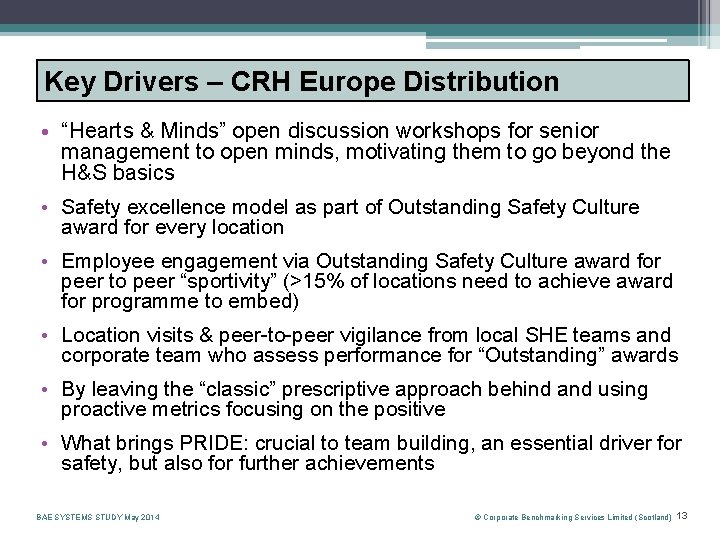
Key Drivers – CRH Europe Distribution • “Hearts & Minds” open discussion workshops for senior management to open minds, motivating them to go beyond the H&S basics • Safety excellence model as part of Outstanding Safety Culture award for every location • Employee engagement via Outstanding Safety Culture award for peer to peer “sportivity” (>15% of locations need to achieve award for programme to embed) • Location visits & peer-to-peer vigilance from local SHE teams and corporate team who assess performance for “Outstanding” awards • By leaving the “classic” prescriptive approach behind and using proactive metrics focusing on the positive • What brings PRIDE: crucial to team building, an essential driver for safety, but also for further achievements BAE SYSTEMS STUDY May 2014 © Corporate Benchmarking Services Limited (Scotland) 13
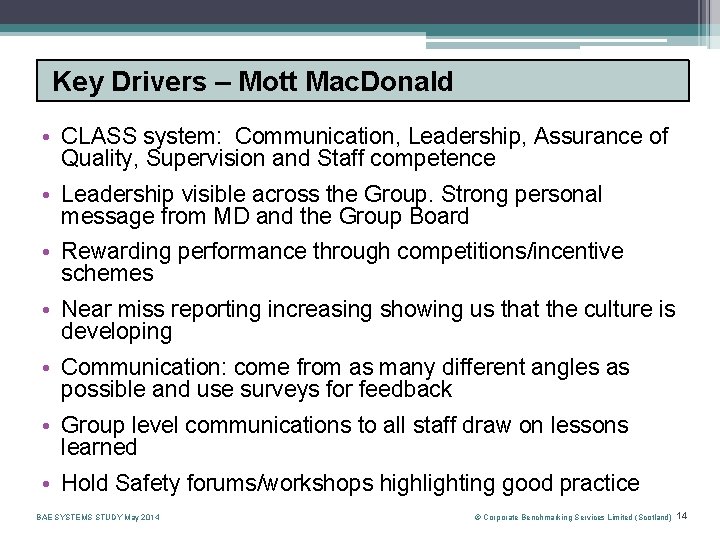
Key Drivers – Mott Mac. Donald • CLASS system: Communication, Leadership, Assurance of Quality, Supervision and Staff competence • Leadership visible across the Group. Strong personal message from MD and the Group Board • Rewarding performance through competitions/incentive schemes • Near miss reporting increasing showing us that the culture is developing • Communication: come from as many different angles as possible and use surveys for feedback • Group level communications to all staff draw on lessons learned • Hold Safety forums/workshops highlighting good practice BAE SYSTEMS STUDY May 2014 © Corporate Benchmarking Services Limited (Scotland) 14
Key Drivers – Qineti. Q Global • Focus on principles over prescription, changing focus from complying with procedures to thinking & making decisions • Senior Leaders commitment is cultural & behavioural based approach • HSL Climate Survey tool • Champions drive engagement, convert others to become champions, mutually support each other, share ideas practice • Internal system for Behavioural Observation & Intervention (BOI), supported by Just Culture model & reporting system forms part of each site Safe for Life measurement dashboard • Safe for Life utilises champions from within teams to act as a vehicle for communications about safety culture issues • Safety competence of leaders & managers has improved with focus on softer skills and cultural aspects BAE SYSTEMS STUDY May 2014 © Corporate Benchmarking Services Limited (Scotland) 15
Key Drivers – Rolls-Royce Holdings plc • Revision of Global HS&E management framework: the way HS&E is embedded in the group process landscape; management and operational control standards and guidance • Leading Excellence in HS&E workshops using external case studies and reflecting on maturity and the role of leaders • Revised HS&E accountability framework to clarify line ownership for HS&E • Some global programmes e. g. lifting, have involved wide engagement and awareness alongside more targeted training for specialist roles • More formal use of communications in programmes and projects to support change & engagement • HIPO (High Potential Incident) reporting and investigation • More consistency in coverage of topics in HS&E governance forums BAE SYSTEMS STUDY May 2014 © Corporate Benchmarking Services Limited (Scotland) 16
Key Drivers – Scottish Water • Board and Executive Leadership Team endorsed H&S Strategy delivered through Functional Action Plans ensuring ownership of H&S within the business • Visible H&S Leadership through involvement: regular site tours, weekly team conference calls to discuss all aspects of safety performance and incidents • Highly visible, targeted and varied methods of communicating H&S is an essential element in improving safety performance • Genuine commitment to understanding and managing safety risks building a strong relationship between management and workforce • BBS Leadership programme has helped leaders realise that “Consequences” have a greater influence on “Behaviour” than “Antecedents” BAE SYSTEMS STUDY May 2014 © Corporate Benchmarking Services Limited (Scotland) 17
Key Drivers – Sonae Sierra • SHEMS drives awareness, training, communication, involvement and participation of the workforce, suppliers, contractors, tenants, and visitors • Board Members commonly perform SHE Preventive Observations (SPO) in shopping centres and corporate offices • Company believes Health and Safety is a shared responsibility and everyone has a role to perform • H&S Culture led to 66% reduction in lost time accidents since 2005, now plateaued • Award programme promotes a Safety culture and healthy competition between sites BAE SYSTEMS STUDY May 2014 © Corporate Benchmarking Services Limited (Scotland) 18
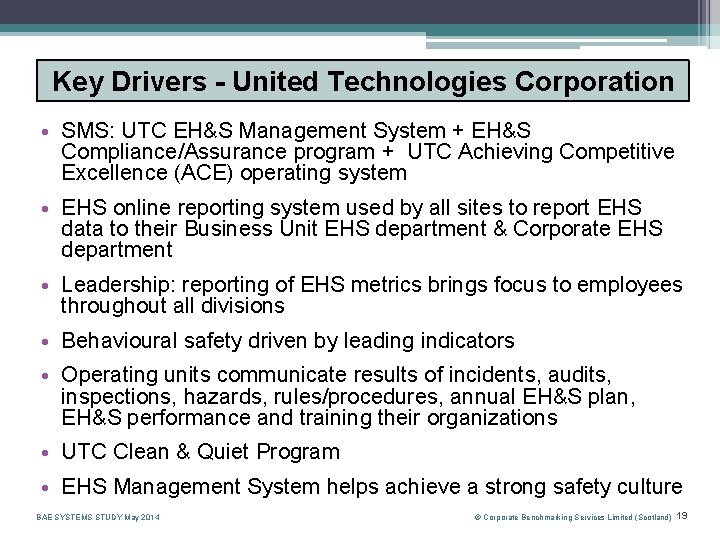
Key Drivers - United Technologies Corporation • SMS: UTC EH&S Management System + EH&S Compliance/Assurance program + UTC Achieving Competitive Excellence (ACE) operating system • EHS online reporting system used by all sites to report EHS data to their Business Unit EHS department & Corporate EHS department • Leadership: reporting of EHS metrics brings focus to employees throughout all divisions • Behavioural safety driven by leading indicators • Operating units communicate results of incidents, audits, inspections, hazards, rules/procedures, annual EH&S plan, EH&S performance and training their organizations • UTC Clean & Quiet Program • EHS Management System helps achieve a strong safety culture BAE SYSTEMS STUDY May 2014 © Corporate Benchmarking Services Limited (Scotland) 19
- Slides: 19