
BAE Automated Systems Denver International Airport Baggage Handling
BAE Automated Systems: Denver International Airport Baggage. Handling System Case Study Olga Arbitman Anna Grebneva Dimitriy Mikhaylov
Overview n n Denver International Airport (DIA) was planned to be the most technologically advanced airport in the world and to be opened by October 1993 Construction problems as well as problems with the implementation of the baggage system forced numerous delays in opening of the airport In May 1994, Denver’s Mayor hired independent consultant firm Logplan to assess the state of Automated Baggage System. The result of the assessment was a recommendation to build a backup system of tugs, carts and conveyor belts
DIA Baggage System n n n $195 million project built by BAE Automated Systems. 22 mile of track, six miles of conveyors, 10000 motors, 14 million feet of wire, barcode readers, and 4000 individual fiberglass carts (Telecar) run at 17 mph. Controlled by 100 souped-up ATs running under OS 2 using an Ethernet-based network. Programmed by 20 programmers. BAE contracted in 1991 to build United baggage system. City asked BAE to build system for entire airport. Munich system built by BAE tested for 2 years and ran 24 hours a day in the airport for six months before airport opened. Numerous change requests by airlines.
Expectations and Outcome Expectations: n To build a fully automated large-scale baggage system that delivers bags from check-in to the aircraft and from aircraft to aircraft or baggage claim. Results: n Jammed cars n Cars collision n Piles of disgorged clothes lying beneath the Telecar’s tracks Outcome: n BAE failed to deliver

BAE Problems Rank Description 1 Short timeline and poor planning for such an enormously complex project with novel technologies. 2 Inexperienced project management team. 3 Constant requirements changes due to poorly implemented data gathering phase. 4 Lack of centralized control and cooperation. “Who’s in charge? ”
Problem 1: Short Timeline This is a research-oriented development which is always risky. Success is not guaranteed and a short timeline is not an option. Concerns: n Enormous complexity. n Evolving technology under tight time constraints. n No proper testing. n Airport was designed without baggage system in mind Alternative 1: Backup system should be planned in advance. Alternative 2: Do not offer a full-blown system and use a phased approach. Alternative 3: Do nothing, take a risk.
Problem 2: Inexperienced Management Team The project management team did not understand the importance of baggage system. It was treated as a major public works project. No Support. Concerns: n Lack of support and limited access to sites. Alternative 1: Ignore Alternative 2: Stop, reassess the risks, and contact top management
Problem 3: Bad Requirements did not take into consideration what Airlines needed and didn’t consider the layout of the airport ( late construction ). n Based upon the agreement between BAE and Denver, there would be freeze dates for mechanical and software design n Even though development of the Baggage System was well under way, the Airlines still requested changes to the systems’ design Alternative 1: Accept the changes Alternative 2: Negotiate and plan new due date n
Problem 4: Lack of Control The death of Chief Airport Engineer Slinger in October 1992 had a significant impact on a project n His replacement, Gail Edmond did not know much about the actual construction. She did not have the autonomy nor the authority to make key decisions. n Anarchy: Contractors were forced to make decisions on their own, and everyone was doing his/her own thing (“who is in charge? ”) Alternative 1: Re-elect Chief Airport Engineer who would have full authority power and understand the issues. Alternative 2: Meet with city council to discuss why current CAE does not have autonomy and authority n
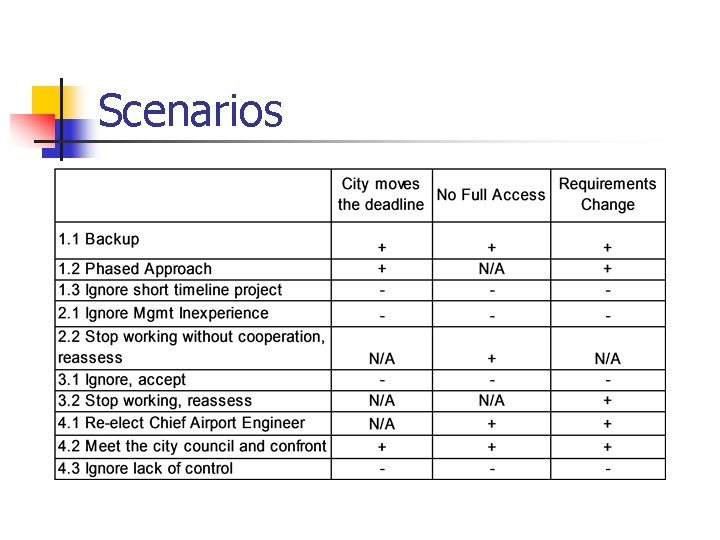
Scenarios
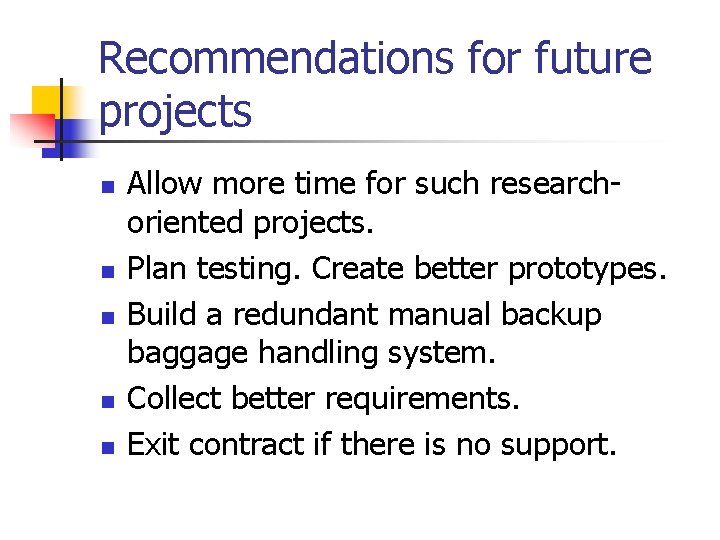
Recommendations for future projects n n n Allow more time for such researchoriented projects. Plan testing. Create better prototypes. Build a redundant manual backup baggage handling system. Collect better requirements. Exit contract if there is no support.
- Slides: 11