
BaculovirusInsect Cell Expression System n Insect cell system
Baculovirus-Insect Cell Expression System n Insect cell system ¨ n similar posttranslational modification systems between insects and mammals Baculovirus Infect invertebrates ¨ Two forms ¨ n Single nucleocapsid (virus particle) ¨ n Budding off from an infected cell Polyhedron ¨ ¨ Clusters of nucleocapsids (virions) trapped in a protein matrix polyhedrin Release after cell lysis
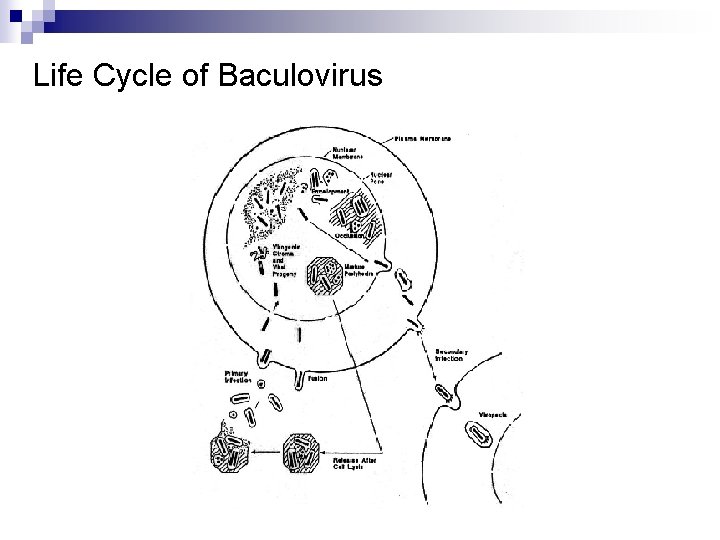
Life Cycle of Baculovirus

Two Forms of Baculovirus • virion ~ cluster of nucleocapsids • polyhedron ~ entire package of occluded virion ~ released into the environment after cell lysis • polyhedrin ~ protein matrix
Baculovirus Expression Vector System n Host insect cell ¨ Spodoptera frugiperda (Sf) ¨ Bombyx mori n Baculovirus vector ¨ Autographa californica multiple nuclear polyhedrosis virus (Ac. MNPV) n Promoter of the polyhedrin (polyh) gene ¨ exceptionally strong ¨ used for the production of heterologous protein
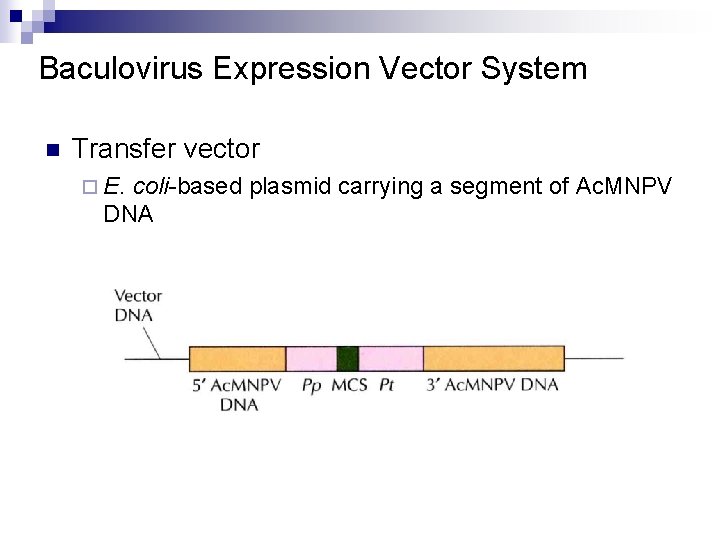
Baculovirus Expression Vector System n Transfer vector ¨ E. coli-based plasmid carrying a segment of Ac. MNPV DNA
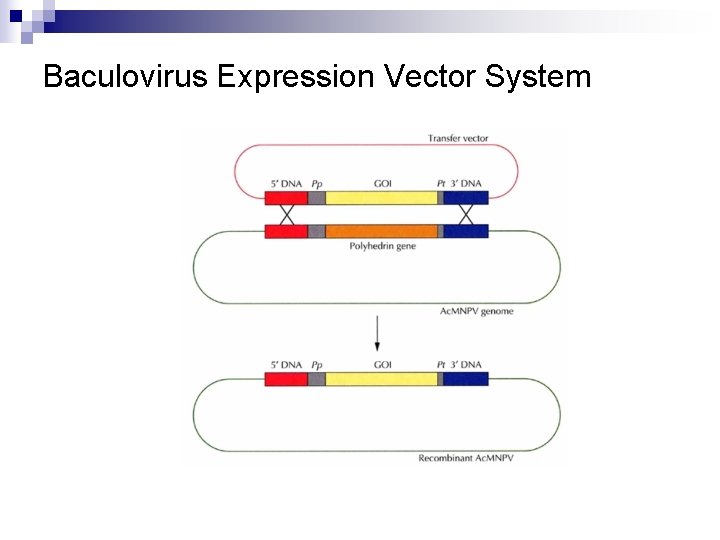
Baculovirus Expression Vector System n Insect cells are cotransfected with Ac. MNPV DNA and a transfer vector carrying a cloned gene. (Figure 7. 12) double crossover event (loss of polyhedrin gene) occlusion-negative plaques isolation of recombinant baculovirus (For the visual identification, lac. Z under the control of a baculovirus promoter can be used. )
Baculovirus Expression Vector System
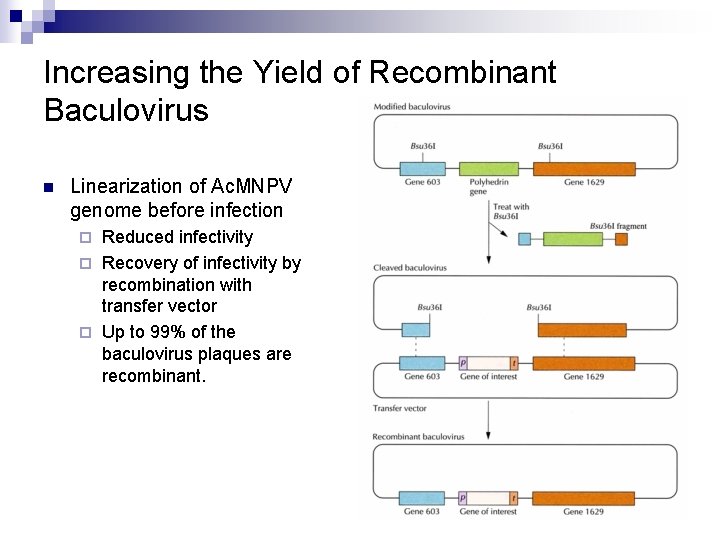
Increasing the Yield of Recombinant Baculovirus n Linearization of Ac. MNPV genome before infection Reduced infectivity ¨ Recovery of infectivity by recombination with transfer vector ¨ Up to 99% of the baculovirus plaques are recombinant. ¨
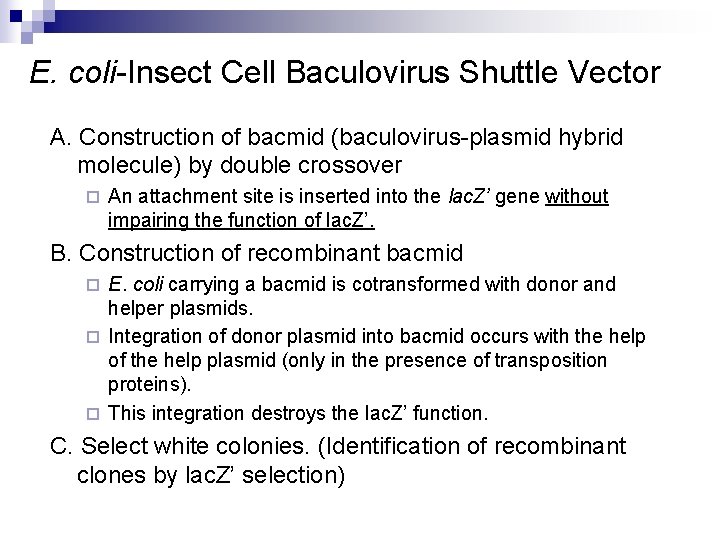
E. coli-Insect Cell Baculovirus Shuttle Vector A. Construction of bacmid (baculovirus-plasmid hybrid molecule) by double crossover ¨ An attachment site is inserted into the lac. Z’ gene without impairing the function of lac. Z’. B. Construction of recombinant bacmid E. coli carrying a bacmid is cotransformed with donor and helper plasmids. ¨ Integration of donor plasmid into bacmid occurs with the help of the help plasmid (only in the presence of transposition proteins). ¨ This integration destroys the lac. Z’ function. ¨ C. Select white colonies. (Identification of recombinant clones by lac. Z’ selection)
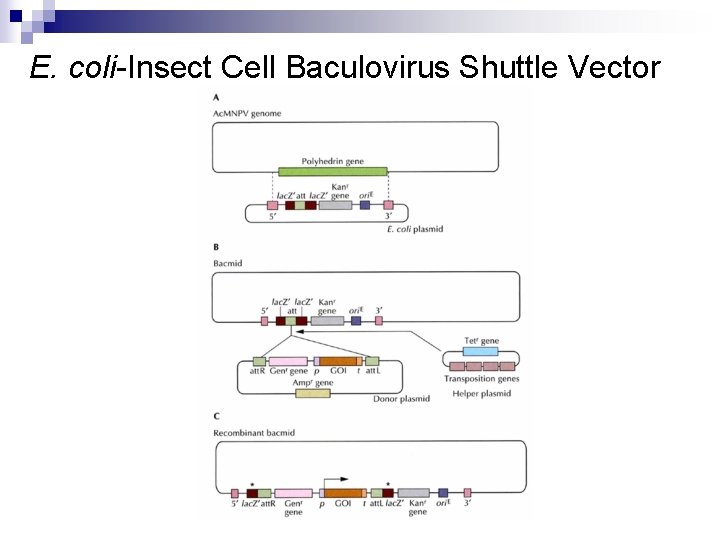
E. coli-Insect Cell Baculovirus Shuttle Vector
Mammalian Glycoprotein and Processing of Precursor Proteins in Insect Cells n For proper glycosylation ¨ Using mammalian α-2, 6 -sialtransferase and β-1, 4 galactotransferase for terminal sialic acid and galactose n For processing of precursor proteins ¨ Introduction of genes for processing enzymes (proprotein convertase)
Mammalian Cell Expression System n n n For the production of heterologous proteins with a full complement of posttranslational modifications Chinese hamster ovary (CHO) cells are commonly used. Cell lines ¨ For short term expression n ¨ COS: from African green monkey kidney BHK: baby hamster kidney HEK-293: human embryonic kidney For long term (stable) gene expression n CHO: Chinese hamster ovary
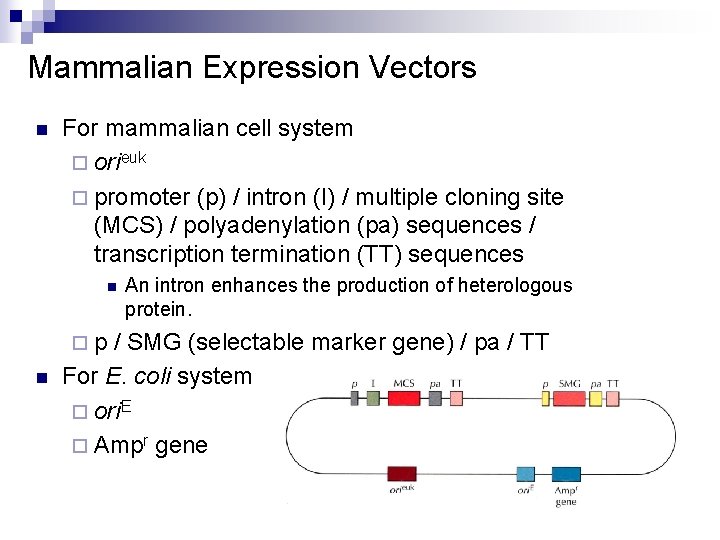
Mammalian Expression Vectors n For mammalian cell system ¨ orieuk ¨ promoter (p) / intron (I) / multiple cloning site (MCS) / polyadenylation (pa) sequences / transcription termination (TT) sequences n ¨p n An intron enhances the production of heterologous protein. / SMG (selectable marker gene) / pa / TT For E. coli system ¨ ori. E ¨ Ampr gene
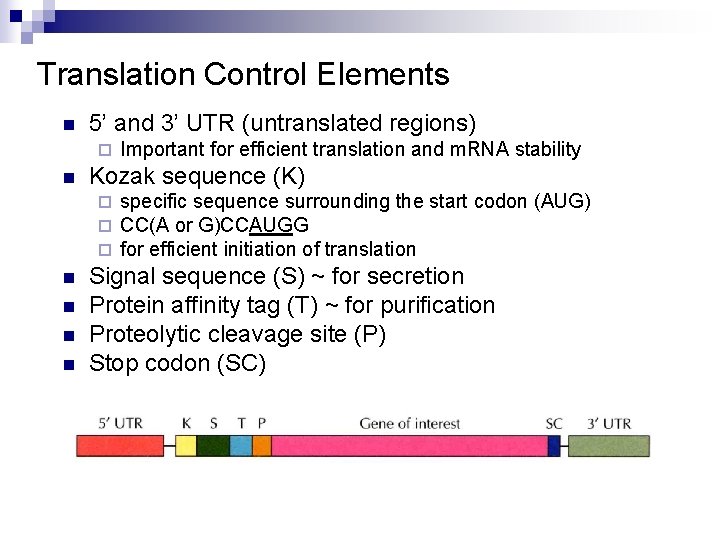
Translation Control Elements n 5’ and 3’ UTR (untranslated regions) ¨ n Kozak sequence (K) ¨ ¨ ¨ n n Important for efficient translation and m. RNA stability specific sequence surrounding the start codon (AUG) CC(A or G)CCAUGG for efficient initiation of translation Signal sequence (S) ~ for secretion Protein affinity tag (T) ~ for purification Proteolytic cleavage site (P) Stop codon (SC)
Expression of Two Genes n n For the production of multimeric proteins, in vivo assembly of dimeric and tetrameric proteins is quite efficient. Two-vector expression ¨ n Cotransfection of two plasmids One-vector expression ¨ Two-gene expression vector n ¨ Expression of two genes by independent promoters Bicistronic vector n Two genes are separated by an internal ribosomal entry site (IRES) from mammalian virus
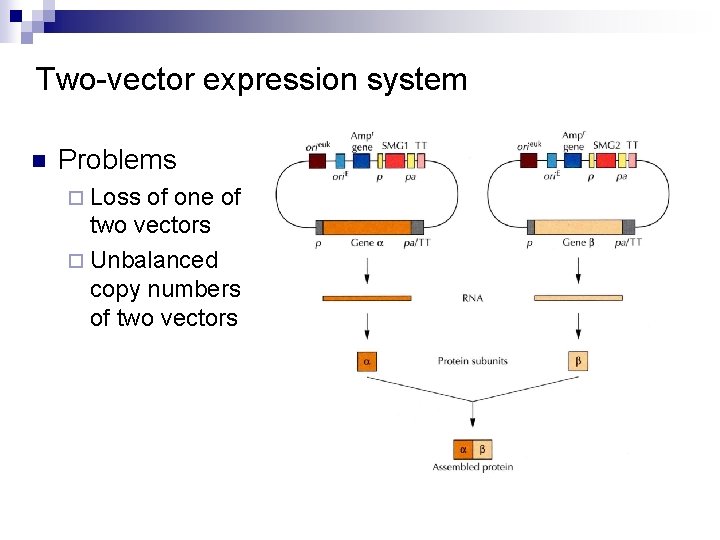
Two-vector expression system n Problems ¨ Loss of one of two vectors ¨ Unbalanced copy numbers of two vectors
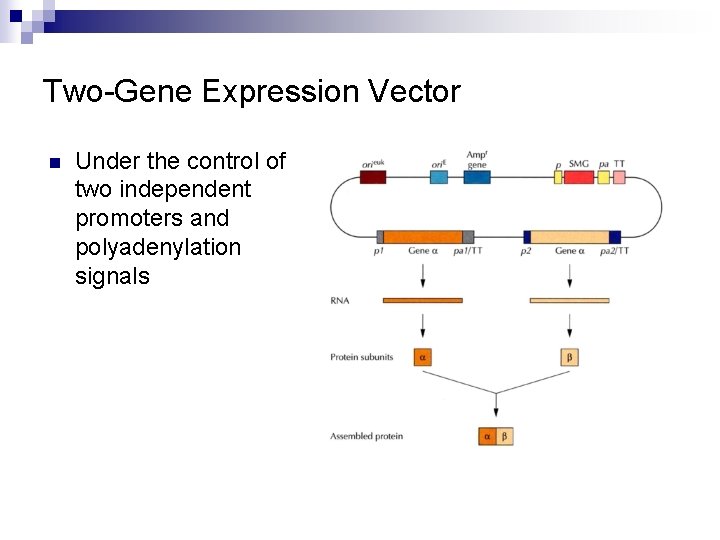
Two-Gene Expression Vector n Under the control of two independent promoters and polyadenylation signals
Bicistronic Vector n Under the control of a single promoter and polyadenylation signal ¨ to ensure the equal expression of the recombinant subunits ¨ IRES (internal ribosomal entry site) n n found in mammalian virus genomes translation of different proteins from a polycistronic m. RNA molecules

Bicistronic Vector
Selectable Markers n n Table 7. 2 Neo (neomycin phosphotransferase, bacterial gene) ¨ The transfected cell can grow in the medium containing G-418 (Geneticin, a neomycin derivative). n n ¨ n G-418: inhibitor of eukaryotic protein synthesis Neomycin: not an effective inhibitor of eukaryotic protein synthesis G-418 is inactivated (phosphorylated) by Neo. Selection to increase copy number of the plasmid DHFR-MTX (dihydrofolate reductase-methotrexate) system ¨ GS-MSX (glutamine synthetase-methionine sulfoximine) system ¨
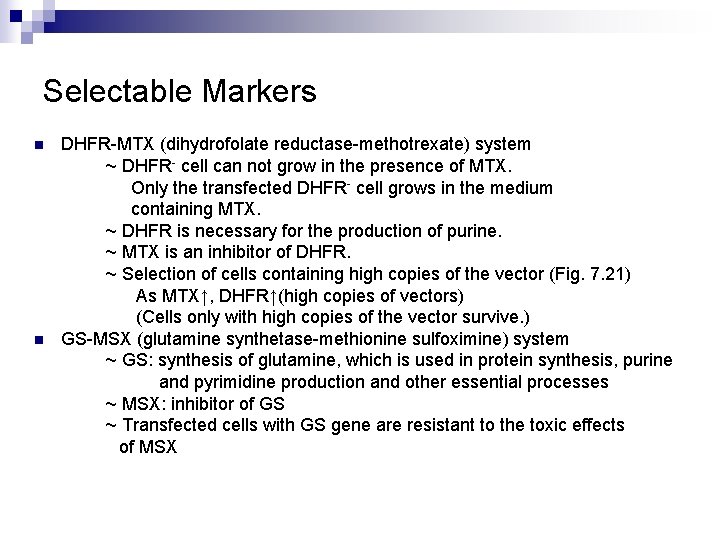
Selectable Markers n n DHFR-MTX (dihydrofolate reductase-methotrexate) system ~ DHFR- cell can not grow in the presence of MTX. Only the transfected DHFR- cell grows in the medium containing MTX. ~ DHFR is necessary for the production of purine. ~ MTX is an inhibitor of DHFR. ~ Selection of cells containing high copies of the vector (Fig. 7. 21) As MTX↑, DHFR↑(high copies of vectors) (Cells only with high copies of the vector survive. ) GS-MSX (glutamine synthetase-methionine sulfoximine) system ~ GS: synthesis of glutamine, which is used in protein synthesis, purine and pyrimidine production and other essential processes ~ MSX: inhibitor of GS ~ Transfected cells with GS gene are resistant to the toxic effects of MSX
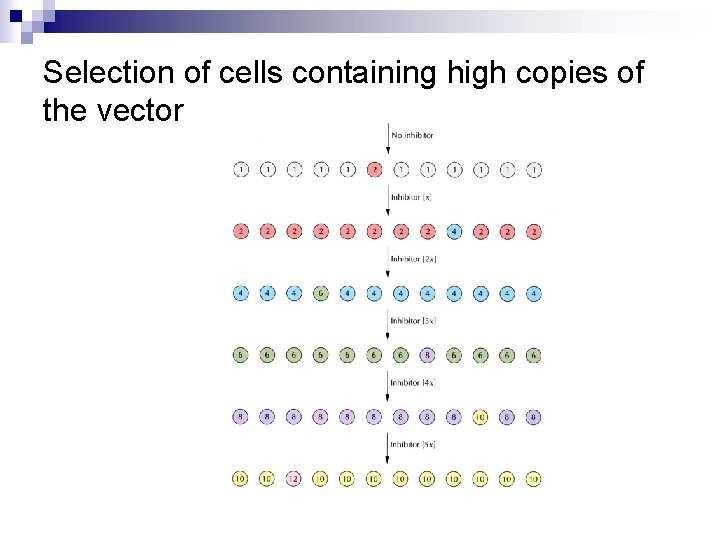
Selection of cells containing high copies of the vector
- Slides: 22