
BACTERIOLOGY 2 BACTERIAL CELL STRUCTURE a Prof Dr

BACTERIOLOGY (2) BACTERIAL CELL STRUCTURE- a) Prof. Dr. Waiel Farghaly Professor of Microbiology/ Dept. Botany, Fac. Science
Bacterial Cell Structure 1. 2. 3. 4. 5. 6. 7. 8. 9. Capsules Cell Wall Plasma Membrane Cytoplasm & Cytoplasmic Inclusions Ribosomes Bacterial DNA Pili Flagella Spores

Summary of characteristics for typical bacterial cell structure
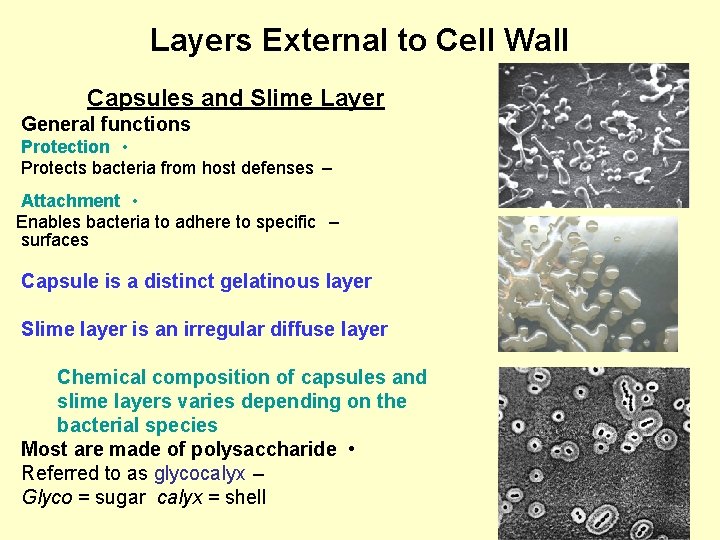
Layers External to Cell Wall Capsules and Slime Layer General functions Protection • Protects bacteria from host defenses – Attachment • Enables bacteria to adhere to specific – surfaces Capsule is a distinct gelatinous layer Slime layer is an irregular diffuse layer Chemical composition of capsules and slime layers varies depending on the bacterial species Most are made of polysaccharide • Referred to as glycocalyx – Glyco = sugar calyx = shell

Chemical composition of some bacterial capsules
Capsular material and the environment • Mucoid bacterial colonies in the rhizospheric region of desert plants increase the ability of these plants to resist drought and keep the moisture content of the root surface. • Cements water bacteria in films and facilitates its adhesion to solid surfaces. • The encapsulated bacteria of the oral microflora, in the presence of polysaccharides, stimulate dental caries processes. • Hinders the attack by bacteriophages specific for Oantigens and lipopolysaccharide regions of the cell wall.

• The capsule may enclose a huge number of cells forming colonies called “zooglea”. Zooglea will form in concentrated sugar solutions in the sugar refinery plants. These zooglea cause problems in these factories by stopping the flow of sugar solution in the pipes. • Capsule formation may be responsible for considerable economic loss in dairy and other food industries. Carbohydrate- containing materials become “ropy” when encapsulated organisms grow on it. • Some organisms such as Leuconostoc species, are employed commercially in the production of dextran (polymer of glucose). Dextrans are used as plasma extenders in the treatment of chock resulting from blood loss.
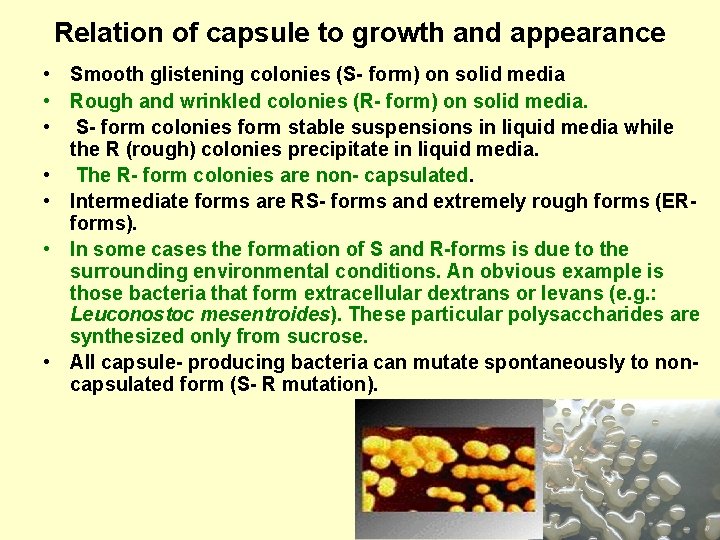
Relation of capsule to growth and appearance • Smooth glistening colonies (S- form) on solid media • Rough and wrinkled colonies (R- form) on solid media. • S- form colonies form stable suspensions in liquid media while the R (rough) colonies precipitate in liquid media. • The R- form colonies are non- capsulated. • Intermediate forms are RS- forms and extremely rough forms (ERforms). • In some cases the formation of S and R-forms is due to the surrounding environmental conditions. An obvious example is those bacteria that form extracellular dextrans or levans (e. g. : Leuconostoc mesentroides). These particular polysaccharides are synthesized only from sucrose. • All capsule- producing bacteria can mutate spontaneously to noncapsulated form (S- R mutation).
Relation of capsule to bacterial pathogenicity • If the smooth colonies are pathogenic (diseasecausing), so the rough mutants are not. This means that the virulence is associated with the occurrence of the capsule. • Most of bacterial antigens are proteins, but in pneumococcus (Streptococcus pneumonia), polysaccharides are also antigens resulting in specific antibodies produced by the host after infection. When these antibodies are mixed the pneumococcus cells, the capsules of the latters are largely swollen due to the precipitation of antibodies on the capsule. This swelling phenomenon is known as “Neufeld” reaction and most commonly “Quellung” reaction (Quellung in German = Swelling in English).
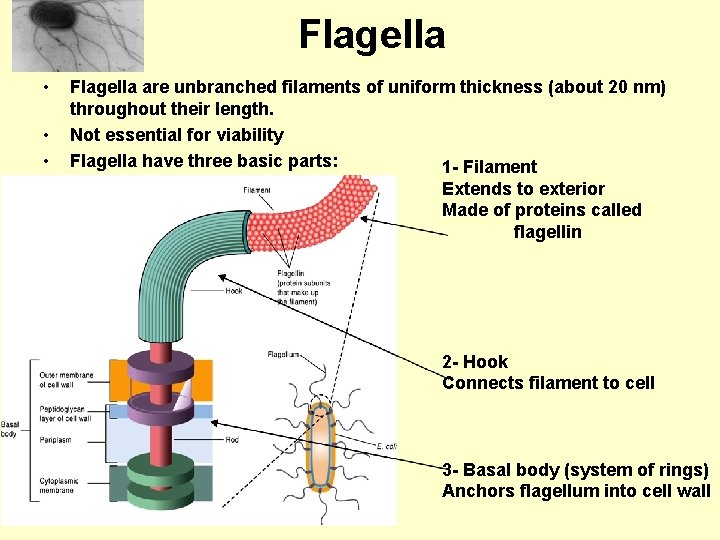
Flagella • • • Flagella are unbranched filaments of uniform thickness (about 20 nm) throughout their length. Not essential for viability Flagella have three basic parts: 1 - Filament Extends to exterior Made of proteins called flagellin 2 - Hook Connects filament to cell 3 - Basal body (system of rings) Anchors flagellum into cell wall
• More than 98% of filament components is protein with high acidic amino acid content with some aromatic amino acids. • The protein unit of filament (seen as beads under electron microscope) is called flagellin. Flagellin is synthesized within the cell and moves out through the hollow central core of the flagellum to its tip to be assembled there. • The full length can be completed within 10 to 20 minutes.
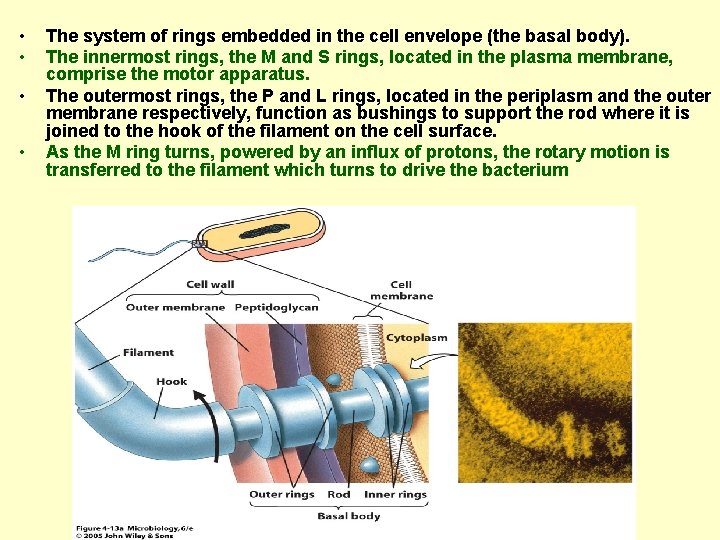
• • The system of rings embedded in the cell envelope (the basal body). The innermost rings, the M and S rings, located in the plasma membrane, comprise the motor apparatus. The outermost rings, the P and L rings, located in the periplasm and the outer membrane respectively, function as bushings to support the rod where it is joined to the hook of the filament on the cell surface. As the M ring turns, powered by an influx of protons, the rotary motion is transferred to the filament which turns to drive the bacterium

Bacteria use flagella for motility Motile through sensing chemicals • Chemotaxis If chemical compound is nutrient • Acts as attractant If compound is toxic • Acts as repellent Note that there are different types of tactic behaviour and different types of taxis including chemotaxis phototaxis aerotaxis magnetotaxis. . etc
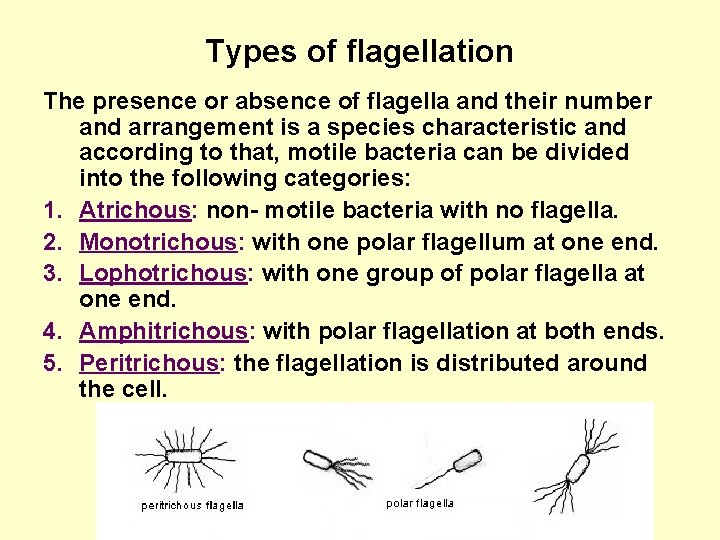
Types of flagellation The presence or absence of flagella and their number and arrangement is a species characteristic and according to that, motile bacteria can be divided into the following categories: 1. Atrichous: non- motile bacteria with no flagella. 2. Monotrichous: with one polar flagellum at one end. 3. Lophotrichous: with one group of polar flagella at one end. 4. Amphitrichous: with polar flagellation at both ends. 5. Peritrichous: the flagellation is distributed around the cell.
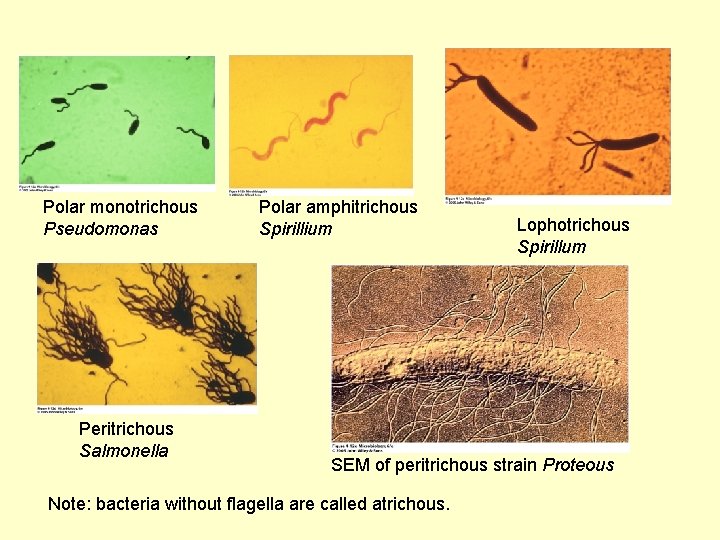
Polar monotrichous Pseudomonas Peritrichous Salmonella Polar amphitrichous Spirillium Lophotrichous Spirillum SEM of peritrichous strain Proteous Note: bacteria without flagella are called atrichous.
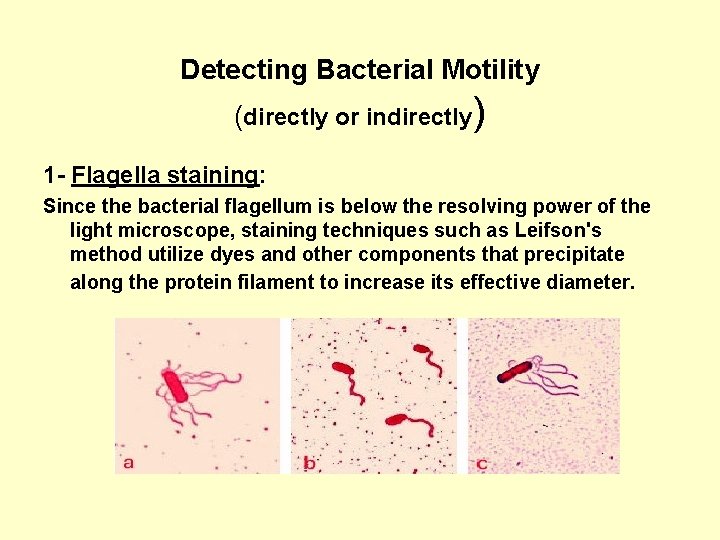
Detecting Bacterial Motility (directly or indirectly) 1 - Flagella staining: Since the bacterial flagellum is below the resolving power of the light microscope, staining techniques such as Leifson's method utilize dyes and other components that precipitate along the protein filament to increase its effective diameter.

2 - Motility test medium A semisolid medium is inoculated with the bacteria in a straight- line stab with a needle. After incubation, if turbidity (cloudiness) or indicator colour change, due to bacterial growth, can be observed away from the line of the stab it is evidence that the bacteria are motile. 3 - Direct microscopic observation by using a “hangingdrop slide”. Most unicellular bacteria, because of their small size, will shake back and forth in a wet mount observed at 400 X or 1000 X. This is Brownian movement, due to random collisions between water, molecules and bacterial cells. True motility is confirmed by observing the bacterium swim from one side of the microscope field to the other side.
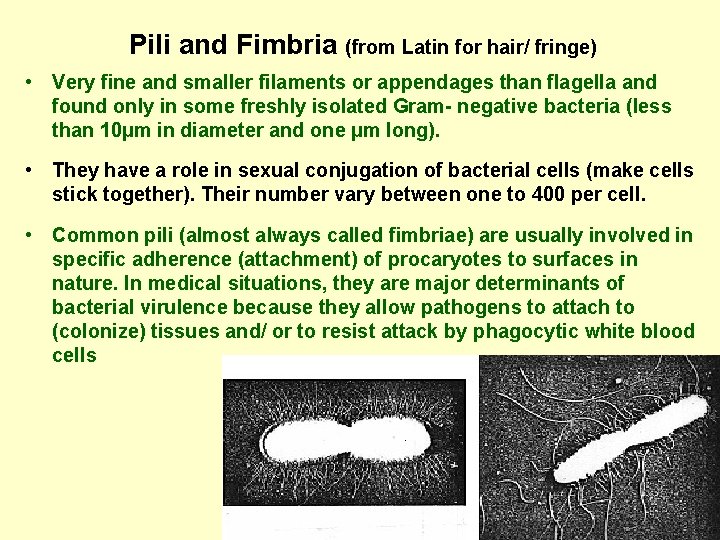
Pili and Fimbria (from Latin for hair/ fringe) • Very fine and smaller filaments or appendages than flagella and found only in some freshly isolated Gram- negative bacteria (less than 10µm in diameter and one µm long). • They have a role in sexual conjugation of bacterial cells (make cells stick together). Their number vary between one to 400 per cell. • Common pili (almost always called fimbriae) are usually involved in specific adherence (attachment) of procaryotes to surfaces in nature. In medical situations, they are major determinants of bacterial virulence because they allow pathogens to attach to (colonize) tissues and/ or to resist attack by phagocytic white blood cells

Some properties of pili and fimbria
- Slides: 19