
Bacterial Vaginosis and Pregnancy Clinical Overview and Public
Bacterial Vaginosis and Pregnancy: Clinical Overview and Public Health Implications Deborah B. Nelson, Ph. D. Assistant Professor Center for Clinical Epidemiology and Biostatistics University of Pennsylvania School of http: //www. med. upenn. edu/crrwh/Nelson. h Medicine
Learning Objectives • Review the Prevalence, Identification, and Treatment of Bacterial Vaginosis (BV) • Describe the Epidemiology and Consequences of Bacterial Vaginosis in Pregnancy • Discuss Current Research Findings • Present the BEAR Project: Nelson DB, Macones GA. Bacterial in Pregnancy: Hypothesis, Specific Aims Vaginosis and Methodology Current Findings and Future Directions. Epidemiologic Reviews 2002 (24: 102 -108).
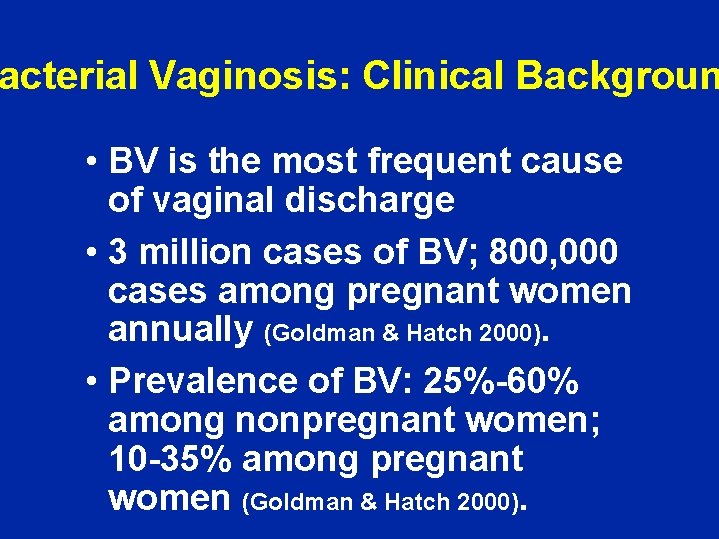
acterial Vaginosis: Clinical Backgroun • BV is the most frequent cause of vaginal discharge • 3 million cases of BV; 800, 000 cases among pregnant women annually (Goldman & Hatch 2000). • Prevalence of BV: 25%-60% among nonpregnant women; 10 -35% among pregnant women (Goldman & Hatch 2000).
Bacterial Vaginosis: Microbiology • The normal vagina is an acidic environment inhabited primarily by hydrogen-producing lactobacilli • There is some change in the microbiological flora of the vagina (due to environmental, behavioral, or hormonal factors) • BV is characterized by a reduced number of lactobacilli and an overgrowth of gram negative,
Bacterial Vaginosis: Microbiology • Anaerobic organisms in BV include: Mycoplasma hominis, Bacteroides spp. , Mobiluncus spp. , Gardnerella vaginalis. • Increase in polyamines resulting in the characteristic odor of BV and the increase in epithelial cell exfoliation.
Bacterial Vaginosis: Clinical Diagnosis • Amsel criteria: three of four clincal conditions • • • An elevated vaginal p. H (> 4. 5). Amine odor with KOH (whiff test). Presence of clue cells (20% of cells).
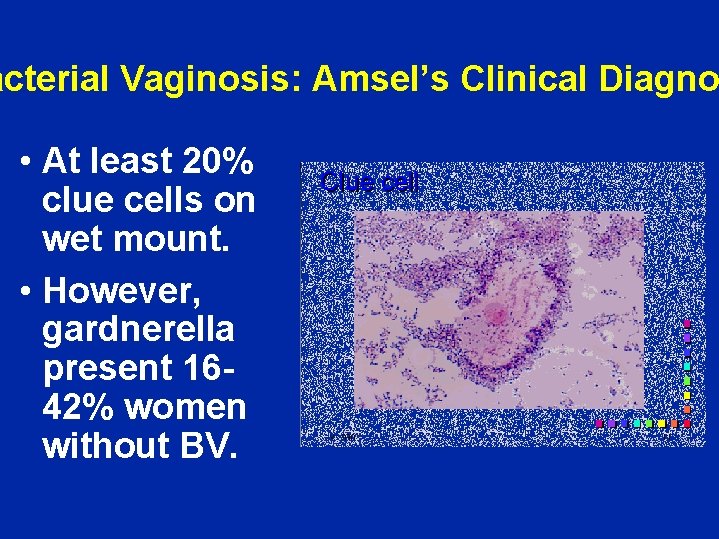
acterial Vaginosis: Amsel’s Clinical Diagno • At least 20% clue cells on wet mount. • However, gardnerella present 1642% women without BV.

acterial Vaginosis: Amsel’s Clinical Diagnos • Assessment of vaginal p. H lacks specificity • Conduct of Whiff test is subjective and lacks sensitivity • Identification of clue cells subjected to skill and interpretation of the microscopist
cterial Vaginosis: Nugent’s Clinical Diagno Gram stain using Nugent’s criteria: • High sensitivity and specificity • Permanent record • Commonly used in epidemiologic studies (NICHD maternal-fetal medicine unit)

Bacterial Vaginosis: Clinical Diagnosis Gram stain using Nugents criteria: Gardnerella/ Lactobacillus Bacteroides Mobiluncus Total score: >= 7 indicates BV, 4 -6 intermediate stage of BV
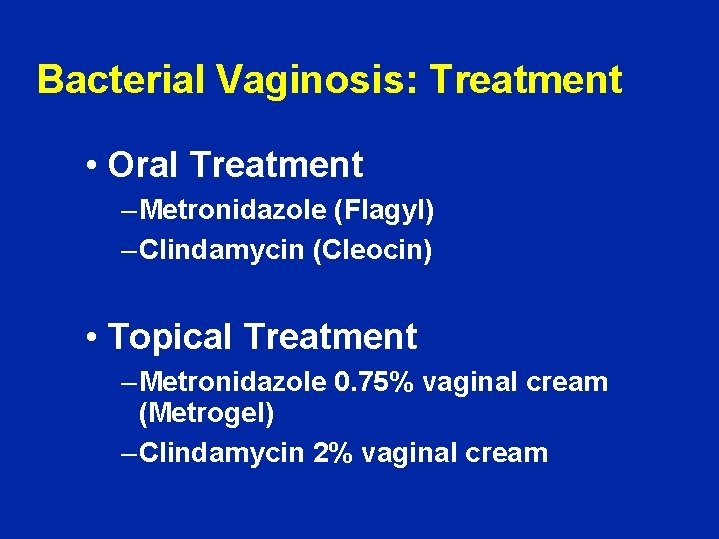
Bacterial Vaginosis: Treatment • Oral Treatment – Metronidazole (Flagyl) – Clindamycin (Cleocin) • Topical Treatment – Metronidazole 0. 75% vaginal cream (Metrogel) – Clindamycin 2% vaginal cream
Bacterial Vaginosis in Pregnancy: Epidemiology Race Socioeconomic status Sexual activity Vaginal douching Drug use Psychosocial stress
Bacterial Vaginosis: Clinical Implication • Pelvic Inflammatory Disease • Post-hysterectomy vaginal cuff cellulitis • Plasma cell endometritis
Bacterial Vaginosis and Pregnancy: Clinical Implications • Amniotic fluid infection • Postpartum endometritis • Preterm delivery • Preterm labor • Premature rupture of the membranes • Spontaneous abortion (? )
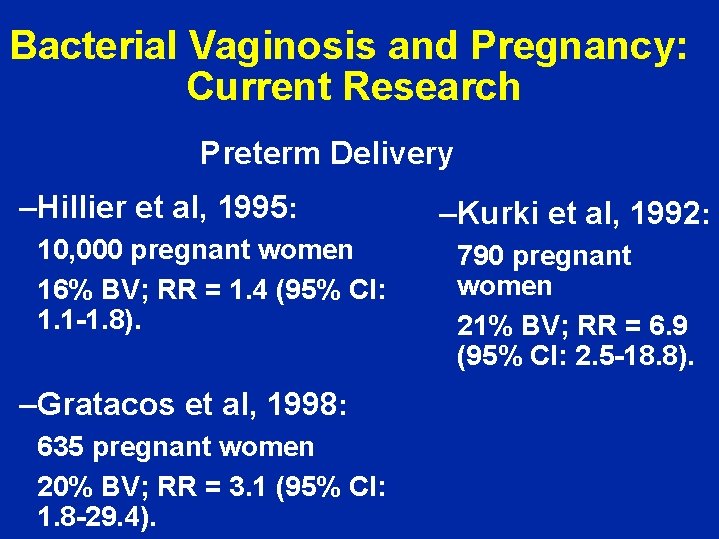
Bacterial Vaginosis and Pregnancy: Current Research Preterm Delivery –Hillier et al, 1995: 10, 000 pregnant women 16% BV; RR = 1. 4 (95% CI: 1. 1 -1. 8). –Gratacos et al, 1998: 635 pregnant women 20% BV; RR = 3. 1 (95% CI: 1. 8 -29. 4). –Kurki et al, 1992: 790 pregnant women 21% BV; RR = 6. 9 (95% CI: 2. 5 -18. 8).

Bacterial Vaginosis: Treatment paradigm in a pregnant population Pregnant women Symptomatic Asymptomatic High risk Low risk Screen Treatment No Treatment (? ) Screen (? ) No treatment (Hauth 1995, Morale 1994, Mc. Donald 1997, Carey 2001)
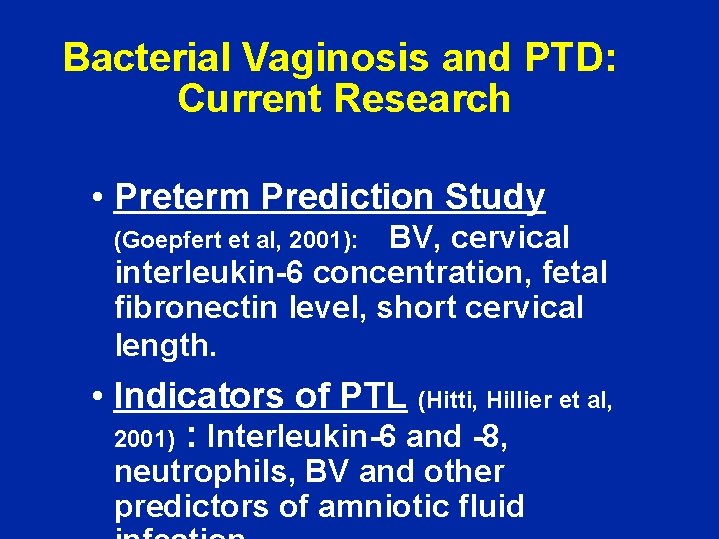
Bacterial Vaginosis and PTD: Current Research • Preterm Prediction Study BV, cervical interleukin-6 concentration, fetal fibronectin level, short cervical length. (Goepfert et al, 2001): • Indicators of PTL (Hitti, Hillier et al, 2001) : Interleukin-6 and -8, neutrophils, BV and other predictors of amniotic fluid
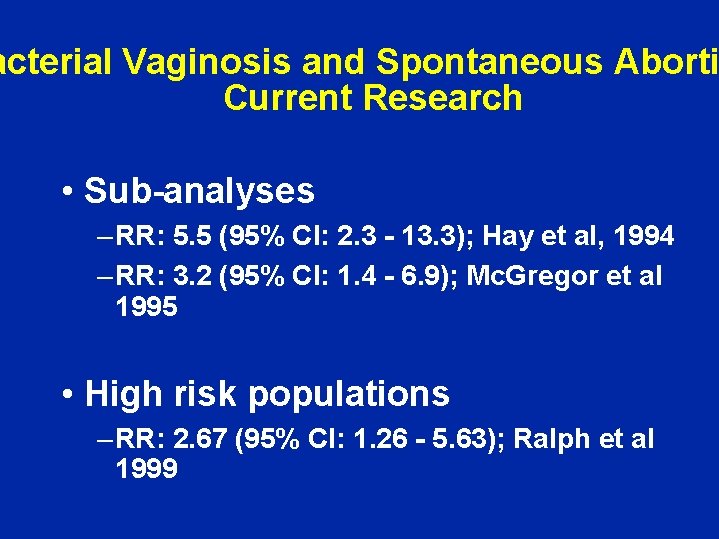
acterial Vaginosis and Spontaneous Aborti Current Research • Sub-analyses – RR: 5. 5 (95% CI: 2. 3 - 13. 3); Hay et al, 1994 – RR: 3. 2 (95% CI: 1. 4 - 6. 9); Mc. Gregor et al 1995 • High risk populations – RR: 2. 67 (95% CI: 1. 26 - 5. 63); Ralph et al 1999
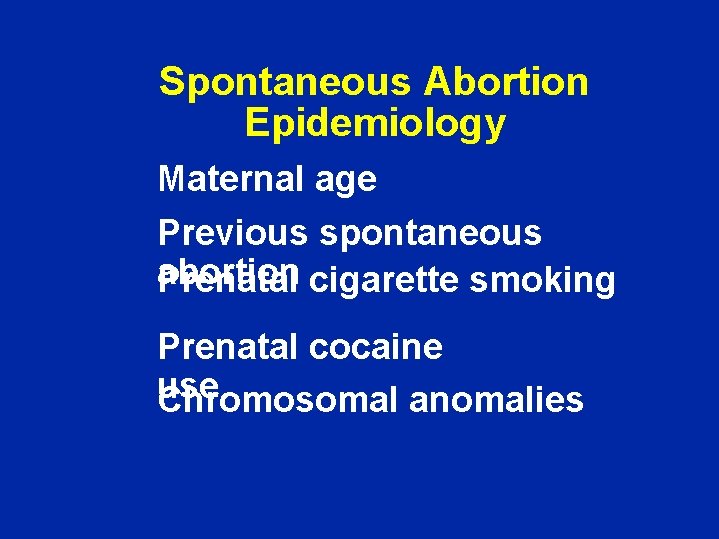
Spontaneous Abortion Epidemiology Maternal age Previous spontaneous abortion Prenatal cigarette smoking Prenatal cocaine use Chromosomal anomalies
BEAR Project: Bacterial vaginosis Evaluation And early Reproduction
BEAR Project: Study Design • Four year NICHD-funded study. • Prospective cohort enrolling women seeking prenatal care. • Exposure: Bacterial Vaginosis. • Outcome: Spontaneous Abortion. • 30 month data collection period (N=2200).
BEAR Project: Specific Aims • Aim 1: Among women seeking prenatal care at urban obstetric clinics, characterize the prevalence and predictors of BV. • Aim 2: Evaluate whether BV during pregnancy is an important, independent predictor of SAB.
BEAR Project: Eligibility Criteria • OB patient at their first prenatal care visit seen at the Gates clinic or PTP. • 12. 6 weeks gestation or earlier based on last menstrual period. • Resident of Philadelphia. • Single, intrauterine pregnancy.
BEAR Project: Study Methods • Baseline data collection (Nurse Coordinators) – Enroll women and obtain informed consent. – Collect vaginal swabs for all eligible women (regardless of symptoms). – Obtain urine sample. – Administer 15 minute questionnaire.
BEAR Project: Baseline Questionnaire • Risk factors for BV: race, prior and current sexual activity, douching, drug use, psychosocial stress measures. • Risk factors for SAB: age, prior pregnancy information, drug use, vaginal bleeding.
BEAR Project: Study Methods • Follow-up data collection (Follow-up Coordinator) – Conduct follow-up telephone interviews. – Medical confirmation of outcomes through medical record review. – Classify women as eligible and either a case or pregnant control.
BEAR Project: Follow-up Questionnaire • Determine pregnancy status at 20 weeks gestation. • Identify subsequent diagnoses of BV and compliance with medical therapy. • Measure other risk factors for SAB.
BEAR Project: Study Methods • Case: Women • Control: experiencing a spontaneous abortion during the study period (20 weeks). Pregnant women maintaining their pregnancy through 20 weeks gestation.
BEAR Project: Goals • Determine the prevalence of symptomatic and asymptomatic BV among women in first trimester of pregnancy. • Identify predictors of BV in the first trimester (ie. stress, douching, prior pregnancy outcomes).
BEAR Project: Goals • Examine the independent relationship between BV and spontaneous abortion. • Assess the separate relationship between symptomatic and asymptomatic BV and spontaneous abortion.

Bacterial Vaginosis and Pregnancy: Clinical Implications and Current Research Deborah B. Nelson, Ph. D. Assistant Professor Center for Clinical Epidemiology and Biostatistics University of Pennsylvania School of Medicine
- Slides: 31