
Bacterial Intoxification INTRODUCTION The Genus Bacillus was established
Bacterial Intoxification 黃顯宗 東吳大學
INTRODUCTION • The Genus Bacillus was established in 1872 with B. subtilis as type species. B. cereus was added fifteen years later • Several accounts of food poisoning attributed to members of the genus Bacillus appeared in the European literature before 1950
INTRODUCTION • An accumulating number of reports implicate both B. subtilis and B. licheniformis as potential food poisoning agents.

OCCURRENCE IN FOOD AND ENVIRONMENT • B. cereus has a wide distribution in nature, frequently isolated from soil and growing plants, but it is also well adapted for growth in the intestinal tract of insects and mammals • It has been isolated from foods that were not involved in foodborne illness outbreaks. It is also present in the stools of 14 to 15% of healthy humans • It is frequently isolated from milk and dairy products. In milk, B. cereus causes a defect known as 'bitty' cream or sweet curdling. It is found in rice, rice products, oriental dishes and ingredients
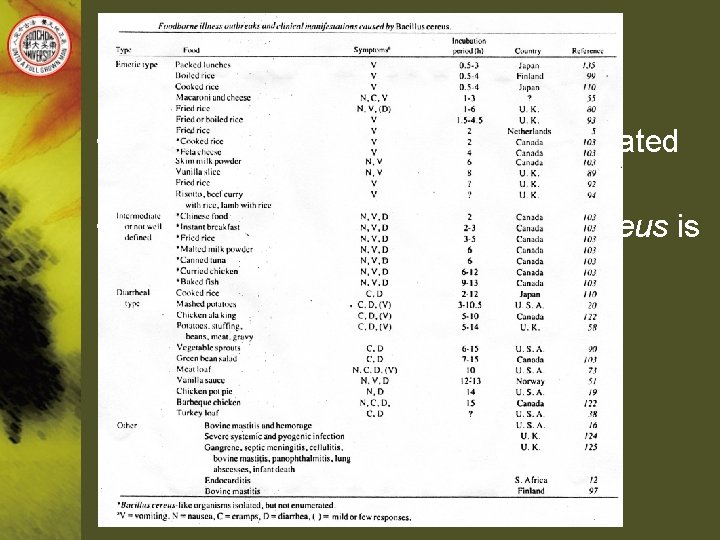
OCCURRENCE IN FOOD AND ENVIRONMENT • A variety of foods have been implicated in food-poisoning • Emetic syndrome caused by B. cereus is highly associated with rice and rice products
OCCURRENCE IN FOOD AND ENVIRONMENT • B. cereus was isolated from 9, 35, 14 and 48% of raw milk, pasteurized milk, Cheddar cheese and ice cream samples, respectively • In a local study, B. cereus occurred in 17% of fermented milks, 52% of ice creams, 35% of soft ice creams, 2% of pasteurized milks and pasteurized fruit- or nut-flavored reconstituted milks, and 29% of milk powders, mostly in fruit- or nut-flavored milk mixes (Wong et al. , 1988 a). • B. cereus was found in 71. 4% and 33. 3% in spring and in autumn samples of full-fat milk in mainland China, respectively, and the average count among the positive samples was 11. 7 MPN/ml (Zhou et al. , 2008). • Dried milk products and infant food are known to be frequently contaminated with B. cereus, 261 samples of infant food distributed in 17 countries were collected and 54% were contaminated with B. cereus reaching levels from 0. 3 to 600/g (Becker et al. , 1994).
OCCURRENCE IN FOOD AND ENVIRONMENT • Chinese 'take-out' foods appear to be particularly vulnerable to B. cereus infection and it has been shown that suspensions (2%) of seed flours and meals from diverse botanical origins were found to be excellent sources of nutrients for growth (Beuchat and Ma. Lin, 1980)
OCCURRENCE IN FOOD AND ENVIRONMENT • Of 433 honey samples collected in Argentina, 27% yielded B. cereus isolates and 14% yielded other species of Bacillus. • Results showed a high degree of diversity, both phenotypic and genotypic among the isolates of B. cereus (Lopez and Alippi, 2007).
OCCURRENCE IN FOOD AND ENVIRONMENT • The B. cereus isolates from food are highly toxigenic. All the isolates from local dairy products lysed rabbit erythrocytes; 98% showed verotoxicity, 68% showed cytotonic toxicity for CHO cells (Wong et al. , 1988 a). • In another study of 136 strains of B. cereus isolated from milk and cream, 43% and 22% showed toxicity to human embryonic lung cell when the isolates were cultured in brain heart infusion and milk, respectively (Christiansson et al. , 1989). • In milks, B. cereus growed rapidly and produced cytotonic and cytotoxic toxins (Wong et al. , 1988 b). Toxin production of B. cereus in milk at low temperature was also evaluated (Christiansson et al. , 1989).
OCCURRENCE IN FOOD AND ENVIRONMENT • For the B. cereus isolated from seafood, 48% isolates produced both the hemolysin BL (HBL) and nonhemolytic (NHE) enterotoxins, and 94% and 50% produced NHE or HBL toxins, respectively. • Only one B. cereus isolate possessed the cereulide synthetase gene, ces (Rahmati and Labbe, 2008).
OCCURRENCE IN FOOD AND ENVIRONMENT • The enterotoxin genes hbl. A, hbl. C, hbl. D(前面 幾種兼溶血), nhe. A, nhe. B and nhe. C (前面幾種 不溶血)occurred in B. cereus isolates from fullfat milk products with frequencies of 37. 0%, 66. 3%, 71. 7%, 62. 0% and 71. 7% respectively • Nine B. thuringiensis isolates were also identified from six pasteurized milk samples, and most of them harbored six enterotoxic genes and the insecticidal toxin cry 1 A gene. • The single B. mycoides isolate harbored nhe. A and nhe. C genes (Zhou et al. , 2008).
CHARACTERISTICS AND TAXONOMY • B. cereus is a Gram-positive, motile, facultative, aerobic sporeformer. • Dimensions of vegetative cells are typically 1. 0 - 1. 2 μm by 3. 0 -5. 0 μm. • The ellipsoidal spores are formed in a central or paracentral position without swelling the sporangium. • The organism does not ferment mannitol and has a very active phospholipase (lecithinase) system. B. cereus is keyed as citrate(+), arabinose (-), Gram (+), aerobic sporeformer.
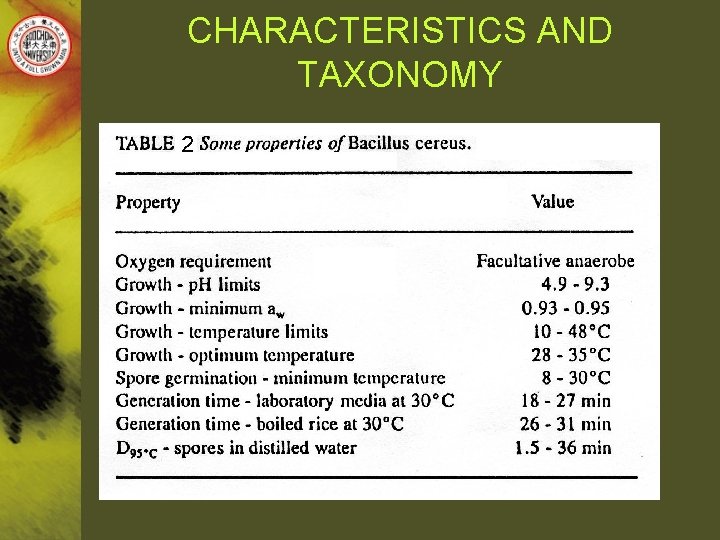
CHARACTERISTICS AND TAXONOMY
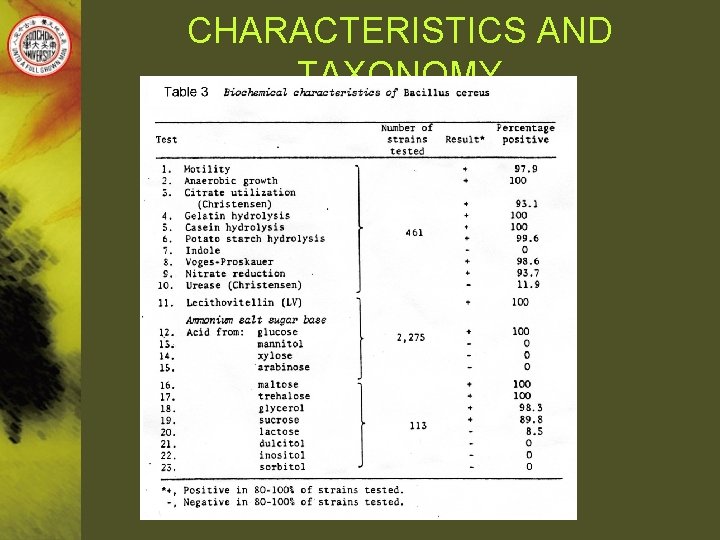
CHARACTERISTICS AND TAXONOMY
CHARACTERISTICS AND TAXONOMY • Plasmids have been identified in B. cereus. Plasmids of molecular weight ranged from 1. 6 to 105 MDa. • Bacteriocin production could be attributed to a 45 MDa plasmid (p. BC 7), and tetracycline resistance to a 2. 8 MDa plasmid (p. BC 16)
SPORE AND GERMINATION • B. cereus produces elliptical shaped endospore with dominant central position, no distended sporangium. • The spore when liberated from the sporangium is encased in a loose fitting exosporium. • On germination the spore coat undergoes rapid lysis while the vegetative cell is emerging. Since spores of B. cereus may survive heat processing, spore germination is important in B. cereus study.
GERMINATION STEPS • Once the initial 'trigger reaction' has been activated, germination continues in the absence of the inducer. • After the 'trigger' steps, the various spore properties are changed sequentially in the following order: loss of heat resistance, release of dipicolinic acid (DPA) and Ca 2+ into the medium, increase in spore stainability, beginning of phase darkening and decrease of the optical density of spore suspension as cortex peptidoglycan is hydrolyzed and the products released to the medium • Finally, the onset of metabolic activity as measured by oxygen uptake.
Role of trypsin-like enzyme • The germination of B. cereus spore is partially prevented by several inhibitors of trypsin-like enzymes (leupeptin, antipain, and tosyl-lysine-chloromethyl ketone) • A synthetic substrate of trypsin also inhibited germination (Boschwitz et al. , 1983).
SPORE AND GERMINATION • Inactivation of B. cereus spores during cooling from 90 C occurs in two phases, one phase occurs during cooling from 90 to 80 C; the second occurs during cooling from 46 to 38 C. • No inactivation occurs when spores are cooled from a maximum temperature of 80 C.
SPORE AND GERMINATION • Germination of B. cereus spores is more extensive in rice than in trypticase soy broth at <15 C and is generally more extensive for diarrheal strains in either medium than emetic strains • Germination of B. cereus spores was also inhibited by the growth of lactic acid bacteria or the organic acids produced (Wong and Chen, 1988).
SPORE AND GERMINATION • B. cereus spores germinate in inosine or in l-alanine as sole germinants
Confirmation of outbreak • B. cereus strains of the same serotype should be present in the epidemiologically food, feces and/or vomitus of the affected persons. Or • Significant numbers (>105 CFU/g) of B. cereus of an established food poisoning serotype should be isolated from the incriminated food, or feces, or vomitus of the affected persons. or • Significant numbers (>105 CFU/g) of B. cereus should be isolated from the incriminated food, together with detection of the organism in the feces and/or vomitus of the affected persons.
Bacillus cereus • 毒素 – 有多種溶血素 cereolysin – emetic toxin “cereulide”:小peptide,耐熱 – enterotoxin:分離不易,不耐熱與蛋白 酵素
Enterotoxins • hemolysin BL (HBL) enterotoxins • nonhemolytic (NHE) enterotoxins
Bacillus cereus • 培養利用強的lecithinase,培養平板培養 基加入 蛋黃 – 其他成分,營養與呈色 • 生化鑑定 • 毒素和毒素基因鑑定 – reversed passive latex agglutination (BCETRPLA) kit (Oxoid), and the Duopath Cereus Enterotoxins (Merck) – gene
Detecting Cereulide • cereulide synthetase gene (ces) • liquid chromatography-tandem mass spectrometry analysis • HEp-2 cell vacuolation test • mitochondrial respiratory uncoupling activity • sperm micro assay(boar spermatozoa )
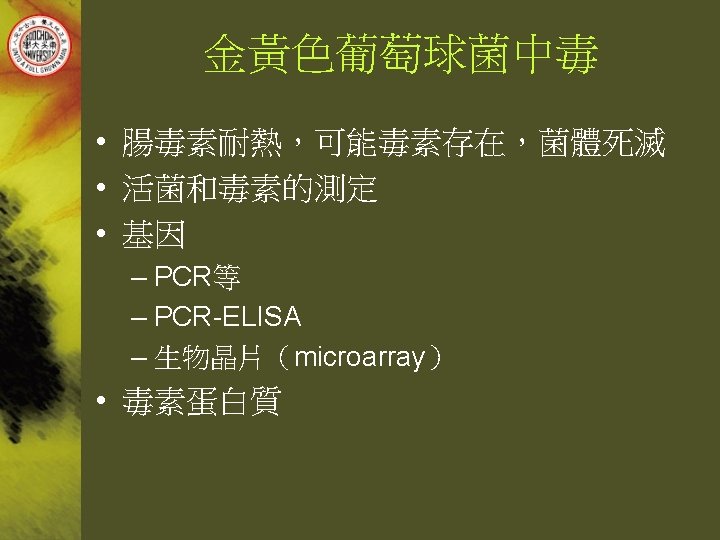
Staphylococcus aureus毒素 • • • Coagulase,coagulate citrate plasma Alpha-exotoxin,細胞毒素 Beta-toxin,a hot-cold 溶血素 FS toxin,可破壞白血球的毒素 Hyaluronidase,spreading factor Toxic shock syndrome toxins toxin, TSST • Enterotoxins
Enterotoxins 腸毒素 • 中毒以A,B兩型為主 • 耐熱 – A 60度 20 min – B 100度 5 min可減低一半毒性 • 對蛋白酵素穩定pepsin,trypsin, chymotrypsin,rennin,papain等
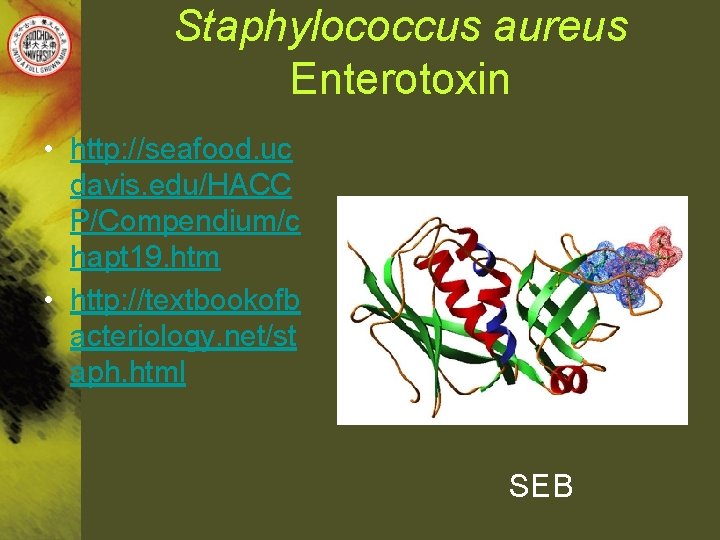
Staphylococcus aureus Enterotoxin • http: //seafood. uc davis. edu/HACC P/Compendium/c hapt 19. htm • http: //textbookofb acteriology. net/st aph. html SEB
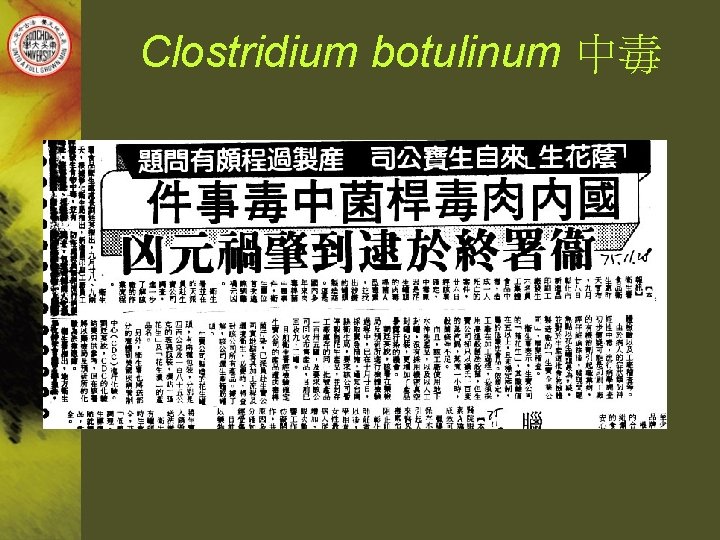
Clostridium botulinum 中毒
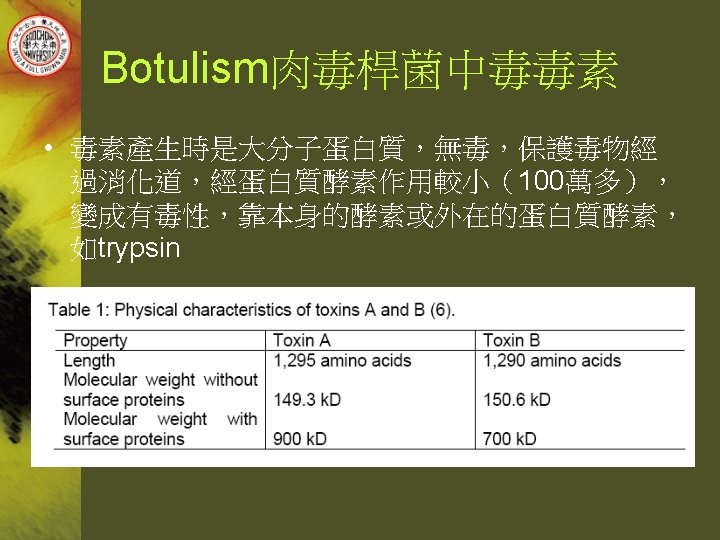
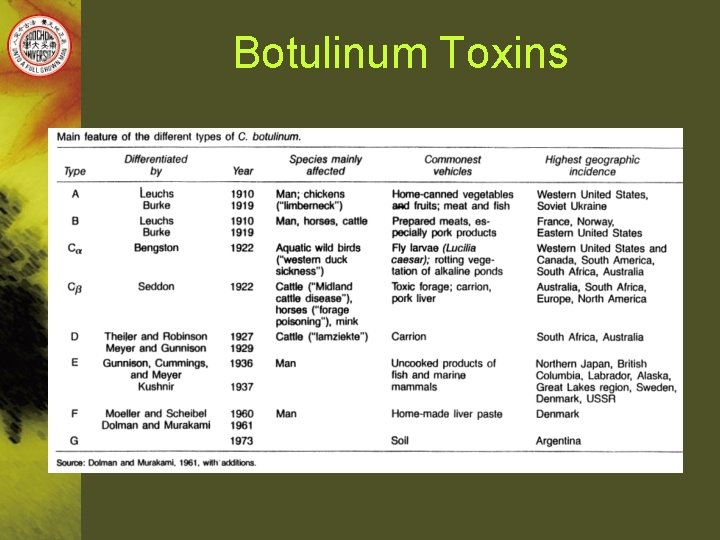
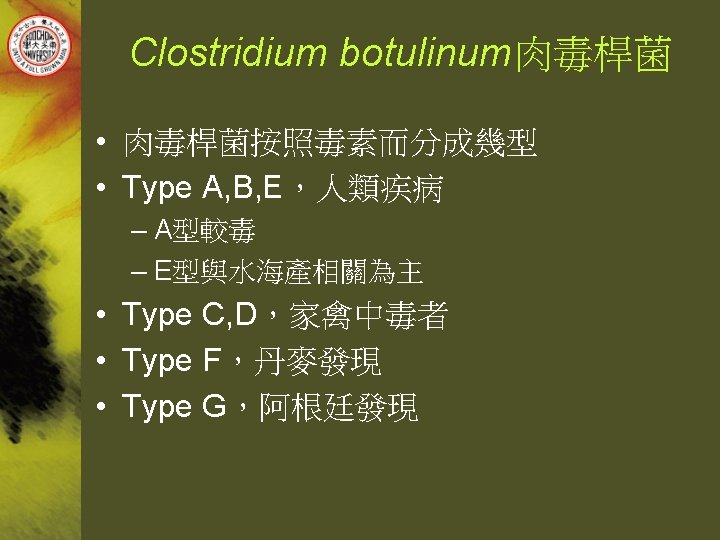
Botulinum Toxins
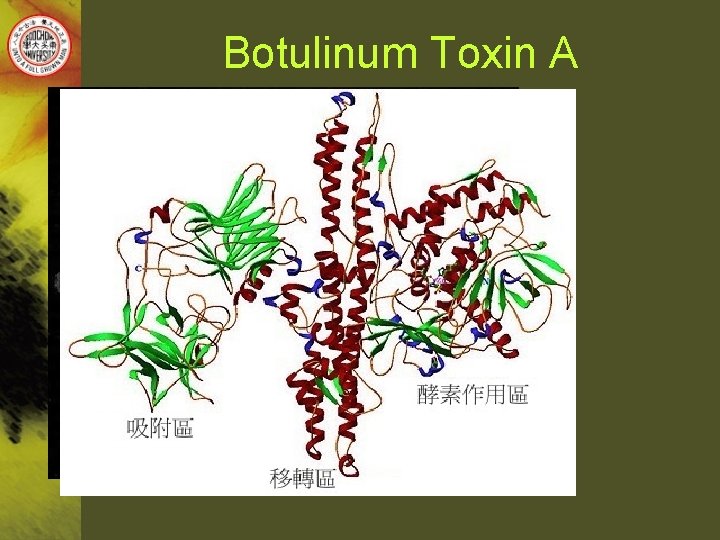
Botulinum Toxin A
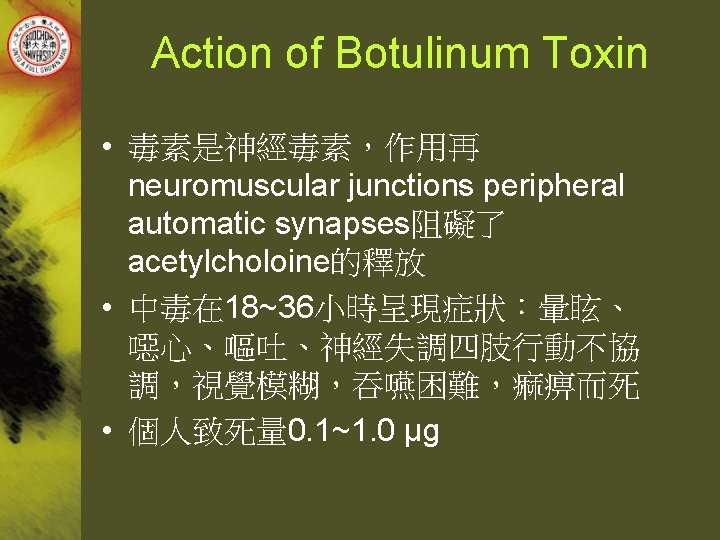
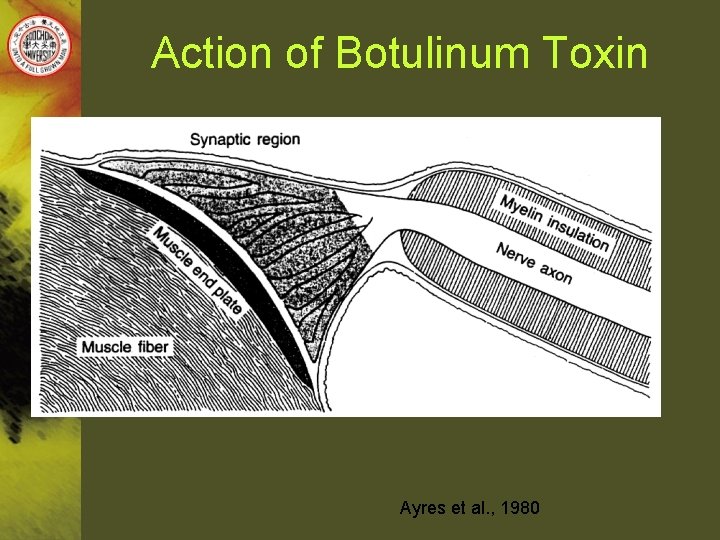
Action of Botulinum Toxin Ayres et al. , 1980
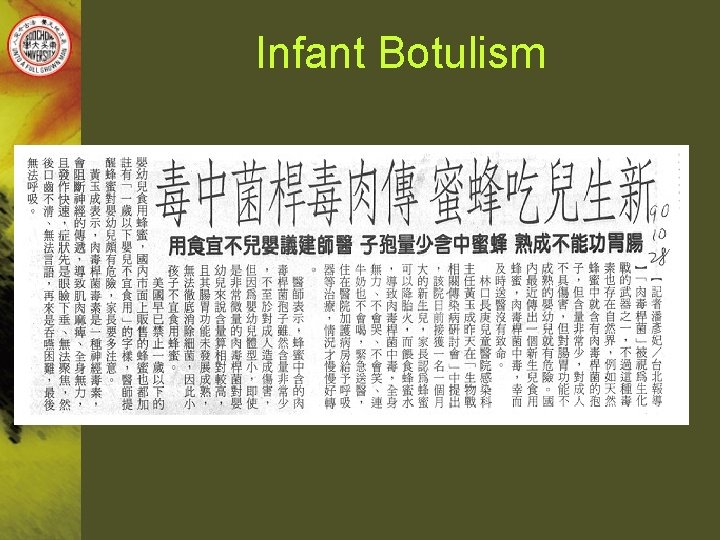
Infant Botulism
肉毒桿菌檢測 • 厭氧培養 • 小白鼠毒性偵測 – Trypsin treatment. Toxins of nonproteolytic types, if present, may need trypsin activation to be detected – Conduct parallel tests with trypsin-treated materials and untreated duplicates – Inject each of separate pairs of mice intraperitoneally (i. p. ) with 0. 5 ml untreated undiluted fluid and 0. 5 ml of each dilution of untreated test sample
肉毒桿菌檢測 • 厭氧培養 • 小白鼠毒性偵測 • Typing of toxin. USE monovalent antitoxins BAM http: //www. fda. gov/Food. Science. Research/Laboratory. Methods/ ucm 070879. htm
- Slides: 55