
Bacterial growth defined 1 Since individual cells double
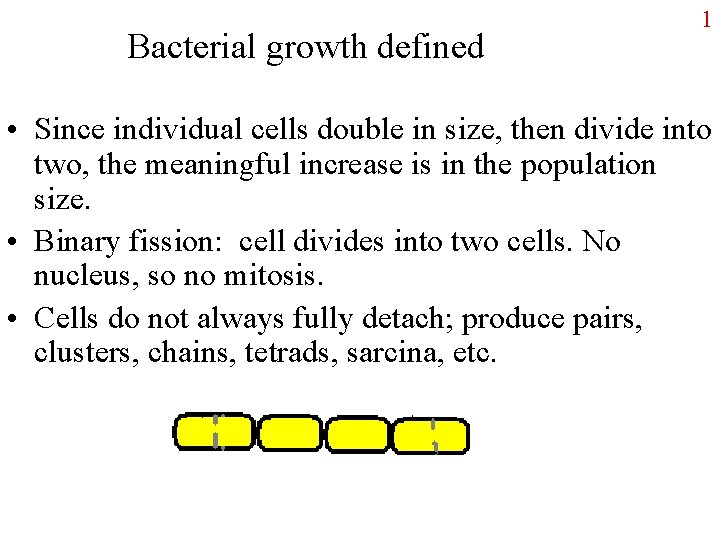
Bacterial growth defined 1 • Since individual cells double in size, then divide into two, the meaningful increase is in the population size. • Binary fission: cell divides into two cells. No nucleus, so no mitosis. • Cells do not always fully detach; produce pairs, clusters, chains, tetrads, sarcina, etc.
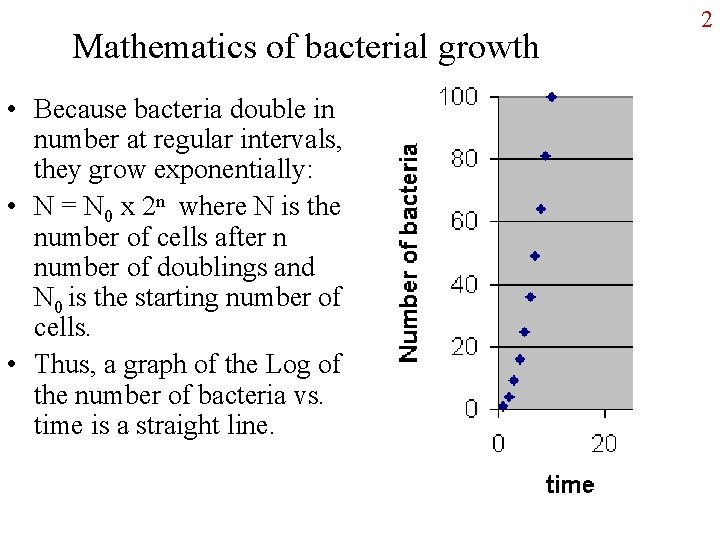
Mathematics of bacterial growth • Because bacteria double in number at regular intervals, they grow exponentially: • N = N 0 x 2 n where N is the number of cells after n number of doublings and N 0 is the starting number of cells. • Thus, a graph of the Log of the number of bacteria vs. time is a straight line. 2

The Bacterial Growth Curve • Bacteria provided with an abundant supply of nutrients will increase in number exponentially, but eventually run out of nutrients or poison themselves with waste products. 3 2 1 4 1. Lag phase 2. Exponential or Log phase 3. Stationary phase 4. Decline or Death phase. 3
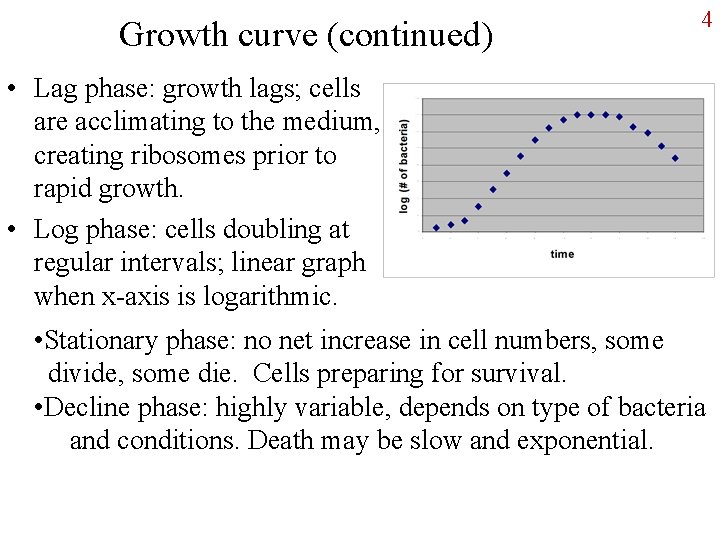
Growth curve (continued) 4 • Lag phase: growth lags; cells are acclimating to the medium, creating ribosomes prior to rapid growth. • Log phase: cells doubling at regular intervals; linear graph when x-axis is logarithmic. • Stationary phase: no net increase in cell numbers, some divide, some die. Cells preparing for survival. • Decline phase: highly variable, depends on type of bacteria and conditions. Death may be slow and exponential.
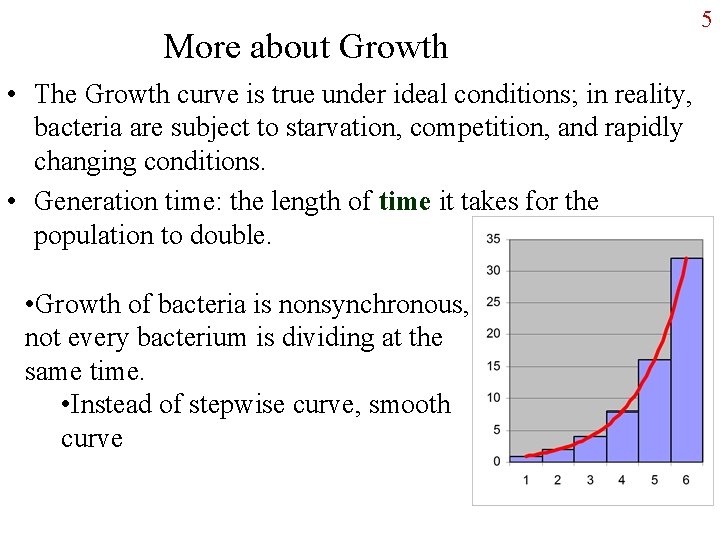
More about Growth • The Growth curve is true under ideal conditions; in reality, bacteria are subject to starvation, competition, and rapidly changing conditions. • Generation time: the length of time it takes for the population to double. • Growth of bacteria is nonsynchronous, not every bacterium is dividing at the same time. • Instead of stepwise curve, smooth curve 5

Measurement of growth • Direct methods: cells actually counted. – Petroff-Hausser counting chamber (right), 3 D grid. Count the cells, multiply by a conversion factor. – Dry a drop of cells of known volume, stain, then count. • Coulter-counter: singlefile cells detected by change in electric current. 6

Measurement of growth -2 7 • Viable plate count – Relies on bacteria being alive, multiplying and forming colonies. – Spread plate: sample is spread on surface of agar. – Pour plate: sample is mixed with melted agar; colonies form on surface and within agar. biology. clc. uc. edu/. . . /Meat_Milk/ Pour_Plate. htm
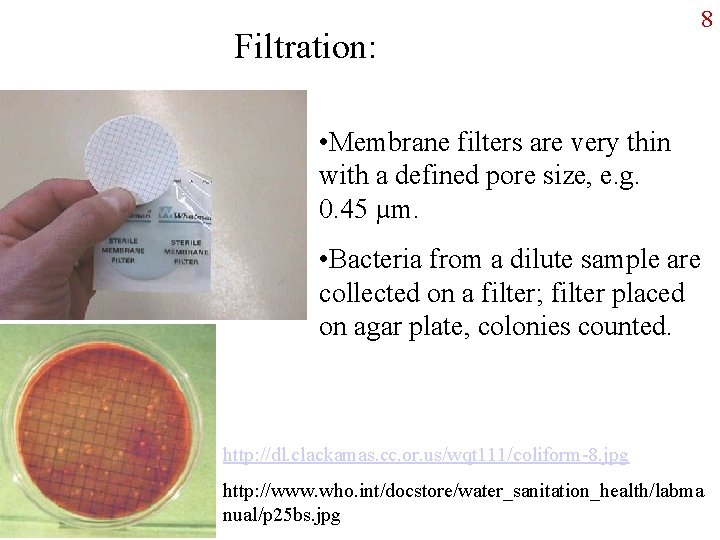
Filtration: 8 • Membrane filters are very thin with a defined pore size, e. g. 0. 45 µm. • Bacteria from a dilute sample are collected on a filter; filter placed on agar plate, colonies counted. http: //dl. clackamas. cc. or. us/wqt 111/coliform-8. jpg http: //www. who. int/docstore/water_sanitation_health/labma nual/p 25 bs. jpg
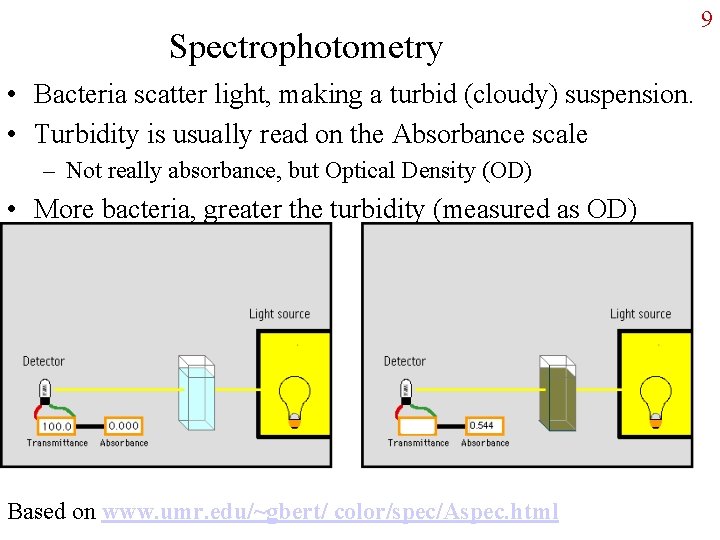
Spectrophotometry • Bacteria scatter light, making a turbid (cloudy) suspension. • Turbidity is usually read on the Absorbance scale – Not really absorbance, but Optical Density (OD) • More bacteria, greater the turbidity (measured as OD) Based on www. umr. edu/~gbert/ color/spec/Aspec. html 9

More about Spectrophotometry 10 – Does NOT provide an actual number unless a calibration curve (# of bacteria vs. O. D. ) is created. • Indirect counting method – Quick and convenient, shows relative change in the number of bacteria, useful for determining growth (increase in numbers). – Does NOT distinguish between live and dead cells. To create a calibration curve, best to plot OD vs. number of cells determined with microscope (not plate count).
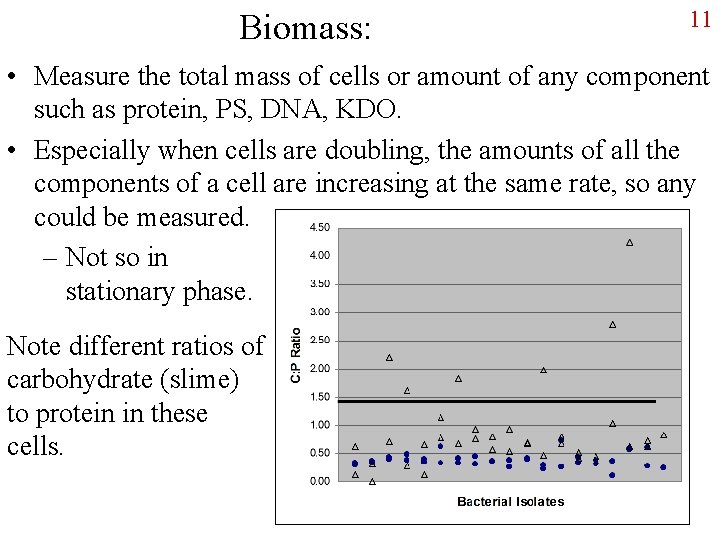
Biomass: 11 • Measure the total mass of cells or amount of any component such as protein, PS, DNA, KDO. • Especially when cells are doubling, the amounts of all the components of a cell are increasing at the same rate, so any could be measured. – Not so in stationary phase. Note different ratios of carbohydrate (slime) to protein in these cells.
- Slides: 11