
Bacterial Growth and Reproduction Reproduction Bacteria can reproduce
Bacterial Growth and Reproduction
Reproduction • Bacteria can reproduce using three methods: 1. Binary Fission 2. Conjugation 3. Spore Formation
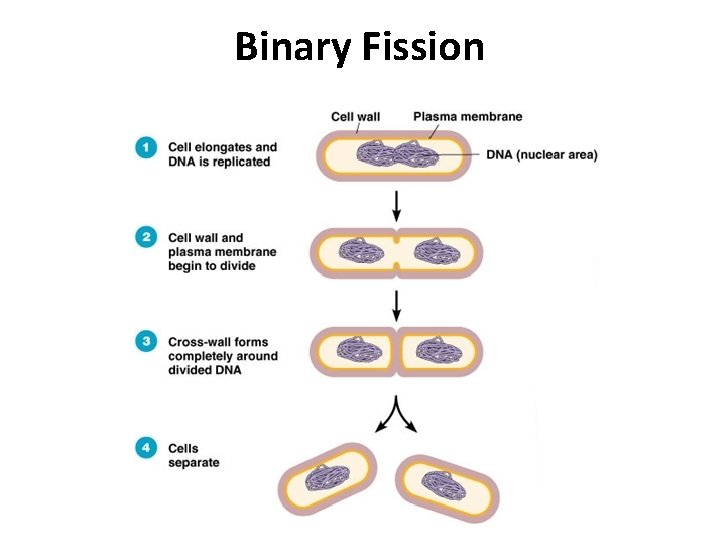
Binary Fission • A form of asexual reproduction • When a cell has almost doubled in size it will replicate its DNA and divide in half • This produces 2 identical daughter cells • Asexual reproduction does not invovle the exchange of genetic material
Binary Fission
Conjugation • Is a form of sexual reproduction • A long bridge of proteins forms between two bacterial cells • DNA is transferred from one cell (donor) to another (recipient) • Genetic Information is exchanged between individuals
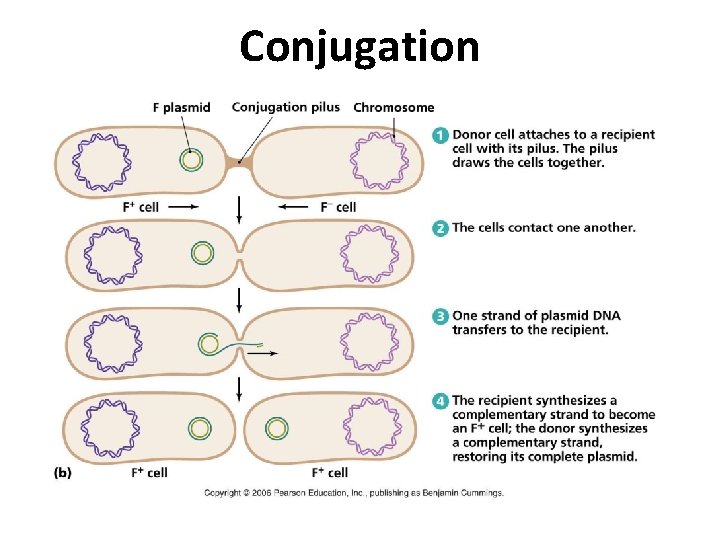
Conjugation
Spore Formation • Bacteria form spores during unfavorable conditions • One type is called an endospore – Cell forms a thick internal wall the encloses its DNA • Spores can remain dormant for months or even years until conditions improve • When conditions become favorable, the endospore will open, and the bacterium will grow again
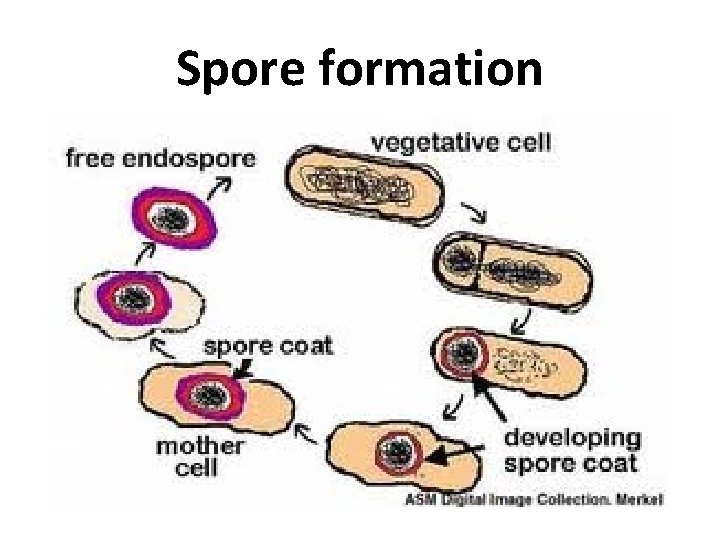
Spore formation
Generation time • Time required for one cell to produce two new cells. • Varies depending on the type of organism and environmental conditions. • Average 15 - 20 min. (varies - 10 minutes to 24 hrs. )
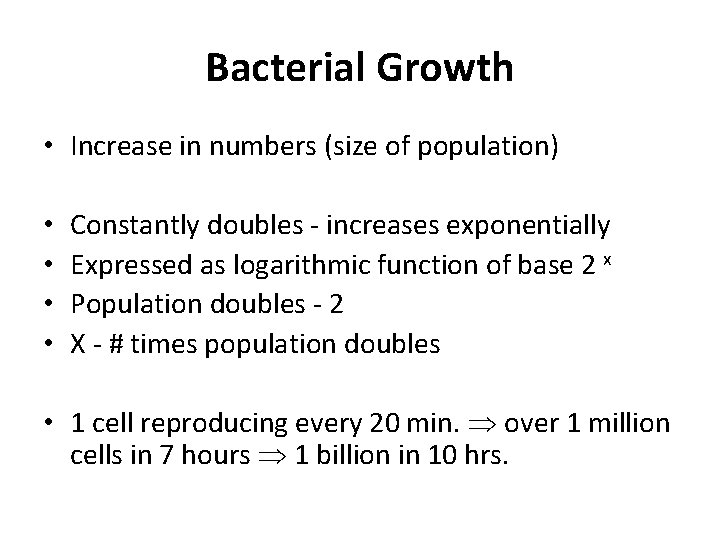
Bacterial Growth • Increase in numbers (size of population) • • Constantly doubles - increases exponentially Expressed as logarithmic function of base 2 x Population doubles - 2 X - # times population doubles • 1 cell reproducing every 20 min. over 1 million cells in 7 hours 1 billion in 10 hrs.
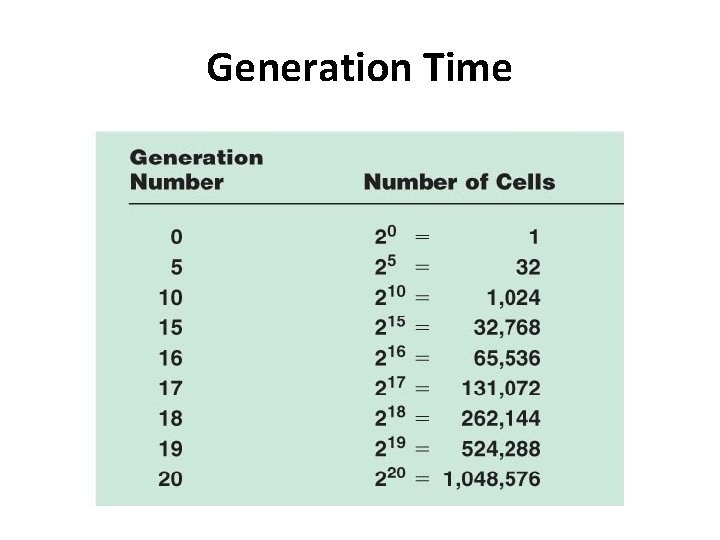
Generation Time
Factors Affecting Bacterial Growth 1. Temperature 3. Oxygen 2. Light 4. Ph (acidity) 3. Nutrients 5. Moisture
Temperature • All bacteria grow within temperature range (minimum maximum) • Most rapid reproduction occurs at the optimal temperature • Starting at minimum temp. growth slowly increases • Reaches maximum rate at optimum. • As temp. continues to rise growth rapidly decreases.
Bacteria can be divided into 3 groups according to their growth temperature Mesophiles - 20 C - 45 C (50 C) Ex. Environmental bacteria, pathogen Thermophiles - 45 C (50 ) - 80 C Extreme thermophiles - up to 110 C Ex. Hot springs, volcanoes in ocean, decomposers Psychrophiles - 0 C - 20 C Ex. Cold springs, lakes; polar regions; refrigerator.
Light (Radiation) • Very small group photosynthetic bacteria (cyanobacteria) - require UV light • Non-photosynthetic bacteria (eubacteria) UV light is lethal (causes mutations)
Oxygen • Bacteria can be divided into 3 groups based on requirement of gaseous oxygen: – Aerobes - require the presence of gaseous (molecular) oxygen – Anaerobes - require absence of gaseous oxygen (utilize O in oxygen containing compounds - chemical oxygen). – Facultative - either condition
Nutrients • Basic requirements for growth : C - building blocks of cell components N 2 - production of proteins, nucleic acids H 2 - occur in organic compounds O 2 - involved in the production of energy Minerals, Trace Elements - required in small amounts • Special metabolites ( growth factors ) Substances required for growth that the cell cannot produce using the basic requirements already listed. ( Ex. : vitamins, amino acids, carbohydrates, blood factors )
Two types of organisms based on source of nutrients • Autotrophs - utilize inorganic compounds ( C - CO 2, carbonates; N - NH 4, N 2, NO 3 ) • Heterotrophs - utilize organic compounds ( C - CHO, lipids; N - proteins )
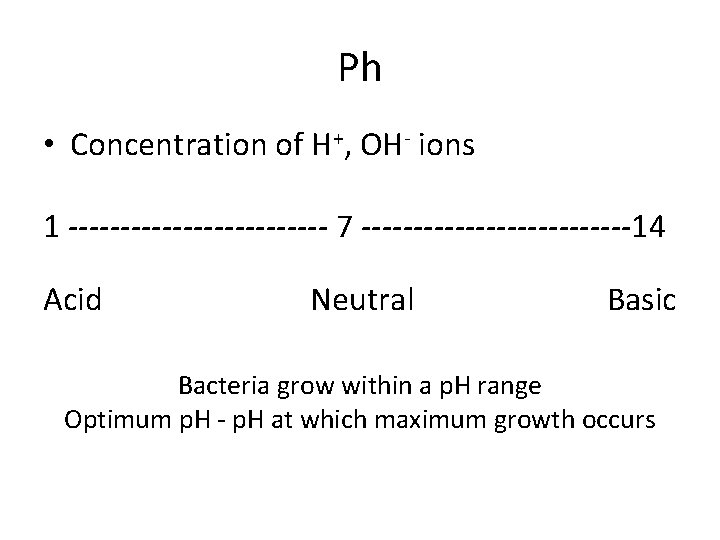
Ph • Concentration of H+, OH- ions 1 ------------- 7 -------------14 Acid Neutral Basic Bacteria grow within a p. H range Optimum p. H - p. H at which maximum growth occurs
Bacteria can be divided into three groups according to PH 1. Neutrophiles (5 -8) (optimal 7 -7. 2) 2. Acidophiles (0 -5) 3. Alkalinophiles (8 -12) (Soil Bacteria)
Moisture • All metabolically active bacteria require presence of water: – Cells largely water – Most nutrients, wastes soluble in water to cross cell membrane. – Site of metabolic reactions (cytoplasm)
- Slides: 21