
Bacterial endospores structure resistance and sporicidal testing JeanYves
Bacterial endospores: structure, resistance and sporicidal testing Jean-Yves Maillard Cardiff School of Pharmacy and Pharmaceutical Sciences Cardiff University
OVERVIEW Endospores & susceptibility to biocides Tests for sporicidal activity Impact of targeting endospores on formulation design Sporicides and surface applications 1 J-Y Maillard – WFHSS Lille 2015
ENDOSPORES AND SUSCEPTIBILITY TO BIOCIDES 2 J-Y Maillard – WFHSS Lille 2015
ENDOSPORES & SUSCEPTIBILITY TO BIOCIDES STERILISATION Low Level of susceptibility High 3 - prions SPORICIDES bacterial spores protozoal cysts mycobacteria naked viruses HLD vegetative Gram-negative fungi protozoa vegetative Gram-positive enveloped viruses J-Y Maillard – WFHSS Lille 2015

ENDOSPORES & SUSCEPTIBILITY TO BIOCIDES Leggett et al. J Appl Microbiol 2012; 113: 485 -98. EXOSPORIUM Degradation ? Persistence on surfaces SPORE CORE SPORE COATS Barrier to biocides INNER MEMBRANE Highly compressed Barrier to biocide Barrier to rehydration 4 Small Acid Soluble Proteins (SASPs) Protection of nucleic acid Low water content Protection of proteins CORTEX Barrier to biocides Physical pressure to inner membrane J-Y Maillard – WFHSS Lille 2015

ENDOSPORES & SUSCEPTIBILITY TO BIOCIDES EXOSPORIUM Oxidising agents SPORE CORE Hydrogen peroxide SPORE COATS Hypochlorites, chlorine dioxide, hydrogen peroxide, ozone, glutaraldehyde, ethylene oxide, iodine, chlorhexidine INNER MEMBRANE 5 CORTEX Alkali, hypochlorites, chlorine dioxide, ozone, glutaraldehyde, iodine chlorhexidine J-Y Maillard – WFHSS Lille 2015
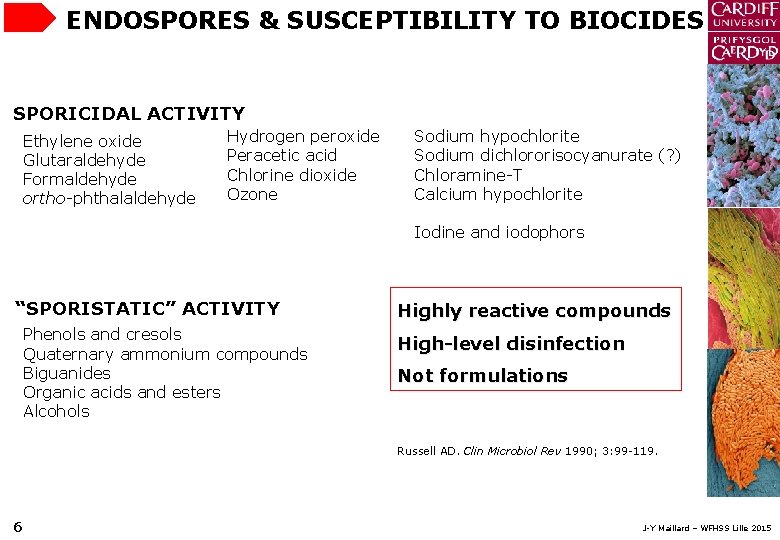
ENDOSPORES & SUSCEPTIBILITY TO BIOCIDES SPORICIDAL ACTIVITY Ethylene oxide Glutaraldehyde Formaldehyde ortho-phthalaldehyde Hydrogen peroxide Peracetic acid Chlorine dioxide Ozone Sodium hypochlorite Sodium dichlororisocyanurate (? ) Chloramine-T Calcium hypochlorite Iodine and iodophors “SPORISTATIC” ACTIVITY Phenols and cresols Quaternary ammonium compounds Biguanides Organic acids and esters Alcohols Highly reactive compounds High-level disinfection Not formulations Russell AD. Clin Microbiol Rev 1990; 3: 99 -119. 6 J-Y Maillard – WFHSS Lille 2015
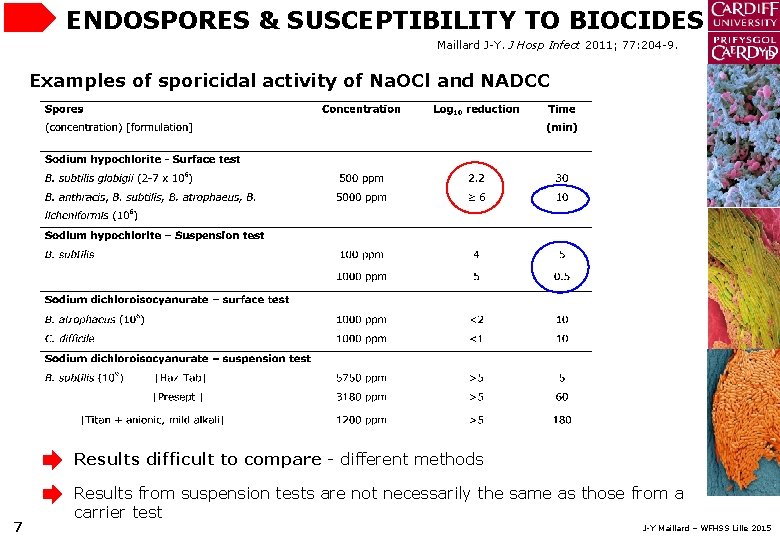
ENDOSPORES & SUSCEPTIBILITY TO BIOCIDES Maillard J-Y. J Hosp Infect 2011; 77: 204 -9. Examples of sporicidal activity of Na. OCl and NADCC Results difficult to compare - different methods 7 Results from suspension tests are not necessarily the same as those from a carrier test J-Y Maillard – WFHSS Lille 2015
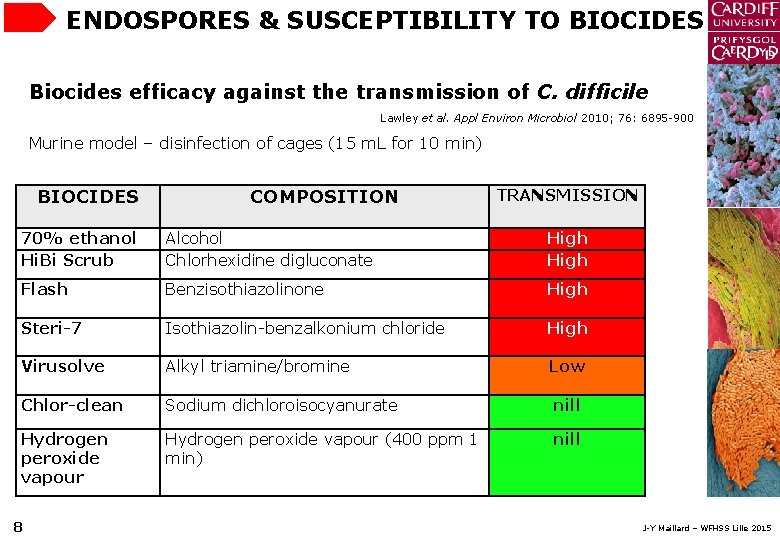
ENDOSPORES & SUSCEPTIBILITY TO BIOCIDES Biocides efficacy against the transmission of C. difficile Lawley et al. Appl Environ Microbiol 2010; 76: 6895 -900 Murine model – disinfection of cages (15 m. L for 10 min) BIOCIDES COMPOSITION TRANSMISSION 70% ethanol Hi. Bi Scrub Alcohol Chlorhexidine digluconate High Flash Benzisothiazolinone High Steri-7 Isothiazolin-benzalkonium chloride High Virusolve Alkyl triamine/bromine Low Chlor-clean Sodium dichloroisocyanurate nill Hydrogen peroxide vapour (400 ppm 1 min) nill 8 J-Y Maillard – WFHSS Lille 2015
TESTS FOR SPORICIDAL ACTIVITY 9 J-Y Maillard – WFHSS Lille 2015
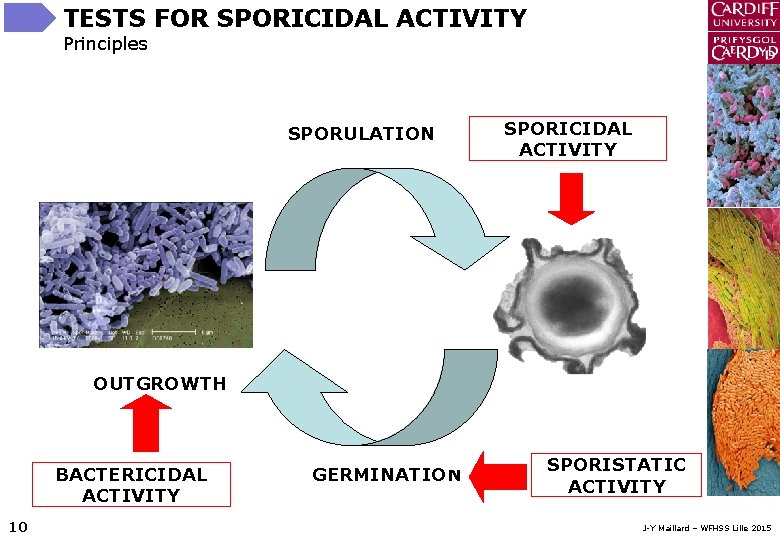
TESTS FOR SPORICIDAL ACTIVITY Principles SPORULATION SPORICIDAL ACTIVITY OUTGROWTH BACTERICIDAL ACTIVITY 10 GERMINATION SPORISTATIC ACTIVITY J-Y Maillard – WFHSS Lille 2015
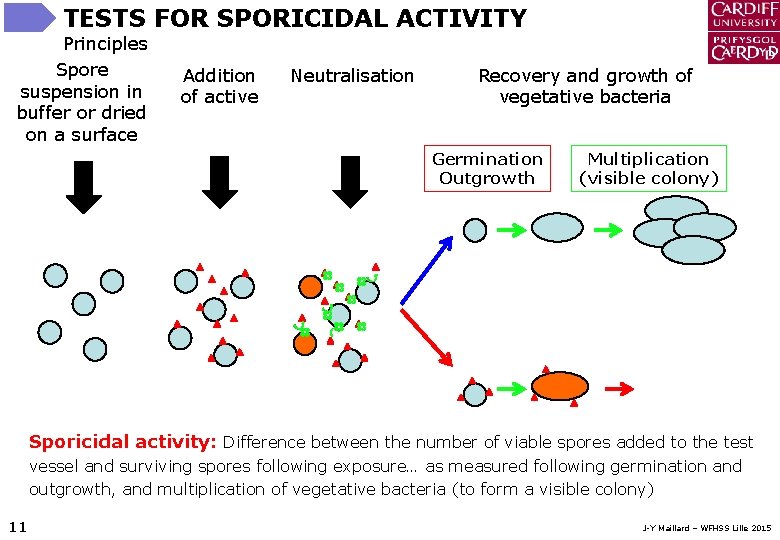
TESTS FOR SPORICIDAL ACTIVITY Principles Spore suspension in buffer or dried on a surface Addition of active Neutralisation Recovery and growth of vegetative bacteria Germination Outgrowth Multiplication (visible colony) Sporicidal activity: Difference between the number of viable spores added to the test vessel and surviving spores following exposure… as measured following germination and outgrowth, and multiplication of vegetative bacteria (to form a visible colony) 11 J-Y Maillard – WFHSS Lille 2015
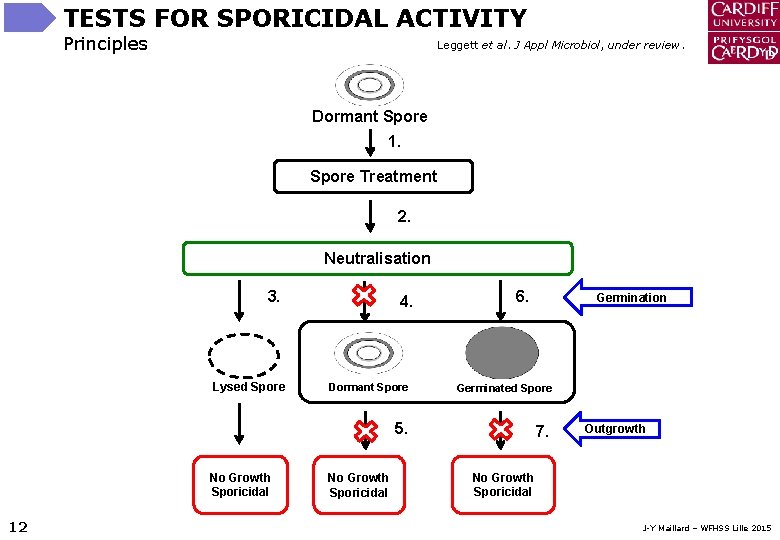
TESTS FOR SPORICIDAL ACTIVITY Principles Leggett et al. J Appl Microbiol, under review. Dormant Spore 1. Spore Treatment 2. Neutralisation 3. Lysed Spore No Growth Sporicidal 12 4. 6. Germination Dormant Spore Germinated Spore 5. 7. No Growth Sporicidal Outgrowth No Growth Sporicidal J-Y Maillard – WFHSS Lille 2015
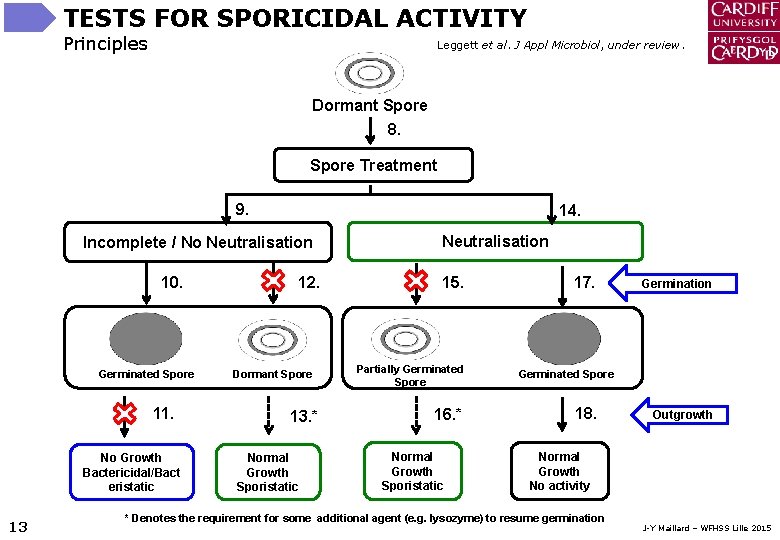
TESTS FOR SPORICIDAL ACTIVITY Principles Leggett et al. J Appl Microbiol, under review. Dormant Spore 8. Spore Treatment 9. 14. Incomplete / No Neutralisation 10. Germinated Spore 11. No Growth Bactericidal/Bact eristatic 13 12. Dormant Spore 13. * Normal Growth Sporistatic Neutralisation 15. Partially Germinated Spore 16. * Normal Growth Sporistatic 17. Germination Germinated Spore 18. Outgrowth Normal Growth No activity * Denotes the requirement for some additional agent (e. g. lysozyme) to resume germination J-Y Maillard – WFHSS Lille 2015
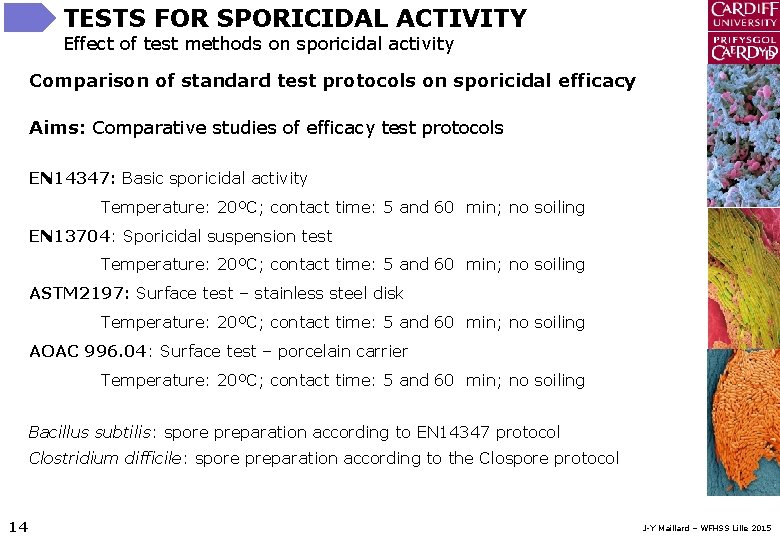
TESTS FOR SPORICIDAL ACTIVITY Effect of test methods on sporicidal activity Comparison of standard test protocols on sporicidal efficacy Aims: Comparative studies of efficacy test protocols EN 14347: Basic sporicidal activity Temperature: 20ºC; contact time: 5 and 60 min; no soiling EN 13704: Sporicidal suspension test Temperature: 20ºC; contact time: 5 and 60 min; no soiling ASTM 2197: Surface test – stainless steel disk Temperature: 20ºC; contact time: 5 and 60 min; no soiling AOAC 996. 04: Surface test – porcelain carrier Temperature: 20ºC; contact time: 5 and 60 min; no soiling Bacillus subtilis: spore preparation according to EN 14347 protocol Clostridium difficile: spore preparation according to the Clospore protocol 14 J-Y Maillard – WFHSS Lille 2015

TESTS FOR SPORICIDAL ACTIVITY Effect of test methods on sporicidal activity 5 min contact time Log 10 Reduction (± SD) BIOCIDES/PRODUCTS BS EN 14347 Clean condition C. diff B. sub Glutaraldehyde - 2% 0. 54 (0. 26) 1. 92 (0. 15) 0. 27 (0. 20) 0. 00 (0. 40) -0. 41 (0. 08) -0. 09 (0. 00) 0. 49 (0. 04) O. 18 (0. 03) Ortho-phthalaldehyde- 0. 55% 1. 73 (0. 27) 1. 77 (0. 05) 0. 65 (0. 25) -0. 09 (0. 34) 1. 76 (0. 74) 0. 02 (0. 00) 1. 66 (0. 09) -0. 01 (0. 02) Ortho-phthalaldehyde- 0. 65% 1. 19 (0. 29) 1. 93 (0. 32) 0. 73 (0. 28) -0. 22 (0. 37) 2. 35 (0. 74) 0. 16 (0. 00) 1. 77 (0. 72) 0. 02 (0. 04) Didecyldimehtyl ammonium chloride -1% 1. 16 (0. 35) 1. 87 (0. 29) 0. 11 (0. 11) -0. 24 (0. 29) 0. 11 (0. 15) -0. 04 (0. 00) 0. 05 (0. 13) 0. 13 (0. 05) Bis(aminopropyl)lauryla mine – 1% 0. 99 (0. 34) 1. 87 (0. 23) 0. 22 (0. 05) 0. 25 (0. 57) -0. 10 (0. 12) -0. 20 (0. 00) 1. 15 (0. 20) 0. 30 (0. 02) Amine -1% + quaternary ammonium- 1% 1. 05 (0. 66) 0. 48 (0. 09) 0. 15 (0. 05) 0. 63 (0. 15) 0. 40 (0. 60) -0. 20 (0. 00) 0. 06 (0. 23) 0. 31 (0. 05) Anoxy-Twin-1200 ppm >6. 16 (0. 25) >5. 96 (0. 17) > 6. 44 (0. 03) >4. 88 (0. 10) > 6. 18 (0. 07) 5. 05 (0. 08) 3. 65 (0. 00) >5. 17 (0. 77) >5. 31 (0. 02) TBC >6. 81 (0. 64) TBC 5. 05 (0. 08) 2. 15 (0. 00) 2. 12 (0. 11) 4. 01 (0. 16) >6. 16 (0. 25) 1. 36 (0. 06) >5. 96 (0. 17) 1. 36 (0. 14) 5. 05 (0. 08) 0. 95 (0. 00) >5. 83 (0. 00) 0. 38 (0. 03) Aniosept Activ – 2% Na. OCl 5000 ppm 15 BS EN 13704 AOAC 966. 04 ASTM E 2197 J-Y Maillard – WFHSS Lille 2015
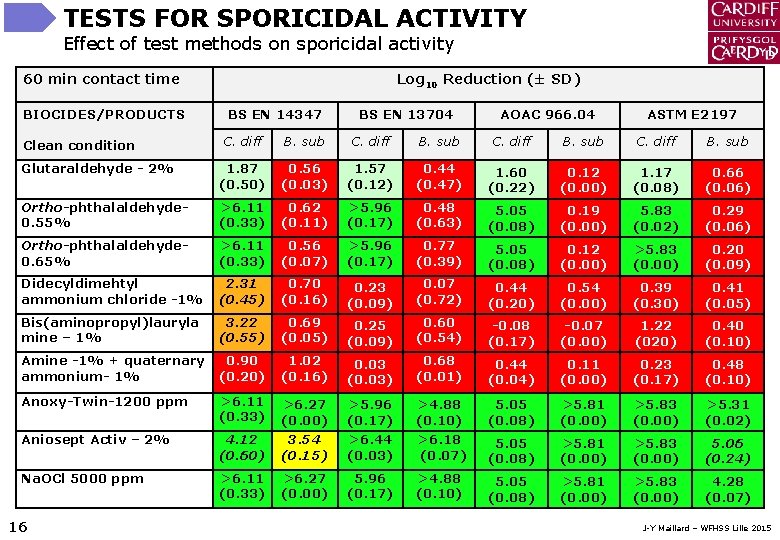
TESTS FOR SPORICIDAL ACTIVITY Effect of test methods on sporicidal activity 60 min contact time BIOCIDES/PRODUCTS Log 10 Reduction (± SD) BS EN 14347 BS EN 13704 AOAC 966. 04 ASTM E 2197 Clean condition C. diff B. sub Glutaraldehyde - 2% 1. 87 (0. 50) 0. 56 (0. 03) 1. 57 (0. 12) 0. 44 (0. 47) 1. 60 (0. 22) 0. 12 (0. 00) 1. 17 (0. 08) 0. 66 (0. 06) Ortho-phthalaldehyde- 0. 55% >6. 11 0. 62 (0. 33) (0. 11) >5. 96 (0. 17) 0. 48 (0. 63) 5. 05 (0. 08) 0. 19 (0. 00) 5. 83 (0. 02) 0. 29 (0. 06) Ortho-phthalaldehyde- 0. 65% >6. 11 0. 56 (0. 33) (0. 07) >5. 96 (0. 17) 0. 77 (0. 39) 5. 05 (0. 08) 0. 12 (0. 00) >5. 83 (0. 00) 0. 20 (0. 09) Didecyldimehtyl ammonium chloride -1% 2. 31 (0. 45) 0. 70 (0. 16) 0. 23 (0. 09) 0. 07 (0. 72) 0. 44 (0. 20) 0. 54 (0. 00) 0. 39 (0. 30) 0. 41 (0. 05) Bis(aminopropyl)lauryla mine – 1% 3. 22 (0. 55) 0. 69 (0. 05) 0. 25 (0. 09) 0. 60 (0. 54) -0. 08 (0. 17) -0. 07 (0. 00) 1. 22 (020) 0. 40 (0. 10) Amine -1% + quaternary 0. 90 ammonium- 1% (0. 20) 1. 02 (0. 16) 0. 03 (0. 03) 0. 68 (0. 01) 0. 44 (0. 04) 0. 11 (0. 00) 0. 23 (0. 17) 0. 48 (0. 10) >6. 11 >6. 27 (0. 33) (0. 00) 4. 12 3. 54 (0. 60) (0. 15) >5. 96 (0. 17) >6. 44 (0. 03) >4. 88 (0. 10) >6. 18 (0. 07) 5. 05 (0. 08) >5. 81 (0. 00) >5. 83 (0. 00) >5. 31 (0. 02) 5. 05 (0. 08) >5. 81 (0. 00) >5. 83 (0. 00) 5. 06 (0. 24) >6. 11 >6. 27 (0. 33) (0. 00) 5. 96 (0. 17) >4. 88 (0. 10) 5. 05 (0. 08) >5. 81 (0. 00) >5. 83 (0. 00) 4. 28 (0. 07) Anoxy-Twin-1200 ppm Aniosept Activ – 2% Na. OCl 5000 ppm 16 J-Y Maillard – WFHSS Lille 2015
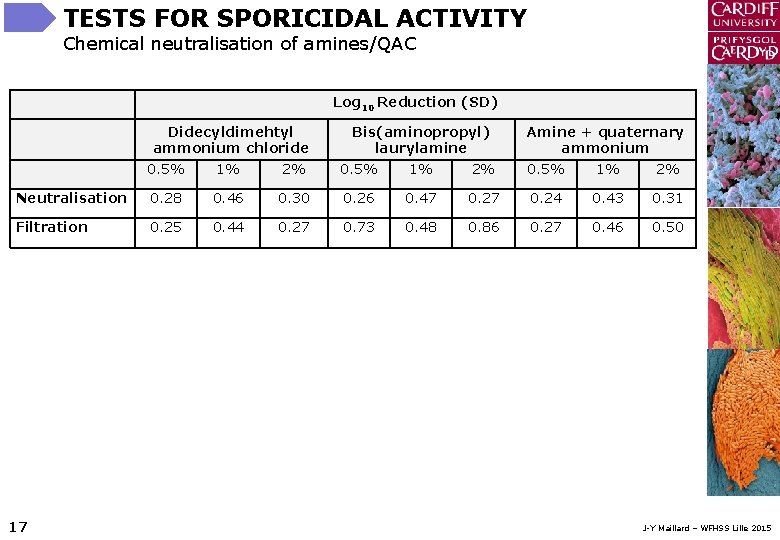
TESTS FOR SPORICIDAL ACTIVITY Chemical neutralisation of amines/QAC Log 10 Reduction (SD) Didecyldimehtyl ammonium chloride 0. 5% 1% 2% Bis(aminopropyl) laurylamine 0. 5% 1% 2% Amine + quaternary ammonium 0. 5% 1% 2% Neutralisation 0. 28 0. 46 0. 30 0. 26 0. 47 0. 24 0. 43 0. 31 Filtration 0. 25 0. 44 0. 27 0. 73 0. 48 0. 86 0. 27 0. 46 0. 50 17 J-Y Maillard – WFHSS Lille 2015
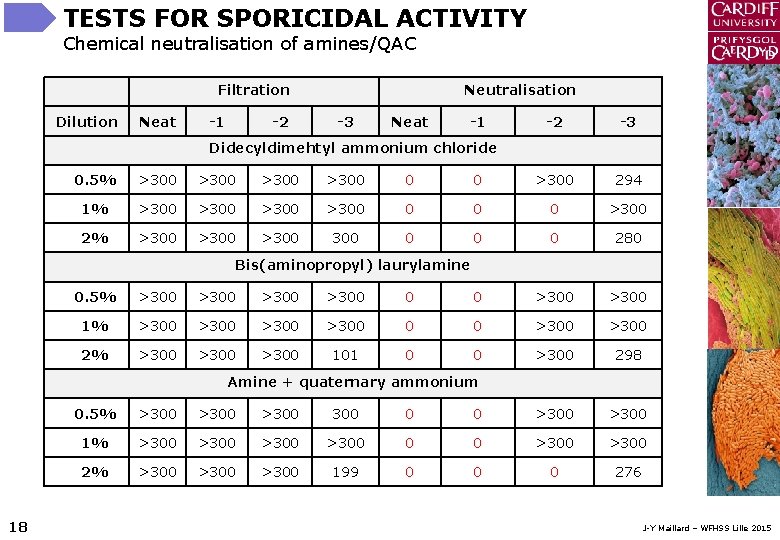
TESTS FOR SPORICIDAL ACTIVITY Chemical neutralisation of amines/QAC Filtration Dilution Neat -1 -2 Neutralisation -3 Neat -1 -2 -3 Didecyldimehtyl ammonium chloride 0. 5% >300 0 0 >300 294 1% >300 0 0 0 >300 2% >300 0 0 0 280 Bis(aminopropyl) laurylamine 0. 5% >300 0 0 >300 1% >300 0 0 >300 2% >300 101 0 0 >300 298 Amine + quaternary ammonium 18 0. 5% >300 0 0 >300 1% >300 0 0 >300 2% >300 199 0 0 0 276 J-Y Maillard – WFHSS Lille 2015
IMPACT OF TARGETING ENDOSPORES ON FORMULATION DESIGN 19 J-Y Maillard – WFHSS Lille 2015
ENDOSPORES AND FORMULATION DESIGN Considerations about a product FACTORS INHERENT TO THE BIOCIDE Concentration exponent (η) Formulation Including p. H, surfactants, ion chelators etc. Ingredients (compatibility) Improving penetration -Spore coats/cortex – surfactants/wetting agents? Triggering germination -Germinants – correct combination -Targeting cortex – enzymes? Enhancing spore mechanical removal from surfaces -Exosporium? –surfactants/ wetting agents -Aggregates 20 J-Y Maillard – WFHSS Lille 2015
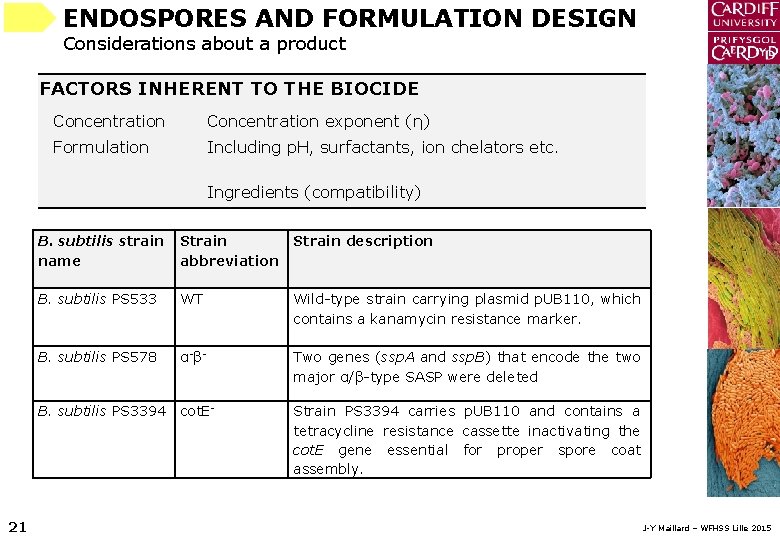
ENDOSPORES AND FORMULATION DESIGN Considerations about a product FACTORS INHERENT TO THE BIOCIDE Concentration exponent (η) Formulation Including p. H, surfactants, ion chelators etc. Ingredients (compatibility) 21 B. subtilis strain Strain name abbreviation Strain description B. subtilis PS 533 WT Wild-type strain carrying plasmid p. UB 110, which contains a kanamycin resistance marker. B. subtilis PS 578 α- β - Two genes (ssp. A and ssp. B) that encode the two major α/β-type SASP were deleted B. subtilis PS 3394 cot. E- Strain PS 3394 carries p. UB 110 and contains a tetracycline resistance cassette inactivating the cot. E gene essential for proper spore coat assembly. J-Y Maillard – WFHSS Lille 2015
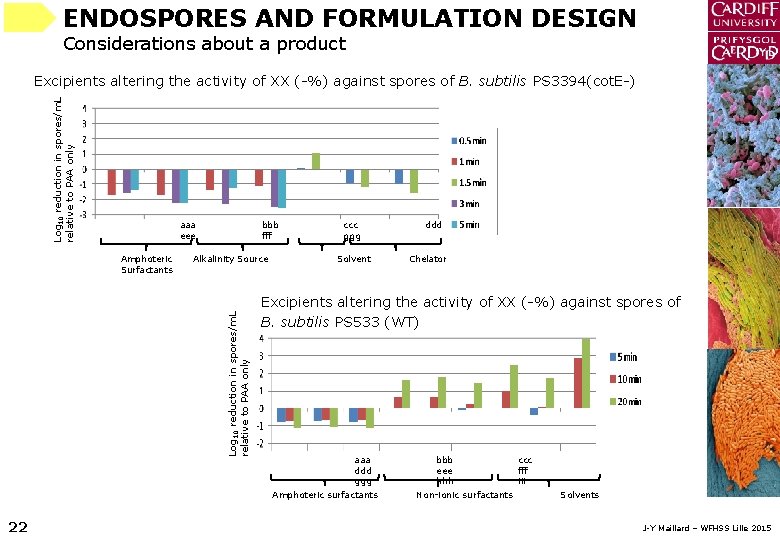
ENDOSPORES AND FORMULATION DESIGN Considerations about a product Log 10 reduction in spores/m. L relative to PAA only Excipients altering the activity of XX (-%) against spores of B. subtilis PS 3394(cot. E-) aaa eee Alkalinity Source Log 10 reduction in spores/m. L relative to PAA only Amphoteric Surfactants bbb fff ccc ggg Solvent Chelator Excipients altering the activity of XX (-%) against spores of B. subtilis PS 533 (WT) aaa ddd ggg Amphoteric surfactants 22 ddd bbb eee hhh Non-ionic surfactants ccc fff iii Solvents J-Y Maillard – WFHSS Lille 2015
ENDOSPORES AND FORMULATION DESIGN Considerations about a product FACTORS INHERENT TO THE APPLICATION Contact time Temperature Q 10 Soiling Relative humidity Gaseous biocides, antimicrobial surfaces, wipes Surface type Permeability, nature etc. Applicator Delivery of the sporicide(s); wipe, spray, liquid Applications: Does my efficacy test reflect how the sporicide is delivered? - Compatibility of the materials/vessels/containers with the active - Effect of the applicator of target microorganisms (spores) Require a realistic test protocol to enable the comparison of different formulation/applicator combinations 23 J-Y Maillard – WFHSS Lille 2015
SPORICIDES & SURFACE APPLICATIONS 24 J-Y Maillard – WFHSS Lille 2015
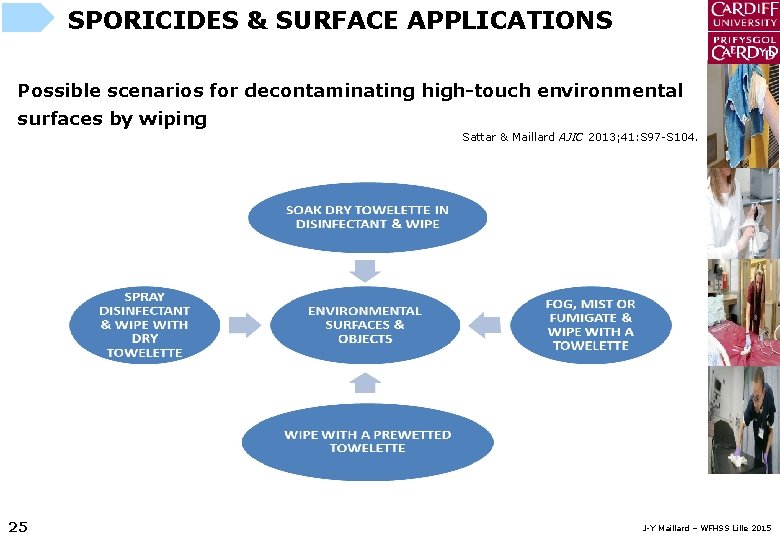
SPORICIDES & SURFACE APPLICATIONS Possible scenarios for decontaminating high-touch environmental surfaces by wiping Sattar & Maillard AJIC 2013; 41: S 97 -S 104. 25 J-Y Maillard – WFHSS Lille 2015
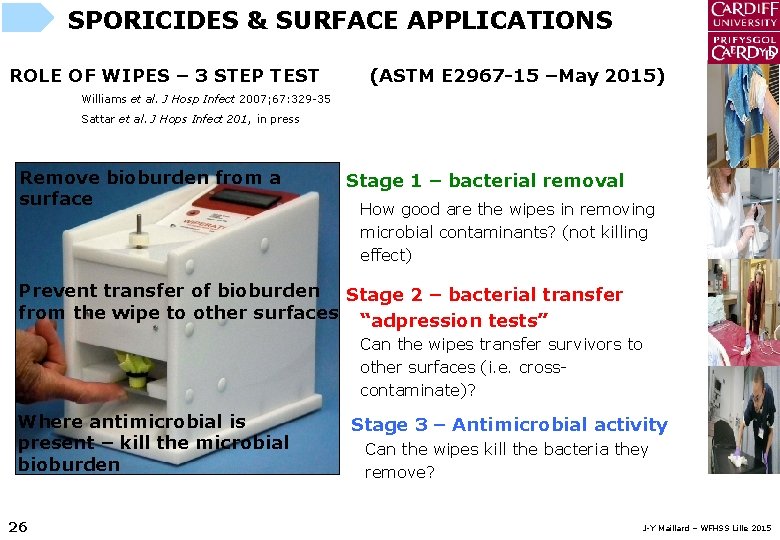
SPORICIDES & SURFACE APPLICATIONS ROLE OF WIPES – 3 STEP TEST (ASTM E 2967 -15 –May 2015) Williams et al. J Hosp Infect 2007; 67: 329 -35 Sattar et al. J Hops Infect 201, in press Remove bioburden from a surface Stage 1 – bacterial removal How good are the wipes in removing microbial contaminants? (not killing effect) Prevent transfer of bioburden Stage 2 – bacterial transfer from the wipe to other surfaces “adpression tests” Can the wipes transfer survivors to other surfaces (i. e. crosscontaminate)? Where antimicrobial is present – kill the microbial bioburden 26 Stage 3 – Antimicrobial activity Can the wipes kill the bacteria they remove? J-Y Maillard – WFHSS Lille 2015
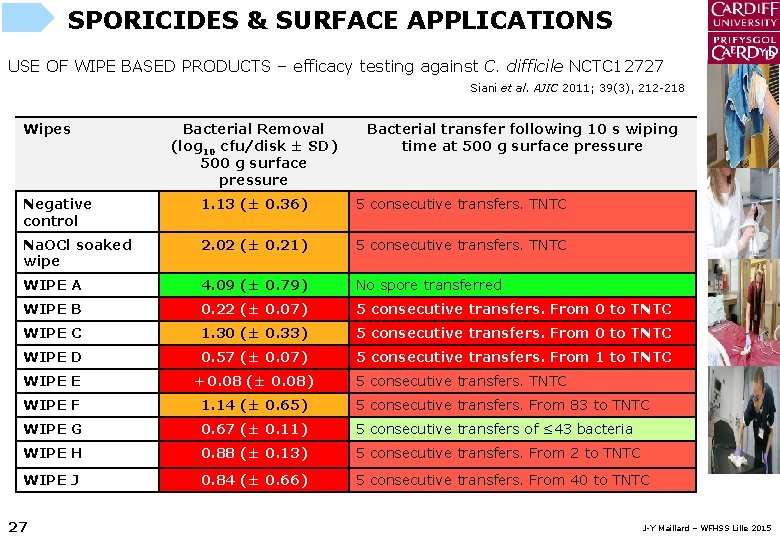
SPORICIDES & SURFACE APPLICATIONS USE OF WIPE BASED PRODUCTS – efficacy testing against C. difficile NCTC 12727 Siani et al. AJIC 2011; 39(3), 212 -218 Wipes Bacterial Removal (log 10 cfu/disk ± SD) 500 g surface pressure Bacterial transfer following 10 s wiping time at 500 g surface pressure Negative control 1. 13 (± 0. 36) 5 consecutive transfers. TNTC Na. OCl soaked wipe 2. 02 (± 0. 21) 5 consecutive transfers. TNTC WIPE A 4. 09 (± 0. 79) No spore transferred WIPE B 0. 22 (± 0. 07) 5 consecutive transfers. From 0 to TNTC WIPE C 1. 30 (± 0. 33) 5 consecutive transfers. From 0 to TNTC WIPE D 0. 57 (± 0. 07) 5 consecutive transfers. From 1 to TNTC WIPE E +0. 08 (± 0. 08) WIPE F 1. 14 (± 0. 65) 5 consecutive transfers. From 83 to TNTC WIPE G 0. 67 (± 0. 11) 5 consecutive transfers of ≤ 43 bacteria WIPE H 0. 88 (± 0. 13) 5 consecutive transfers. From 2 to TNTC WIPE J 0. 84 (± 0. 66) 5 consecutive transfers. From 40 to TNTC 27 5 consecutive transfers. TNTC J-Y Maillard – WFHSS Lille 2015
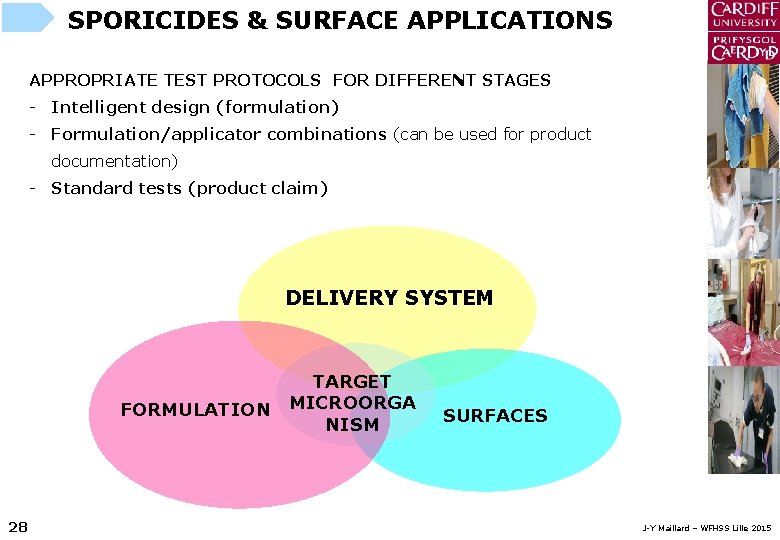
SPORICIDES & SURFACE APPLICATIONS APPROPRIATE TEST PROTOCOLS FOR DIFFERENT STAGES - Intelligent design (formulation) - Formulation/applicator combinations (can be used for product documentation) - Standard tests (product claim) DELIVERY SYSTEM TARGET FORMULATION MICROORGA NISM 28 SURFACES J-Y Maillard – WFHSS Lille 2015
THANK YOU 29 J-Y Maillard – WFHSS Lille 2015
- Slides: 30