
Bacterial Diversity v Objective w To be able
Bacterial Diversity v Objective w To be able to describe the main features of bacterial cells and to understand the different nutritional and metabolic types. v References w Gray N. F. Biology of Wastewater Treatment w Madigan M. T. , Martinko J. M. , Parker J. Brock - Biology of Microorganisms w Stanier R. Y. General Microbiology v Lecture Outline w Bacterial Cell Structure w Characteristics of Bacteria
Introduction v What are they? w Prokaryotic organisms w Bacteria (eubacteria), Archaea (archaebacteria) v Importance in Environmental Engineering w Biodegradation w Nutrient Cycling w Pathogens in Contaminated Waters
Cell Structure v Size w smallest living organisms, 1 m. v Shape w typically cocci or rods (bacilli), spiral, stalked, filamentous. w multicellular swarms (gliding myxobacteria, myxococcus) v DNA w single strand, supercoiled, no nuclear membrane. w Extranuclear DNA or Plasmids. v Reproduction w Asexual = Binary fission, Conjugation via Pili.
Cell Structure v Cell Wall w Two types, Gram Positive, Gram Negative w Both have Peptidoglycan w Gram Negatives also have Lipopolysaccharide (LPS) v Archaea w similar to G+ve, have pseudopeptidoglycan
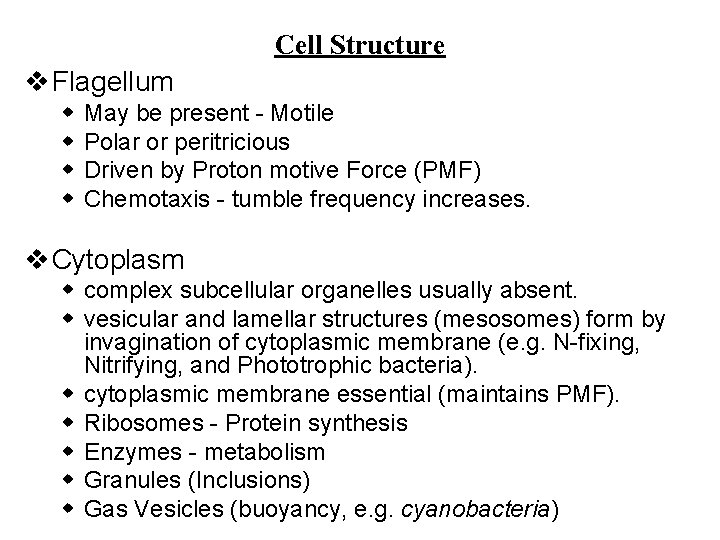
Cell Structure v Flagellum w w May be present - Motile Polar or peritricious Driven by Proton motive Force (PMF) Chemotaxis - tumble frequency increases. v Cytoplasm w complex subcellular organelles usually absent. w vesicular and lamellar structures (mesosomes) form by invagination of cytoplasmic membrane (e. g. N-fixing, Nitrifying, and Phototrophic bacteria). w cytoplasmic membrane essential (maintains PMF). w Ribosomes - Protein synthesis w Enzymes - metabolism w Granules (Inclusions) w Gas Vesicles (buoyancy, e. g. cyanobacteria)
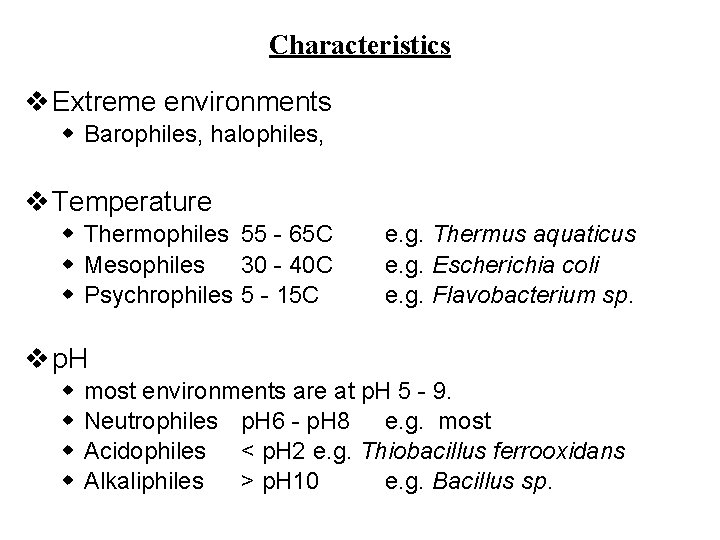
Characteristics v Extreme environments w Barophiles, halophiles, v Temperature w Thermophiles 55 - 65 C w Mesophiles 30 - 40 C w Psychrophiles 5 - 15 C e. g. Thermus aquaticus e. g. Escherichia coli e. g. Flavobacterium sp. v p. H w w most environments are at p. H 5 - 9. Neutrophiles p. H 6 - p. H 8 e. g. most Acidophiles < p. H 2 e. g. Thiobacillus ferrooxidans Alkaliphiles > p. H 10 e. g. Bacillus sp.

Characteristics v Oxygen Requirements w w Aerobic Microaerophilic Facultative (aerobe) Anaerobic (strict) v Growth Requirements - Organic substrates w Heterotrophic (Chemoorganotrophs) – Pseudomonas, Bacillus, Zoogloea, etc. w Key role in Nutrient Cycling w Biodegradation of Organic Detritus w Soluble low molecular weight substrates e. g. acetate, methanol, sugars. w Polymers degraded by extracellular hydrolytic Enzymes.
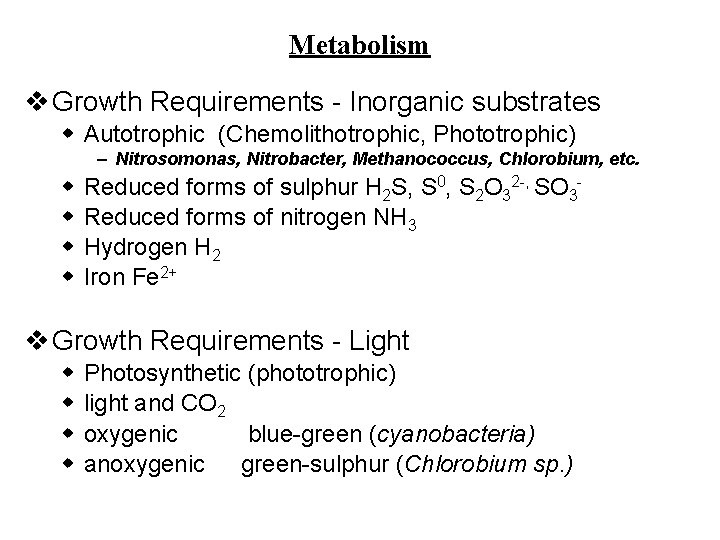
Metabolism v Growth Requirements - Inorganic substrates w Autotrophic (Chemolithotrophic, Phototrophic) – Nitrosomonas, Nitrobacter, Methanococcus, Chlorobium, etc. w w Reduced forms of sulphur H 2 S, S 0, S 2 O 32 -, SO 3 Reduced forms of nitrogen NH 3 Hydrogen H 2 Iron Fe 2+ v Growth Requirements - Light w w Photosynthetic (phototrophic) light and CO 2 oxygenic blue-green (cyanobacteria) anoxygenic green-sulphur (Chlorobium sp. )
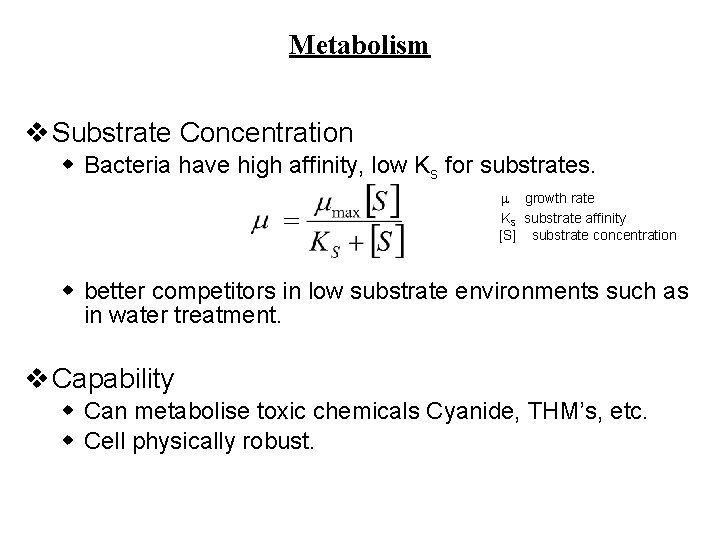
Metabolism v Substrate Concentration w Bacteria have high affinity, low Ks for substrates. growth rate KS substrate affinity [S] substrate concentration w better competitors in low substrate environments such as in water treatment. v Capability w Can metabolise toxic chemicals Cyanide, THM’s, etc. w Cell physically robust.
- Slides: 9