
Bacterial Cell Surface Charge Attachment and Decontamination on
Bacterial Cell Surface Charge, Attachment and Decontamination on Melon Rind Surfaces Eastern Regional Research Center Dike O. Ukuku Ph. D. FSIT-ERRC-ARS-USDA Wyndmoor, PA 19038
Background Information ¨ Ability of pathogenic bacteria to adhere to surfaces of fruits and vegetables continue to be a potential food safety problem for the produce industry and consumers alike ¨ Fruits and vegetables are frequently in contact with soil, insects, animals, and humans during growing, harvesting, and in the processing plant ¨ Presence of human bacterial pathogens in fresh produce and outbreaks of diseases has led to costly recalls 2
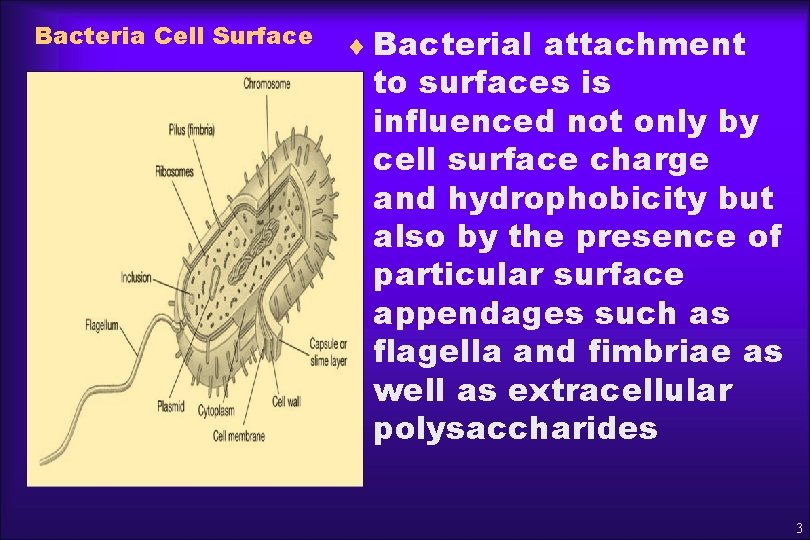
Bacteria Cell Surface ¨ Bacterial attachment to surfaces is influenced not only by cell surface charge and hydrophobicity but also by the presence of particular surface appendages such as flagella and fimbriae as well as extracellular polysaccharides 3
¨ Bacteria surfaces are heterogeneous with physicochemical properties determined primarily by teichoic acid (gram-positive strains) or other polysaccharides (gramnegative strains) along with proteinaceous appendages (fimbriae) ¨ Surface structure and biochemical characteristics of bacteria and of a substratum as, in this case, melon play a major role on how and where bacteria may attach 4
¨ Plant surfaces and microbes both have negative surface potential, which results in electrostatic repulsion between the two surfaces ¨ Most bacteria are readily suspended in aqueous media because of polar, hydrophilic moieties on bacterial cell surfaces (Mafu et al. 1991) ¨ Bacterial cell surface properties can only be measured indirectly, through phenomena that reflect more or less the nature of molecular interactions (Mozes and Rouxhet, 1987) 5
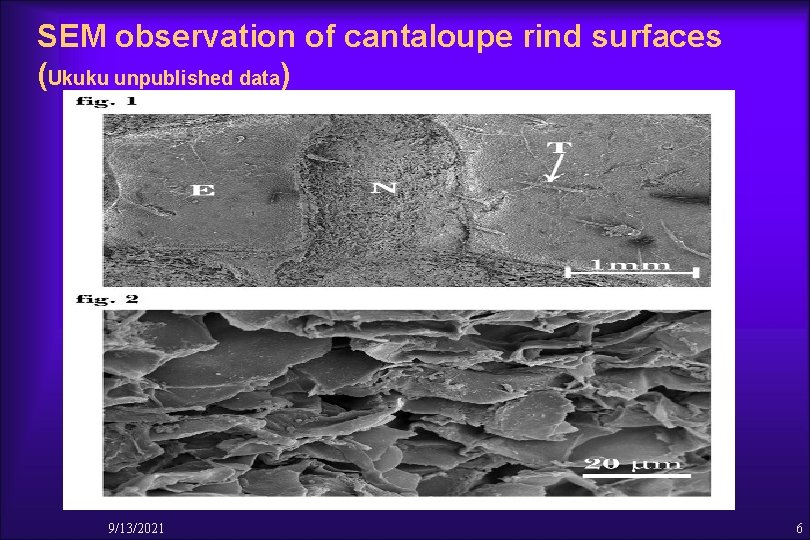
SEM observation of cantaloupe rind surfaces (Ukuku unpublished data) 9/13/2021 6
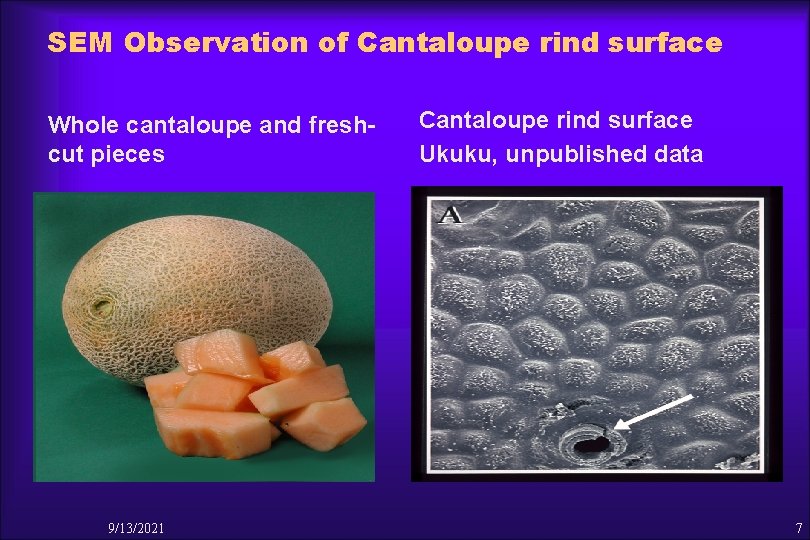
SEM Observation of Cantaloupe rind surface Whole cantaloupe and freshcut pieces 9/13/2021 Cantaloupe rind surface Ukuku, unpublished data 7
¨ There are several techniques used for measuring bacterial cell surface charge The most widely used techniques are: ¨ Hydrophobic interaction chromatography (HIC) ¨ Electrostatic interaction chromatography (ESIC) 8
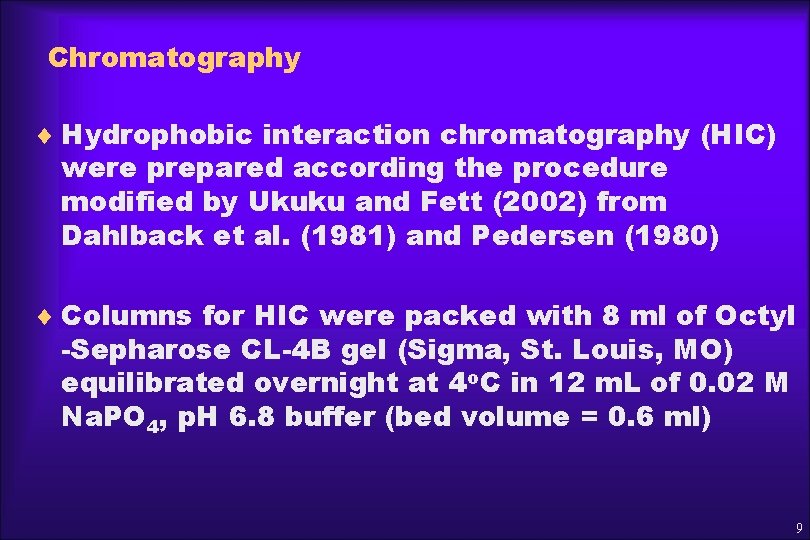
Chromatography ¨ Hydrophobic interaction chromatography (HIC) were prepared according the procedure modified by Ukuku and Fett (2002) from Dahlback et al. (1981) and Pedersen (1980) ¨ Columns for HIC were packed with 8 ml of Octyl -Sepharose CL-4 B gel (Sigma, St. Louis, MO) equilibrated overnight at 4 o. C in 12 m. L of 0. 02 M Na. PO 4, p. H 6. 8 buffer (bed volume = 0. 6 ml) 9
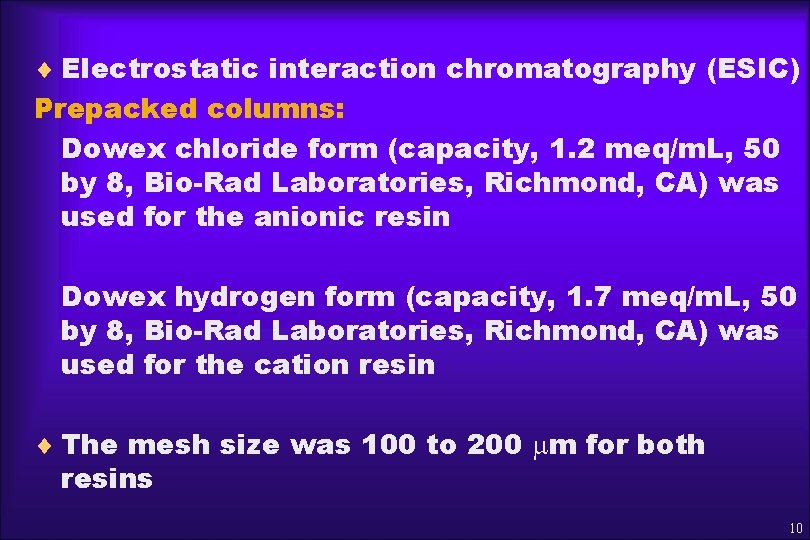
¨ Electrostatic interaction chromatography (ESIC) Prepacked columns: Dowex chloride form (capacity, 1. 2 meq/m. L, 50 by 8, Bio-Rad Laboratories, Richmond, CA) was used for the anionic resin Dowex hydrogen form (capacity, 1. 7 meq/m. L, 50 by 8, Bio-Rad Laboratories, Richmond, CA) was used for the cation resin ¨ The mesh size was 100 to 200 m for both resins 10
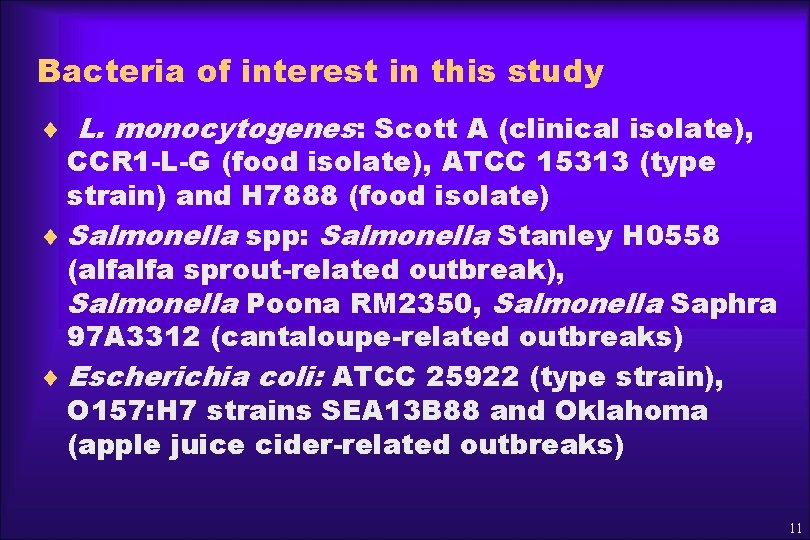
Bacteria of interest in this study ¨ L. monocytogenes: Scott A (clinical isolate), CCR 1 -L-G (food isolate), ATCC 15313 (type strain) and H 7888 (food isolate) ¨ Salmonella spp: Salmonella Stanley H 0558 (alfalfa sprout-related outbreak), Salmonella Poona RM 2350, Salmonella Saphra 97 A 3312 (cantaloupe-related outbreaks) ¨ Escherichia coli: ATCC 25922 (type strain), O 157: H 7 strains SEA 13 B 88 and Oklahoma (apple juice cider-related outbreaks) 11
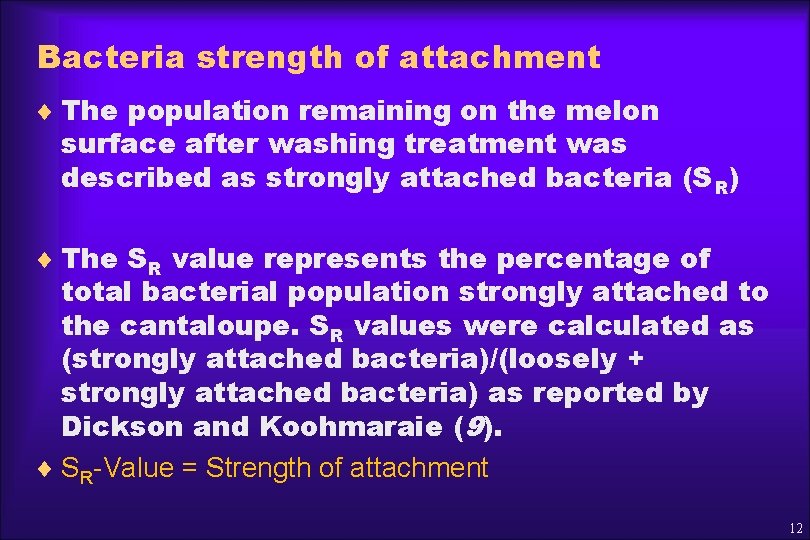
Bacteria strength of attachment ¨ The population remaining on the melon surface after washing treatment was described as strongly attached bacteria (S R) ¨ The SR value represents the percentage of total bacterial population strongly attached to the cantaloupe. SR values were calculated as (strongly attached bacteria)/(loosely + strongly attached bacteria) as reported by Dickson and Koohmaraie (9). ¨ SR-Value = Strength of attachment 12
RESULTS ¨ Table 1 - Bacterial cell surface hydrophobicity (HIC) and charge (ESIC) ¨ Table 2 - Bacterial attachment on melon surfaces in relation to SR-Value at day 0 13
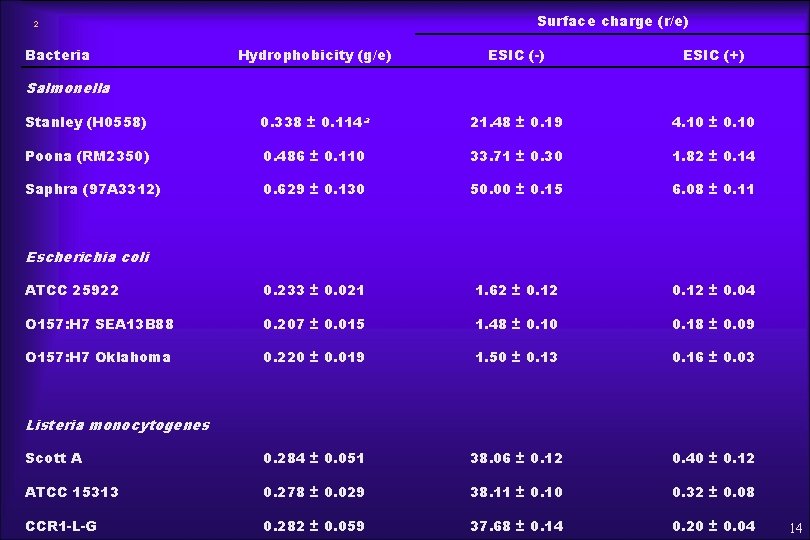
Surface charge (r/e) 2 Bacteria Hydrophobicity (g/e) ESIC (-) ESIC (+) Stanley (H 0558) 0. 338 ± 0. 114 a 21. 48 ± 0. 19 4. 10 ± 0. 10 Poona (RM 2350) 0. 486 ± 0. 110 33. 71 ± 0. 30 1. 82 ± 0. 14 Saphra (97 A 3312) 0. 629 ± 0. 130 50. 00 ± 0. 15 6. 08 ± 0. 11 ATCC 25922 0. 233 ± 0. 021 1. 62 ± 0. 12 ± 0. 04 O 157: H 7 SEA 13 B 88 0. 207 ± 0. 015 1. 48 ± 0. 10 0. 18 ± 0. 09 O 157: H 7 Oklahoma 0. 220 ± 0. 019 1. 50 ± 0. 13 0. 16 ± 0. 03 Scott A 0. 284 ± 0. 051 38. 06 ± 0. 12 0. 40 ± 0. 12 ATCC 15313 0. 278 ± 0. 029 38. 11 ± 0. 10 0. 32 ± 0. 08 CCR 1 -L-G 0. 282 ± 0. 059 37. 68 ± 0. 14 0. 20 ± 0. 04 Salmonella Escherichia coli Listeria monocytogenes 14
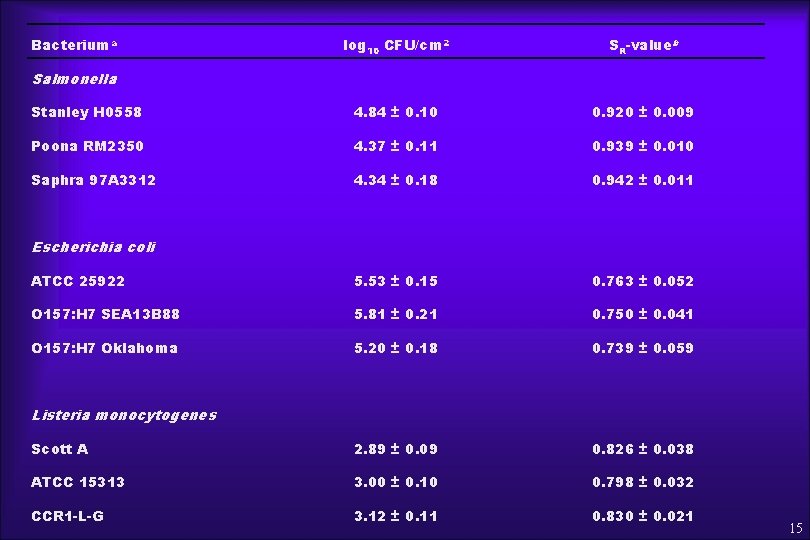
Bacteriuma log 10 CFU/cm 2 SR-valueb Stanley H 0558 4. 84 ± 0. 10 0. 920 ± 0. 009 Poona RM 2350 4. 37 ± 0. 11 0. 939 ± 0. 010 Saphra 97 A 3312 4. 34 ± 0. 18 0. 942 ± 0. 011 ATCC 25922 5. 53 ± 0. 15 0. 763 ± 0. 052 O 157: H 7 SEA 13 B 88 5. 81 ± 0. 21 0. 750 ± 0. 041 O 157: H 7 Oklahoma 5. 20 ± 0. 18 0. 739 ± 0. 059 Scott A 2. 89 ± 0. 09 0. 826 ± 0. 038 ATCC 15313 3. 00 ± 0. 10 0. 798 ± 0. 032 CCR 1 -L-G 3. 12 ± 0. 11 0. 830 ± 0. 021 Salmonella Escherichia coli Listeria monocytogenes 15
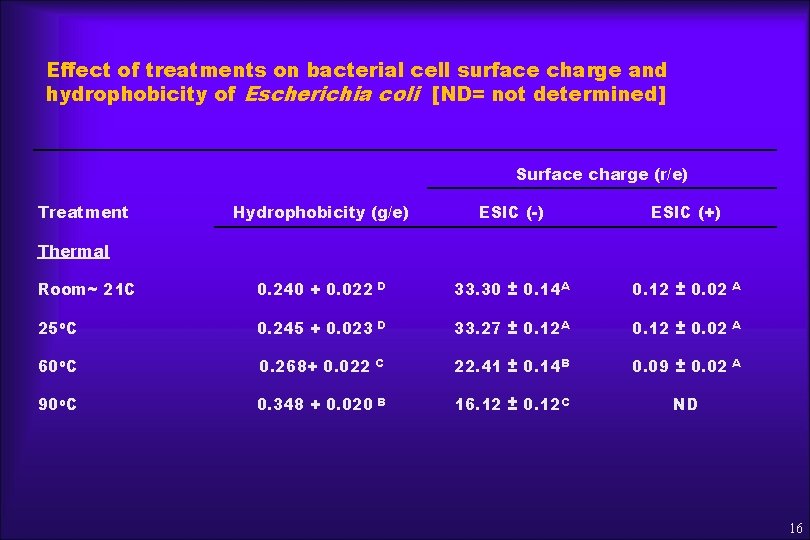
Effect of treatments on bacterial cell surface charge and hydrophobicity of Escherichia coli [ND= not determined] Surface charge (r/e) Treatment Hydrophobicity (g/e) ESIC (-) ESIC (+) Room~ 21 C 0. 240 + 0. 022 D 33. 30 ± 0. 14 A 0. 12 ± 0. 02 A 25 o. C 0. 245 + 0. 023 D 33. 27 ± 0. 12 A 0. 12 ± 0. 02 A 60 o. C 0. 268+ 0. 022 C 22. 41 ± 0. 14 B 0. 09 ± 0. 02 A 90 o. C 0. 348 + 0. 020 B 16. 12 ± 0. 12 C ND Thermal 16
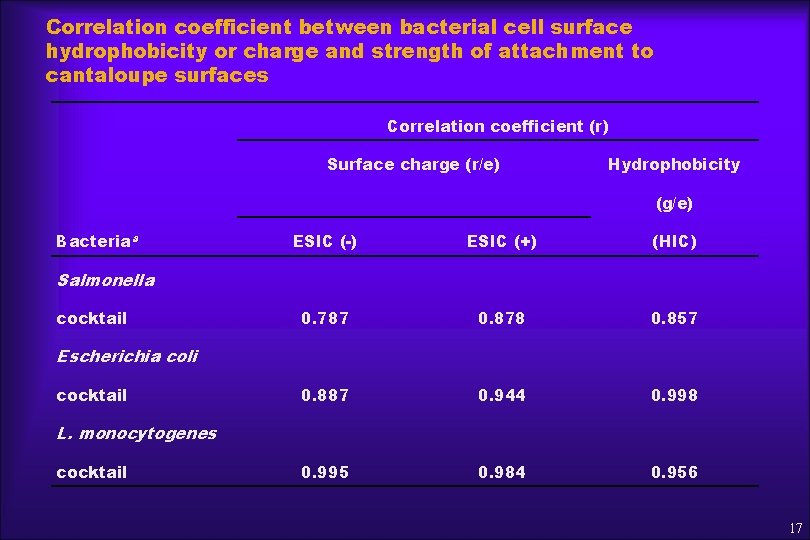
Correlation coefficient between bacterial cell surface hydrophobicity or charge and strength of attachment to cantaloupe surfaces Correlation coefficient (r) Surface charge (r/e) Hydrophobicity (g/e) Bacteriaa ESIC (-) ESIC (+) (HIC) 0. 787 0. 878 0. 857 0. 887 0. 944 0. 998 0. 995 0. 984 0. 956 Salmonella cocktail Escherichia coli cocktail L. monocytogenes cocktail 17
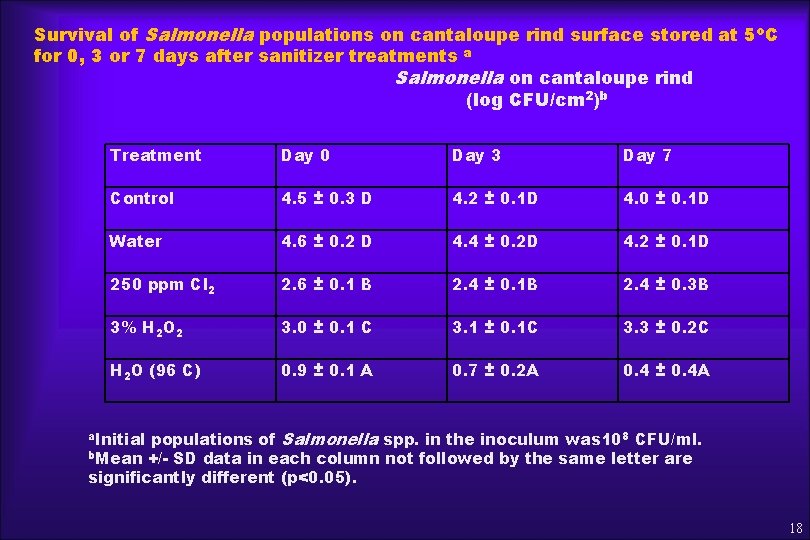
Survival of Salmonella populations on cantaloupe rind surface stored at 5 o. C for 0, 3 or 7 days after sanitizer treatments a Salmonella on cantaloupe rind (log CFU/cm 2)b Treatment Day 0 Day 3 Day 7 Control 4. 5 ± 0. 3 D 4. 2 ± 0. 1 D 4. 0 ± 0. 1 D Water 4. 6 ± 0. 2 D 4. 4 ± 0. 2 D 4. 2 ± 0. 1 D 250 ppm Cl 2 2. 6 ± 0. 1 B 2. 4 ± 0. 1 B 2. 4 ± 0. 3 B 3% H 2 O 2 3. 0 ± 0. 1 C 3. 1 ± 0. 1 C 3. 3 ± 0. 2 C H 2 O (96 C) 0. 9 ± 0. 1 A 0. 7 ± 0. 2 A 0. 4 ± 0. 4 A populations of Salmonella spp. in the inoculum was 108 CFU/ml. b. Mean +/- SD data in each column not followed by the same letter are significantly different (p<0. 05). a. Initial 18
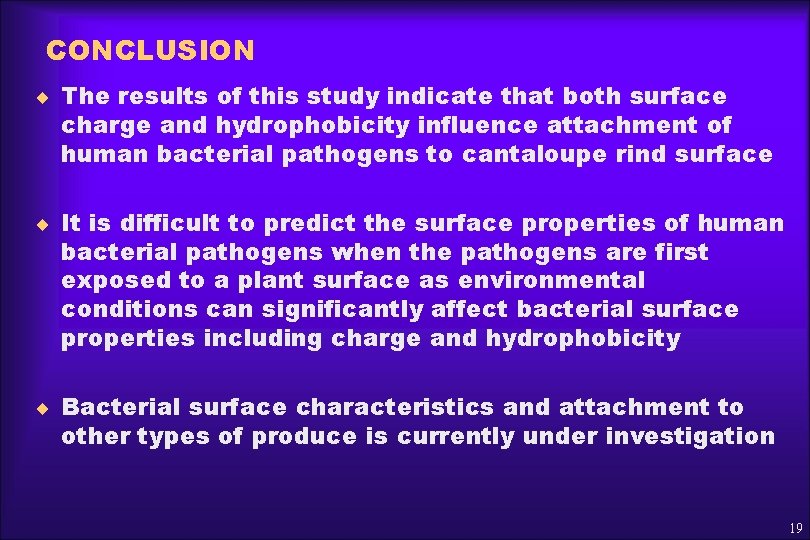
CONCLUSION ¨ The results of this study indicate that both surface charge and hydrophobicity influence attachment of human bacterial pathogens to cantaloupe rind surface ¨ It is difficult to predict the surface properties of human bacterial pathogens when the pathogens are first exposed to a plant surface as environmental conditions can significantly affect bacterial surface properties including charge and hydrophobicity ¨ Bacterial surface characteristics and attachment to other types of produce is currently under investigation 19
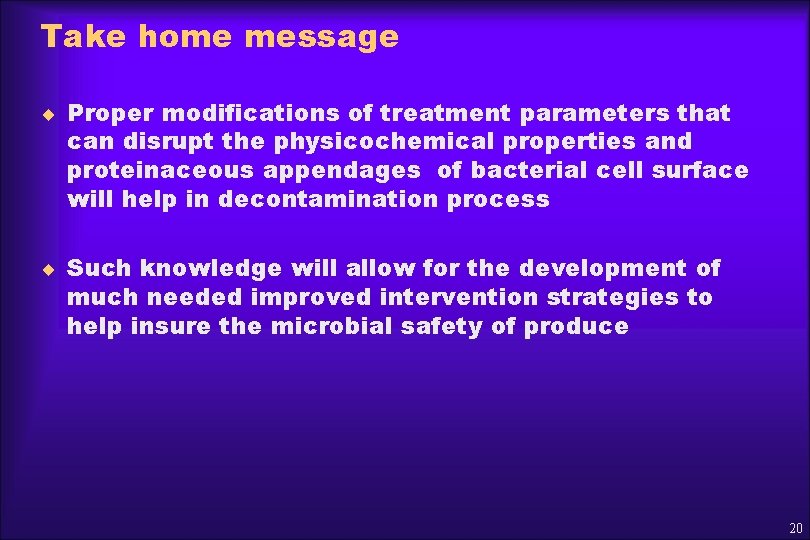
Take home message ¨ Proper modifications of treatment parameters that can disrupt the physicochemical properties and proteinaceous appendages of bacterial cell surface will help in decontamination process ¨ Such knowledge will allow for the development of much needed improved intervention strategies to help insure the microbial safety of produce 20

Acknowledgement ¨ Donyel M. Jones, Microbiologist ¨ Lee Chau, Biologist ¨ Dr. John Phillip, ERRC Statistician 21
For more information Contact: Dr. Dike O. Ukuku Senior Scientist, FSIT- ERRC- ARS-USDA 600 E. Mermaid La, Wyndmoor, PA 19038 215 -233 -6427, Fax 215 -233 -6406 dike. ukuku@ars. usda. gov http: //www. ars. usda. gov/naa/errc 22
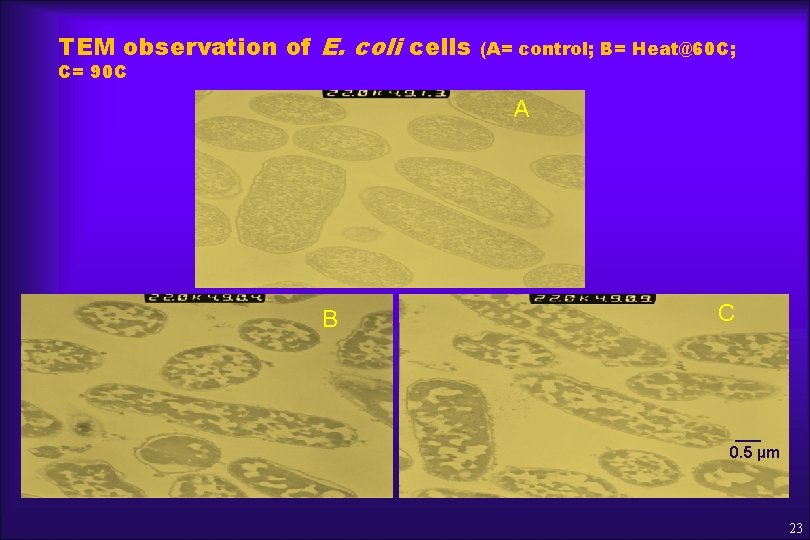
TEM observation of E. coli cells C= 90 C (A= control; B= Heat@60 C; A B C ___ 0. 5 µm 23
- Slides: 23