
BACTERIAL CELL ORGANELLES WEEK TWO 1 Objectives At
BACTERIAL CELL ORGANELLES (WEEK TWO) 1
Objectives At the end of the class, students should be able to: Ø describe the bacterial cell organelles Ø distinguish features of the Gram-negative bacteria and Grampositive bacteria cell wall Ø know the structures and the functions of the flagella and other extracellular structures 2

• The cytoplasmic matrix and inclusions The cytoplasmic matrix is composed largely of water. Suspends organelles - ribosomes, nucleoids, inclusion bodies • Ribosomes (the site for protein synthesis) ü Found in both the cytoplasmic matrix and loosely attached to the plasmic membrane. ü Made of protein and ribonucleic acid (RNA). ü It is the site for protein synthesis. ü The shape of each protein is determined by its amino acid sequence. ü Prokaryotic ribosomes are smaller than the eukaryotic ribosomes ü They are called 70 S ribosomes (composed of a 50 S and a 30 S subunit) ü The ‘S’ –Svedberg unit ü Svedberg unit is the unit of the sedimentation coefficient. 3
• Nucleoid (nuclear region) - contain the chromosome (DNA) of the bacteria cell - 60% DNA, 30% RNA and 10% protein by weight Exceptions - Pirellula sp. - Gemmata obscuriglobus • cytoskeletal filaments Participate in cell division, localize protein to certain sites in the cell, determines cells shape for cell without cell wall. • Inclusion bodies – granules of organic and inorganic materials. for storage, reduce osmotic pressure e. g glycogen granules, polyphosphate granules, cyanophycin granules 4
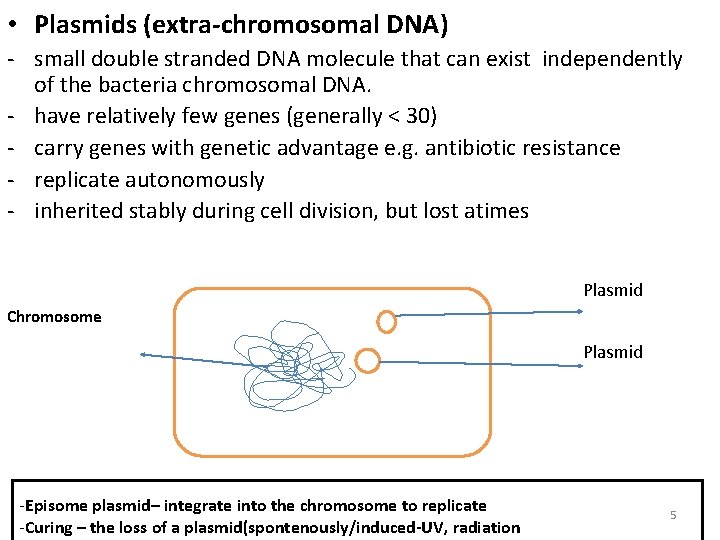
• Plasmids (extra-chromosomal DNA) - small double stranded DNA molecule that can exist independently of the bacteria chromosomal DNA. - have relatively few genes (generally < 30) - carry genes with genetic advantage e. g. antibiotic resistance - replicate autonomously - inherited stably during cell division, but lost atimes Plasmid Chromosome Plasmid -Episome plasmid– integrate into the chromosome to replicate -Curing – the loss of a plasmid(spontenously/induced-UV, radiation 5
• Bacteria can transfer plasmid to another by conjugation. • Plasmids that carry out conjugation are called vectors. • Scientist insert DNA fragments/genes into a plasmid vector to create recombinant plasmid. • The plasmid is introduced into the bacteria by transformation. • The bacteria can reproduce copies of the DNA fragments in large quantities during it cell division. Plasmid can be grouped based on how they came to be, spread and what they do. Types of bacterial plasmids - Fertility Factor/F plasmid Resistance factor/ R plasmids Col plasmids Virulence plasmids Metabolic plasmids 6
- Fertility plasmids Have genes that conduct the formation of sex pili and can transfer copies of themselves to other bacteria through conjugation. They are episomes - Resistance Plasmids They have genes to defend the host. Genes responsible for destroying antibiotics. Usually, they are not episomes. - Col plasmids They have genes capable of synthesizing bacteriocins (colicins-protein that can kill other bacteria). Not all bacteriocin genes are on plasmids. - Virulence plasmids The carry gene that enables their host to become pathogenic. E. g. some bacteria has plasmid that codes for enterotoxin. - Metabolic plasmids They carry genes for enzymes that degrade substances such as aromatic compound, pesticides and sugars. 7
• Bacterial cell wall Lies just outside the plasma membrane. - Determines cell’s shape - Protect cell from osmotic lysis - Protect cell from toxic substances - Can contribute to pathogenicity - It is also the site of action of some antibiotics Bacteria were classified as Gram-positive and Gram-negative by their reaction to Gram staining was discovered by Christian Gram in 1884. Gram-positive cell wall Consist of a single layer of peptidoglycan (murein), which lies after the plasma membrane. It is about 20 -80 nm thick 8
Gram-negative cell wall It has 2 -7 nm peptidoglycan layer, covered by outer membrane (7 -8 nm thick) Ther space between the plasma membrane and the outer membrane is known as periplasmic space 9
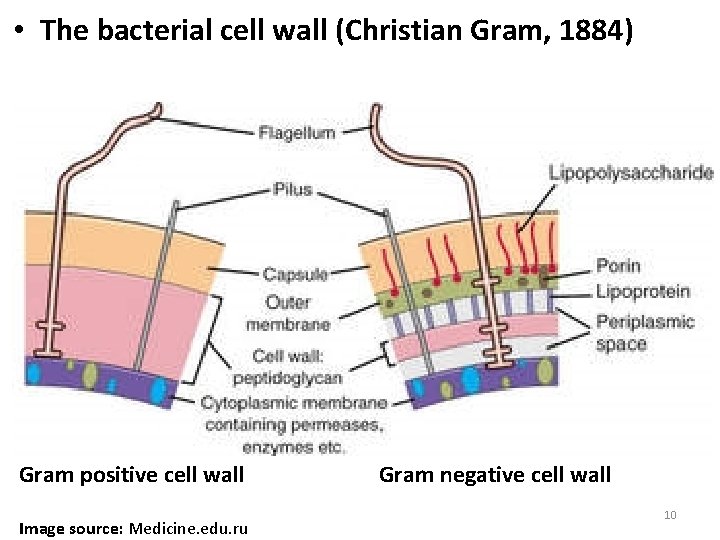
• The bacterial cell wall (Christian Gram, 1884) Gram positive cell wall Image source: Medicine. edu. ru Gram negative cell wall 10
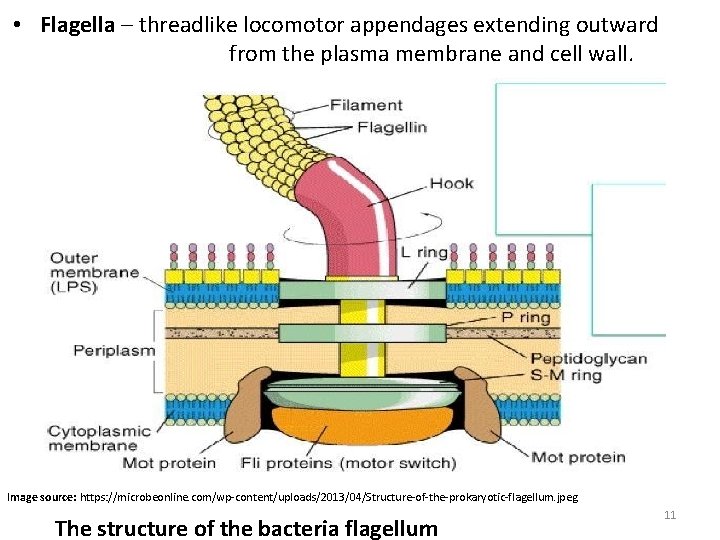
• Flagella – threadlike locomotor appendages extending outward from the plasma membrane and cell wall. Image source: https: //microbeonline. com/wp-content/uploads/2013/04/Structure-of-the-prokaryotic-flagellum. jpeg The structure of the bacteria flagellum 11
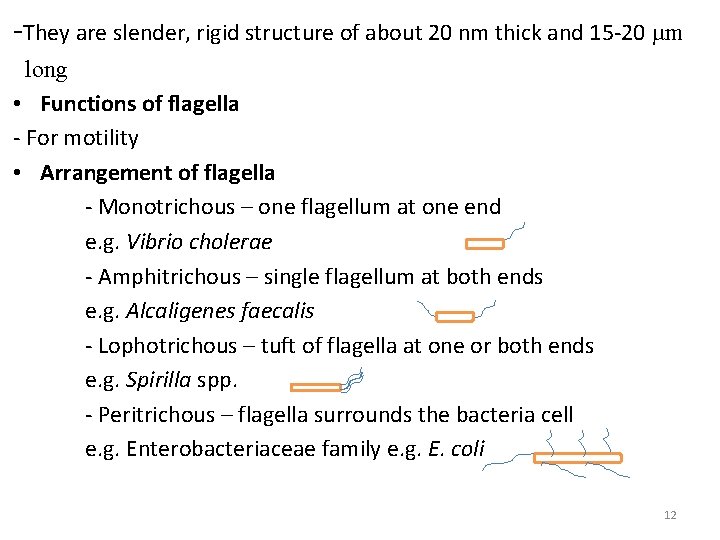
-They are slender, rigid structure of about 20 nm thick and 15 -20 µm long • Functions of flagella - For motility • Arrangement of flagella - Monotrichous – one flagellum at one end e. g. Vibrio cholerae - Amphitrichous – single flagellum at both ends e. g. Alcaligenes faecalis - Lophotrichous – tuft of flagella at one or both ends e. g. Spirilla spp. - Peritrichous – flagella surrounds the bacteria cell e. g. Enterobacteriaceae family e. g. E. coli 12
• Extra-cellular structures (structure outside the cell) - Capsules Well organized layer of polysaccharides and not easily washed off. It protects the cell. Also for attachment and pathogenicity. - Slime Layers Unorganized polysaccharide layer that can easily be removed. For protection, attachment and nutrient reserve, enhance motility a times. - S-layer Extracellular structure composed of protein/glycoprotein. It may protect the cell against ion and p. H fluctuations, osmotic stress, maintain the shape and envelope rigidity of some cells. It can also promote cell adhesion to surfaces. Contribute to virulence. 13
• Extra-cellular structures (structure outside the cell) - Pili (s. , pilus) Hollow filamentous non-helical structure, numerous and shorter and thinner than flagella (about 9 -10 nm in diameter). Longer than fimbriae. Needed during conjugation - Fimbriae (s. , fimbria) Short, fine hair-like appendages that are thinner than the flagella. About 3 -10 nm thick. For attachment to solid surfaces such as host tissue and for mobility in some bacteria e. g. Pseudomonas aeruginosa, Neisseria gonorrhoeae 14
Suggested books and online sources • Willey, J. M, Sherwood, L. M and Woolverton, C. J. 2008. Prescott, Harley and Klein’s Microbiology Mc. Graw-Hill 7 th Edition, New York • Atlas, R. M and Bartha, R. 1993. Microbial Ecology: fundamental and application Benjamin/ Cummings Publishing 3 rd Edition, Canada • http: //. tnmanning. com • http: //peer. tamu. edu https: //microbeonline. com/wpcontent/uploads/2013/04/fdsmall. gif 15
- Slides: 15