
BACTERIAL ADAPTATIONS AND THEIR APPLICATION IN GENETIC ENGINEERING
BACTERIAL ADAPTATIONS AND THEIR APPLICATION IN GENETIC ENGINEERING
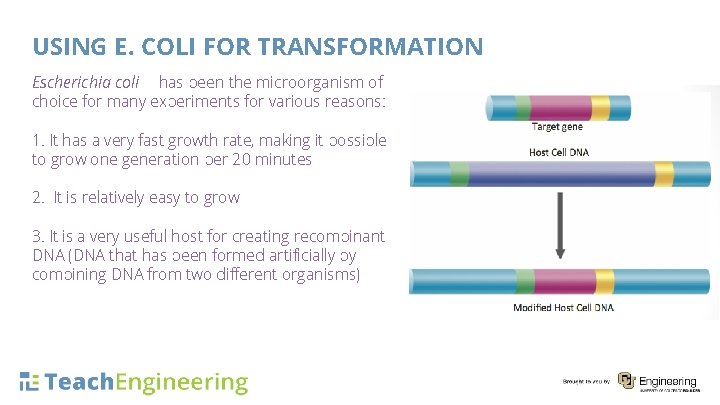
USING E. COLI FOR TRANSFORMATION Escherichia coli has been the microorganism of choice for many experiments for various reasons: 1. It has a very fast growth rate, making it possible to grow one generation per 20 minutes 2. It is relatively easy to grow 3. It is a very useful host for creating recombinant DNA (DNA that has been formed artificially by combining DNA from two different organisms)
GENETIC ENGINEERING Genetic engineering is the process through which genes are manipulated to purposefully change the genetic material and enhance organisms. It sometimes uses bacteria because of their plasmids. - Easy to map and modify since they are small pieces of DNA - Cells understand how to read them and follow their instructions Scientists can cut them open and insert a new gene from another organism then the bacteria can transfer its modified plasmid into another cell, carrying the new gene.
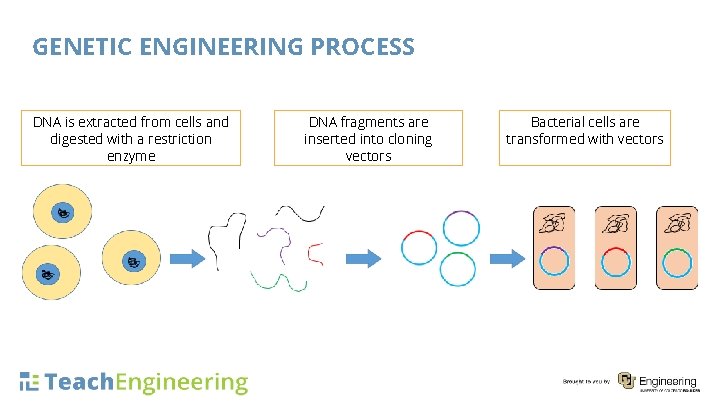
GENETIC ENGINEERING PROCESS DNA is extracted from cells and digested with a restriction enzyme DNA fragments are inserted into cloning vectors Bacterial cells are transformed with vectors
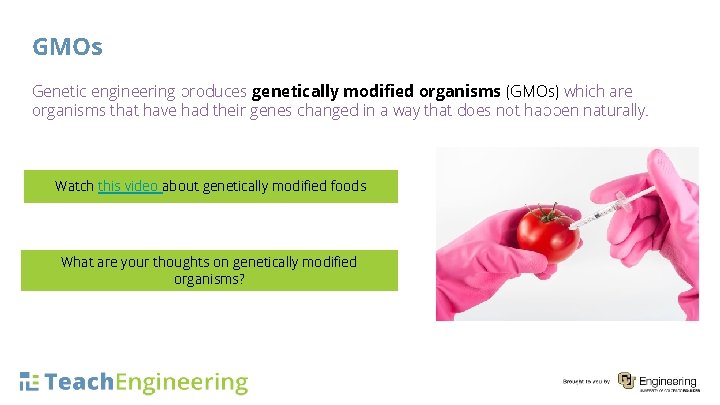
GMOs Genetic engineering produces genetically modified organisms (GMOs) which are organisms that have had their genes changed in a way that does not happen naturally. Watch this video about genetically modified foods What are your thoughts on genetically modified organisms?
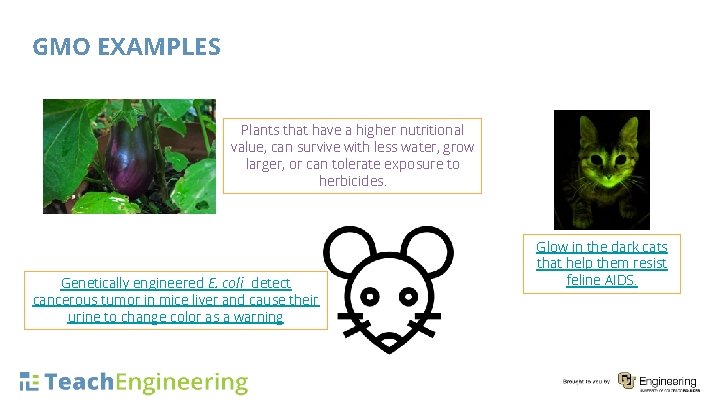
GMO EXAMPLES Plants that have a higher nutritional value, can survive with less water, grow larger, or can tolerate exposure to herbicides. Genetically engineered E. coli detect cancerous tumor in mice liver and cause their urine to change color as a warning Glow in the dark cats that help them resist feline AIDS.
- Slides: 6