
Bacteria Chapter 17 P 360 371 Monera What
Bacteria Chapter 17 P. 360 -371
Monera What you need to know: Characteristics of prokaryotic cells Moneran diversity Structure and function of bacteria Roles and effects of bacteria Effects of antibacterial agents
Classification There are two types of cells, eukaryotic and prokaryotic. Cells are placed into one of these two categories based on how complex their structure and cell division process is. Plant and animal cells are eukaryotic, meaning “true nucleus” Bacterial cells are prokaryotic, meaning “before nucleus. ”
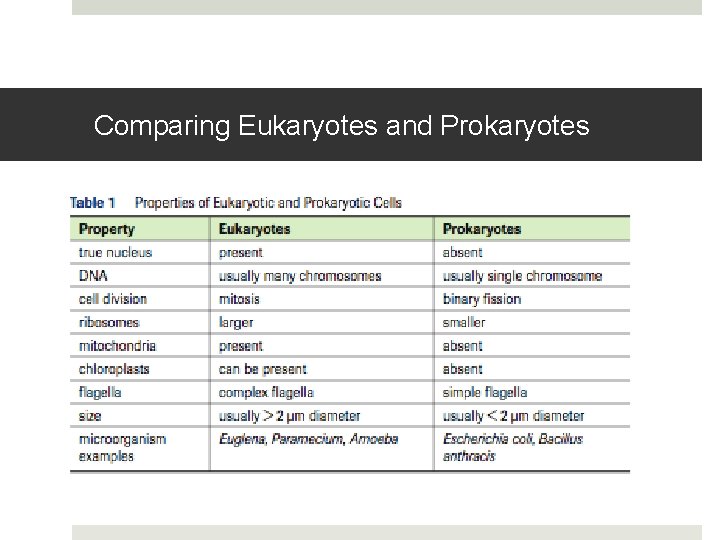
Comparing Eukaryotes and Prokaryotes
Background of Prokaryotes Light microscope gave the world a pretty big shock when they were suddenly able to observe the microscopic life that covers the entire world All prokaryotics fall within 2 kingdoms: Eubacteria or Archaebacteria Eubacteria makes up the larger kingdom Archaebacteria – prokaryotes that survive in harsh environments
Characteristics that unify Prokaryotes (Monerans) All are unicellular; some stick together in colonies. Bacteria usually lack membrane-bound internal structures, having no organized nucleus, vacuoles, mitochondria, or chloroplasts. Cells usually have a single chromosome in the form of a DNA loop. Cells reproduce asexually by binary fission. Cells thrive only in moist environments and become inactive if the environment dries up.
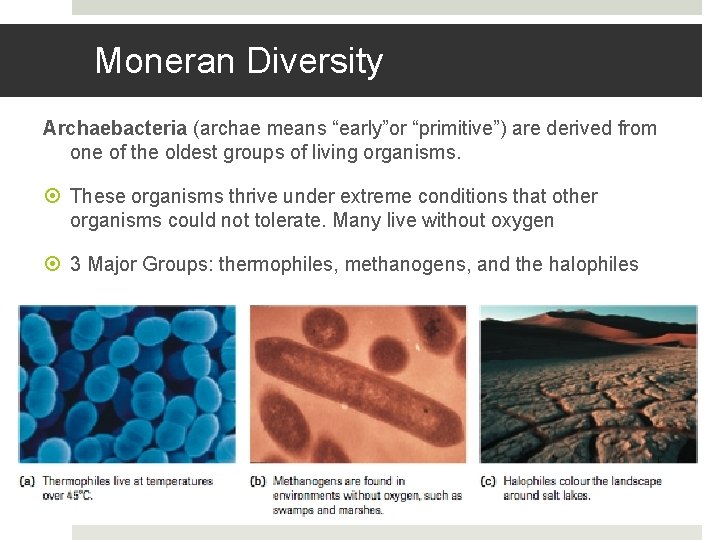
Moneran Diversity Archaebacteria (archae means “early”or “primitive”) are derived from one of the oldest groups of living organisms. These organisms thrive under extreme conditions that other organisms could not tolerate. Many live without oxygen 3 Major Groups: thermophiles, methanogens, and the halophiles
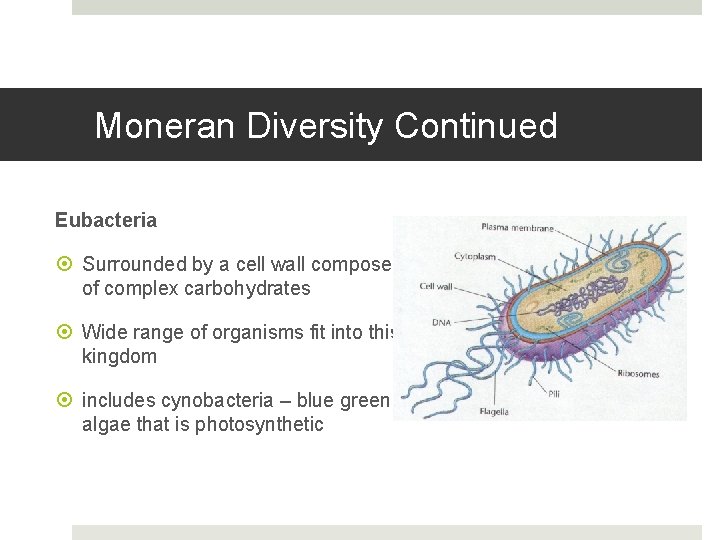
Moneran Diversity Continued Eubacteria Surrounded by a cell wall composed of complex carbohydrates Wide range of organisms fit into this kingdom includes cynobacteria – blue green algae that is photosynthetic

Typical Bacterial Cell
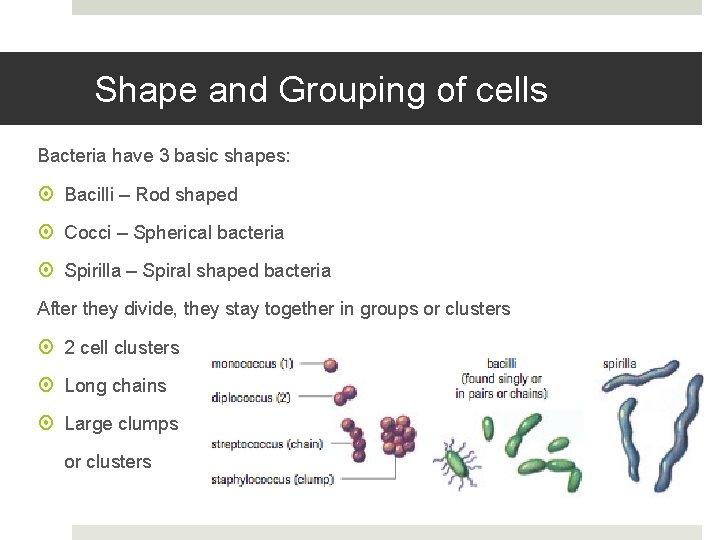
Shape and Grouping of cells Bacteria have 3 basic shapes: Bacilli – Rod shaped Cocci – Spherical bacteria Spirilla – Spiral shaped bacteria After they divide, they stay together in groups or clusters 2 cell clusters Long chains Large clumps or clusters
Motility Bacteria can be identified by how they move: Flagella Lash, snake or spiral movements to propel themselves forward Some glide slowly in a slimelike material they secrete themselves Some don’t move at all
Nutrition Autotrophs Make the energy they require from inorganic substances Can be Photosynthetic – convert carbon dioxide and water into carbohydrates or Chemosynthetic – chemical reactions to create energy Heterotrophs Obtain energy by taking in organic molecules and then breaking them down and absorbing them Most bacteria are heterotrophs (humans are chemotrophic herterotrophs: take in organic molecules and then break them down and absorb them)
Respiration: process that involves oxygen and breaks down food molecules to release energy Fermentation: ability to carry out energy production without oxygen Obligate aerobes: require a constant supply of oxygen Obligate anaerobes: must live in the absence of oxygen Facultative anaerobes: do not require oxygen, but are not poisoned by it’s presence (they can live anywhere!)
Reproduction If unlimited space and food were available to a single bacterium and if all of it’s offspring divided every 20 min in just 2 days they would reach a mass approx. 4000 times the mass of the earth PAUSE FOR OOHS, AHHS AND WOWIE’S!
Reproduction Binary Fission (asexual): bacterium grows to nearly double in size then replicates it’s DNA and divides in half producing 2 identical daughter cells Conjugation (sexual): exchange of genetic material via long bridge of protein that forms between two bacterial cells. Involves donor and recipient and results in a new combination of genes ensures that if the environment changes a few bacteria may be able to survive. Spore Formation: not a true form of reproduction, but allows for the survival of the bacteria during harsh environmental conditions. Bacterium produces a thick internal wall that encloses its DNA and portion of the cytoplasm to form an endospore.
Controlling Bacteria Sterilization – destroys living bacteria by subjecting them to either great heat or chemical action (most can be killed in boiling water) Disinfectants – you can’t drop an entire hospital in a pot of boiling water… so what do you do? Disinfectants! These are chemical solutions that kills bacteria. Food Processing – if we’re not careful bacteria will begin to eat our food before we do. Refridgeratation slows the growth of bacteria
Human Diseases Pathogens (disease-producing agents) There are only a few bacteria that produce diseases Diphtheria, tuberculosis, typhoid fever, tetanus, Hansen disease, syphilis, cholera and bubonic plague. They either damage the cells and tissues by breaking down living cells to use for food, or release toxins or poisons that interfere with normal activity of host’s body. Antibiotics: attack and destroy bacteria
Beneficial Roles of Bacteria Used in the production of cheese, yogurt, buttermilk, sour cream Used to make pickles, or vinegar from wine One type of bacterium digests petroleum (helps clean up oil spills) Remove wastes and poisons from water Mine minerals from the ground Synthesize drugs and chemicals Inhabit our intestines (symbiotic relationships) and help digest our food and create vitamins we couldn’t make on our own.
THE END!
- Slides: 19