
Bacteria Begins Welcome to the presentation of bacteria
Bacteria Begins

Welcome to the presentation of bacteria. I’m Mr. Badbacter and it’s time to learn about me and my evil henchmen. We are so small, humans couldn’t see us so we murdered a lot of people before you developed microscopes and began to study us. I’m Mr. Goodbacter and I work to help humans and the environment. Don’t get fooled by Mr. Badbacter, he just gives all us bacteria a bad reputation. Most of us actually mind our own business and do not cause infection. Matter of fact, we are essential components in the ecological cycling of nutrients through decomposition. We even help you in biotech. We are so numerous that our total biomass exceeds the biomass of all animals combined! You humans yourselves have more bacterial cells than body cells. How about that?
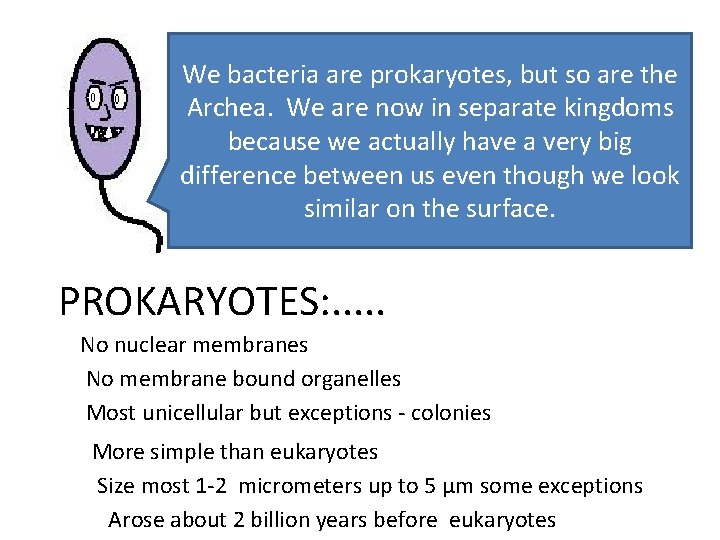
We bacteria are prokaryotes, but so are the Archea. We are now in separate kingdoms because we actually have a very big difference between us even though we look similar on the surface. PROKARYOTES: . . . No nuclear membranes No membrane bound organelles Most unicellular but exceptions - colonies More simple than eukaryotes Size most 1 -2 micrometers up to 5 µm some exceptions Arose about 2 billion years before eukaryotes
Oh, you should never, never doubt what nobody is sure about. The Microbe by Hilaire Belloc [1870 -1953] The Microbe is so very small You cannot make him out at all, But many sanguine people hope To see him through a microscope. His jointed tongue that lies beneath A hundred curious rows of teeth; His seven tufted tails with lots Of lovely pink and purple spots, On each of which a pattern stands, Composed of forty separate bands; His eyebrows of a tender green; All these have never yet been seen-But Scientists, who ought to know, Assure us that they must be so. . . Oh! let us never, never doubt What nobody is sure about!
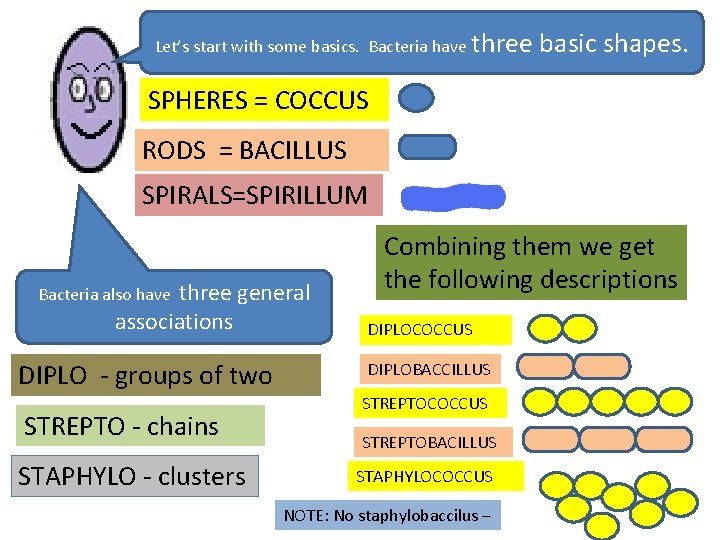
Let’s start with some basics. Bacteria have three basic shapes. SPHERES = COCCUS RODS = BACILLUS SPIRALS=SPIRILLUM three general associations Bacteria also have DIPLO - groups of two STREPTO - chains STAPHYLO - clusters Combining them we get the following descriptions DIPLOCOCCUS DIPLOBACCILLUS STREPTOCOCCUS STREPTOBACILLUS STAPHYLOCOCCUS NOTE: No staphylobaccilus –
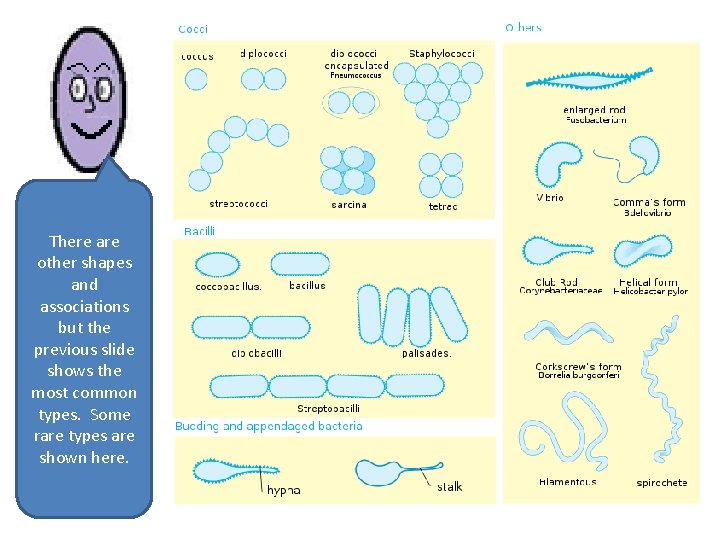
There are other shapes and associations but the previous slide shows the most common types. Some rare types are shown here.
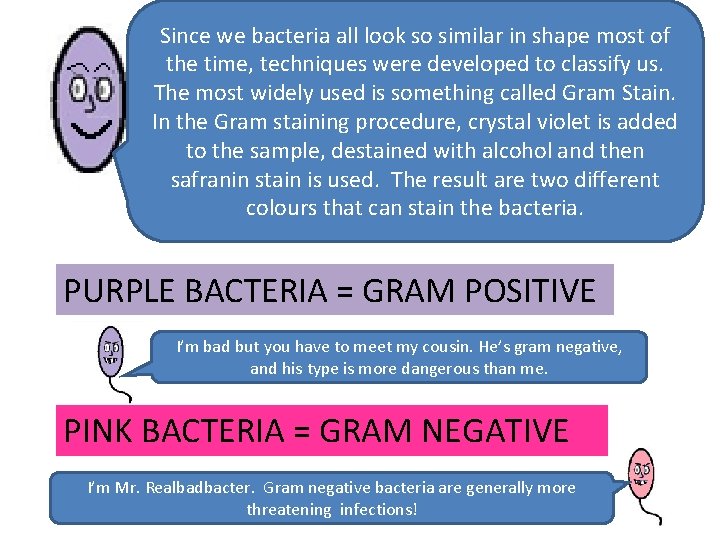
Since we bacteria all look so similar in shape most of the time, techniques were developed to classify us. The most widely used is something called Gram Stain. In the Gram staining procedure, crystal violet is added to the sample, destained with alcohol and then safranin stain is used. The result are two different colours that can stain the bacteria. PURPLE BACTERIA = GRAM POSITIVE I’m bad but you have to meet my cousin. He’s gram negative, and his type is more dangerous than me. PINK BACTERIA = GRAM NEGATIVE I’m Mr. Realbadbacter. Gram negative bacteria are generally more threatening infections!
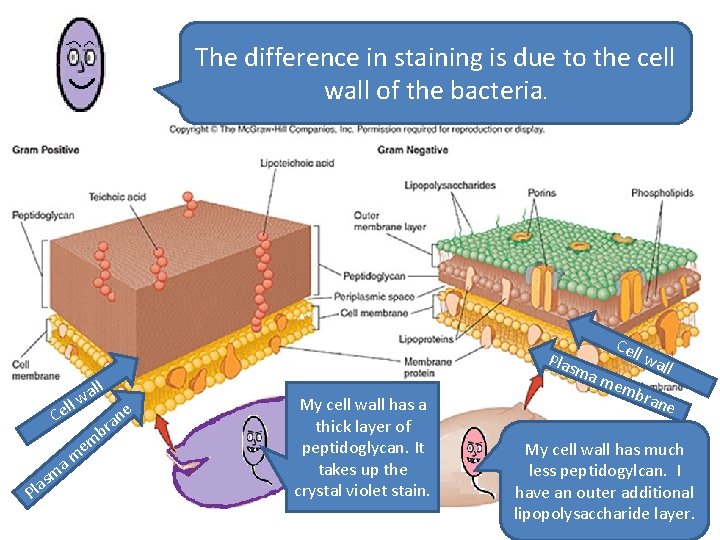
The difference in staining is due to the cell wall of the bacteria. ll Ce ll a w am sm a l P Plas ma em a br ne My cell wall has a thick layer of peptidoglycan. It takes up the crystal violet stain. Cel lw mem all bra ne My cell wall has much less peptidogylcan. I have an outer additional lipopolysaccharide layer.
My lipopolysaccharide coat often makes me toxic In addition, it also helps protect me against the body’s immune defences. It even makes it more difficult for antibiotics to enter my body and do damage. All of our cell walls provide the following. Maintain cell shape Physical protection Prevent cell from bursting
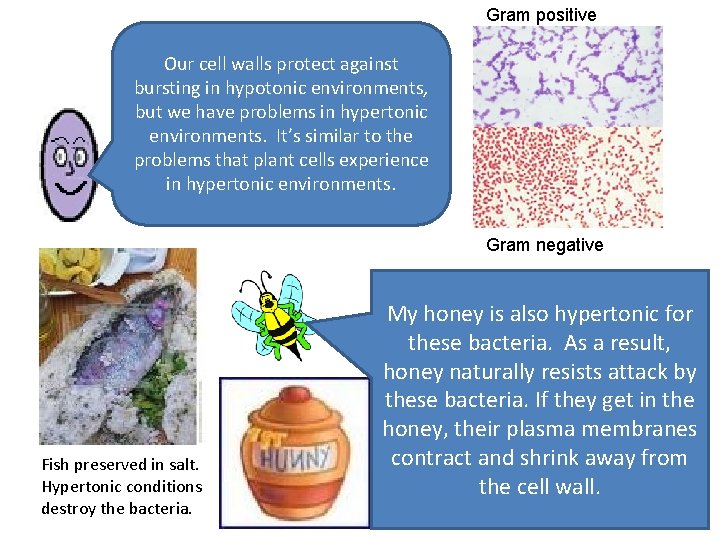
Gram positive Our cell walls protect against bursting in hypotonic environments, but we have problems in hypertonic environments. It’s similar to the problems that plant cells experience in hypertonic environments. Gram negative Fish preserved in salt. Hypertonic conditions destroy the bacteria. My honey is also hypertonic for these bacteria. As a result, honey naturally resists attack by these bacteria. If they get in the honey, their plasma membranes contract and shrink away from the cell wall.
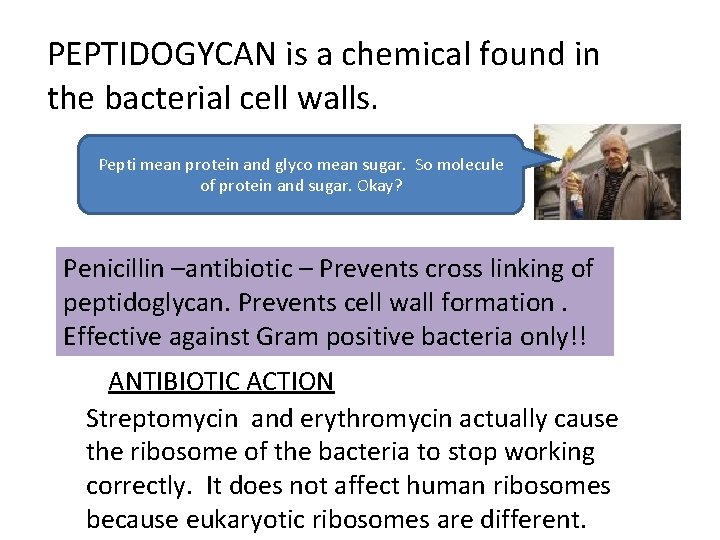
PEPTIDOGYCAN is a chemical found in the bacterial cell walls. Pepti mean protein and glyco mean sugar. So molecule of protein and sugar. Okay? Penicillin –antibiotic – Prevents cross linking of peptidoglycan. Prevents cell wall formation. Effective against Gram positive bacteria only!! ANTIBIOTIC ACTION Streptomycin and erythromycin actually cause the ribosome of the bacteria to stop working correctly. It does not affect human ribosomes because eukaryotic ribosomes are different.
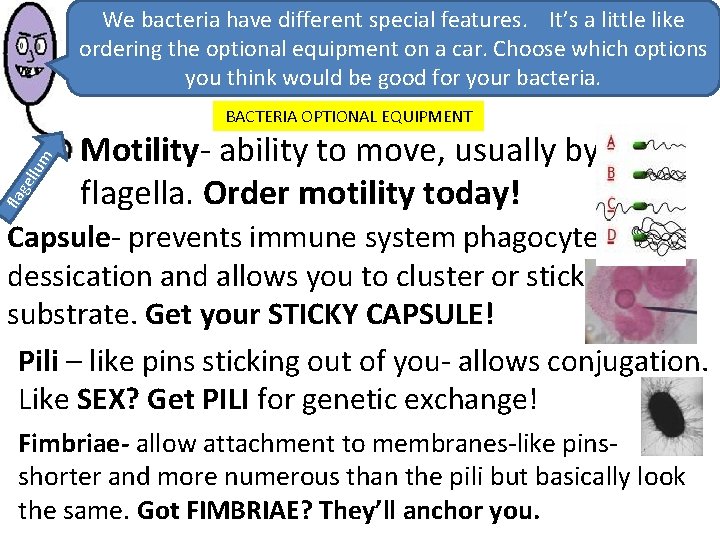
We bacteria have different special features. It’s a little like ordering the optional equipment on a car. Choose which options you think would be good for your bacteria. fla ge llu m BACTERIA OPTIONAL EQUIPMENT Motility- ability to move, usually by flagella. Order motility today! Capsule- prevents immune system phagocytes dessication and allows you to cluster or stick to a substrate. Get your STICKY CAPSULE! Pili – like pins sticking out of you- allows conjugation. Like SEX? Get PILI for genetic exchange! Fimbriae- allow attachment to membranes-like pinsshorter and more numerous than the pili but basically look the same. Got FIMBRIAE? They’ll anchor you.
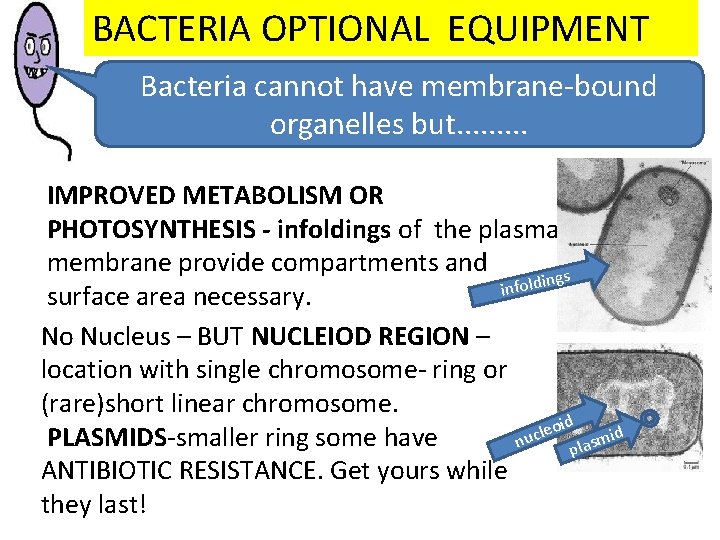
BACTERIA OPTIONAL EQUIPMENT Bacteria cannot have membrane-bound organelles but. . IMPROVED METABOLISM OR PHOTOSYNTHESIS - infoldings of the plasma membrane provide compartments and ings d l o f n i surface area necessary. No Nucleus – BUT NUCLEIOD REGION – location with single chromosome- ring or (rare)short linear chromosome. id o e l id PLASMIDS-smaller ring some have m nuc s a pl ANTIBIOTIC RESISTANCE. Get yours while they last!
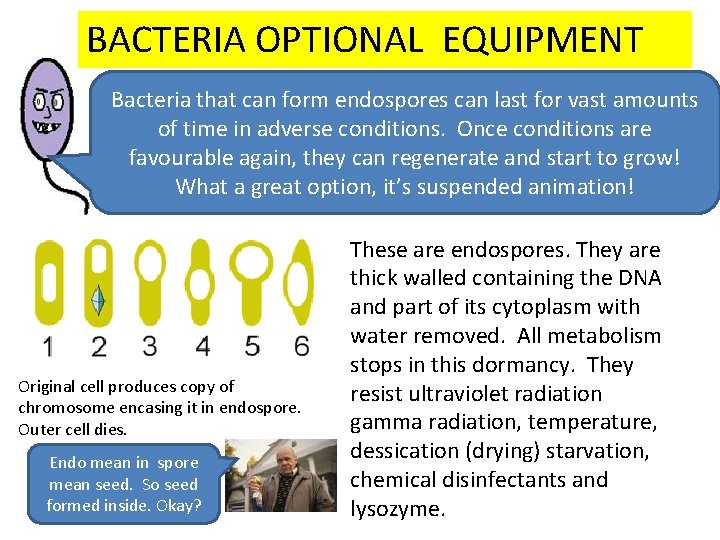
BACTERIA OPTIONAL EQUIPMENT Bacteria that can form endospores can last for vast amounts of time in adverse conditions. Once conditions are favourable again, they can regenerate and start to grow! What a great option, it’s suspended animation! Original cell produces copy of chromosome encasing it in endospore. Outer cell dies. Endo mean in spore mean seed. So seed formed inside. Okay? These are endospores. They are thick walled containing the DNA and part of its cytoplasm with water removed. All metabolism stops in this dormancy. They resist ultraviolet radiation gamma radiation, temperature, dessication (drying) starvation, chemical disinfectants and lysozyme.
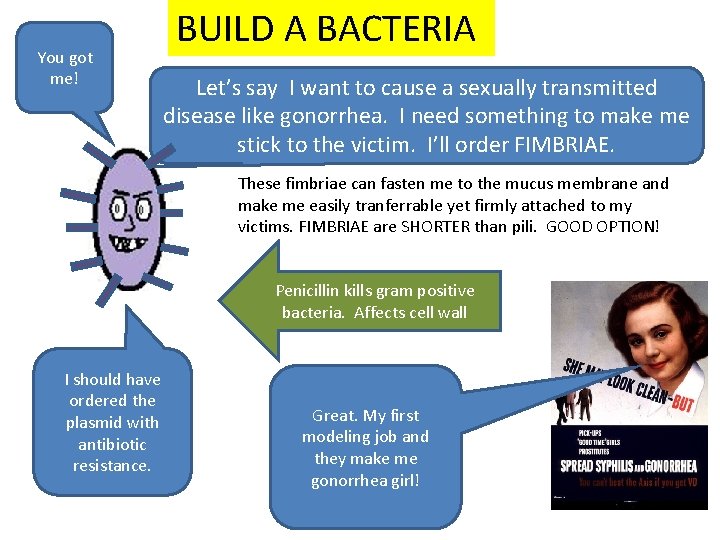
You got me! BUILD A BACTERIA Let’s say I want to cause a sexually transmitted disease like gonorrhea. I need something to make me stick to the victim. I’ll order FIMBRIAE. These fimbriae can fasten me to the mucus membrane and make me easily tranferrable yet firmly attached to my victims. FIMBRIAE are SHORTER than pili. GOOD OPTION! Penicillin kills gram positive bacteria. Affects cell wall I should have ordered the plasmid with antibiotic resistance. Great. My first modeling job and they make me gonorrhea girl!
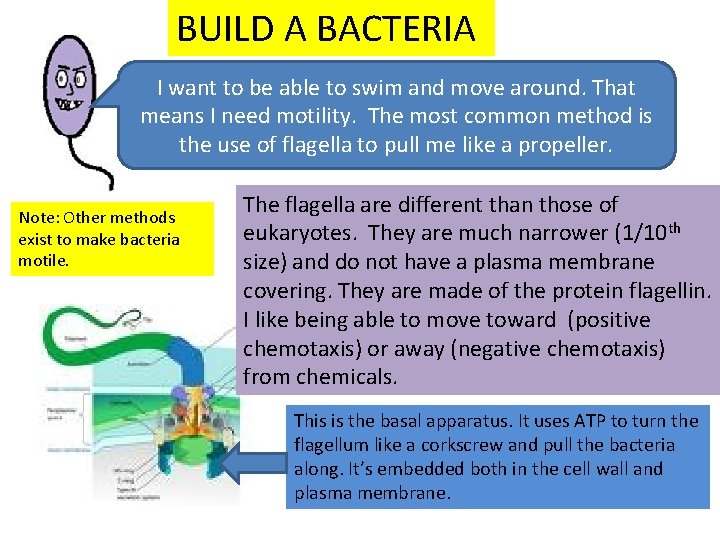
BUILD A BACTERIA I want to be able to swim and move around. That means I need motility. The most common method is the use of flagella to pull me like a propeller. Note: Other methods exist to make bacteria motile. The flagella are different than those of eukaryotes. They are much narrower (1/10 th size) and do not have a plasma membrane covering. They are made of the protein flagellin. I like being able to move toward (positive chemotaxis) or away (negative chemotaxis) from chemicals. This is the basal apparatus. It uses ATP to turn the flagellum like a corkscrew and pull the bacteria along. It’s embedded both in the cell wall and plasma membrane.
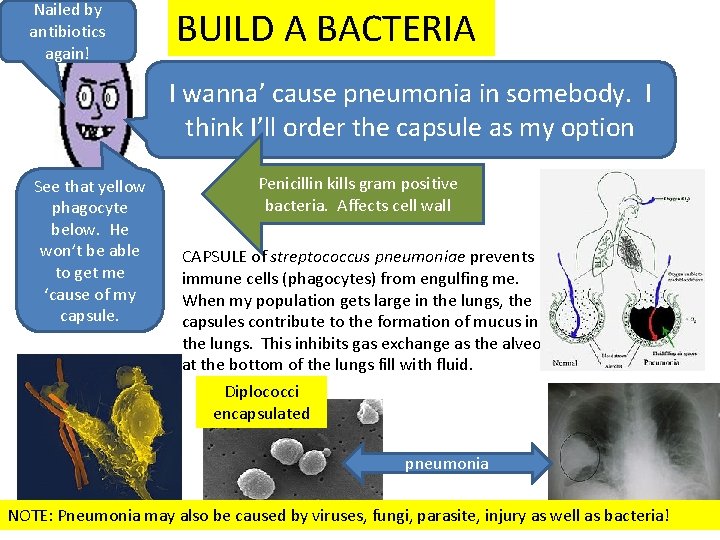
Nailed by antibiotics again! BUILD A BACTERIA I wanna’ cause pneumonia in somebody. I think I’ll order the capsule as my option See that yellow phagocyte below. He won’t be able to get me ‘cause of my capsule. Penicillin kills gram positive bacteria. Affects cell wall CAPSULE of streptococcus pneumoniae prevents immune cells (phagocytes) from engulfing me. When my population gets large in the lungs, the capsules contribute to the formation of mucus in the lungs. This inhibits gas exchange as the alveoli at the bottom of the lungs fill with fluid. Diplococci encapsulated pneumonia NOTE: Pneumonia may also be caused by viruses, fungi, parasite, injury as well as bacteria!
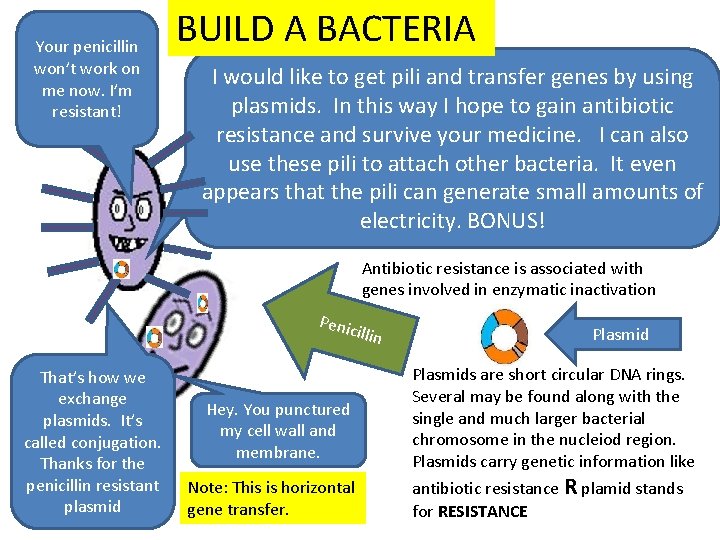
Your penicillin won’t work on me now. I’m resistant! BUILD A BACTERIA I would like to get pili and transfer genes by using plasmids. In this way I hope to gain antibiotic resistance and survive your medicine. I can also use these pili to attach other bacteria. It even appears that the pili can generate small amounts of electricity. BONUS! Antibiotic resistance is associated with genes involved in enzymatic inactivation Penic illin That’s how we exchange plasmids. It’s called conjugation. Thanks for the penicillin resistant plasmid Hey. You punctured my cell wall and membrane. Note: This is horizontal gene transfer. Plasmids are short circular DNA rings. Several may be found along with the single and much larger bacterial chromosome in the nucleiod region. Plasmids carry genetic information like antibiotic resistance R plamid stands for RESISTANCE
Bacteria Part 1 Ends
- Slides: 19