
Bacteria Bacteria Singlecelled microscopic organisms Do NOT have
Bacteria
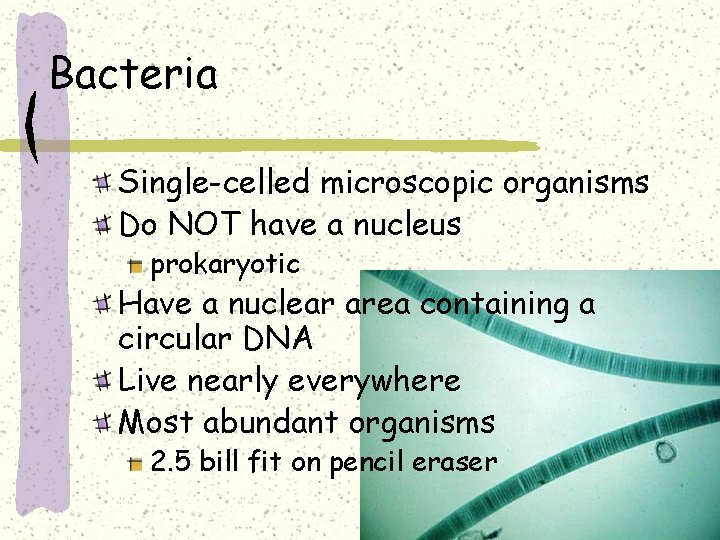
Bacteria Single-celled microscopic organisms Do NOT have a nucleus prokaryotic Have a nuclear area containing a circular DNA Live nearly everywhere Most abundant organisms 2. 5 bill fit on pencil eraser
Characteristics Has a cell membrane and cell wall Have flagella – whiplike structures used for movement (some) Live together in groups of 2 – 4 = colony Some form long chains Some form grapelike bunches Can be producers, decomposers or parasites
Kinds of Bacteria 2 kingdoms Eubacteria Most common Most recently evolved Archeabacteria Oldest Live in extreme conditions
How Bacteria are Classified By shape Round – Cocci Rod – Bacilli Spiral – Spirilla, least common If they need oxygen to live Aerobes – need oxygen Anerobes – do not need oxygen
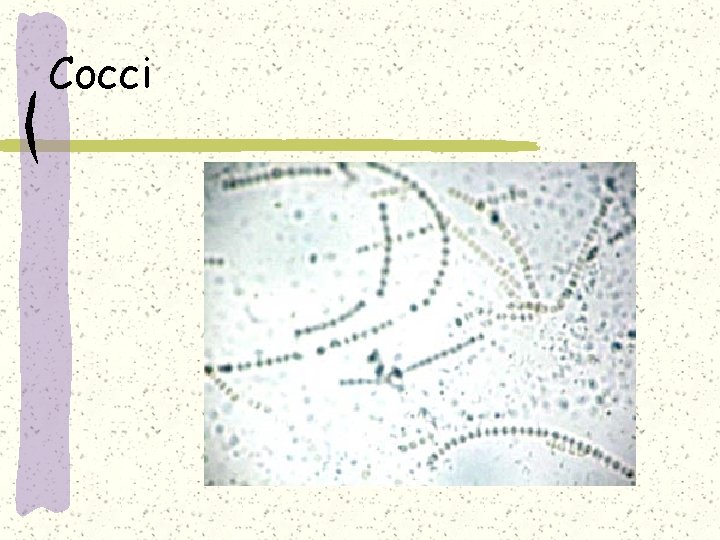
Cocci
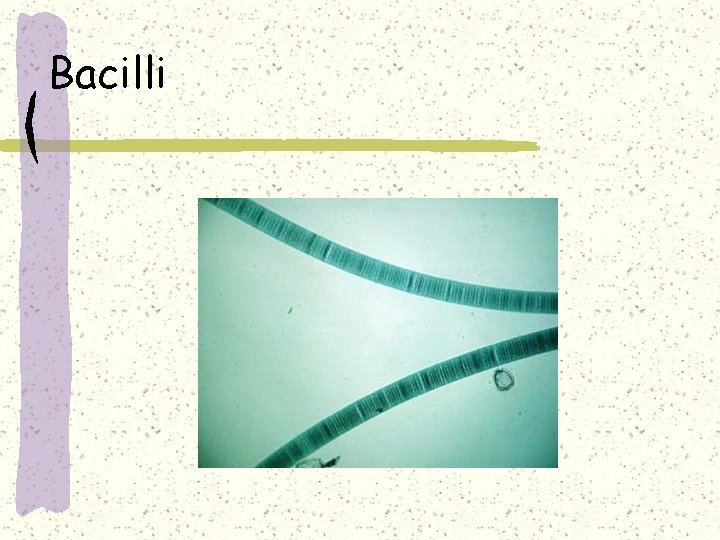
Bacilli
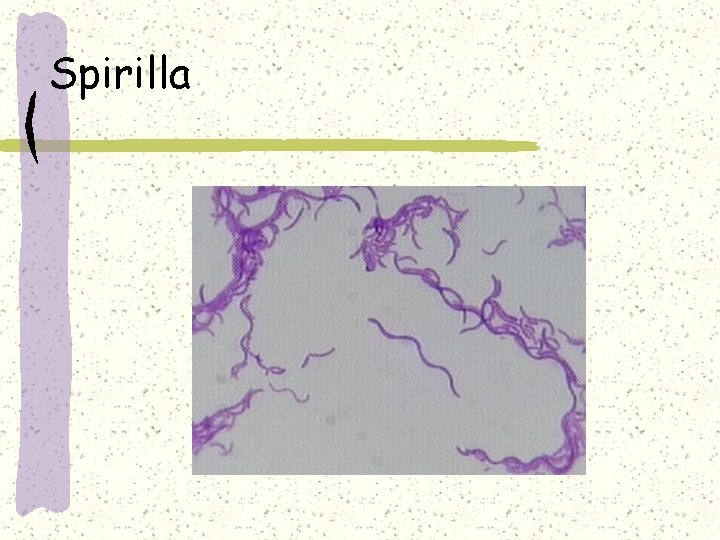
Spirilla
Bacterial Reproduction Reproduce asexually by binary fission One bacterial cell divides into 2 identical cells Need right conditions Warm, moist Food source Reproduce rapidly – every 20 min
Binary Fission Bacterial cell grows twice its size DNA replicates and attaches to cell membrane DNA and copy separate Cell splits in two Two identical cells form
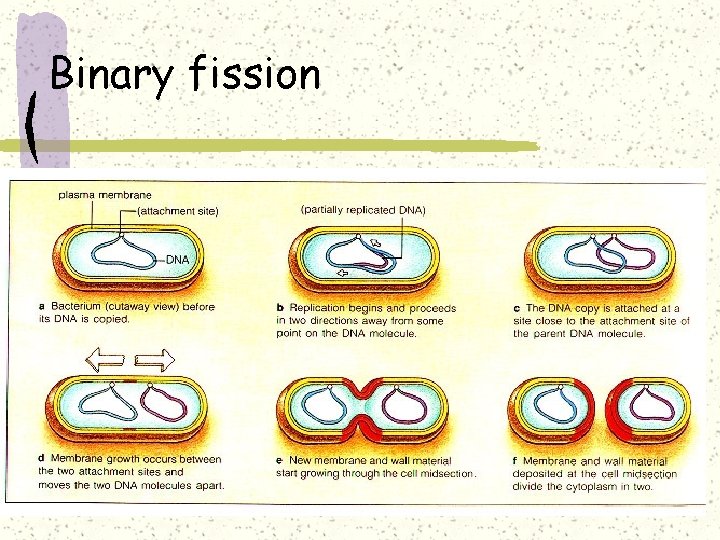
Binary fission
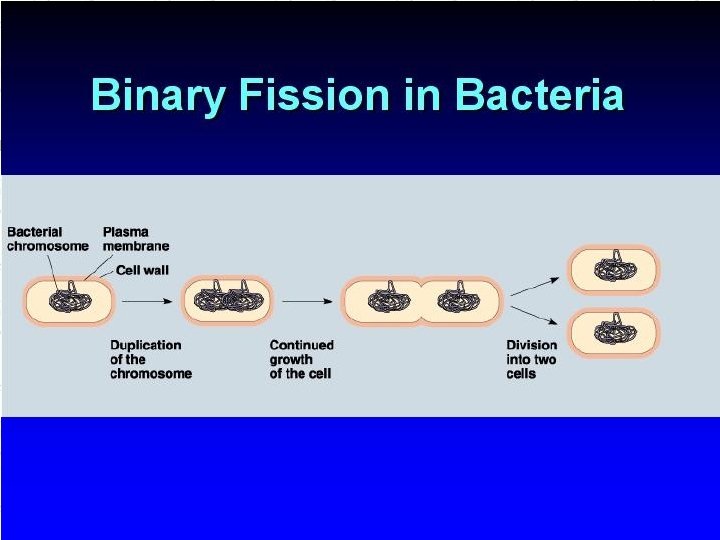
Binary Fission
Bacteria Endospore – a thick protective wall that forms around bacteria during bad conditions / for protection In good conditions – spore breaks open and becomes active.
Helpful Bacteria Plants Nitrogen-fixing bacteria – change nitrogen gas to a form plants use Animals Bacteria live in intestines and stomachs Help digest food Bacteria and Food Used to make yogurt, cheese, sour cream, vinegar, sourkraut Bacteria and Soil Decomposers – feed on dead matter and break it down /recycle
Harmful Bacteria Cause Diseases in plants and animals Reproduce rapidly in the host and give off waste products that are poisons Poisons cause symptoms of disease Body fights back by raising temperature
Antibiotics Medicines used to kill bacteria Discovered by Alexander Fleming Ex. Penicillin
Viruses – Nonliving Particles A strand of hereditary material surrounded by a protein coating. No nucleus or other organelles. No cell membrane. Variety of shapes Tiny (can only see with an electron microscope). Cause diseases such as colds, the flu, AIDS and chicken pox.
How do viruses reproduce? Need a host cell to make a copy of themselves = lytic cycle Inside of host is either active or latent (inactive). Attacks all types of organisms from bacteria (bacteriophages) to animals.
Active vs. Latent Active Causes cell to make new viruses immediately destroys host cell Latent viruses Does not immediately make the host cell make new viruses. As the host cell reproduces, the viral genetic material is copied. Virus waits and becomes active under certain conditions (stress or illnesses). . Ex. Cold sores
Fighting Viruses Vaccines = made from weakened virus particles that can’t cause disease anymore. First vaccine – Edward Jenner in 1796 Smallpox Antibiotics ARE INEFFECTIVE against viruses.
- Slides: 20