
Bacteria and Archaea Allen Viosa and Ali Learning
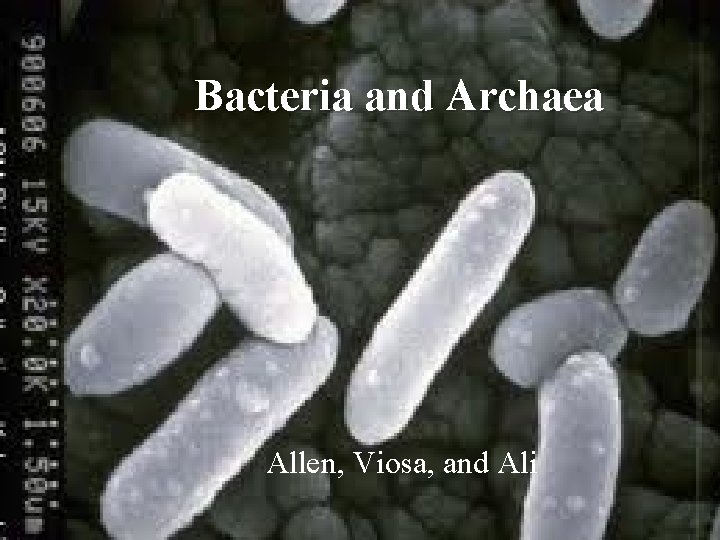
Bacteria and Archaea Allen, Viosa, and Ali
Learning Objectives � Prokaryotes �Three Domains �Characteristics �Phylogeny �Environmental
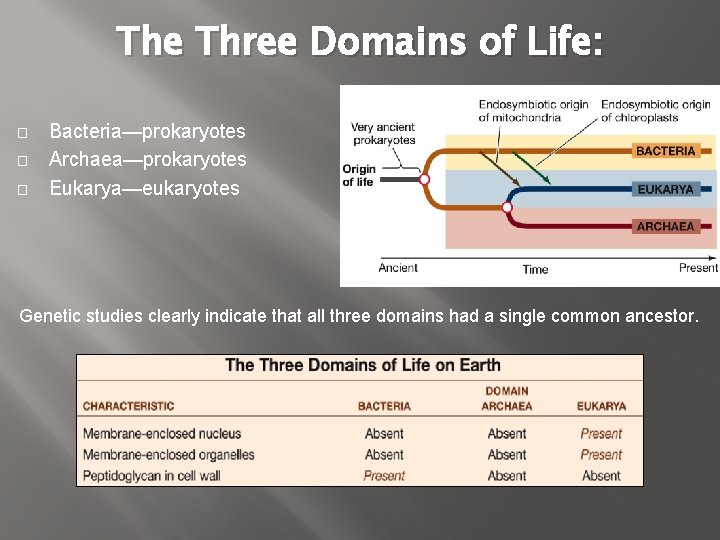
The Three Domains of Life: � � � Bacteria—prokaryotes Archaea—prokaryotes Eukarya—eukaryotes Genetic studies clearly indicate that all three domains had a single common ancestor.
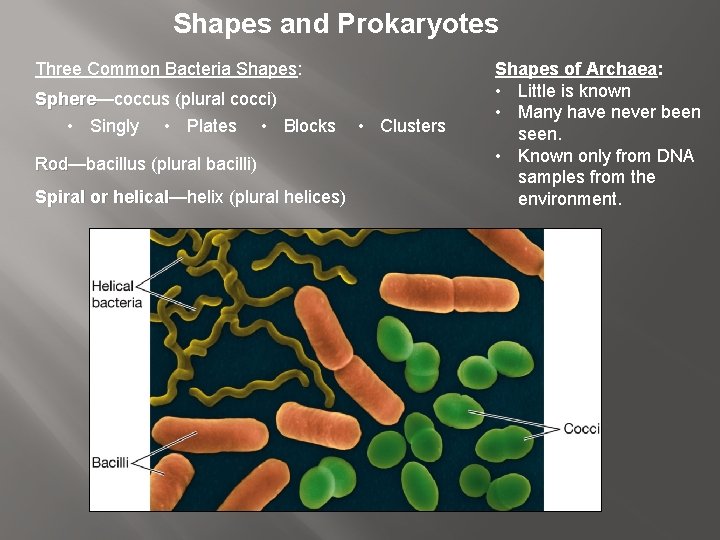
Shapes and Prokaryotes Three Common Bacteria Shapes: Sphere—coccus (plural cocci) Sphere • Singly • Plates • Blocks Rod—bacillus (plural bacilli) Rod Spiral or helical—helix (plural helices) helical • Clusters Shapes of Archaea: • Little is known • Many have never been seen. • Known only from DNA samples from the environment.
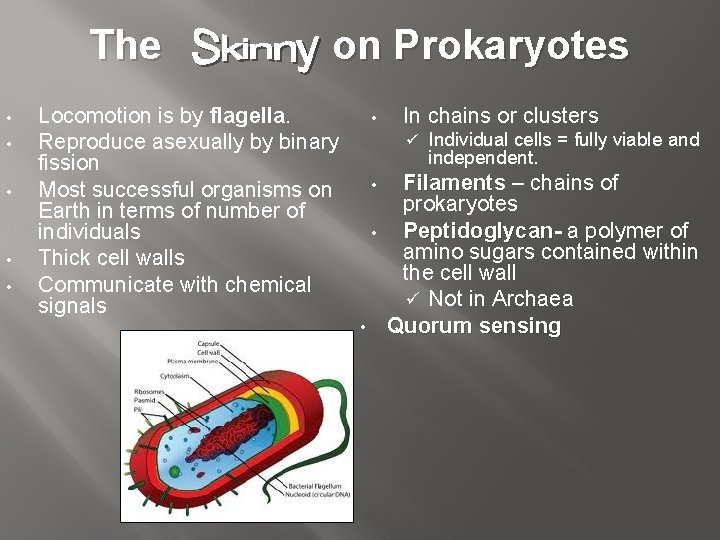
The • • • on Prokaryotes Locomotion is by flagella. Reproduce asexually by binary fission Most successful organisms on Earth in terms of number of individuals Thick cell walls Communicate with chemical signals • In chains or clusters ü Individual cells = fully viable and independent. Filaments – chains of prokaryotes • Peptidoglycan a polymer of amino sugars contained within the cell wall ü Not in Archaea • Quorum sensing •
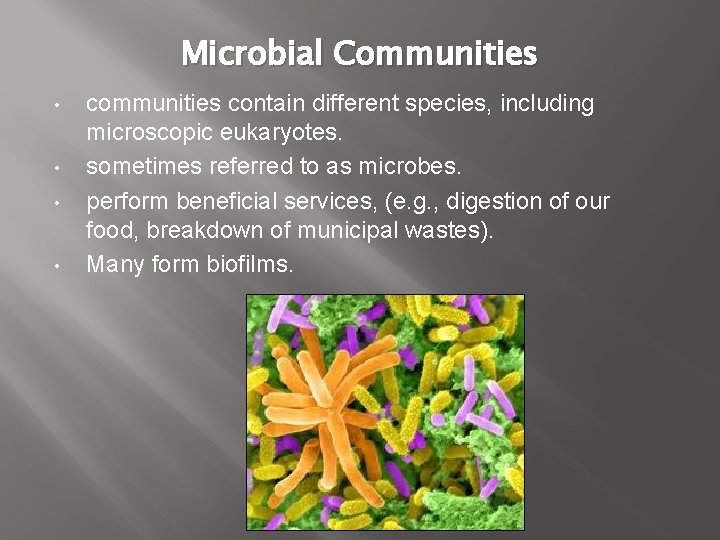
Microbial Communities • • communities contain different species, including microscopic eukaryotes. sometimes referred to as microbes. perform beneficial services, (e. g. , digestion of our food, breakdown of municipal wastes). Many form biofilms.
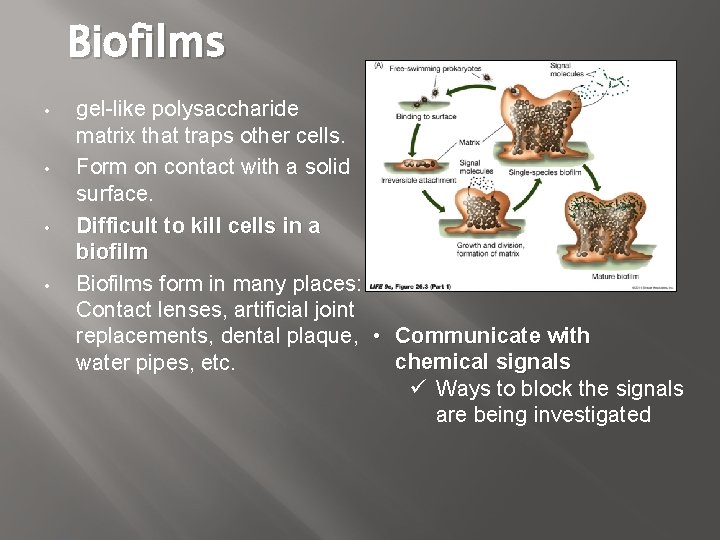
Biofilms • • gel-like polysaccharide matrix that traps other cells. Form on contact with a solid surface. Difficult to kill cells in a biofilm Biofilms form in many places: Contact lenses, artificial joint replacements, dental plaque, • Communicate with chemical signals water pipes, etc. ü Ways to block the signals are being investigated
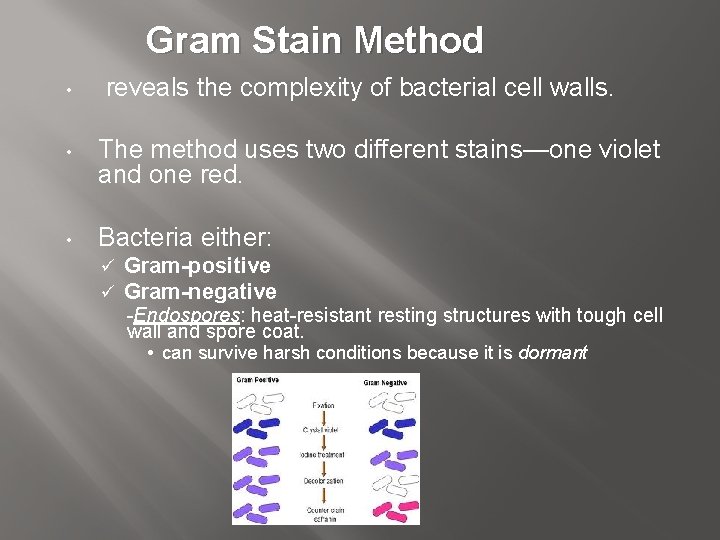
Gram Stain Method • reveals the complexity of bacterial cell walls. • The method uses two different stains—one violet and one red. • Bacteria either: ü ü Gram-positive Gram-negative -Endospores: heat-resistant resting structures with tough cell wall and spore coat. • can survive harsh conditions because it is dormant
How can we resolve prokaryote phylogeny? • • Small size hampers study. • Much learned by using advanced microscopy techniques and from growing bacteria in pure cultures. Taxonomy of prokaryotes: ü ü ü • Shape Color Motility Nutrition Antibiotic sensitivity Gram stain reaction Constructions of classification schemes that reflect evolution are recent.
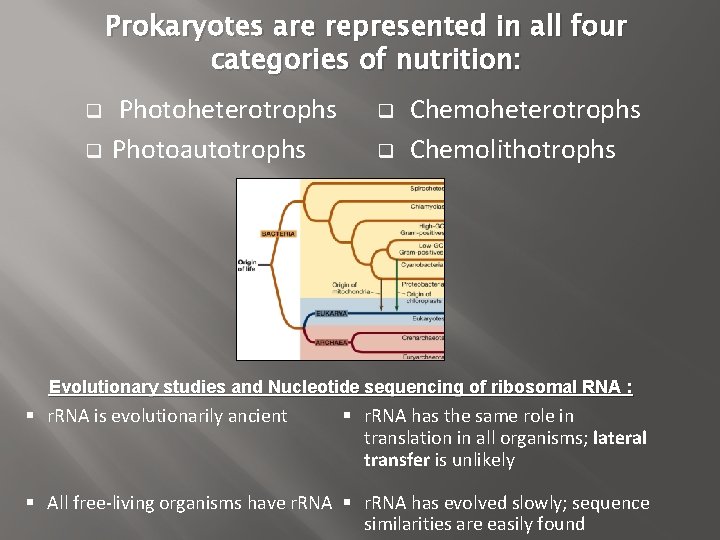
Prokaryotes are represented in all four categories of nutrition: q q Photoheterotrophs Photoautotrophs q q Chemoheterotrophs Chemolithotrophs Evolutionary studies and Nucleotide sequencing of ribosomal RNA : § r. RNA is evolutionarily ancient § r. RNA has the same role in translation in all organisms; lateral transfer is unlikely § All free-living organisms have r. RNA § r. RNA has evolved slowly; sequence similarities are easily found
Archaea = Extremeophiles • • High salinity High Temp High or low p. H Low O 2 Archaea = Mesophiles • soil Grouping Names • Euryarcheota, Crenarcheota, Korarchaeota and Nanoarchaeota
• Prokaryotes are a part of all ecosystems. • Only a small minority are human pathogens (disease-causing organisms). • Many species play many positive roles in such diverse applications as cheese making, sewage treatment, and production of antibiotics, vitamins, and chemicals. • Plants depend on prokaryotes for their nutrition, for processes such as nitrogen fixation and nutrient cycling.
References • • • Berenbaum, May R. "Chapter 26: Bacteria and Archaea. " Life: The Science of Biology, Ninth Edition. By H. Craig. Heller, David M. Hillis, and David Sadava. Sunderland, MA, : Sinauer Ass. , W. H. Freeman and, 2011. N. pag. Print"How. Stuff. Works "Science"" How. Stuff. Works. N. p. , n. d. Web. 10 Oct. 2012. <http: //science. howstuffworks. com/>. "Wikipedia. " Wikipedia. Wikimedia Foundation, 10 Sept. 2012. Web. 10 Oct. 2012. <http: //en. wikipedia. org/wiki/Wikipedia>.
- Slides: 13