
BACTEC MGIT 960 CULTURE SYSTEM FOR MYCOBACTERIA David

BACTEC MGIT 960 CULTURE SYSTEM FOR MYCOBACTERIA David Lubasi Biomedical Scientist TUBERCULOSIS WORKSHOP NDOLA AUGUST 2004
BACKGROUND § In Zambia, a four-fold increase in tuberculosis notification rates was noted in the last decade and the current notification rate stands at over 512 per 100, 000 per year(WHO/MOH report 1999) § Lusaka province has highest incidence in the country, standing at 800/100, 000/year (1996 MOH report).
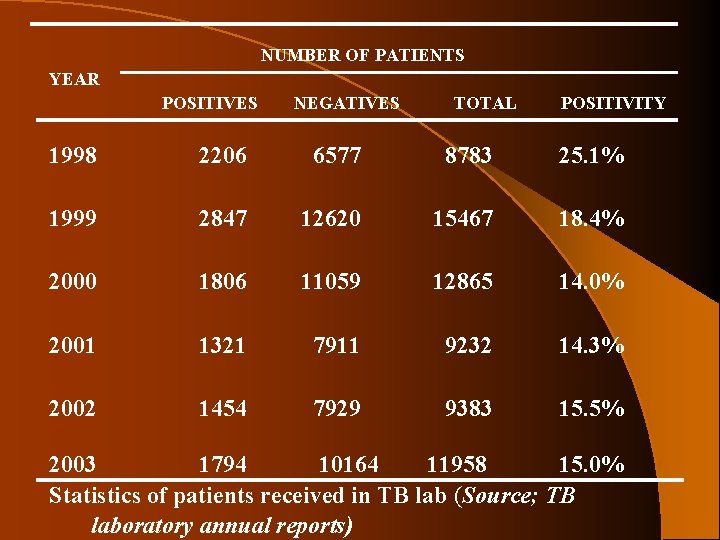
NUMBER OF PATIENTS YEAR POSITIVES NEGATIVES TOTAL POSITIVITY 1998 2206 6577 8783 25. 1% 1999 2847 12620 15467 18. 4% 2000 1806 11059 12865 14. 0% 2001 1321 7911 9232 14. 3% 2002 1454 7929 9383 15. 5% 2003 1794 10164 11958 15. 0% Statistics of patients received in TB lab (Source; TB laboratory annual reports)

§ Diagnosis of tuberculosis has used a variety of clinical and microbiological methods, which, until recently, have changed very little since the discovery of the tubercle bacillus over a century ago. (Reichman et al 1993). § Sensitivity of direct Microscopy is improved by use of the Na. Ocl method (Habeenzu et al 1998), but still not as sensitive as culture. § Conventional culture for Mycobacteria is slow (on average 4 weeks and maximum incubation of 9 weeks).

§ Radiometric BACTEC 460 TB and non radiometric BACTEC 9000 MB are more efficient in recovery of Mycobacteria (ZANETTI et al 1997), but these systems are too expensive for most developing countries. § Due to the heavy workload , the UTH TB lab acquired the BACTEC MGIT 960, 960 purchase of which was financed by JICA through the HIV/AIDS and TB control project.
INTRODUCTION l MGIT stands for Mycobacteria Growth Indicator Tube, and 960 indicates the total number of culture tubes it can hold at any given time l The BACTEC MGIT 960 System is an in vitro diagnostic instrument for rapid detection of Mycobacteria in clinical specimens other than blood. l The system is designed to meet the needs of medium and high volume labs, capable of processing about 8, 000 cultures per year. l This system is simple, efficient , safe to use and occupies small laboratory space.

PRINCIPLE OF THE TEST / PROCEDURE The MGIT 7 ml tube contains modified middle brook 7 H 9 broth. § Culture tubes contain a fluorescent sensor at the bottom which responds to the concentration of oxygen. § Initial concentration of dissolved oxygen quenches the emission from the compound, and little fluorescence can be detected. § Actively respiring micro organisms consume the oxygen which allows the compound to fluorescence. §

METHODS § § § Specimens are collected and transported like in ordinary microscopy and culture for Mycobacteria to the TB laboratory. Decontaminate and digested specimens with an equal volume of 4% sodium hydroxide for 15 minutes vortexing every 5 minutes Transfer the Decontaminated sputum in to a 50 ml corning tube. Centrifuged at 3000 rpm for 15 minutes and discard the supernatant. Add phosphate-buffered saline (PBS p. H 6. 8) to the residue raising the volume to 50 ml. Centrifuge at 3000 rpm for 15 minutes and discard the supernatant.

Add 0. 5 ml of PBS p. H 6. 8 to resuspend the pellets. § Add 0. 5 ml of resuspended deposit to the MGIT culture tube § MGIT tubes are then incubated into the BACTEC MGIT 960 system until positivity is observed for positive samples or upto 8 weeks for negative ones. § Positive cultures are usually detected within 4 – 14 days § When positive tubes are identified, they are removed and are confirmed for Acid fastness (AFB), for species identification and drug susceptibility testing and later storage of isolate. NB MGIT culture tubes contains 7 ml of Middlebrook 7 H 9 and 0. 8 ml of PANTA. §
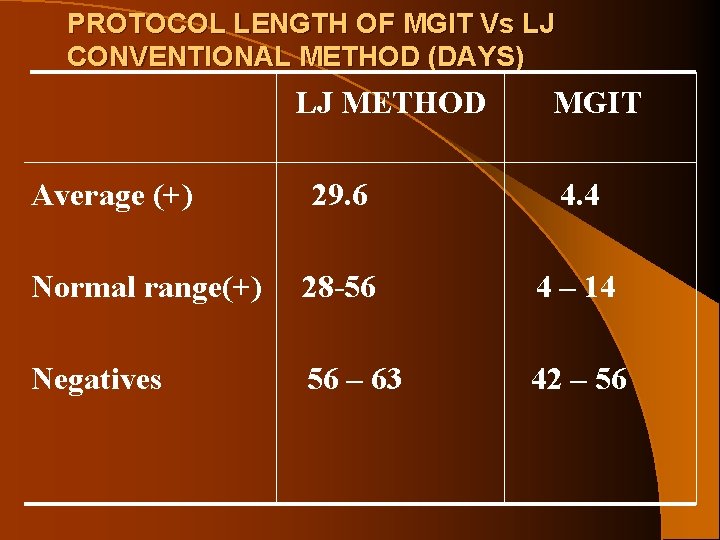
PROTOCOL LENGTH OF MGIT Vs LJ CONVENTIONAL METHOD (DAYS) LJ METHOD Average (+) MGIT 29. 6 4. 4 Normal range(+) 28 -56 4 – 14 Negatives 56 – 63 42 – 56

RESULTS OF MGIT Vs. LJ FROM OTHER RESEARCHERS CONVENTIONAL STUDY Van Griethiuysen et al, 1996 * CULTURE 79. 9% BACTEC SYSTEM 95. 9% Zanetti et al, 1997 69. 3 % 95. 0 % Jesus et al , 2001 46. 6% 86. 6% Lu et al , 2002 45. 5 % 71. 1 % Recovery rates from positive samples

OBSERVATIONS § Most of the studies on evaluation of mycobacteria recovery from the fluorometric BACTEC 960 and the radiometric BACTEC 460 TB system have shown that they are more sensitive in recovery of mycobacteria than the conventional L -J and smear microscopy. § Zannetti et al (1997) showed no significant difference between the radiometric BACTEC 460 TB and the fluorometric BACTEC 960 thus 91. 9% positivity and 95. 1% positivity respectively. But use of radioisotopically labeled substrates has inhibited universal application of the radiometric BACTEC 460 TB system.

This system is simple, efficient , safe to use and occupies small laboratry space. § In poor economies MGIT is relatively expensive to acquire and sustain. §

CONCLUSION. § Diagnosis of TB depends on the isolation and identification of Mycobacteria and the control of MDR tuberculosis depends rapid sensitivity results. Therefore use of sensitive methods and faster culture methods like the BACTEC MGIT 960 system is necessary.

THE END
- Slides: 15