
Backward Design An Integrated Approach to a Systems
Backward Design An Integrated Approach to a Systems Curriculum Michael S. Kirkpatrick Mohamed Aboutabl David Bernstein Sharon Simmons Backward Design: An Integrated Approach to a Systems Curriculum SIGCSE 2015 • Kirkpatrick et. al
Backward Design The Long and Rewarding Path to an ACM ) h i( s 2013 Systems Fundamentals Examplar Michael S. Kirkpatrick Mohamed Aboutabl David Bernstein Sharon Simmons Backward Design: An Integrated Approach to a Systems Curriculum SIGCSE 2015 • Kirkpatrick et. al
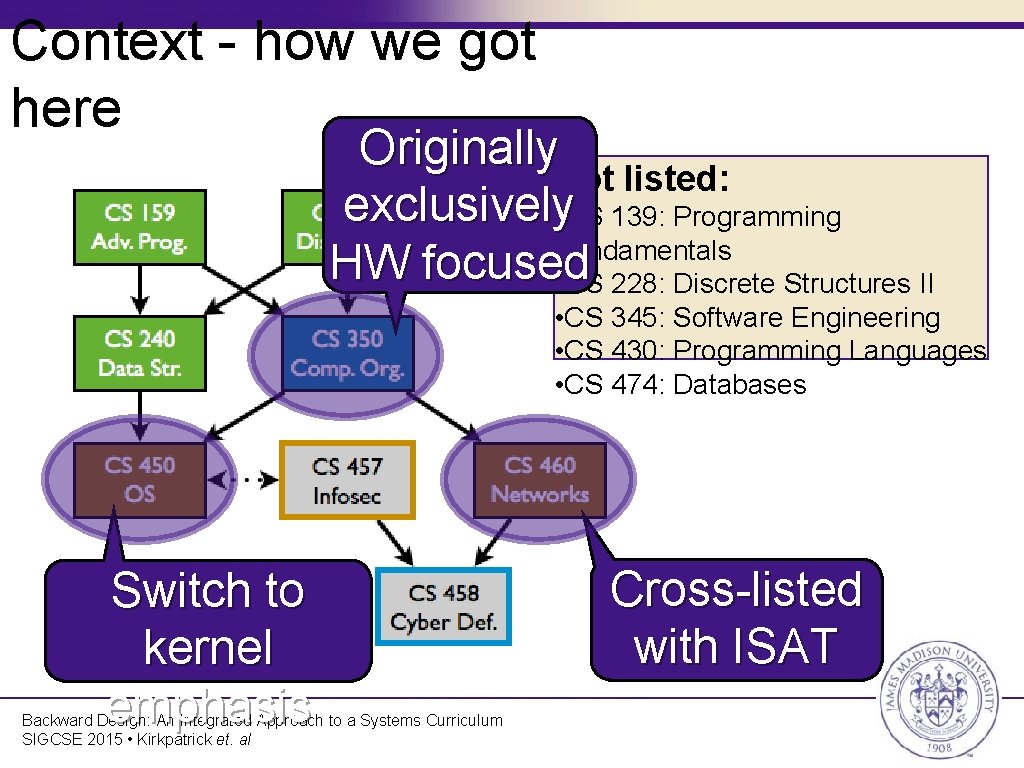
Context - how we got here Originally Not listed: exclusively • CS 139: Programming Fundamentals HW focused • CS 228: Discrete Structures II • CS 345: Software Engineering • CS 430: Programming Languages • CS 474: Databases Switch to kernel emphasis Backward Design: An Integrated Approach to a Systems Curriculum SIGCSE 2015 • Kirkpatrick et. al Cross-listed with ISAT
Backward Design Fixing the Problems that Certain New Faculty Introduced when Hired Michael S. Kirkpatrick Mohamed Aboutabl David Bernstein Sharon Simmons Backward Design: An Integrated Approach to a Systems Curriculum SIGCSE 2015 • Kirkpatrick et. al
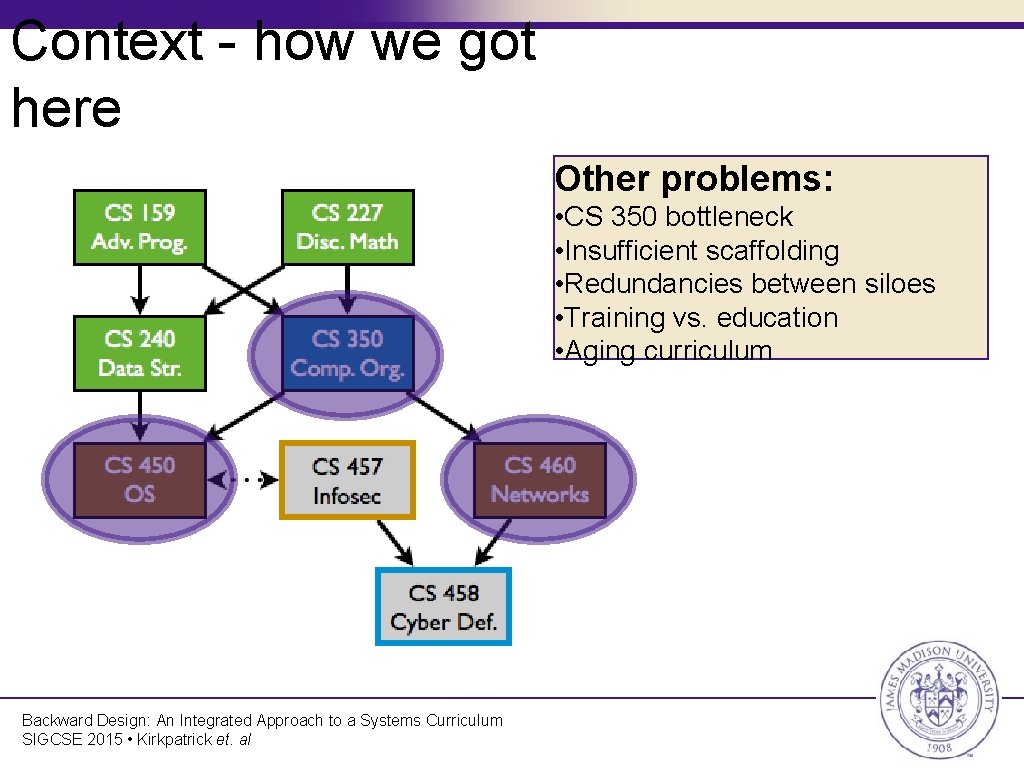
Context - how we got here Other problems: • CS 350 bottleneck • Insufficient scaffolding • Redundancies between siloes • Training vs. education • Aging curriculum Backward Design: An Integrated Approach to a Systems Curriculum SIGCSE 2015 • Kirkpatrick et. al
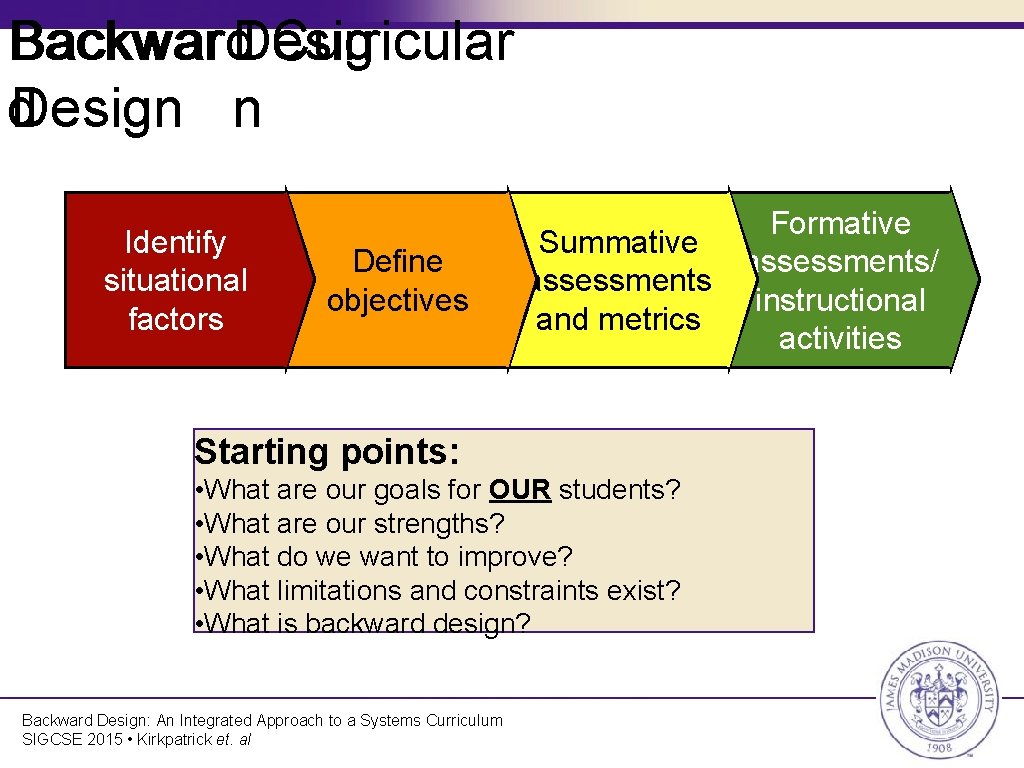
Backward. Desig Curricular Backwar Design n d Identify situational factors Define objectives Formative Summative assessments/ assessments instructional and metrics activities Starting points: • What are our goals for OUR students? • What are our strengths? • What do we want to improve? • What limitations and constraints exist? • What is backward design? Backward Design: An Integrated Approach to a Systems Curriculum SIGCSE 2015 • Kirkpatrick et. al
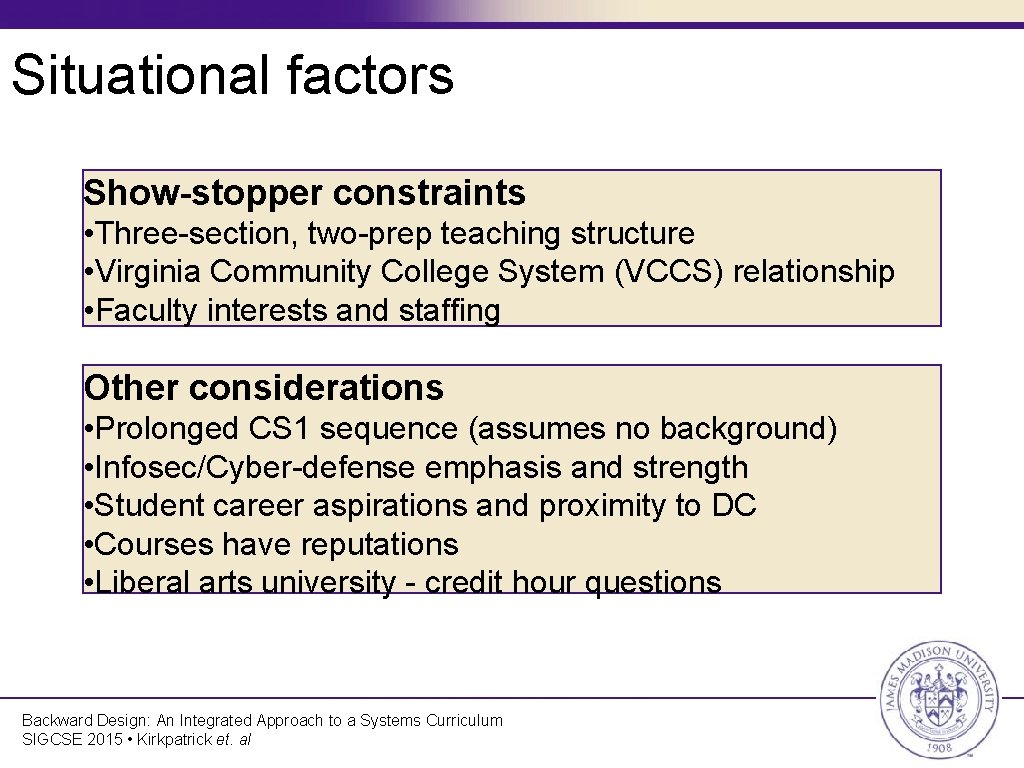
Situational factors Show-stopper constraints • Three-section, two-prep teaching structure • Virginia Community College System (VCCS) relationship • Faculty interests and staffing Other considerations • Prolonged CS 1 sequence (assumes no background) • Infosec/Cyber-defense emphasis and strength • Student career aspirations and proximity to DC • Courses have reputations • Liberal arts university - credit hour questions Backward Design: An Integrated Approach to a Systems Curriculum SIGCSE 2015 • Kirkpatrick et. al
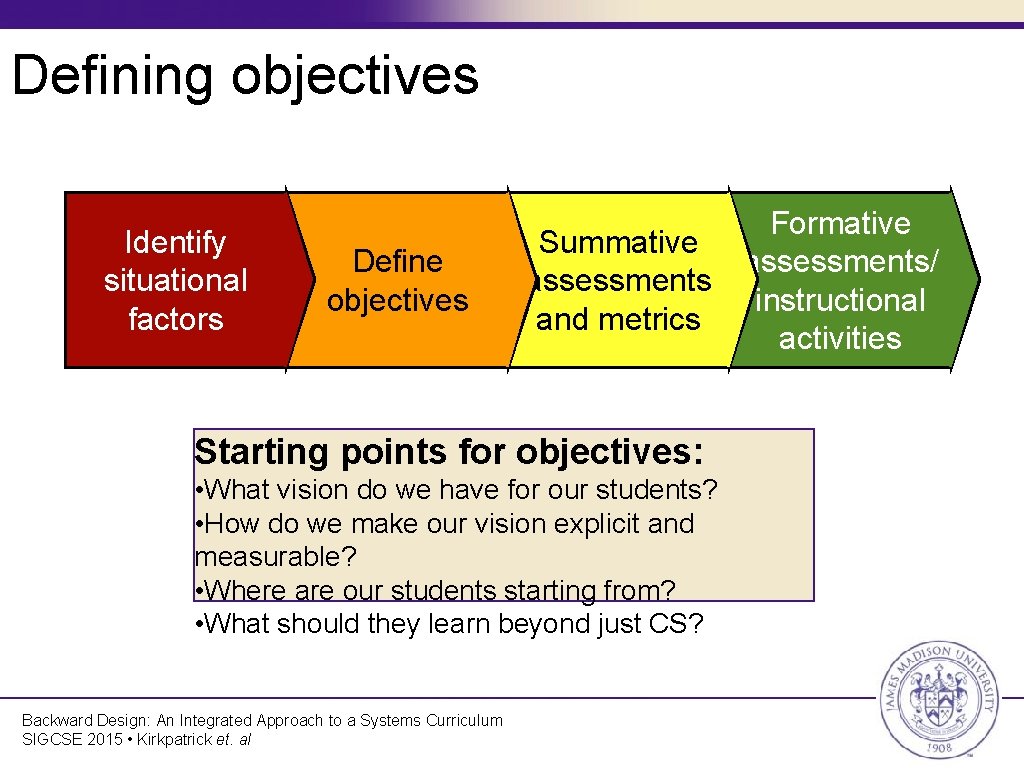
Defining objectives Identify situational factors Define objectives Formative Summative assessments/ assessments instructional and metrics activities Starting points for objectives: • What vision do we have for our students? • How do we make our vision explicit and measurable? • Where are our students starting from? • What should they learn beyond just CS? Backward Design: An Integrated Approach to a Systems Curriculum SIGCSE 2015 • Kirkpatrick et. al
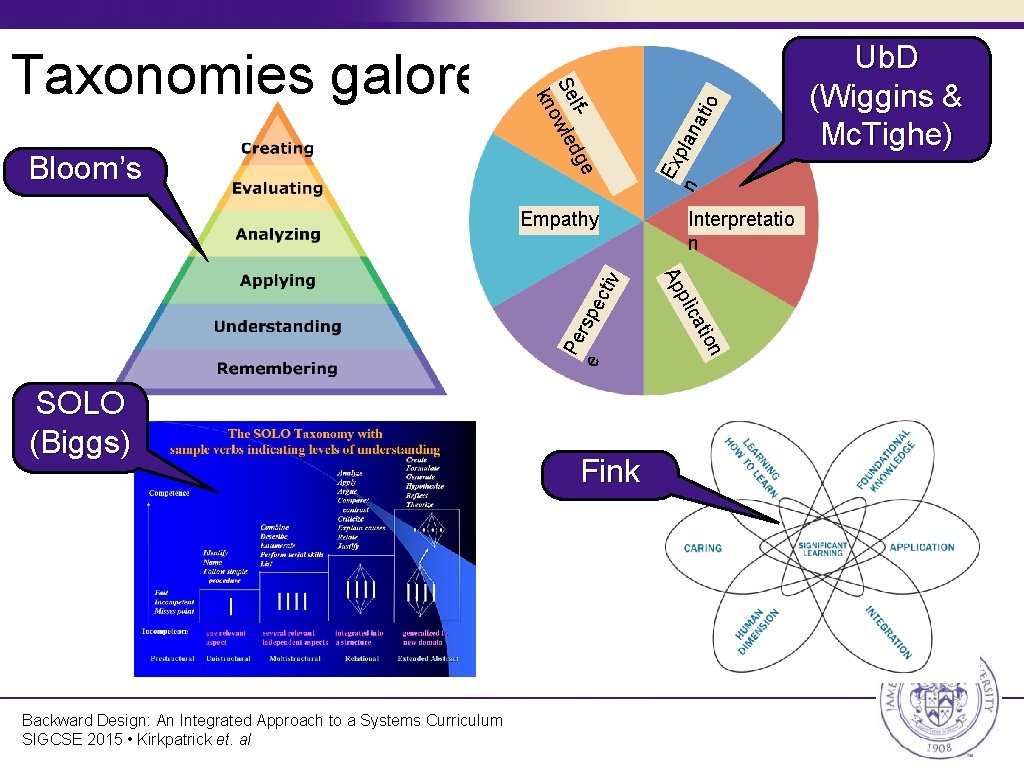
ec rsp e o ati n tio Pe ca Backward Design: An Integrated Approach to a Systems Curriculum SIGCSE 2015 • Kirkpatrick et. al Fink pli SOLO (Biggs) Interpretatio n Ap tiv Empathy Ex n plan Bloom’s e lfdg Se wle o kn Taxonomies galore Ub. D (Wiggins & Mc. Tighe)
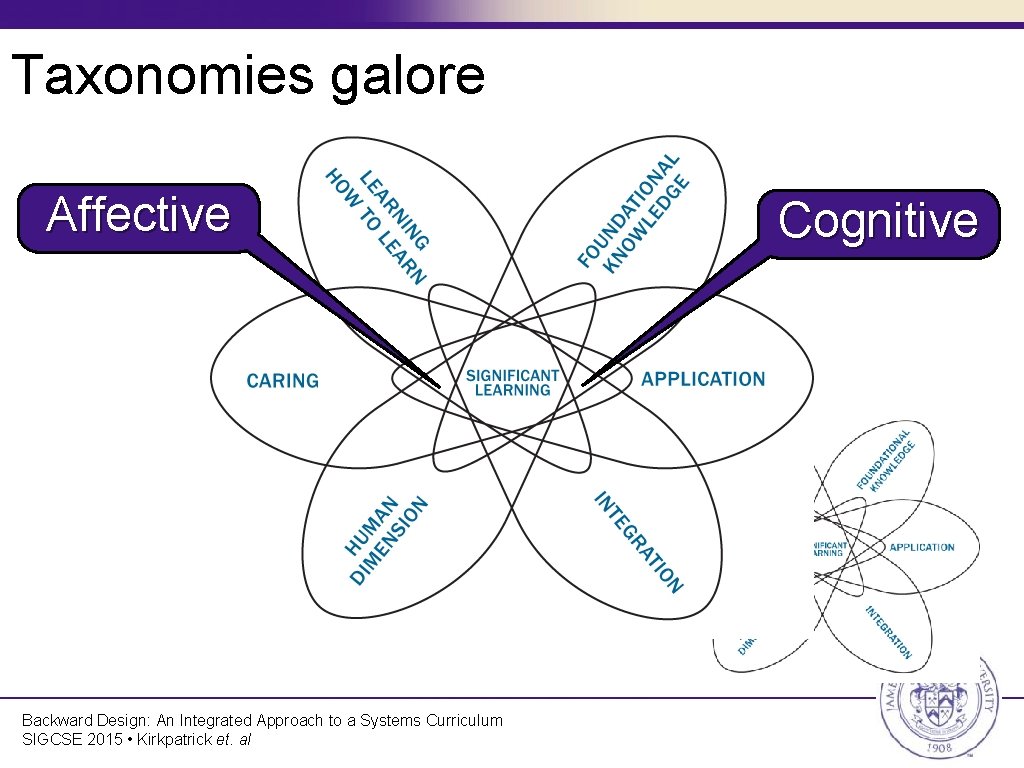
Taxonomies galore Affective Backward Design: An Integrated Approach to a Systems Curriculum SIGCSE 2015 • Kirkpatrick et. al Cognitive
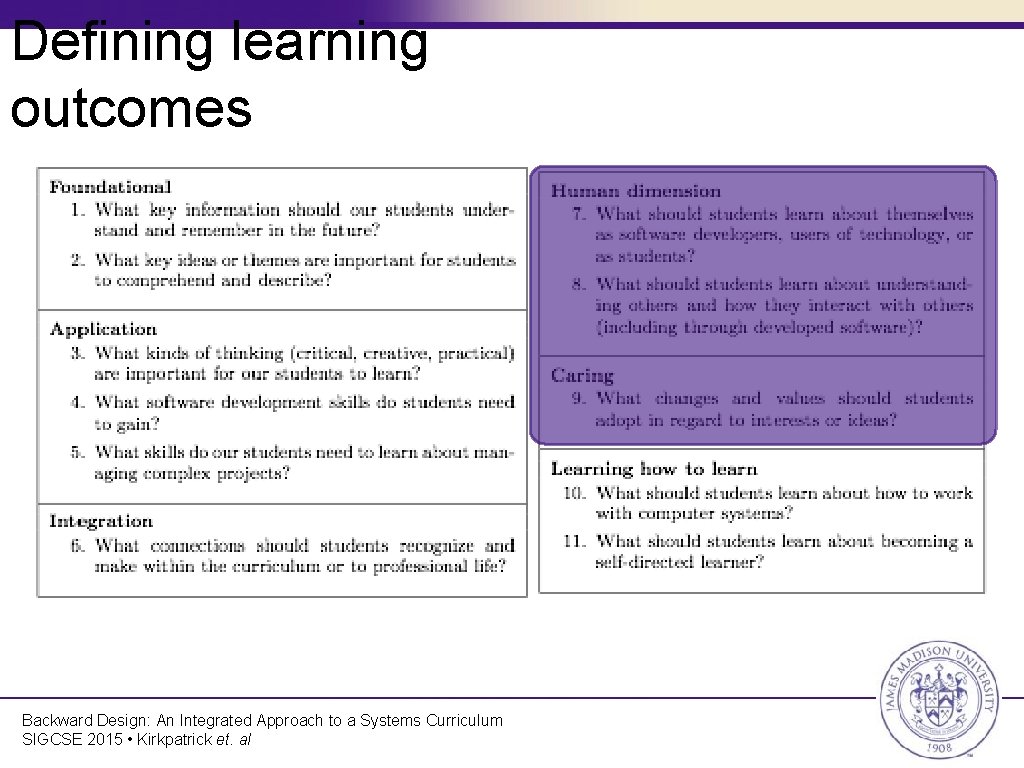
Defining learning outcomes Backward Design: An Integrated Approach to a Systems Curriculum SIGCSE 2015 • Kirkpatrick et. al
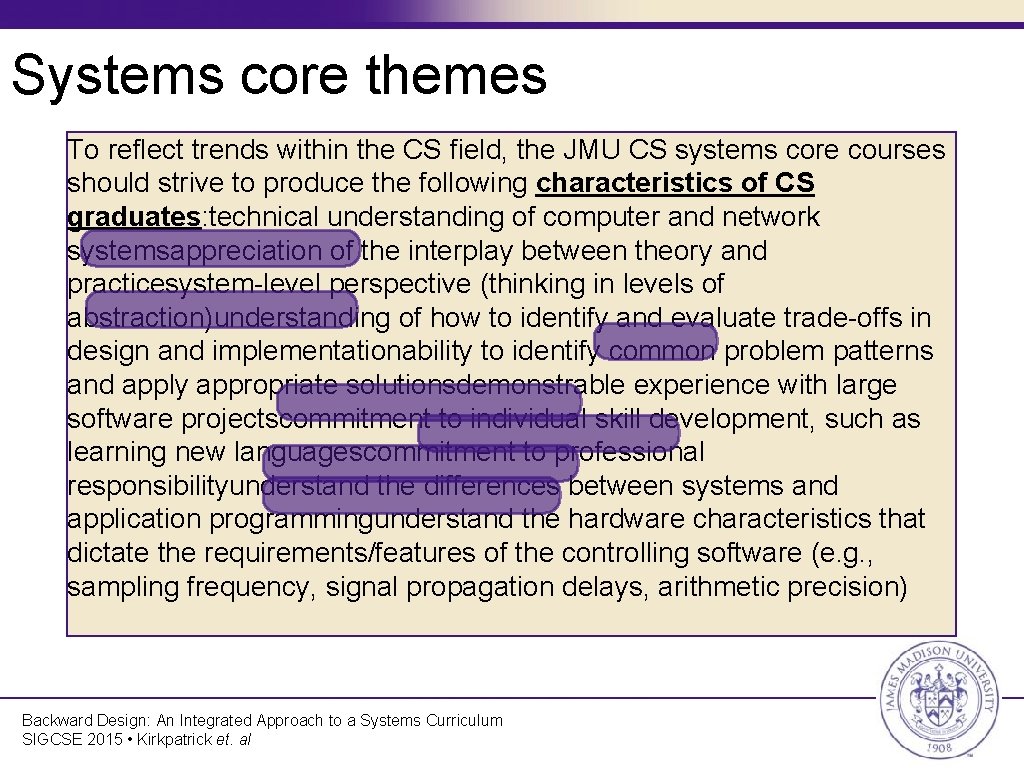
Systems core themes To reflect trends within the CS field, the JMU CS systems core courses should strive to produce the following characteristics of CS graduates: technical understanding of computer and network systemsappreciation of the interplay between theory and practicesystem-level perspective (thinking in levels of abstraction)understanding of how to identify and evaluate trade-offs in design and implementationability to identify common problem patterns and apply appropriate solutionsdemonstrable experience with large software projectscommitment to individual skill development, such as learning new languagescommitment to professional responsibilityunderstand the differences between systems and application programmingunderstand the hardware characteristics that dictate the requirements/features of the controlling software (e. g. , sampling frequency, signal propagation delays, arithmetic precision) Backward Design: An Integrated Approach to a Systems Curriculum SIGCSE 2015 • Kirkpatrick et. al
Systems core themes In support of this goal, the following principles should guide the systems curriculum: open-ended programming assignments that require analysis, design, and testingopportunities to apply systems concepts to realistic problemsa combination of individual- and group-based projectsexperience both reading and writing codeexposure to standard industry tools and techniques where appropriateexploration of the design considerations underlying existing systems softwareemphasis on developing skills for independent learningflexible curriculum that serves the needs of students with varying technical talentsappropriate coverage of fundamental computer and networking concepts Backward Design: An Integrated Approach to a Systems Curriculum SIGCSE 2015 • Kirkpatrick et. al
Systems core themes Every JMU CS student who satisfactorily completes all required systems courses should be able to: Summarize the technical foundations of how software executes on hardware, how parallel and distributed software communicate, what patterns and structures are used to construct systems and concurrent programs, and what layered abstractions support modern computing systems. Explain how bits can represent information, how instructions and communication can be seen as a sequence of state transitions, how mathematical models can describe system behavior, and how reactive programming practices used in systems programming differs from other approaches. Read and understand existing protocols, critically evaluate existing protocols, and select appropriate protocols. Describe the ways in which information can be exchanged between different parts of an existing system, select appropriate ways to exchange information in proposed systems, and implement systems that exchange information. Describe the architectural style/high-level design of a system using appropriate terminology, and evaluate the architectural style/high-level design of existing and proposed systems. • . . . Core Tier 1 vs. Core Tier 2 Backward Design: An Integrated Approach to a Systems Curriculum SIGCSE 2015 • Kirkpatrick et. al
Systems core themes Enduring Understandings • Information = Bits + Context • The Semiotics of Systems • System Design Involves Tradeoffs • Systems Programs are a Foundation • Digital/Discrete Models of an Analog/Continuous World • The Computer as Other • Appearances can be Deceiving • From Abstract Specifications to Complete Implementations • Communication has Multiple Dimensions • Resources must be Shared • Reliability can be Elusive • Use the Right Tool for the Job Backward Design: An Integrated Approach to a Systems Curriculum SIGCSE 2015 • Kirkpatrick et. al

Assessment strategies Identify situational factors Define objectives Formative Summative assessments/ assessments instructional and metrics activities Summative assessments • Question bank for exams • Good for program assessment, too • Common projects - 3 -phase semester-long system building • Shared rubric encourages consistent expectations Formative assessments and activities • Primarily at instructor discretion • Challenge: flipped vs. non-flipped classroom structures Backward Design: An Integrated Approach to a Systems Curriculum SIGCSE 2015 • Kirkpatrick et. al
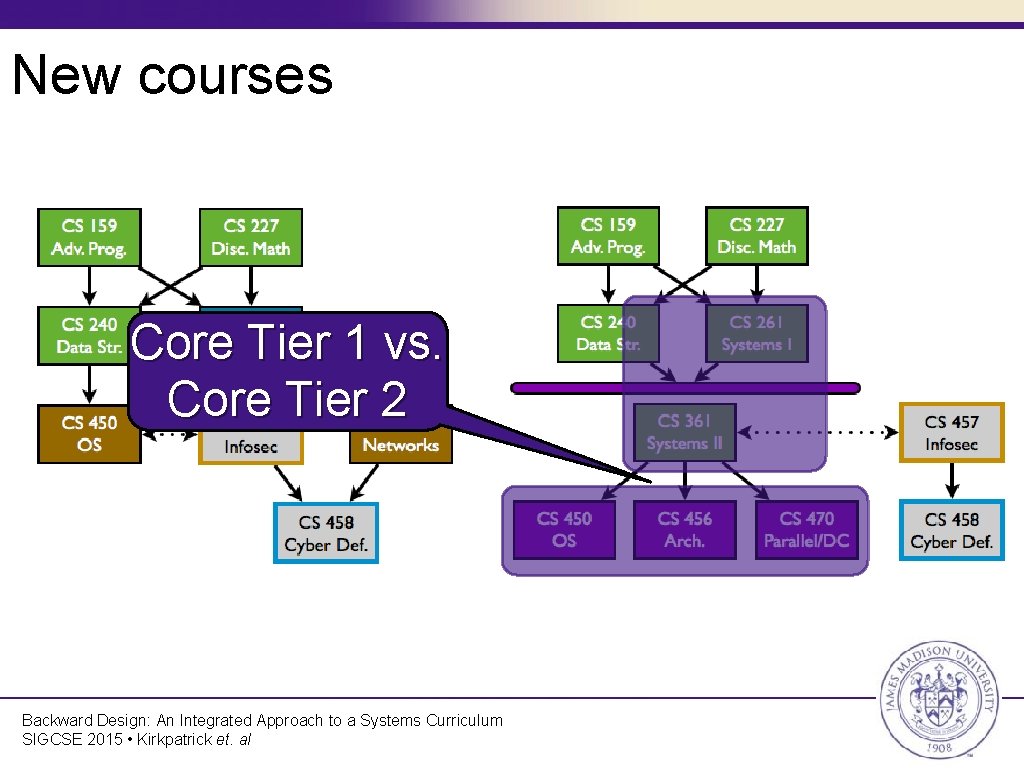
New courses Core Tier 1 vs. Core Tier 2 Backward Design: An Integrated Approach to a Systems Curriculum SIGCSE 2015 • Kirkpatrick et. al

New courses CS 261 Computer Systems I (required)Introduction to operation of modern interrupt-driven computer systems. Explores the representation of software and information in binary memory, the primary components of a CPU, multithreaded programming, and basic interactions with an Operating System. Prerequisites: Grade of “C-” or better in CS 159. Module C basics Hours 6 Description Memory model, pointers Compiler and debugger use 3 GCC/clang, Makefiles, GDB CPU/memory organization 3 Registers and cache, locality Binary representation 4. 5 Two’s complement, IEEE 754, arithmetic encoding von Neumann cycle 3 Role of CPU and memory, load/store instructions Basic circuits 6 Logic gates, adders, ALUs, control signals Threads vs. processes 6 Fork vs. thread creation, unique memory space Interrupts and OS principles 4. 5 Interrupts, system calls, user vs. kernel mode System software design, evaluation 4. 5 Benchmarks, complexity, static/dynamic analysis Backward Design: An Integrated Approach to a Systems Curriculum SIGCSE 2015 • Kirkpatrick et. al

New courses CS 361 Computer Systems II (required)Intermediate exploration of modern interrupt-driven computer systems. Explores models of computation and complex systems, techniques for communication and synchronization of parallel and concurrent software, and the protocols that make up the Internet. Prerequisites: Grades of “C-” or better in CS 240 and CS 261. Module Architecture analysis, evaluation, design State models Mathematical modeling Information exchange Synchronization primitives and problems Parallel decomposition Protocol analysis, evaluation, design The Internet model Hours 3 4. 5 3 6 6 3 9 4. 5 Description P 2 P vs. client-server, layered architecture Notion of state, UML, FSM Basic systems theory Communication basics (blocking vs. non-blocking, IPC vs. sockets) Locks vs. semaphores, producer-consumer, readers-writers, dining philosophers, deadlock Data vs. task parallelism, Amdahl’s law, fork-join pattern, libraries Protocols and services, timing and statechart diagrams, connections, push/pull, flow control, reliability, handshaking, metrics HTTP, DNS, DHCP, TCP, UDP, IP, 802. 3, 802. 11, ARP Backward Design: An Integrated Approach to a Systems Curriculum SIGCSE 2015 • Kirkpatrick et. al
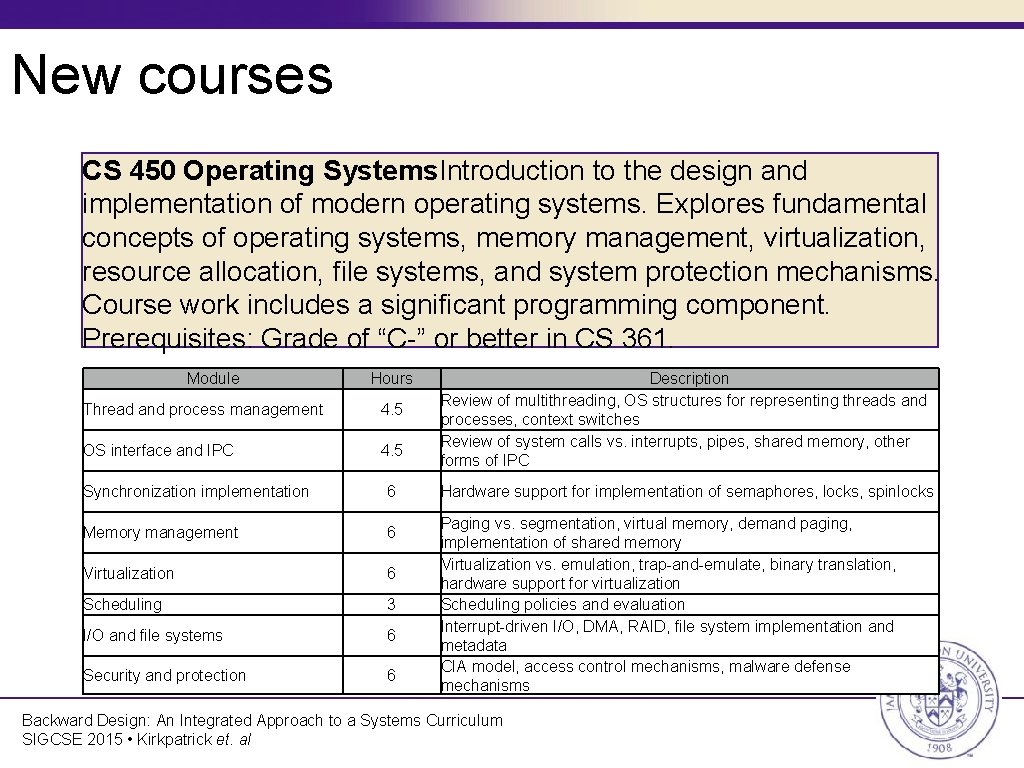
New courses CS 450 Operating Systems. Introduction to the design and implementation of modern operating systems. Explores fundamental concepts of operating systems, memory management, virtualization, resource allocation, file systems, and system protection mechanisms. Course work includes a significant programming component. Prerequisites: Grade of “C-” or better in CS 361. Module Hours Thread and process management 4. 5 OS interface and IPC 4. 5 Synchronization implementation 6 Memory management 6 Virtualization 6 Scheduling 3 I/O and file systems 6 Security and protection 6 Description Review of multithreading, OS structures for representing threads and processes, context switches Review of system calls vs. interrupts, pipes, shared memory, other forms of IPC Hardware support for implementation of semaphores, locks, spinlocks Paging vs. segmentation, virtual memory, demand paging, implementation of shared memory Virtualization vs. emulation, trap-and-emulate, binary translation, hardware support for virtualization Scheduling policies and evaluation Interrupt-driven I/O, DMA, RAID, file system implementation and metadata CIA model, access control mechanisms, malware defense mechanisms Backward Design: An Integrated Approach to a Systems Curriculum SIGCSE 2015 • Kirkpatrick et. al
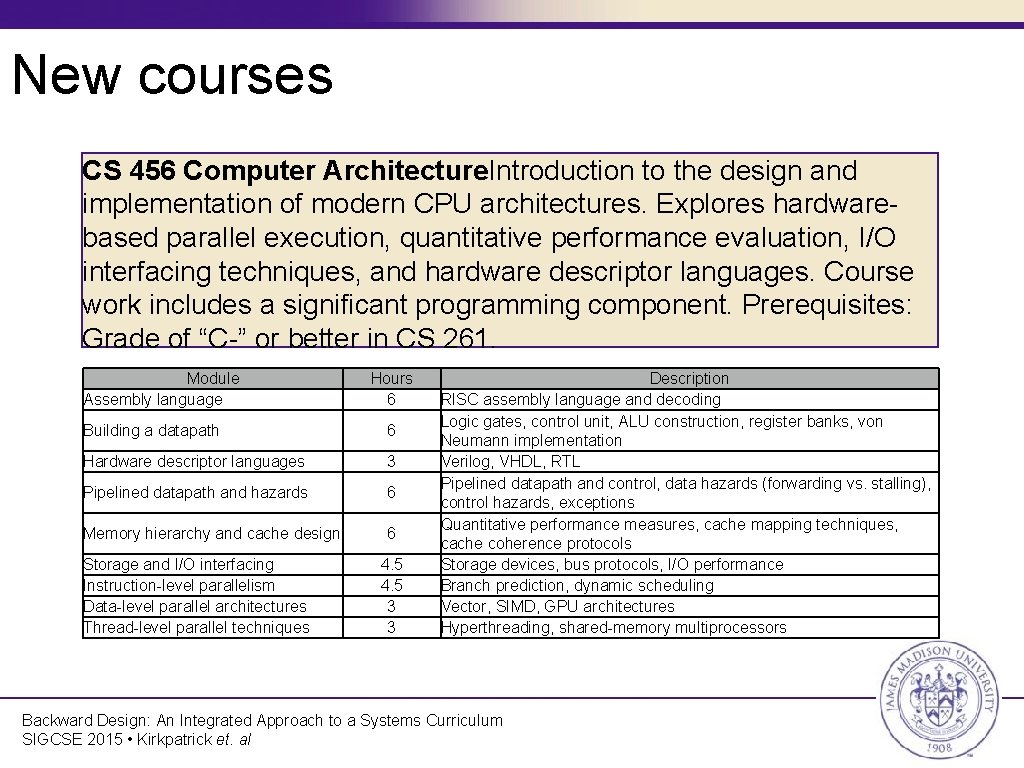
New courses CS 456 Computer Architecture. Introduction to the design and implementation of modern CPU architectures. Explores hardwarebased parallel execution, quantitative performance evaluation, I/O interfacing techniques, and hardware descriptor languages. Course work includes a significant programming component. Prerequisites: Grade of “C-” or better in CS 261. Module Assembly language Hours 6 Building a datapath 6 Hardware descriptor languages 3 Pipelined datapath and hazards 6 Memory hierarchy and cache design 6 Storage and I/O interfacing Instruction-level parallelism Data-level parallel architectures Thread-level parallel techniques 4. 5 3 3 Description RISC assembly language and decoding Logic gates, control unit, ALU construction, register banks, von Neumann implementation Verilog, VHDL, RTL Pipelined datapath and control, data hazards (forwarding vs. stalling), control hazards, exceptions Quantitative performance measures, cache mapping techniques, cache coherence protocols Storage devices, bus protocols, I/O performance Branch prediction, dynamic scheduling Vector, SIMD, GPU architectures Hyperthreading, shared-memory multiprocessors Backward Design: An Integrated Approach to a Systems Curriculum SIGCSE 2015 • Kirkpatrick et. al
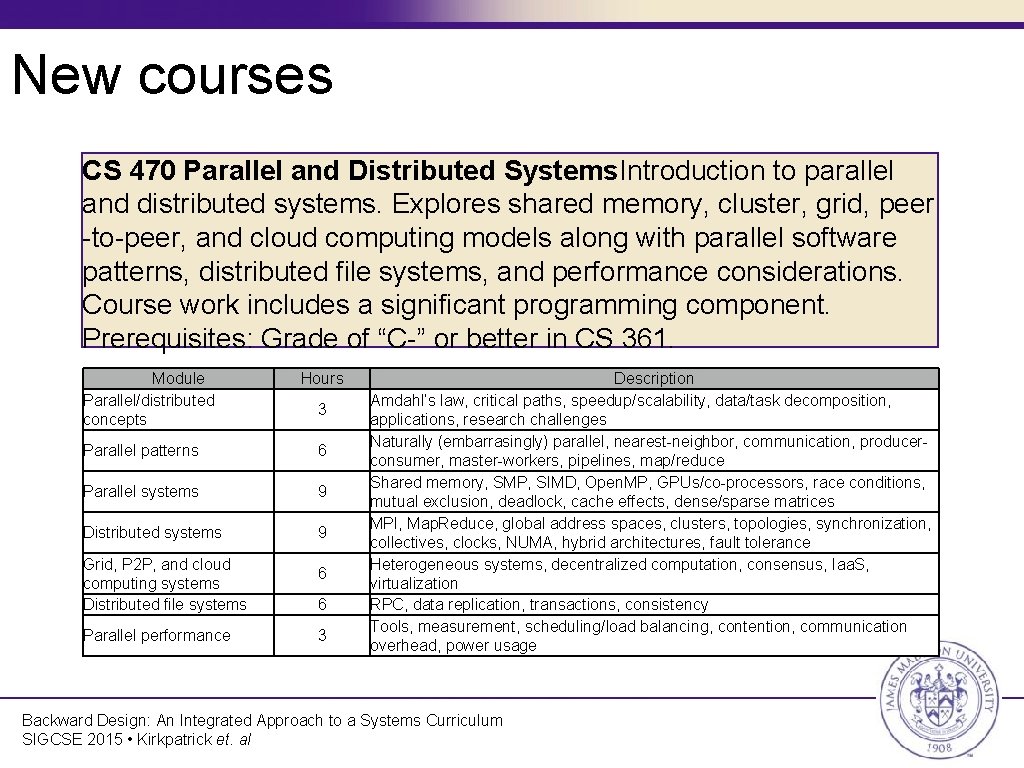
New courses CS 470 Parallel and Distributed Systems. Introduction to parallel and distributed systems. Explores shared memory, cluster, grid, peer -to-peer, and cloud computing models along with parallel software patterns, distributed file systems, and performance considerations. Course work includes a significant programming component. Prerequisites: Grade of “C-” or better in CS 361. Module Parallel/distributed concepts Hours 3 Parallel patterns 6 Parallel systems 9 Distributed systems 9 Grid, P 2 P, and cloud computing systems Distributed file systems Parallel performance 6 6 3 Description Amdahl’s law, critical paths, speedup/scalability, data/task decomposition, applications, research challenges Naturally (embarrasingly) parallel, nearest-neighbor, communication, producerconsumer, master-workers, pipelines, map/reduce Shared memory, SMP, SIMD, Open. MP, GPUs/co-processors, race conditions, mutual exclusion, deadlock, cache effects, dense/sparse matrices MPI, Map. Reduce, global address spaces, clusters, topologies, synchronization, collectives, clocks, NUMA, hybrid architectures, fault tolerance Heterogeneous systems, decentralized computation, consensus, Iaa. S, virtualization RPC, data replication, transactions, consistency Tools, measurement, scheduling/load balancing, contention, communication overhead, power usage Backward Design: An Integrated Approach to a Systems Curriculum SIGCSE 2015 • Kirkpatrick et. al

Possible future courses Breadth-first scaffolding as foundation for: • Advanced networking • Database design and implementation • Virtualization technologies Backward Design: An Integrated Approach to a Systems Curriculum SIGCSE 2015 • Kirkpatrick et. al

ACM 2013 Mapping ACM 2013 KA Current Proposed Algorithms and Complexity Distributed algorithms (T 1) ACM 2013 KA Current Proposed Parallelism fundamentals (T 1) 450 (most) 261, 470 Parallel decomposition (T 1, T 2) none 361, 470 450 (some) 361, 450, 470 350 (little) 261, 470 Parallel and Distributed Computing none 470 Architecture and Organization Machine-level representation of data (T 2) 350 261, 456 Communication and coordination (T 1, T 2) Assembly level machine organization (T 2) 350 261, 456 Parallel architectures (T 1, T 2) Interfacing and I/O strategies (interrupts) (T 2) 350 456 Parallel performance (E) none 470 Memory architecture (T 2) 350 261, 456 Distributed systems (E) none 361, 470 350 (some) 261, 456 350 (some) 261, 361, 456, 470 450 (little) 361, 450, 466, 470 350 (some) 361, 456, 466, 470 350 (little) 361, 456, 470 Functional organization (ILP/datapaths) (E) Operating Systems System Fundamentals Computational paradigms (T 1) OS overview (T 1) 450 261 OS principles (APIs, processes, interrupts) (T 1) 450 261, 450 States, transitions, state machines (T 1) Concurrency (T 2) 450 361, 450 System support for parallelism (T 1) Scheduling (T 2) 450 Performance (T 1) none 261 Memory management (T 2) 450 Resource allocation and scheduling (T 2) 450 Security and protection (T 2) 450 457/450 Proximity (T 2) 350 450, 456, 470 450 (some) 450 Virtualization (T 2) none 450 none 261 Reliability through redundancy (T 2) 460 (little) 361, 456, 470 Introduction (ISPs, circuit vs. packet) (T 1) 460 361 Network applications (HTTP, sockets) (T 1) 460 (most) 361, 466, 470 Reliable data delivery (TCP, flow control) (T 2) 460 361, 466 Routing vs. forwarding (T 2) 460 361, 466 LANs (T 2) 460 361, 466 Resource allocation (T 2) 460 361, 466 Mobility (T 2) 460 361, 466 File systems (E) System performance evaluation (E) Network-centric Computing Backward Design: An Integrated Approach to a Systems Curriculum SIGCSE 2015 • Kirkpatrick et. al Cross-layer communications (T 1)
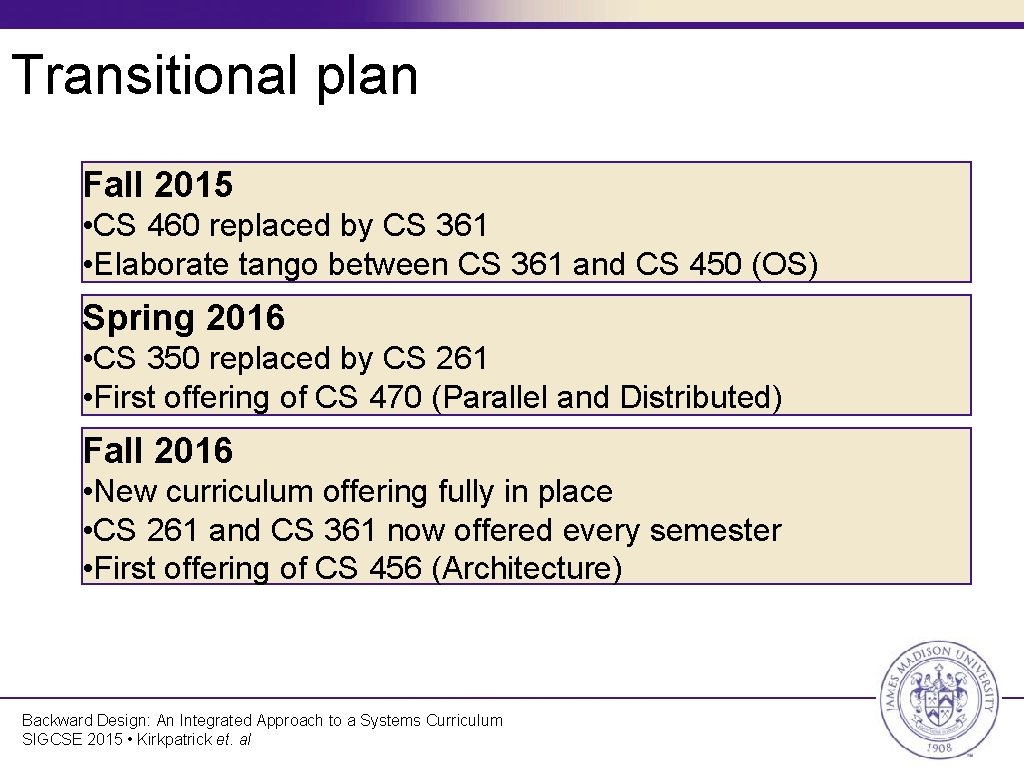
Transitional plan Fall 2015 • CS 460 replaced by CS 361 • Elaborate tango between CS 361 and CS 450 (OS) Spring 2016 • CS 350 replaced by CS 261 • First offering of CS 470 (Parallel and Distributed) Fall 2016 • New curriculum offering fully in place • CS 261 and CS 361 now offered every semester • First offering of CS 456 (Architecture) Backward Design: An Integrated Approach to a Systems Curriculum SIGCSE 2015 • Kirkpatrick et. al
Lessons learned Too many to name. . . • A well-defined vision statement works wonders • Revisit frequently, particularly for conflict resolution • SMART objectives make writing assessments easier • Take the time to do this well • Transition to new curriculum requires improvisation and flexibility • Build your own taxonomy • Fink and Wiggins/Mc. Tighe for aspirational structure • Hansen for enumerating points of emphasis • Bloom and SOLO for instructional objectives • The process will take longer than you expect • Hidden assumptions, connections, requirements Backward Design: An Integrated Approach to a Systems Curriculum SIGCSE 2015 • Kirkpatrick et. al
https: //github. com/kirkpams/JMU-CS-Systems Backward Design: An Integrated Approach to a Systems Curriculum SIGCSE 2015 • Kirkpatrick et. al
- Slides: 27