
Backtracking by image search CPS 100 Fall 2009
Backtracking by image search CPS 100, Fall 2009 9. 1
Search, Trees, Games, Backtracking l Trees help with search Ø Ø l Set, map: binary search tree, balanced and otherwise Quadtree and more, scenes and objects in games 3 -4 Trees, KD-trees, search for files or points in “space” Gametrees, search for game-playing Intelligent search Ø Ø Ø How do we find the “best move” in a game? How do we find optimal needle in haystack? When is brute-force, exhaustive search (im)possible? CPS 100, Fall 2009 9. 2
Search, Backtracking, Heuristics l How do you find a needle in a haystack? Ø Ø How does a computer play chess? Why would you write that program? Ø l How does Bing/Googlemap find routes from one place to another? Ø Ø l Shortest path algorithms Longest path algorithms Optimal algorithms and heuristic algorithms Ø Ø When is close good enough? How do measure “closeness”? When is optimality important, how much does it cost? CPS 100, Fall 2009 9. 3
Exhaustive Search/Heuristics l We use binary search trees to organize data, in searching we don’t need to examine all the data to find what we’re looking for Ø Ø l What do we do when the search space is huge? Ø Ø l Where is the smallest item in a search tree? Largest? How are trees balanced? How many chess boards are there? Count routes between my house and yours? Exhaustive search: look at everything! CPS 100, Fall 2009 9. 4
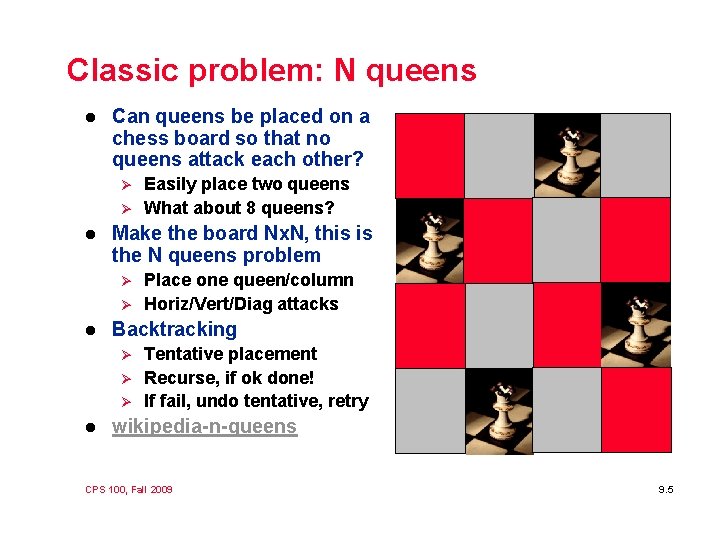
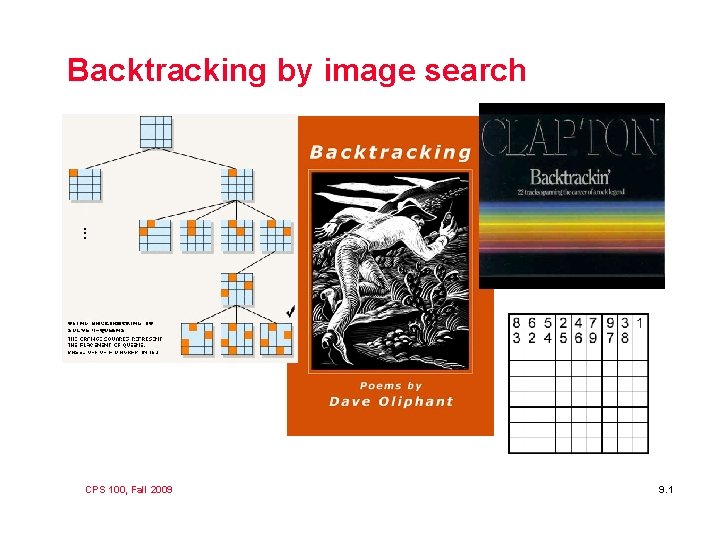
Classic problem: N queens l Can queens be placed on a chess board so that no queens attack each other? Ø Ø l Make the board Nx. N, this is the N queens problem Ø Ø l Place one queen/column Horiz/Vert/Diag attacks Backtracking Ø Ø Ø l Easily place two queens What about 8 queens? Tentative placement Recurse, if ok done! If fail, undo tentative, retry wikipedia-n-queens CPS 100, Fall 2009 9. 5
Backtracking idea with N queens l For each column C, tentatively place a queen Ø Ø l Each column try “knows” where to start its row Ø Ø l Try first row in column C, if ok, move onto next column • Typically “move on” is recursive If solved, done, otherwise try next row in column C • Must unplace queen when failing/unwind recursion If first time, that’s row zero, but might be an attack Unwind recursion/backtrack, try “next” location Backtracking: record an attempt go forward Ø Move must be “undoable” on backtracking/unwinding CPS 100, Fall 2009 9. 6

N queens backtracking: Queens. java public boolean solve(int col){ if (col == my. Size) return true; // try each row until all are tried for(int r=0; r < my. Size; r++){ if (my. Board. safe. To. Place(r, col)){ my. Board. set. Queen(r, col, true); if (solve(col+1)){ return true; } my. Board. set. Queen(r, col, false); } } return false; } CPS 100, Fall 2009 9. 7
Basic ideas in backtracking search l Enumerate all possible choices/moves Ø Ø l Inherently recursive, when to stop searching? Ø Ø Ø l We try these choices in order, committing to a choice If the choice doesn’t pan out we must undo the choice • Backtracking step, choices must be undoable When all columns tried in N queens When we have found the exit in a maze When every possible moved tried in Tic-tac-toe or chess? • Is there a difference between these games? Summary: enumerate choices, try a choice, undo a choice, this is brute force search: try everything CPS 100, Fall 2009 9. 8
Pruning vs. Exhaustive Search l If we consider every possible placement of 4 queens on a 4 x 4 board, how many are there? (N queens) Ø Ø l What about if we avoid diagonal attacks? Ø l 4 x 4 x 4 x 4 if we don’t pay attention to any attacks 4 x 3 x 2 x 1 if we avoid attacks in same row Pruning search space makes more search possible, still could be lots of searching to do! Estimate how long to calculate # solutions to the N-queens problem with our Java code…. CPS 100, Fall 2009 9. 9
Queens Details l How do we know when it’s safe to place a queen? Ø Ø Ø l No queen in same row, or diagonal For each column, store the row that a queen is in See QBoard. java for details For GUI version, we use a decorator Ø Ø Ø The QBoard. GUI is an IQueen. State class and it has an IQueen. State object in it Appears as an IQueen. State to client, but uses an existing one to help do its work One of many object oriented design patterns, seen in Huff in the Bit. Input. Stream class CPS 100, Fall 2009 9. 10
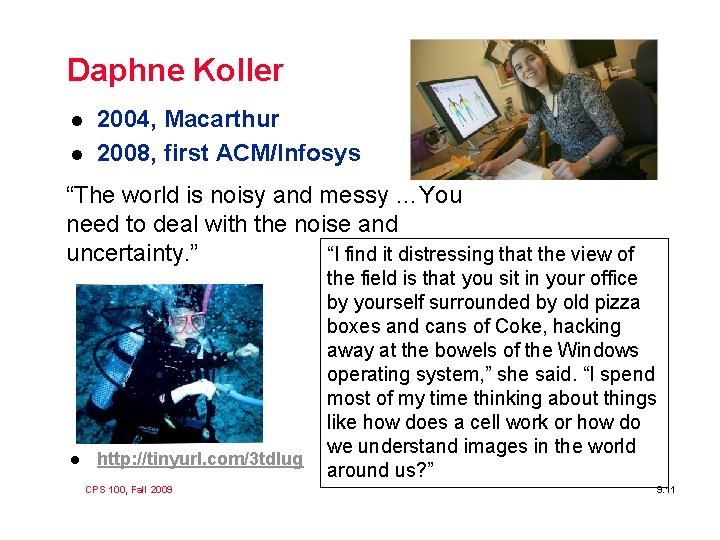
Daphne Koller l l 2004, Macarthur 2008, first ACM/Infosys “The world is noisy and messy …You need to deal with the noise and uncertainty. ” “I find it distressing that the view of l http: //tinyurl. com/3 tdlug CPS 100, Fall 2009 the field is that you sit in your office by yourself surrounded by old pizza boxes and cans of Coke, hacking away at the bowels of the Windows operating system, ” she said. “I spend most of my time thinking about things like how does a cell work or how do we understand images in the world around us? ” 9. 11
Computer v. Human in Games l Computers can explore a large search space of moves quickly Ø l Computers cannot explore every move (why) so must use heuristics Ø Ø l Rules of thumb about position, strategy, board evaluation Try a move, undo it and try another, track the best move What do humans do well in these games? What about computers? Ø CPS 100, Fall 2009 How many moves possible in chess, for example? What about at Duke? 9. 12
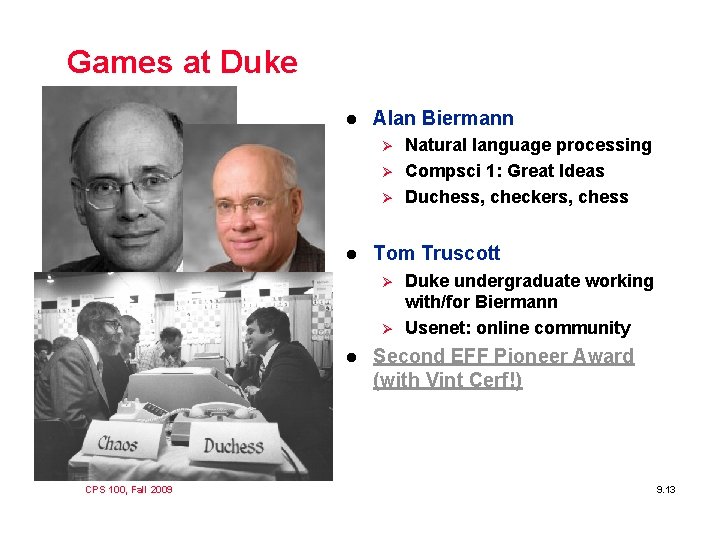
Games at Duke l Alan Biermann Ø Ø Ø l Tom Truscott Ø Ø l CPS 100, Fall 2009 Natural language processing Compsci 1: Great Ideas Duchess, checkers, chess Duke undergraduate working with/for Biermann Usenet: online community Second EFF Pioneer Award (with Vint Cerf!) 9. 13
Heuristics l A heuristic is a rule of thumb, doesn’t always work, isn’t guaranteed to work, but useful in many/most cases Ø l What heuristic is good for Sudoku? Ø Ø Ø l Search problems that are “big” often can be approximated or solved with the right heuristics Is there always a no-reasoning move, e. g. , 5 goes here? What about “if I put a 5 here, then…” Do something else? http: //en. wikipedia. org/wiki/Algorithmics_of_sudoku What other optimizations/improvements can we make? Ø For chess, checkers: good heuristics, good data structures CPS 100, Fall 2009 9. 14
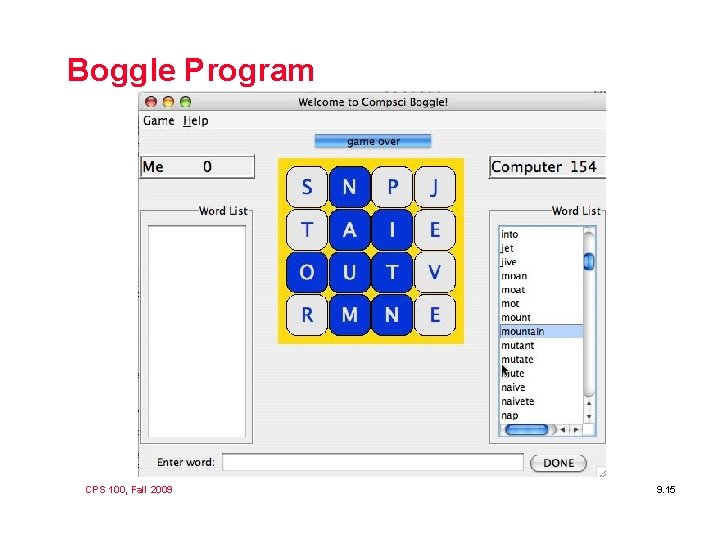
Boggle Program CPS 100, Fall 2009 9. 15
Boggle Search for Word l Starting at board location (row, col): find a string S Ø Ø l How do we know when we’re done? Ø Ø l We want to keep track of where we are in the string Also track what board locations used for S search Base case of recursive, backtracking call Where we are in the string? How do we keep track of used locations? Ø Ø Store in array list: tentatively use current one, recurse If we don’t succeed, take off the last one stored! CPS 100, Fall 2009 9. 16
- Slides: 16