
Backtracking Backtracking Suppose you have to make a

Backtracking
Backtracking • Suppose you have to make a series of decisions, among various choices, where – You don’t have enough information to know what to choose – Each decision leads to a new set of choices – Some sequence of choices (possibly more than one) may be a solution to your problem • Backtracking is a methodical way of trying out various sequences of decisions, until you find one that “works” 2
Solving a maze • Given a maze, find a path from start to finish • At each intersection, you have to decide between three or fewer choices: • • – Go straight – Go left – Go right You don’t have enough information to choose correctly Each choice leads to another set of choices One or more sequences of choices may (or may not) lead to a solution Many types of maze problem can be solved with backtracking 3
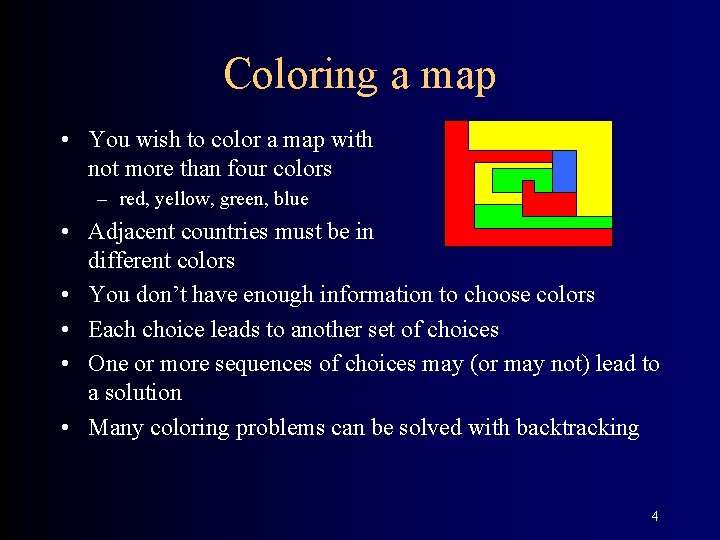
Coloring a map • You wish to color a map with not more than four colors – red, yellow, green, blue • Adjacent countries must be in different colors • You don’t have enough information to choose colors • Each choice leads to another set of choices • One or more sequences of choices may (or may not) lead to a solution • Many coloring problems can be solved with backtracking 4
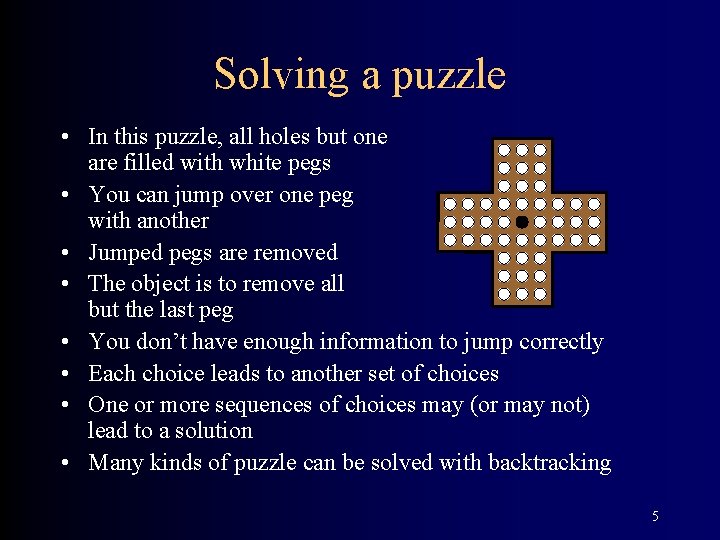
Solving a puzzle • In this puzzle, all holes but one are filled with white pegs • You can jump over one peg with another • Jumped pegs are removed • The object is to remove all but the last peg • You don’t have enough information to jump correctly • Each choice leads to another set of choices • One or more sequences of choices may (or may not) lead to a solution • Many kinds of puzzle can be solved with backtracking 5
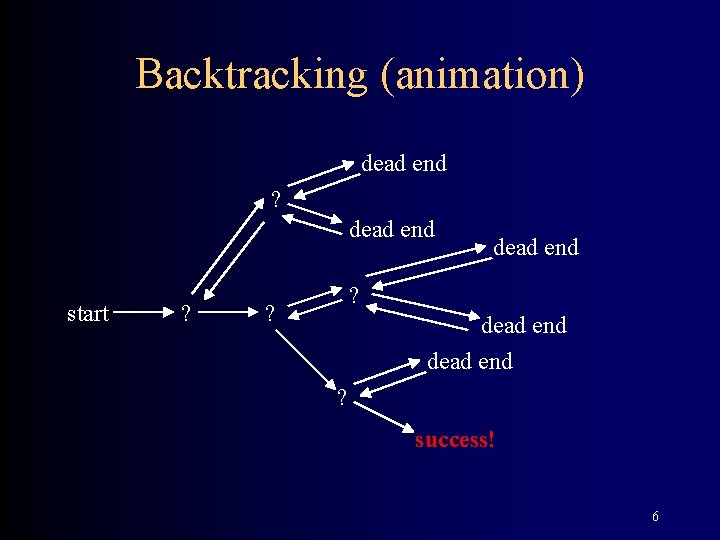
Backtracking (animation) dead end ? dead end start ? dead end ? success! 6
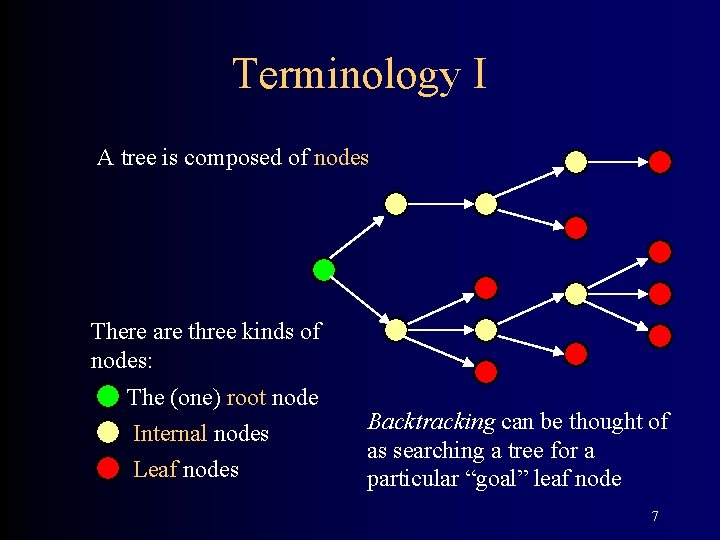
Terminology I A tree is composed of nodes There are three kinds of nodes: The (one) root node Internal nodes Leaf nodes Backtracking can be thought of as searching a tree for a particular “goal” leaf node 7
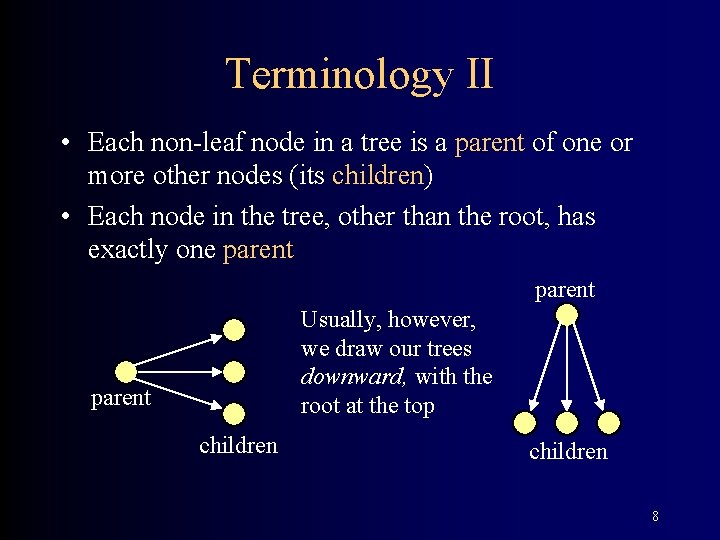
Terminology II • Each non-leaf node in a tree is a parent of one or more other nodes (its children) • Each node in the tree, other than the root, has exactly one parent Usually, however, we draw our trees downward, with the root at the top parent children 8
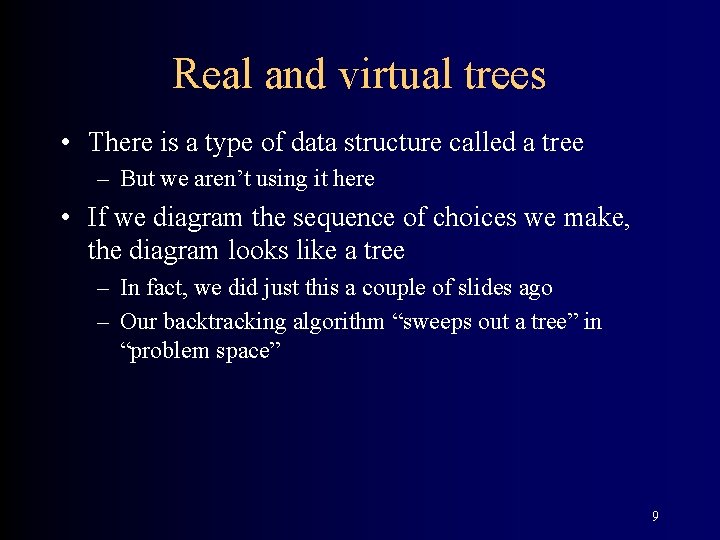
Real and virtual trees • There is a type of data structure called a tree – But we aren’t using it here • If we diagram the sequence of choices we make, the diagram looks like a tree – In fact, we did just this a couple of slides ago – Our backtracking algorithm “sweeps out a tree” in “problem space” 9
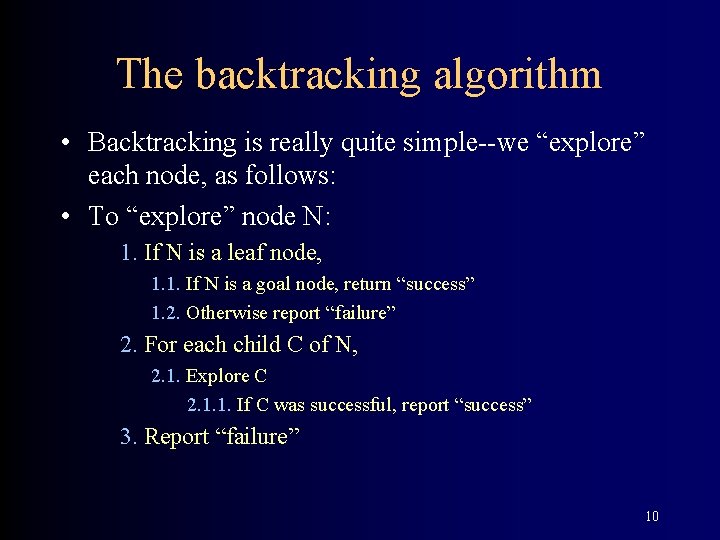
The backtracking algorithm • Backtracking is really quite simple--we “explore” each node, as follows: • To “explore” node N: 1. If N is a leaf node, 1. 1. If N is a goal node, return “success” 1. 2. Otherwise report “failure” 2. For each child C of N, 2. 1. Explore C 2. 1. 1. If C was successful, report “success” 3. Report “failure” 10
Full example: Map coloring • The Four Color Theorem states that any map on a plane can be colored with no more than four colors, so that no two countries with a common border are the same color • For most maps, finding a legal coloring is easy • For some maps, it can be fairly difficult to find a legal coloring • We will develop a complete Java program to solve this problem 11
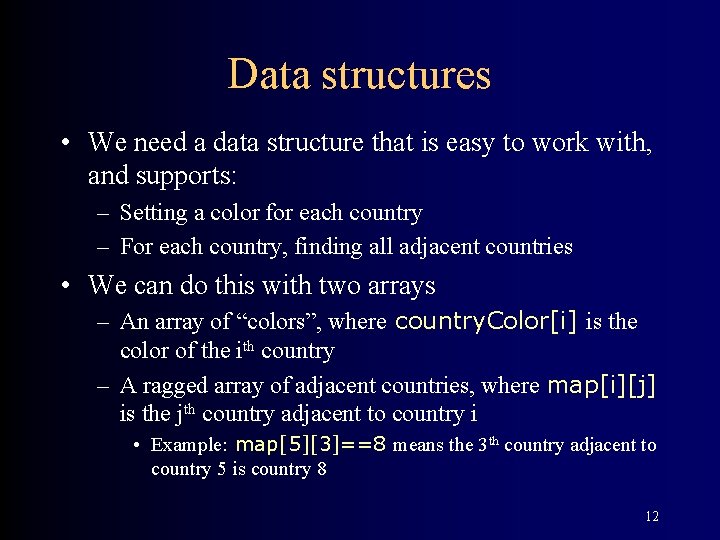
Data structures • We need a data structure that is easy to work with, and supports: – Setting a color for each country – For each country, finding all adjacent countries • We can do this with two arrays – An array of “colors”, where country. Color[i] is the color of the ith country – A ragged array of adjacent countries, where map[i][j] is the jth country adjacent to country i • Example: map[5][3]==8 means the 3 th country adjacent to country 5 is country 8 12
![Creating the map 0 1 int map[][]; void create. Map() { map = new](http://slidetodoc.com/presentation_image_h2/45ac4a2231d54d3bad67d9c47dd00aac/image-13.jpg "Creating the map 0 1 int map[][]; void create. Map() { map = new")
Creating the map 0 1 int map[][]; void create. Map() { map = new int[7][]; map[0] = new int[] { map[1] = new int[] { map[2] = new int[] { map[3] = new int[] { map[4] = new int[] { map[5] = new int[] { map[6] = new int[] { } 4 2 3 5 1, 0, 0, 2, 2, 4, 4, 1, 6, 3, 6 2, 5 }; 6, 5 }; 3, 6, 5 }; 6, 3, 2 }; 1, 0 }; 4, 1, 5 }; 13
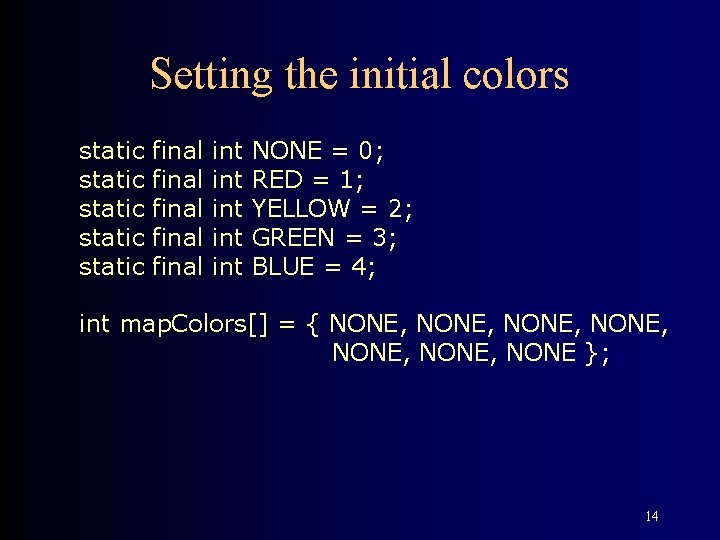
Setting the initial colors static static final final int int int NONE = 0; RED = 1; YELLOW = 2; GREEN = 3; BLUE = 4; int map. Colors[] = { NONE, NONE, NONE }; 14
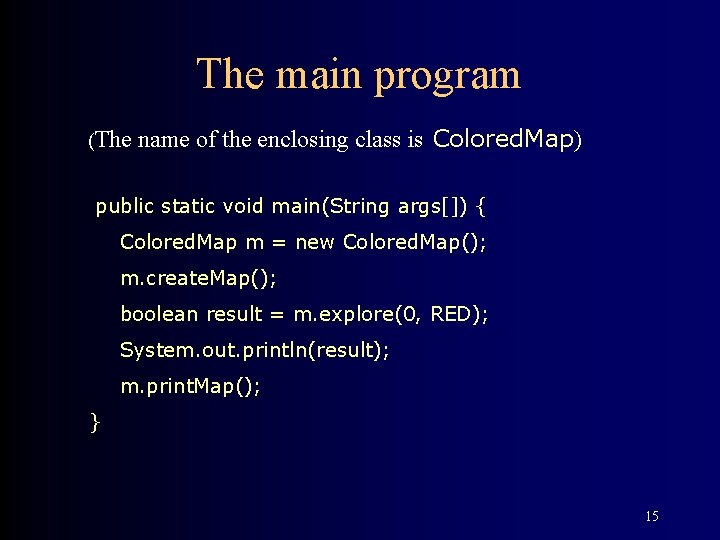
The main program (The name of the enclosing class is Colored. Map) public static void main(String args[]) { Colored. Map m = new Colored. Map(); m. create. Map(); boolean result = m. explore(0, RED); System. out. println(result); m. print. Map(); } 15
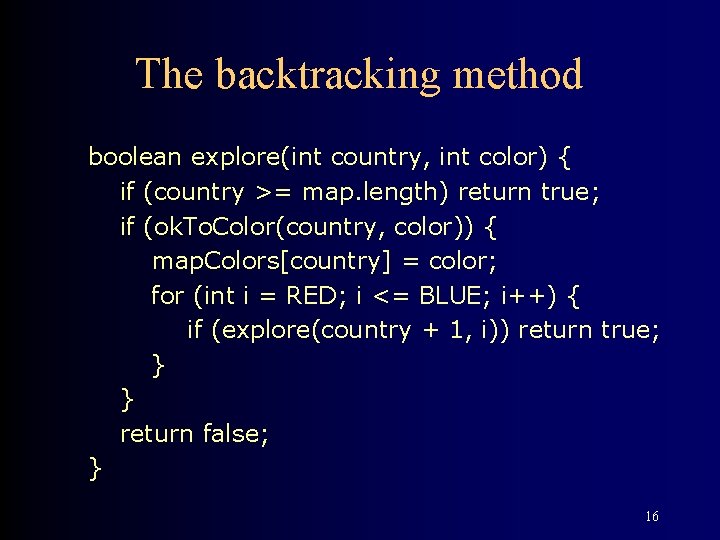
The backtracking method boolean explore(int country, int color) { if (country >= map. length) return true; if (ok. To. Color(country, color)) { map. Colors[country] = color; for (int i = RED; i <= BLUE; i++) { if (explore(country + 1, i)) return true; } } return false; } 16
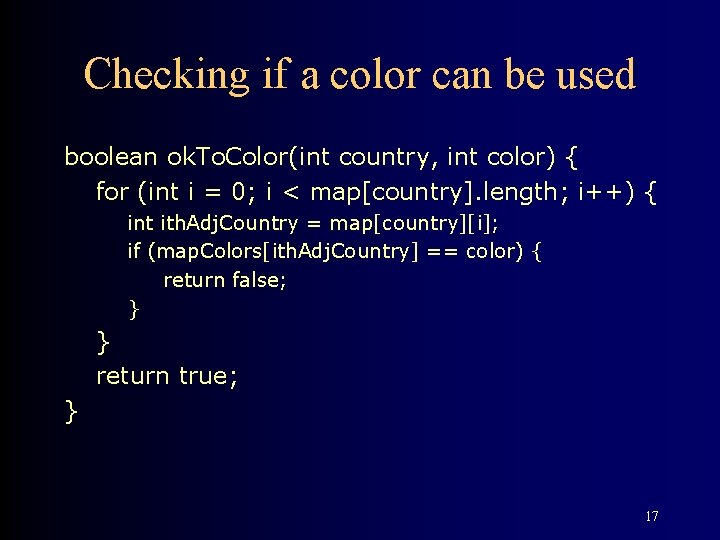
Checking if a color can be used boolean ok. To. Color(int country, int color) { for (int i = 0; i < map[country]. length; i++) { int ith. Adj. Country = map[country][i]; if (map. Colors[ith. Adj. Country] == color) { return false; } } return true; } 17
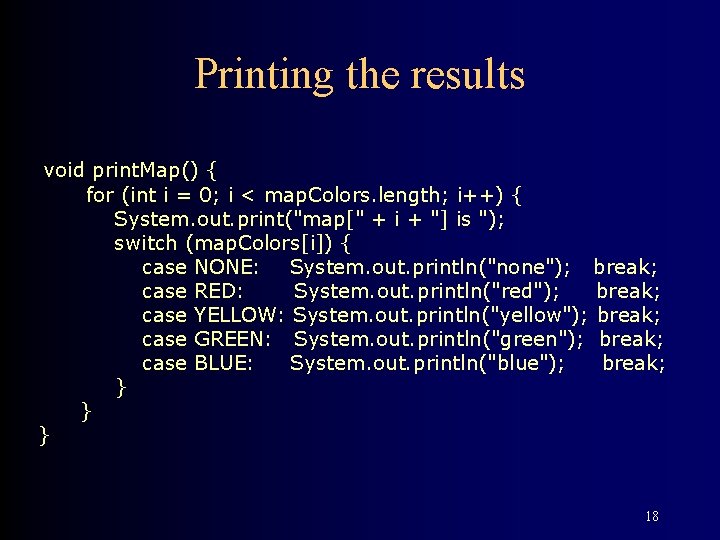
Printing the results void print. Map() { for (int i = 0; i < map. Colors. length; i++) { System. out. print("map[" + i + "] is "); switch (map. Colors[i]) { case NONE: System. out. println("none"); break; case RED: System. out. println("red"); break; case YELLOW: System. out. println("yellow"); break; case GREEN: System. out. println("green"); break; case BLUE: System. out. println("blue"); break; } } } 18
Recap • We went through all the countries recursively, starting with country zero • At each country we had to decide a color – It had to be different from all adjacent countries – If we could not find a legal color, we reported failure – If we could find a color, we used it and recurred with the next country – If we ran out of countries (colored them all), we reported success • When we returned from the topmost call, we were done 19
The End 20
- Slides: 20